On Writing

  • |

    John guest posts about writing memorable fiction on ReidWrite

    Luc Reid is the author of, among other things, Talk the Talk: The Slang of 65 American Subcultures.  He is also the lizard king of Codex, which he started and of which I’m so happy to be a member. He’s always starting provocative threads on Codex, making us all think and reexamine the principles of story and the whole writing business. He recently posted some insights about what makes memorable stories. A lot of other fellow Codexians joined in the discussion. Happily, he asked me to share some of my thoughts on his site, ReidWrite. They begin as follows:

    YOU’RE MINE, DEAR READER

     Mwuhahaha.

     Okay, maybe not. But you are wired to be mine. And you wouldn’t have it any other way.

    Let’s back up. Luc wrote about writing memorable. I agree with the idea that the stories that produce a strong emotional reaction are the most memorable. In fact, I believe that triggering of emotion is THE reason why linear narrative that puts us into the trance has lasted so long in so many forms and makes so much money.

    But can writers guide reader emotions? Or is it all just by accident?

    Read the rest here: http://reidwrite.livejournal.com/8331.html.

    BTW, when you’ve finished that, you might want to check out Luc’s new site, WillpowerEngine.com. It’s a place where he shares what he’s found in his research for his current book project, The Willpower Engine, on how self-motivation works. I think you’ll find a number of the posts there very interesting.

  • |

    John guests on Writing Excuses season 3 episode 16

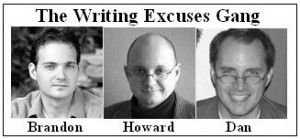
    writing-excuses-the-guys2-300x139A while ago the Writing Excuses team asked me to record with them, and last Friday I got to do it and had a blast.

    We recorded three episodes. In the first podcast we talk about putting and not putting ourselves in our writing and making characters who don’t all sound like the author. As usual, the guys had some great insights. Check it out: The Anti-Mary Sue Episode.

  • How many copies do average authors sell?

    I posted earlier about the sales number for best-selling authors. What about the average author?

    Here’s Patrick Nielsen Hayden, an editor at Tor Books, in an interview on io9.com about the future effects of e-text on publishing:

    io9: Does it make a difference to you if an author has an online reputation? Does that go into your decisions to acquire books?

    PNH: Obviously it makes a difference if an author has a public online profile of some sort, even just down to the level of having a moderately popular blog. Most books sell 5, 10, or 15 thousand copies. Most are midlist books. With those people, even a modest online presence can make a difference in sales.

    The whole interview is interesting. In fact, he says something that I think is important to note about what today’s novelists and, to a lesser degree, short story writers are actually providing:

    One thing I’m sure of is that we’re [Tor Books] going to be in linear immersive narratives that produce the reading trance. We won’t be moving towards a “choose your own adventure” thing. People will do those things, but those are different art forms. There’s something about immersive text that you can read in order – it’s persisted through many technological changes. This fiction stuff works pretty well. It’s been around a long time

    I think he’s right. The EXPERIENCE you get in the reader’s trance, similar to the one you get in a movie, is a strong experience. The media used to convey that experience doesn’t really matter as long as it makes it easy to get into the trance.

    Check out the whole interview.

  • In writing, profanity is a tool, but not the only tool

    In this week’s Writing Excuses comments, a poster named Sam asked:

    How do you, as writers, get past your own inhibitions concerning the use of profanity in order to write a character who does use it?

    Why get past them?

    Any given audience has values (as do you as a writer). Stomp on the values too much and you will make the readers so uncomfortable or angry that their discomfort will outweigh the draw of the story. They will put you down and never read you again. For one audience it’s gore. Another it’s explicit sex or vulgarity. For another it’s the bashing of a political stance or a particular demographic.

    If you or your audience is uncomfortable with profanity then say “he swore” OR find another way to convey the information the profanity does.

    Writing works by evoking types in the reader’s mind (as well as type resistors for surprise, curiosity, humor, etc.). Trigger a type and all the data associated with that type comes with it. Profanity is one way to trigger a type (or work against type) in the reader’s mind. But there are many other ways to evoke that same type, many ways to produce the same effect. Language, especially profanity, is a powerful and efficient method, but it’s not the only one.

    You want a mean cruel man? You can have him call his wife a “cu**” all the time. OR you can just show him doing something cruel to her or slapping her, e.g. he grabs her by the neck and makes her look at the food on his plate up close like some pet owners do to dogs when they crap where they shouldn’t–”Does that look like beef stroganoff to you? Stupid whore.”

    Look at Prison Break. Teddy needed to be scary. Profanity could have helped trigger his character. After all, cons use a lot of profanity. But Prison Break was prime time so the writers used other things to evoke the types they needed. Teddy worked for the purposes of that story. All of the cons did. They were believable. And all that without a deluge of profanity.

    Stay away from replacement profanity that evokes a different type. For example, if you had Teddy using “darn it” all the time, unless it was part of some particular character attribute, it would have not been believable because it evokes the wrong type, e.g. Ned Flanders.

    So if you don’t want to use profanity, don’t. Think about your objective and find another type trigger.

  • How to tell an author you don’t like their book

    Mette Harrison wrote a blog about how various authors respond when they read a book, don’t like it, and then the book’s author asks them directly what they thought of the book. 

    Here’s my response.

    As an author when I ask someone, especially another author, about their experience with my story, I’m looking for a data point to see how the book’s working or to get some insight. I realize others might be looking for validation. And, of course, I hope that everyone who reads my stuff finds nirvana even if I know that is not going to be the case. But I don’t ask unless I want data. And so I would hope they would report their experience accurately. I also hope they do it in friendly and helpful manner.

    So because that’s what I want, that’s what I try to do for others.  And the sandwich+ method has been one good way for me to do that.

    1. State something specific that works for me, e.g. “I love your character Bill because he’s so outrageous.”
     
    2. State the key thing that’s giving me trouble. For example, I might say, “I am having a hard time with the pacing.” But then I ALWAYS want to give the context of me as reader when it applies to my reaction, e.g. I’m a terribly impatient reader, I like to feel hope in what I read and know I don’t like as much despair as many other readers do, I can’t stand clowns (this is true: clowns are some of the scariest creatures out there, second only to crocodiles). The author should know these readerly things when they apply so the author can understand where the comments are coming from.

    If the book’s in pro shape and I think the issue is mostly my tastes, then it’s also useful to compare their work to another successful piece or author that had the same issue for me, e.g. “This reminds me of Twilight; I know people love it, but I just couldn’t get into that book either for the same reason.”

    I don’t think this is fluff. I think it’s part of being accurate. Our reality is what we focus on. And if I make a statement that leaves an author thinking I think the work is bad, then that’s not accurate because the truth is I think I’m not in the audience.

    If I think it’s a craft issue, then I highlight the main thing I think is causing the problem. A laundry list is usually useless. But thoughtful focus on the key issue can be very helpful. If I can’t tell whether it’s a taste issue or a craft issue, I admit it.

    3. State something else that’s working for me, e.g. “While I just couldn’t get past all those clowns freaking me out, I did think your chapter openers were compelling. I always wanted to read more, but then, alas, clowns.”

    4. The + is not just leaving statements hanging. Asking some sincere questions after demonstrates my genuine interest. And I am interested. If the book is unpublished, I might ask about their plans for the book, are they going to be doing another draft or shopping it, or if my reaction is common. If it’s published I might ask how it’s being received, what others are liking about it, and what’s next.  Maybe they tell me about another project they’re working on that sounds fascinating.

    This is what I’d want an author to do for me–be accurate, interested, and friendly. In such a context, someone having issues with a story is not such a big deal. It really isn’t.