|

John guests on Writing Excuses season 3 episode 16

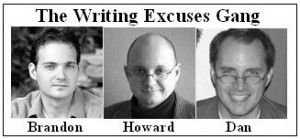
writing-excuses-the-guys2-300x139A while ago the Writing Excuses team asked me to record with them, and last Friday I got to do it and had a blast.

We recorded three episodes. In the first podcast we talk about putting and not putting ourselves in our writing and making characters who don’t all sound like the author. As usual, the guys had some great insights. Check it out: The Anti-Mary Sue Episode.

Share

Similar Posts

  • Nameless Thriller Started

    Those who check the progress bars, will notice that I’ve started the first draft of the thriller, which remains nameless.  Poor thing. You’ll also notice I haven’t finished the working outline. That’s because sometimes–well, often–I need to do some drafting to get the feel of the story and characters before I finish that working document. And also because story development has never been a linear thing for me. 

    I did a lot of work on the premise (the story setup) these last few weeks. Ran into a lot of dead ends.  However, it was all good. I got snippets of scenes throughout the process. Did a lot of useful research. Developed characters. I wrote a few drafts of another beginning that I realized didn’t feel right. It was telling the wrong story, had the wrong angle. A few days later, I figured out the right angle on the premise.  And it is so delicious to me.  Then during another work session–letting my mind run while I showered–I got the outline of the first chapter. I give you the first 300 words below. I’m sure they’ll change, but it’s a taste of what’s to come.

    CHAPTER 1: Cowboy Donut 

    Trying to get a straight job as an ex-con was a lovely experience.  Kind of like being dragged behind a bus.

    No matter how tidy you looked or how sharp your resume was, it all came down to one question: “And what were you in for?”  Frank knew it would be stupid to lie about that.  First of all, he was trying to go straight.  Second, any employer who didn’t have a carrot for a brain was going to run a background check.  So there was no use trying to hide. 

    Frank was now sitting in the back office of Cowboy Donut in Rock Springs, Wyoming across from Mary Rogers, the sun-wrinkled owner.  She was probably in her fifties and had two-tone hair that seemed to take its inspiration from a skunk or badger: all bleached up on top and dark underneath.

    Ms. Mary had just asked the question.  Frank had just dropped his bomb—voluntary manslaughter, a security job gone bad.  He’d been protecting the wrong kind of noun for the wrong kind of people.

    Ms. Mary narrowed her eyes.  “What else am I going to find on your RAP sheet?”

    “That’s it,” Frank said.  “Just the one unfortunate incident.”

    “Murder is a pretty big incident.”

    “Manslaughter,” he corrected.  “Not murder.”

    She made a noncommittal sound and looked down to study his resume a bit more.  Like maybe something new would pop up there. 

    This was always the fun part, waiting for the reply.  First interviews were like first dates.  And Frank had basically told his date he had an Ebola monkey virus that would make her eyes bleed, and would she now like to kiss?  He’d done this now a couple dozen times and knew the best thing was just to be quiet. 

    Poor Frank. And in just a few pages things are going to get so much worse when he finds two old associates waiting for him at his house.

    Share
  • Jennifer Nielsen and “The Rules of Personality”

    Jennifer Nielsen is the author of Elliot and the Goblin War, the forthcoming Elliot and the Pixie Plot (Sourcebooks, August 2011), and The False Prince (Scholastic, April 2012).  She’s also worked for many years with a troubled youth program. I recently sat in on one of her presentations on characters and personality at a writers conference and quickly found myself scribbling down insights. Later I convinced her to share some of that here. Enjoy. You can learn more about her at www.jennielsen.com.

    The Rules of Personality

    In the Mockingjay series by Suzanne Collins, 16-year-old Katniss Everdeen is selected as one of the contestants for the brutal Hunger Games held by the Capitol each year. Katniss is resourceful, fierce, intelligent, and compassionate. It is these traits she uses in her attempt to survive the Hunger Games. She is joined in the games arena by Peeta Mellark, who is clever, protective, and likable. Like Katniss, Peeta’s traits help him in his fight to survive.

    These characters are excellent illustrations of the importance of character in a story. What if Suzanne Collins had not given Katniss her compassion? For those who have read the story, they know changing that single trait would have dramatically changed the plot.

    It’s for this reason that character is so important in the creation of a story. If you change the plot, the character will remain the same. But if you change a character, the plot will inevitably change with it.

    In order to create a believable human sketch, a visual artist would have to understand the physical body, muscle structure, proportions, etc. In a similar way, for a writer to create a believable character, he must understand the basic rules of personality.

    But to create a believable characterization, there are some important things for the writer to understand about personality. Personality is the traits of a person’s core self. For example, there are many different types of people who value and practice honesty (the “trait”). But personality will determine how that trait is exhibited. An extrovert is far more likely to state the blunt truth while an introvert might create an opportunity for the people to discover the truth on their own. So although the trait is the same, there is no single way in which it might be expressed.

    In other words, while the presence of a trait is important in developing character, the way it is expressed is equally important. A person’s stubbornness might be demonstrated as passive-aggressiveness or outward defiance. A person’s jealousy might be expressed in withdrawal or by vicious repercussions. It’s personality that determines the way character traits are expressed.

    There are four important things to understand about personality. The better writers understand this, the better they can understand the characters they created.

    #1 Personality is Stable.  The core of who a person is remains about the same throughout a lifetime. The way a trait is expressed may evolve or adapt as the events of life unfold, but the core self doesn’t change much.

    For example, a shy child may hide behind her mother’s legs and refuse to talk. As she grows into adulthood, she will probably learn to manage her shyness and interact in the world. But she will likely never be the outspoken, bold, center stage person.

    #2 The Intensity of the Trait Matters.  When creating character, most writers stop at listing the presence of a trait. However, that is rarely good enough because it’s really the intensity that matters. Someone who has a hard time forgiving others and holds grudges is probably fairly normal. But increase the intensity of the trait and you may create a villain who’ll go to extreme lengths for revenge.

    #3 People Rarely Behave Out of Character.  Occasionally, writers finds themselves in a position where in order to make the plot unfold the way they want it to, they must force their character into behaviors outside of anything they’d normally do. This almost always fails the believability test because in real life, people rarely act out of character.

    Consider the example of the shy woman. Is it possible that she would willingly get up in front of a crowd and speak with boldness? Of course. But is it likely? No. It’s far more likely that she would find someone else to deliver the message for her, or find another way to communicate the message.

    When I’m speaking about this issue to groups, a common response from writers who are facing writer’s block is that this is the root of their problem. They are trying to force a character into a behavior not consistent with their personality. The entire scene becomes forced as the character literally balks at the writer’s attempts.

    #4 People Tend to Rework the Same Issues Throughout Life.  Everyone has “issues.” Some are more major than others, of course, but we all have them. And whatever it is that we battle, we likely battle it throughout life, even if the way we experience that issue evolves.

    For example, the teenager who becomes explosively angry is later the man who may take out his anger on his wife or children. In later life that trait may evolve so that he turns his anger inward and develops a drinking problem. Or perhaps the man matures and mellows. Perhaps he’s learned to manage it, or perhaps he’s too tired to create the same fuss as when he was younger.

    In April 2012, I’ll release a series with Scholastic that begins with Book 1: The False Prince. The protagonist in this story is a defiant boy named Sage who must use his own cleverness, determination, and strength to survive a contest that will name the winner as the false heir to the throne.

    As the writer of this series, it was important for me to understand Sage’s personality if I was going to create a believable character. One of his core traits is his instinct to rebel. It’s a more intense than would generally be found in his peers, so I needed to respect the fact that he would rarely back down from a fight, regardless of the consequences. There is one scene in the book where Sage steals an item from his master that Sage believes was stolen from him. He refuses to tell anyone where he hid it, even though he knows the consequences will be serious. I didn’t want those consequences to happen to Sage, but he would not have had things any other way. To attempt to create a story where he gave in to the master would have cheated the character, the story, and the reader.

    Likewise, writers must understand that creating great characters begins with understanding the rules of personality. And when it’s done right, whether it’s Katniss Everdeen, or any of your favorite characters, the reader will always remember them.

    *

    JOHN SEZ: I particularly like #2 because homo-ficti need to be a little bit larger than life.  A litter more courageous. A little more finicky. A little more skilled. A little more outrageous. Exaggeration is one of the key tools for developing characters.

    The statements about the core part of personality being stable and long-lasting, and folks dealing with issues for a long time, are interesting to me as well. It seems like this is where deep motives lie. 

    Of course, I know I don’t start with personality grids when developing characters. But I do eventually try to peg my characters.  I’ve found that having a dominant impression, a type, helps a great deal when working with them, even if my characters mix or bend the types.  If I know that this one is a wise-cracking farmer, that one a quick-tempered tailor, and that one a no-nonsense baker, it makes them easier to work with.  It makes it easier to envision how they might react in a given situation.

    In fact, I think I’ve created my most enjoyable characters when I didn’t try to make them super complex. They might have had things that occured in their past that affected them greatly. They might be dealing with terrible dilemmas now.  They might have a number of interesting details about them.  But if I can peg them in my mind as this or that type of person, it seems the scenes flow more easily.  I can improvise the dialogue and their reactions much better in my mind as I write.

    Sometimes I can capture that type with a description, e.g. “scary smart farmer.” Sometimes it’s enough to get a voice or a photograph or link them to someone I know.  Sometimes I’ve linked them to animals and that gave me the center.  Very often they form as I write them. They often have to come on stage first and have me start writing them for everything to coalesce.

    Check out Nielsen’s site. I love the first line of Goblin War. I mean not only does she get all these fab illustrations for her book, but then she opens it with this: “When he was 8 years old, Elliot Penster started an inter-species war.  Don’t blame him.  As anyone who has ever started an inter-species war will tell you, it’s not that difficult to do.” Elliot is trick-or-treating at the moment, everyone thinking he is dressed up as a hobo, when in reality he’s just wearning his normal day clothes. Hum. A little homo-fictus anyone?

    Share
  • Villainous Heroes

    If we root against villains based on moral judgments, then how is it possible to root for heroes who are not just bad boys but down right criminal, e.g. hitmen, mobsters, thieves?

    It’s a wonderful question that has a simple and revealing explanation.  We root for these bad guys because they’re really good.

    What?!

    When talking about bad heroes, what we often do is:

    1. Take them out of their context.
    2. Focus on one or two negative traits, not the person as a whole.
    3. Abstract them and miss what’s happening in real time as we process the story. We only have so much working memory and usually can only think about what’s being presented versus what we think about when we’re out of the story. What’s being presented in the story is mostly the threats to these heroes, not the consequences of their evil deeds. And if the consequences are show, it’s always modified by context (#1 and #2 above).
    4. Confuse fascination with rooting.

    When we actually look at what’s happening with the hero in the context of the story, what we find is that rooting is still based on moral judgments of who is good/right and who is not. We root for people we think are in the right (given their context) or are getting, undeservedly, the short end of the stick; we root against people who we think are in the wrong.

    Here are some examples.

    DISNEY’S ALADDIN

    Thief. This one’s easy, I grant it. But it’s illustrative. I never once didn’t root for the boy. But I also never saw him as a true bad boy. He was nice. He shared the bread he stole with kids less fortunate. The guards were mean brutes. Jaffar was wicked and threatened the sultan and Jasmine who were good and innocent. was in a situation that provided some leeway for his behavior (alone, penniless).

    1. Context. He’s fighting a much greater evil, someone we are rooting against.
    2. Whole Person. He is a thief, but he’s also kind. Given his whole person, he falls on the side of good.
    3. Processing. As we process the story we’re never shown awful consequnces of his theiving. Mostly just the good and courageous things he does. And the threats to his welfare.

    THE ITALIAN JOB

    Thieves.

    1. Context. The movie starts with a heist and then a betrayal and murders by a traitor. Yes they’re theives, but we wittness a greater evil. The people they fight against are worse than they are.
    2. Whole person. Except for the thieving, he’s a likeable guy.
    3. Processing. We see few negative consequences of their actions to others, but we are constantly being presented with threats to them by guys who are committing greater crimes.
    4. Fascination. I was incredibly interested in the scam–the plans, tech, everything.

    THE PROFESSIONAL

    Mob Hit Man

    1. Context. He’s protecting a girl from other hit men. He’s fighting a bigger evil. He’s also taken advantage of by his boss.
    2. Whole Person. He’s a hitman, but more time is spent on his kindness.
    3. Processing. We see very little of the effect his hits have on others. Instead we are presented with threats to the girl and him.

    DIRTY HARRY

    Murdering vigilante

    1. Context. He’s stopping guys who are doing terrible things.
    3. Processing. We don’t focus on negative consequences of his vigilantism, but the threats from these really bad guys.

    MATCHSTICK MEN

    Scammers of the elderly

    From IMDB “Roy’s private life, however, is not so successful. An obsessive-compulsive agoraphobe with no personal relationships to call his own, Roy is barely hanging on to his wits, and when his idiosyncrasies begin to threaten his criminal productivity he’s forced to seek the help of a psychoanalyst just to keep him in working order. While Roy is looking for a quick fix, his therapy begets more than he bargained for: the revelation that he has a teenage daughter–a child whose existence he suspected but never dared confirm. What’s more troubling, 14-year-old Angela wants to meet the father she never knew. At first, Angela’s appearance disrupts her neurotic father’s carefully ordered routine. Soon, however, with his own unique spin on parenthood, Roy begins to enjoy a relationship he never dreamed of having with his daughter.”

    1. Context. Much of the time is spent his on his loneliness and issues with his estranged daughter.
    2. Whole person. He steals, but we never see huge suffering from it. We see all the other issues he deals and have sympathy for him.
    3. Processing. We’re focused on the threats to him, not the consequences of his one negative trait.
    4. Fascination. I was fascinated by the scam and this pulled me along through the first.

    CONCLUSION

    What happened in all these stories as I experienced them was that the story carefully managed my view of the hero. He was always on the better side of the antagonists. He was always more good than bad, even if only by a little. And the story focused my attention most of the time on the bad/threats/consequences flowing from the antagonists, not the bad from the hero’s deeds.

    What this shows is that you could write a story about a villain and make him the hero. In some instances it might be exceedingly difficult. For example, I think Hitler would be a hard sell as a hero, someone we’d root for. But the Neo-Nazis prove it’s not too hard a sell for some people. 

    I don’t think recognizing the fact that we can make “bad” people sympathetic means authors are “simply being clever” or “pushing buttons.” After all, to write well you must believe and care about what you’re writing about. YOU have to believe it. Nor do I think it undercuts the notion that we root for people based on a moral stance. It just recognizes the fact that moral judgments, in fact, the vast majority of appraisals of situations, happen quickly with the facts at hand, which are the ones in our working memories. The ones the authors are controlling.

    Share
  • Indie Thoughts: Enticing with price

    The top two factors driving book sales both stem from having a loyal customer base. Building that base is the goal as it is in any business that depends on repeat customers. In a previous post I outlined these parts to building that base.

    1. Create a product (a book in this case) that’s likely to delight a certain set of consumers (readers).
    2. Let those consumers (readers) know about it.
    3. Make it enticing for them to give it a try.
    4. Make it easy for those who liked it to know when they can get another; and make it easy to get.
    5. Get more product (another book that’s similar to the last) out the door so your repeat customers can come back for more.

    In this post I’m going to share some thoughts on #3.

    So how do you entice someone new to give you a try? There are a lot of things I see that play into that:  a great cover, description, sample chapters, and reviews that all say quality and scream genre. But there’s another huge factor to making something enticing. And that is price. Or rather price vs. perceived value.

    I’m looking at Mark Corkers reports from Smashwords.

    I’m looking at slides 65-69. I know many of us have seen them.

    If the patterns are similar at Amazon, which sells more ebooks than anyone else, then a price of $3.99 on average will sell more than double the copies of $6.99.

    $3.99 means MORE readers who might develop some level of loyalty, MORE word of mouth, and it means MORE revenue than at other price levels.

    It means more than double the chances of getting your stuff in front on an influencer.

    More than double the chances for luck to come into play.

    And those odds grow exponentially.

    And, again, all along the way that price earns you more than if you were pricing at $6.99 or $9.99 because you sell more books.

    Of course, these are averages, which means folks are winning at prices above and below this. Furthermore, it’s not the same across genres. For example, it appears romance tends to sell better towards the lower end of the range Corker shows.  But it clearly shows that price is an important part of enticing a reader to give you a try.

    And when I look at the indies who are selling huge numbers and have built their customer base, the vast majority of them seem to have gotten there by tapping into the market forces Corker shows on these slides.

    That doesn’t mean they price all their books the same. Some are doing very well using a loss-leader/sample strategy where they offer the first book in a series for 99 cents or free. This also doesn’t mean they set their price and forget. it. They seem to do just the opposite, experimenting with different prices.  I noticed the Joe Konrath, who became a mega-seller at $2.99, raised his prices to $5.99 recently. He’s dropped them back down to $2.99 and $3.99. But he was clearly testing something. In an interview earlier this year with Simon Duringer, Russell Blake who is doing very well in the thriller category recently said this.

    Probably the most effective thing I did over the last two years other than Select, which came and went in terms of usefulness, was making the first book in my JET and my Assassin series free. That lowered the barrier to giving my work a whirl to nil, and my readership exploded from there. About a month and a half ago I stopped doing that because I saw my conversion rates were averaging about 12-13% from the first to the second book, and I questioned whether, with, say, 500 downloads a day, and seeing 60 sales of book two, it might not be more desirable to get 70 paid sales of book one, and seeing that same 60 on the conversion (because if someone pays for your first book, they’re probably going to read it, and soon, whereas if they get it free, it could take years, or more likely, never happen). So far so good.

    Clearly the folks who are doing well with this are experimenting with price to see which levels maximize revenue and loyal customers. And I think that’s the key. They are looking at what seems to be working for others, experimenting, and basing decisions on results.


    Share
  • Servant of a Dark God in Italian!

    For all you Italian speakers, SERVANT OF A DARK GOD was published in Italy by Gruppo Editoriale Armenia for the 2011 holiday season. Here’s the cover.


    Don’t mess with the man in black!

    If you speak Italian, here’s the publisher’s page for it: http://www.armenia.it/libri/984/Fantasy/I-classici-del-fantasy/Servo-di-un-Dio-oscuro.html

    Do you know how cool it is to think somebody in Italy is reading about Hunger and Sugar and the gang?

    Viva Italia!

    Share
  • NEWS: Cover Artist Selected for SERVANT and CURSE

    After reviewing almost 100 applications, we have selected an artist to do the covers for SERVANT and CURSE. His name is Giorgio Grecu Shards, and he lives in the UK. You can see his gallery here: http://shards.cghub.com/images/.

    Some of my favorite pieces of his include these. 

    BatGirl by Shards
    BatGirl by Shards

     And this

    Dancer by Shards
    Dancer by Shards

    There were quite a number of others who we gave serious consideration, including Shen Fei, ThuyNgan, Nusha Amini, and Nick Greenwood. In the end, we felt Giorgio could pull off the feel the best. We’re very excited to have made the selection and come to the agreement. Right now we’re targeting October-November for the release of both books. I’ll keep you posted as the cover art shapes up.

    Share

3 Comments

Comments are closed.