John’s Reviews – books, movies, whatever

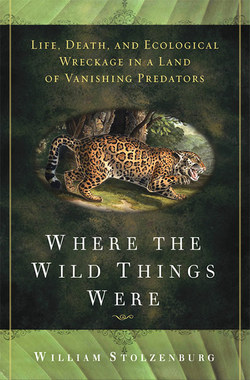
  • Where the Wild Things Were by William Stolzenburg
    I live among ranchers in northern Utah, people whose livelihood walks around on four legs. People who can lose thousands of dollars of future income if they lose one good cow or calf. People who think one of the dumbest things to happen in recent times in the West is the reintroduction of wolves to Yellowstone. Now, I don’t agree with them, but I do think they have good cause.

    Contrary to what people will tell you, wolves do not kill just for food. Wolves kill because they like killing. If you don’t believe me, then believe Temple Grandin, an expert on animals, who asks the question in her Animals in Translation: “Is it fun to kill a groundhog?” 

    She reviews a number of studies done on animals and answers with an unequivocal yes, predators love to kill. In fact:

    “Animals like having their predatory killing circuits turned on, and will turn them on themselves if you show them how. When you think about what predatory killing is all about, of course it ought to feel good, because predatory killing means dinner. Killing a mouse feels good to a cat the same way finding a luscious ripe banana feels good to a primate.” (p138)

    What this means is that when wolves come to kill sheep, they don’t just kill one old and decrepit ewe. No, they do what they did on a neighbor’s land a few miles from my home. They maim and kill five or six. Not because two wolves were that hungry, but because it was fun and they could.

    Sheep are like popcorn to wolves. Compare them to elk or other wild animals. The reason why wolves tend to indeed eliminate the young, weak, and old in the wild is that those poor specimens tend to run a bit slower than their brethren. In the wild, slow means dead. For the wolf, it’s hard work to run down an elk or buffalo. And if you’re a hungry son-of-a-gun, you’re not going to go chasing after another dinner while there’s fresh meat in front of you because the rest of the pack will eat it before you get back. And you ain’t going to catch one on your own anyway. But sheep aren’t elk. Cattle aren’t elk. They’re bred for meat, not sprinting. Sheep are easy meat. And the wolves can’t help themselves.

    But even if the wolves exercise restraint and eat just one, that’s cash. That’s clothes for the kids. That’s a mortgage. That’s heat. And it’s a danger for children as well (adults I don’t worry about: who cares about a few devoured adults?). My girls like to hike. And while I’m sure wolves will usually stay away, a sick or starving wolf will risk humans just as sick and starving mountain lions do. You get a different mindset about predators when you live up where I do. When they’re not something you see caged up in the zoo or on PBS.

    For all these reasons and others, I couldn’t wait to read Where The Wild Things Were by William Stolzenburg. Folks, the book is fabulous–well-written and interesting from page one to the very end. The key point is that predators play a huge role in maintaining a healthy diversity of both plant and animal life in any given ecosystem. Stolzenburg begins with starfish and moves through otters, killer whales, jaguars, mountain lions, and wolves. Along the way he reveals just how important killing is.

    Yes, killing is critical to life as we know it.

    Because without it, the most dominant herbivores will end up eating all the food. And this will end up killing off most of the other herbivores. It will kill off the great variety of flora in any given system. It can turn a paradise into a hell as Stolzenburg illustrates with the islands of Lago Guri in Venezuela. 

    Of course, some people think the answer is to bring back all the big predators. The rewilding supporters want to populate the West not only with wolves, but also lions (African), jaguars, cheetahs. Heck, they salivate at the idea of giant Pleistocene bears that can run faster than a horse (yeah, I want one of those up where the Boy Scouts camp).  I think it’s good the wolves are back in Yellowstone. But I don’t want packs of wolves eating my friend’s herds and daughters (of course, maybe a few Boy Scouts are okay). Still, I believe there has to be another alternative. What that is I don’t know. But we all need to think about it. We do. And great way to start is by reading Stolzenburg’s book.

  • |

    Buffett’s Letter to Berkshire Hathaway Shareholders on 2008

    I got my masters degree in accounting and information systems. While going to school I started an investment club and learned about a man named Warren Buffett.

    Warren Buffett is humble, full of folksy humor, and trades places with Bill Gates as the richest man in the world, depending on the year you’re counting. His annual letters to his shareholders are a delight to read. This year’s is full of wisdom about the current financial crisis. Moreover, within a few minutes of reading you will be able to get some key insights that can help as you evaluate the plans being hatched in Washington and how to prevent this particular type of crisis from happening again. 

    If you’re not that into finance, I recommend reading:


    1. The introduction starting on page 2 and ending on page 3
    2. The “Finance and Financial Products” section starting on page 10 and running through page 12

    Once you’ve read those, if you want to laugh and see Buffet’s humor, skip to page 21 where Buffett talks about the annual meeting of shareholders. Tell me you wouldn’t want to attend.

    The Berkshire Hathaway homepage

    This year’s letter to shareholders (you will click on 2008 because he’s discussing the results of that year)

  • |

    Animals in Translation by Temple Grandin + Interview

    I have read few books more interesting than Temple Grandin’s Animals in Translation: Using the Mysteries of Autism to Decode Animal Behavior.

    In it she describes her world of autism and how it helped her a perspective into animals unlike any other expert in the field. She can literally see what we block out. It’s part of what helped her make a huge impact on the meat packing industry.

    And it’s had an impact on her. When she was visiting her grandparents once in Arizona, she saw a squeeze chute in operation on a ranch. She saw the cattle calm, for the most part, in the chute. “Watching those cattle calm down,” she says, “I knew I needed a squeeze chute of my own.” So when she got back home she built a human-sized one with the help of her teacher. “I got through my teenage years thanks to my squeeze machine and my horses.”

    Grandin is not a vegetarian activitst (she eats meat herself) or a brutal slayer. She has taken the middle ground between the fantatics that want to prevent the consumption of all meat, on one hand, or totally disregard the life of animals on the other. She writes, she says, “because I wish animals could have more than just a low-stress life and a quick, painless death. I wish animals could have a good life, too, with something useful to do. I think we owe them that.”

    Temple has dozens and dozens of insights into animals, which she shares here. You’ll learn about rapist roosters and the problem of one-trait breeding, whether prediators find it “fun to kill a groundhog” (yes, she says, they do), whether animals have true cognition, and so many other things it’s impossible to list them here. I was fascinated on every page. If you have anything to do with animals, you’re going to LOVE this book.

    Get the book. Read it. In the meantime, watch a 27 minute interview of Temple by Doug Fabrizio on Utah NOW. I caught this on TV flipping through the channels and couldn’t look away. This is a fascinating interview of a fascinating woman.

    Source:Temple Grandin on Utah NOW

  • | |

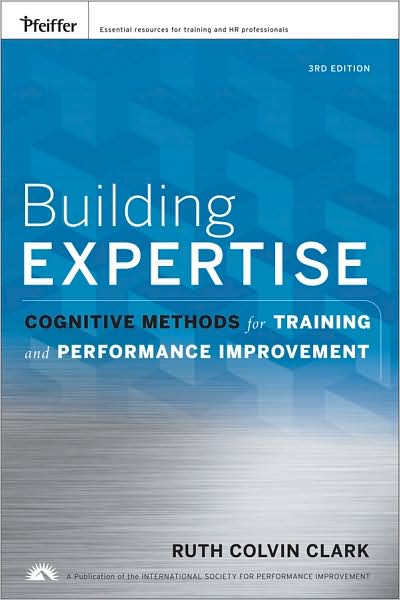
    Building Expertise by Ruth Colvin Clark

    When we find a great teacher, we prize them not only because what we learn improves our lives but also because good learning can be one of the most exhilirating things we experience. Unfortunately, a lot of teaching stinks. It’s boring, rambling, forgettable.

    I’ve made a study of teaching. I’ve had to. For almost 20 years I’ve taught and designed courses in the private sector. And for many of those years my work has been in a revenue generating department. What that means is that if my classes are ineffective and dull, nobody signs up, revenue falls, and a lot of folks will stand around and wonder if it might not be better to just replace me with a potted plant. At least a plant would be something pleasant to look at, plus it would also clean the air.

    Now not everything I do is stellar (I wish that were so). Sometimes in the quality, cost, speed triangle, quality is the thing that takes the hit. But the point is I have to be alert and try to miminize the schlock. But how do you do that? How do you develop and deliver effective and interesting education?

    Luckily, the field of instructional technology (I’m not talking about computers, but principles of instruction) has come a long way in identifying what works and what doesn’t. This is important because teaching theories of the past (many of which are still used today) often relied on rules of thumb and anecdotal evidence. Their precriptions were often ineffective and sometimes counterproductive. What’s exciting is that in the last few decades researchers in this area have put techniques and principles to the test. We know better now than ever before how to structure learning that is effective and interesting. And I have yet to find a better explanation of the proven techniques and principles than Ruth Colvin Clark’s Building Expertise: Cognitive Methods for Training and Performance Improvement, 3rd Edition.  

    Don’t let the “training” part fool you. We often associate “training” with learning procedures and simple tasks (which is what leads to the “we want to provide sex education, not sex training” obfuscation). But Clark isn’t using the term that way. Training here includes all types of learning.

    What Clark does is not only share the techniques that build expertise, but also the psychological reasons and research-based evidence for those techniques. This isn’t nonsense based on personality or political correctness. It’s practical and proven.

    Among other things, you’ll learn:

    • Why working memory is key to instruction and how to overcome its limits
    • How to motivate learners
    • How to structure learning
    • When to use lecture and when to put learners into action
    • What methods work best

    You’ll learn when taking notes can actually be counterproductive and what you can do about it. Or how making your delivery more personable (and what that means) can actually improve attention. You’ll see why lots of practice isn’t always the best answer–sometimes your child will learn more if you do half of their homework questions for them.

    You’ll find that there “Is no Yellow Brick road” in teaching. Instead, you’ll see that the effectiveness of any method depends on whether it’s suited to the specific situation. And Clark will explain what the key factors in any situation are so you know which methods to apply and the trade-offs you’ll make when you do.

    If you’re a teacher in any setting–family, job, church, school, or recreation–or if you’re trying to teach yourself, this book (specifically the 3rd edition) will be a goldmine for you. I can’t recommend it highly enough.

  • J.R.R. Tolkien: A Biography by Humphrey Carpenter

    Why I didn’t read Humphrey Carpenter’s J.R.R. Tolkien: A Biography long ago is a mystery. I owned the book when I was a teen (and stupidly gave it away in my 20’s). But maybe the long wait was inevitable. Back then I wanted more hobbits and sweeping saga, not biography. Luckily, that’s not the case today. 

    Folks, this is a marvelous read. I’m sure part of the reason I have not read a biography with more interest is because I love The Lord of the Rings so much. But I think there much more to it than that.

    Tolkien had a story life as a child and young man. Not story as in wonderful and easy, but as in hard. He was orphaned early, forbidden to see his love when he found her. So Tolkien’s life is compelling on its own, not just because he’s famous.

    Furthermore, Carpenter writes, not a dry list of facts,  but a narrative full of particular and interesting details, transporting you back to the very times and places Tolkien lived in. He also transports you, if only lightly, into the mind of the man and some of his opinions. You’ll learn why Mordor is not Nazi Germany. How the batmen of WW1 found their way into his work. And that Frodo was originally named Bingo (can you imagine?). Carpenter also attempts to point out cause and effect as he sees it, to sum up key factors in Tolkien’s life, but without being glib. Carpenter writes all this with such clarity and grace I found myself carried along.

    If you’re a fan of Tolkien’s work, don’t miss this book. Get a copy. Find a favorite tree, if you can. And then read.