This last June, I stood outside Warwick Castle next to a longbowman and stared up at the massive structure. The curtain walls rose forty to fifty feet high. The great tower soared even higher—one hundred and twenty feet. But it wasn’t just the walls.
The moat. Holy schnitzel, folks, the MOAT.
On one side of the castle, the River Avon provided a barrier. On the other, a dry moat stretched forty to sixty feet wide and twenty to thirty feet deep. Standing at the bottom, you’d be staring up at seventy feet of turf and stone. That’s like staring up at a six-story building—with armed soldiers waiting at the top.
My only thought was: good night, what kind of madman would assault these defenses?
The answer, of course, is almost no one. Medieval sieges were usually about starving the defenders out, not storming the gates in a blaze of glory. Unless you had a trebuchet—which I also saw demonstrated that day.
It was the kind of moment that makes a writer’s brain spark. Assassin, the fourth book in my Drovers series, is set in the capital city of Broniss, which bristles with towers and walls of its own. Standing there at Warwick, I realized: no sane army would attack such walls directly. Which is why the High King of Osson has other dark plans.
Of course, Warwick had more than just military lessons. There was a falconry show where hawks, vultures, eagles, and even a condor soared just above our heads. Here’s a tip. If you go, sit on the benches, not under the tree. The benches are where you get the most flyovers.
There was a dungeon tour that turned into a hilarious series of skits, complete with a plague doctor and a judge who convicted one of us.
And afterward, we went into the city to a Thai place called The Giggling Squid (yes, that’s really its name). The food was amazing.
It was a glorious day, and it reminded me that some of the best research often comes from first-hand experience. Although some things—like being pierced through with a sword—I’m happy to leave to my imagination.
I’m back at the desk now, hard at work on Assassin. It’s turning into a terrific ride, and I can’t wait to share more soon.
Here’s to Ferran, Sura, and Lagash—will they foil the traitor’s plot and stop the hashida’s creature, or will Ferran and the others fail and find all their dreams dashed to pieces?
Mrs. Brown, my wife, teaches language arts for the 7th and 8th grades as well as reading comprehension. She’s big on reading. She wants to provide every opportunity for kids to not only get good at it, but also learn to love it.
And so her walls are lined with bookshelves full of awesome books teens love. She reads the first chapters of books to her classes to let them sample various stories. She features their book reports. She has them paste the covers of the books they’ve read on pages displayed around the classroom. And the school’s awesome librarian supports with her own programs.
The 7th and 8th grade students at Rich Middle School are marinated in a big celebration of reading.
In Mrs. Brown’s class, it’s fairly straight forward to get an A on reading, which is a huge part of your grade—all you’ve got to do is read.
But how much reading do they need to do? How do you track it? And what books should they read?
Check this out.
First, she tests each student to see what his or her reading speed is.
Next, she takes the number of hours they’re supposed to be reading each week for homework (I think it’s 2 or 2.5), then does the math to get a feasible reading word count for the trimester for each student. She may adjust it a bit, depending on the student’s ability.
Third, she presents that number to the student, and the two of them set a word count goal for the trimester. Talk about an individualized goal.
If you want to get an A in reading, all you have to do is reach that word count goal.
How do you know how many words a book has?
The Accelerated Reader program provides that information.
But how does she know that they’ve read the books?
She uses the Accelerated Reader tests. And if there isn’t one, the student can write a report.
And what books do the students read?
Any dang book they like.
I love this. The kids get to select their own books and just read, read, read.
Another part of this is that she pings each student once a week to ask them what book they’re reading, what page they’re on, and what they think of the book. This weekly check-in provides the more frequent accountability students of that age need.
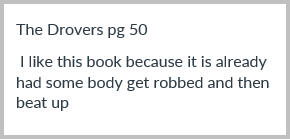
Yesterday, she received this report from one of her 8th grade boys who is reading Prey, the first book in The Drovers series.
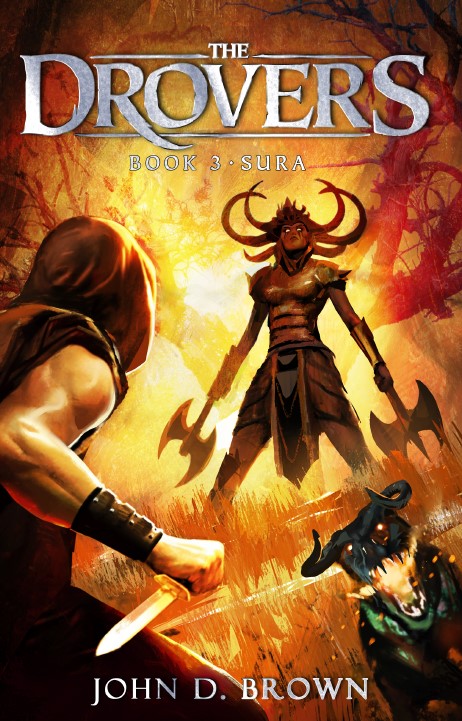
Behold the cover. A big thanks to Dixon Leavitt for the art.
And here’s the description we’ll be using.
Nobody in their right mind travels through this place.
All Ferran wants to do is get the cattle to Broniss, get paid, and free his family from the threat of slavery. But an unexpected and terrible enemy takes most of the crew prisoner in the Blight.
Ferran, Winwallom, and Sura, the fierce Mashadian girl none of the boys trust, must free them.
But how will they when the trio is vastly outnumbered, they’re days from help, and other things lurk in the woods?
I’m so excited to get this book into your hands. I had a blast writing it.
I was saddened today to learn that Dave Wolverton, best known by his pen name David Farland, passed away this week.
Dave was such an incredibly helpful mentor to me. It was the workshop he held at BYU back in 1993 that made me think I could actually write stories that entertained people. It was that workshop that prompted me to start submitting to the magazines.
And when I finally got my first publication, he was involved. He was the initial judge for Writers of the Future when my story won a first prize. And he was there, helping lead the writer’s workshop in Cocoa Beach, Florida and cheering all of us on.
Later, when I started writing novels, it was his thoughtful feedback that helped me improve my second novel to a publishable level. He believed in it enough to write a recommendation for me to Tor Books. When they decided to publish me, it was Dave that agreed to take me on tour with him. I enjoyed hours and hours driving with him, chatting, laughing, and signing at bookstores in Washington, Oregon, and California.
He was always interested. Always friendly. Always willing to talk and share his expertise. And always had great stories to share about his life.
As an entertainer, his stories thrilled me. In college, I was swept away by SERPENT CATCH, PATH OF THE HERO, ON MY WAY TO PARADISE, and THE GOLDEN QUEEN trilogy. My wife and I had so many delightful hours reading that trilogy to each other.
I still remember going to the bookstore in Pleasanton, California in 1998, hoping to get a copy of RUNELORDS when it was first published, being so excited when I found it on the self, opening it, and reading the first pages. They completely enthralled me. Blew me away. I felt like I was in the cinema. I loved that series and was always waiting for the final book.
I loved Dave’s stories. I appreciated so much his many kindnesses to me and his good humor.
May you rest in paradise, my friend, until the trumpet sounds.
A cracking good story idea requires five critical elements.
Until you have all five, you’ll struggle to plot. You’ll write a few scenes and run out of gas. You’ll feel like the story just isn’t going anywhere.
And that’s because it isn’t. It can’t. A story isn’t a story without all five elements.
However, once you develop these five things, your story will suddenly roar to life. There are a few other elements that are important as well, but these five things form the core of the story setup.
In this course you’re not going to merely learn about all of those story elements. You’re going to go deep and learn what can only be learned by actually doing the work and developing story idea after story idea with personal one-on-one feedback from someone who knows what they’re doing.
When you finish, you won’t just know story theory. You will be a story idea machine. And you will be that because you have put in the work. The right work.
Again, this is not a course full of lectures and videos. This is a course where you’re going to work. And develop the insights and skills that only come from doing the work.
You’re actually going to:
Come up with story setup after story setup after story setup
And improve them with one-on-one feedback.
It’s going to:
Eliminate years of you wandering about in the story wilderness trying to figure things out on your own.
Put you miles ahead of other writers who have no idea what’s really at the core of story.
You are going to learn how to develop killer story ideas on purpose instead of on accident. Which means you’ll be able to do again and again. Reliably. Like clockwork.
Course details
The focus of the class is not on learning about story, although you will do that. The majority of your time will be spent on developing stories.
You can’t become a carpenter by watching videos and reading books about it.
You have to get out on the work site, cut wood, and pound nails. You have to make the mistakes all beginning carpenters make, get feedback, and improve.
The same goes for writing.
And you’re going to work in this class. You develop 21 story setups. In fact, you develop more because the 21 are just the ones you turn into me. And with each one your skills, insights, and abilities grow.
In the beginning, your setups will be bare bones. By the end, they’ll be fully developed setups that beg to be written. Setups you can use to immediately write the first draft of your novel, whether that’s in outline or chapter form.
Here’s what you do each week.
Week 1.
Uncover the secrets of what’s really at the heart of story and how to generate ideas.
Define your genre requirements
Create story setups 1-3
Week 2.
Uncover the secrets to compelling characters
Create character sketches
Create story setups 4-7
Week 3.
Uncover the secrets to formidable obstacles
Create story setups 8-11
Week 4.
Uncover the secrets to interesting casts
Create story setups 12-15
Week 5.
Uncover the secrets to managing multiple storylines and series
Create story setups 16-19
Week 6.
Create story setups 20-21. These are your capstone projects where you apply everything you’ve learned and take it to the next level
In this class you develop story idea after story idea after story idea. You are going to be marinated in the work of developing characters, THOMs, goals, obstacles, settings, casts, and more. And because of that, each week will not only bring an explosion of insights, but new skills and abilities.
Every week you get two private, one-on-one, live sessions with me where you get encouragement and feedback on what you’ve developed. And you’ll have access to a private Facebook group where you can apply the principles to brainstorm even MORE ideas for each other’s stories.
At first you might feel a bit shy and worried about your ideas and abilities. But you’ll soon get over that. By the end of the course you’ll be one of those people that can generate terrific ideas easily. And you’ll be able to do that because you will have put in the work to become a different writer.
What’s the price?
Hours of one-on-one instruction from a professional editor or author costs thousands of dollars. An MFA program can cost $25,000 to $30,000 or more!
But this course won’t cost anywhere close to that.
Plus you’re going to learn things here you’ll never get in an MFA program (I know. I was accepted into a top-ranked program).
The cost of this course is $799. And I personally guarantee your results. You’ll be totally oh-my-gosh-I’m-so-happy-I-took-that-class satisfied, or I’ll give you your money back. No questions asked.
Now’s your chance to stop spinning your wheels. I can’t tell you how much I wish I’d had something like this when I’d started:
The secrets about the true core of story.
The secrets about how to come up with ideas.
Actual work with personal one-on-one feedback.
Laser focused on what actually matters, not a bunch of ridiculous writing rules.
When you finish, you will be a story idea machine.
You won’t know plotting. That’s a different course and set of skills. You won’t know how to write chapters. But you’ll know how to create the engine that powers all the rest of that. You’ll know how to create the core that makes awesome plots and chapters possible.
If you want to take this course, click the button below and contact me. I will tell you exactly how to apply.
I’m not going to be able to accept everyone who wants to take the class. I have a very strict limit on the number of students I can work with. So you need to get your application in before the deadline of midnight, December 11th.