On Teaching

  • | |

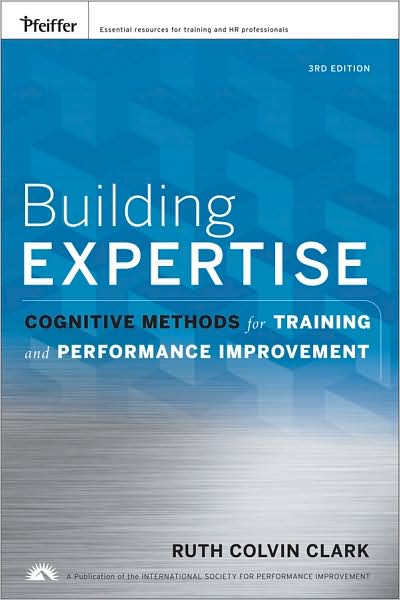
    Building Expertise by Ruth Colvin Clark

    When we find a great teacher, we prize them not only because what we learn improves our lives but also because good learning can be one of the most exhilirating things we experience. Unfortunately, a lot of teaching stinks. It’s boring, rambling, forgettable.

    I’ve made a study of teaching. I’ve had to. For almost 20 years I’ve taught and designed courses in the private sector. And for many of those years my work has been in a revenue generating department. What that means is that if my classes are ineffective and dull, nobody signs up, revenue falls, and a lot of folks will stand around and wonder if it might not be better to just replace me with a potted plant. At least a plant would be something pleasant to look at, plus it would also clean the air.

    Now not everything I do is stellar (I wish that were so). Sometimes in the quality, cost, speed triangle, quality is the thing that takes the hit. But the point is I have to be alert and try to miminize the schlock. But how do you do that? How do you develop and deliver effective and interesting education?

    Luckily, the field of instructional technology (I’m not talking about computers, but principles of instruction) has come a long way in identifying what works and what doesn’t. This is important because teaching theories of the past (many of which are still used today) often relied on rules of thumb and anecdotal evidence. Their precriptions were often ineffective and sometimes counterproductive. What’s exciting is that in the last few decades researchers in this area have put techniques and principles to the test. We know better now than ever before how to structure learning that is effective and interesting. And I have yet to find a better explanation of the proven techniques and principles than Ruth Colvin Clark’s Building Expertise: Cognitive Methods for Training and Performance Improvement, 3rd Edition.  

    Don’t let the “training” part fool you. We often associate “training” with learning procedures and simple tasks (which is what leads to the “we want to provide sex education, not sex training” obfuscation). But Clark isn’t using the term that way. Training here includes all types of learning.

    What Clark does is not only share the techniques that build expertise, but also the psychological reasons and research-based evidence for those techniques. This isn’t nonsense based on personality or political correctness. It’s practical and proven.

    Among other things, you’ll learn:

    • Why working memory is key to instruction and how to overcome its limits
    • How to motivate learners
    • How to structure learning
    • When to use lecture and when to put learners into action
    • What methods work best

    You’ll learn when taking notes can actually be counterproductive and what you can do about it. Or how making your delivery more personable (and what that means) can actually improve attention. You’ll see why lots of practice isn’t always the best answer–sometimes your child will learn more if you do half of their homework questions for them.

    You’ll find that there “Is no Yellow Brick road” in teaching. Instead, you’ll see that the effectiveness of any method depends on whether it’s suited to the specific situation. And Clark will explain what the key factors in any situation are so you know which methods to apply and the trade-offs you’ll make when you do.

    If you’re a teacher in any setting–family, job, church, school, or recreation–or if you’re trying to teach yourself, this book (specifically the 3rd edition) will be a goldmine for you. I can’t recommend it highly enough.

  • |

    What Separates the Gifted from the Schlubs and How Praise Can Backfire

    What makes someone gifted?

    Raw talent?

    Sure. An apptitutde for something always helps. But it appears it’s not enough. True expertise takes work. And those trying to help (i.e. parents, teachers, coaches) can hinder if they give the wrong kind of praise.

    I wanted to share three articles reporting the results of a number of interesing studies on expertise which often appears as a skill level that seems unobtainable by normal, motivated individuals.

    The Meadow Mount School of Music

    This music school in the Adirondacks has “trained such luminaries as Pinchas Zukerman, Itzhak Perlman, Joshua Bell, Lynn Harrell, and Yo-Yo Ma.” A number of researchers wanted to see what the difference was between the students who seemed most skilled and those who weren’t. They divided students “into three skill levels, including one the faculty had identified as having the best chance of becoming world-class soloists.” Then they looked at the differences.

    According to the report, “the results were clear-cut, with little room for any sort of inscrutable God-given talent. The elite musicians had simply practiced far more than the others…Psychologists found a second attribute in elite players that is less obvious than sheer hours of practice. While most of us think of practice as the repetition of tough spots (and this is how many young people do practice), elite musicians, they found, took a different approach.”  Read full article.

    The majority of childhood prodigies never fulfill their early promise

    Why? According to these researchers it’s because so many early-bloomers get warped by their experience and fail to develop perseverance. More here.

    Praise that Undermines Achievement

    It appears that how we praise achievement affects performance. Sometimes in large and startling ways.

    You may think that it’s good to praise your child for being “smart” or “good” in some subject. But there’s growing evidence that giving kids such labels doesn’t improve or motivate performance, but actually reduces it.

    Psychologist Carol Dweck and her team have studied the effect of praise on students in a variety of settings. “Repeating her experiments, Dweck found this effect of praise on performance held true for students of every socioeconomic class. It hit both boys and girls—the very brightest girls especially (they collapsed the most following failure). Even preschoolers weren’t immune to the inverse power of praise.” So what type of praise actually works? Read here.

    When does genius bloom?

    We often think genius must be tied to being precocity. After all, Motzart was doing musical flips when he was still a kid.  For writers, however, it appears this isn’t the case. More here.

  • |

    Why you can’t popularize literary fiction, part 2

    I voiced my opinions on the TC Boyle message board. Needless to say, I’m probably too aggressive in my stance. But a guy over there said: “(easy,chewable,harmless pages) shouldn’t be the goal of any writer with even the tiniest self-respect.”

    Here’s my response.

    —-

    I don’t know any of these successful authors who don’t have self-respect because I don’t know any of them who try to write based on what they think will sell. Everyone of them that I know writes from passion. And I know some NY Times Bestsellers. They might look at 10 projects they have passion for and choose one that might be more marketable. But the passion comes first.

    I don’t know how anyone could spend the amazing number of hours it takes to finish a novel unless they have passion for the project. In fact, I wonder if it’s possible to create something that’s actually sellable without it. Everyone’s always talking about these hacks out there with metal brains writing for money. But after all the writers I’ve met, I’ve yet to find one. In my experience they’re as scarce as the yeti.

    So my intent wasn’t to say you can write for love or money, but not both. My intent was to say that I believe most MFA programs have made themselves irrelevant to the greater stream of literacy in the country. The teachers have passion for fringe genre and teach their students how to entertain that fringe reader. And if they DO have passion for the types of fiction most readers want, such enjoyment is always talked about as some form of slumming. There’s an apology or at least a statement making it clear they know such fiction is not something you bring to the table where serious writers work.

    But this isn’t true. Serious writers, passionate writers work in those genres. And they deliver excellent work. By that I do NOT mean they deliver the tropes of literary fiction in drag. What they deliver doesn’t appeal to the fringe markets. But it’s excellent, nevertheless, because it delivers exactly what the people go to those stories for.

  • |

    Why you can’t popularize literary fiction

    T.C. Boyle is one of my favorite writers. He saved me in my undergraduate program. I was buying the The Best American Short Story, Pushcart, and O’Henry anthologies. I was reading for my coursework. And so much of it bored me to death. And then one day I began reading “The Ape Lady in Retirement” and my eyes hung out because finally the text was interesting. Finally someone wrote a story I could read start to finish.

    I immediately bought his anthologies–Greasy Lake, If The River Was Whiskey, Descent of Man. I was in heaven. Now, not all of his stories worked magic on me. But when I was having a hard time finding one story in a whole anthology, his books seemed like a treasure trove.

    He didn’t do as well in his novels. Oh, the writing was just as good. The characters and descriptions just as odd and stunning. But he didn’t keep my interest. The problems never built into anything. Nevertheless, I loved him.

    I’ve been having a brief conversation with him and the fan boy in me is delighted to finally talk to this guy. And after reading an interview with him, I realize why he probably spoke to me. While the other literary fiction authors were following the tastes of the fringe group, Boyle at least wanted to entertain.

    In his interview he says.

     Everybody has forgotten that literature, like all art, is, at root, entertainment. It is supposed to entertain you. It’s not supposed to be some conundrum to be resolved by some professors in the university. It’s not a game. It’s not masturbation. It’s art. And I think great art is great on all levels. But the first level on which it must be great is that it must be entertaining.

    Amen, brother Boyle. Amen!

    I’m in a top-20 MFA program in the West.  And I think it’s odd that many in these MFA writing programs, mine included, totally miss the boat on what readers want and bemoan it when nobody comes to buy their stuff. They don’t get it’s about entertainment. About being moved. About much, much more than the language.

    Here the full Boyle AWP interview.

    However, I still think he misses the mark. In it he says about bestsellers:

    But it’s mainly vampire books and Tom Clancy and all the rest of it. I don’t understand why we can’t make our books more available to everybody-not by compromising what we do, but by popularizing them, getting them out to the public.
    He also says about editors and MFA programs:
    I think that now we don’t have great editors. We have editors who are basically trying to hold on to their jobs and who publish good books once in a while. They’re basically cheerleaders for the books. They’re not editors, really. They’re incapable of being editors; they don’t need to be. Because editing is done-self-editing is done-through the apprenticeship in the writing programs. Nearly everyone from my generation on to your generation and beyond will have been through an MFA program. It’s just the way it is now. It’s a different world. It’s essential.

    I’d like to suggest that Boyle, despite his love of entertainment, still misses the mark in his interview because you cannot popularize something that only appeals to a small market. The reason why Stephenie Meyer, Patterson, et al sell exponential circles around folks like Don DeLillo or Louise Erdrich is because Meyer and gang are very good at delivering what the largest portions of the reading public want. They deliver types of entertainment that DeLillo and Erdrich do not. (And I mean “entertainment” in a very broad sense.)

    We could point at the Oprah effect (whether you like it or not, Mr. Cold Mountain) and say that’s not true. It’s all PR and marketing. But that assumes publisers are idiots. And while some of them may be, I think it’s an extreme assumption. Publishers are in it for the love AND money. And you can be sure that the board of directors is looking for smart, money people to lead the companies. You don’t make money, you’re fired.

    Which means that IF the publishers found literary fiction sold like hotcakes they’d promote it like hotcakes. But literary fiction too often fails to entertain anybody but a handful of fringe readers. And so trying to popularize it can only have a limited effect. When people are thirsty, not many are going to pass up tall glasses of ice water for the pickled jalapenos at the end of the line.

    Meyer, Clancy, Grisham, Roberts etc are masters of entertainment. And, like it or not, that’s the main reason the small portion of the public who actually read go to fiction.

    I think it’s fine to cater to the fringe audience if that’s your pleasure. But I think it’s ridiculous to think such fare is better than what most people enjoy. Or that it deserves any special veneration. The MFA programs I’m familiar with seem, by and large, to miss the point. Instead of teaching the meat of fiction (entertainment) they focus on teaching students to serve up the parsley with great pomp. And when the customers go elsewhere to get the meat they crave (or the salad for you vegans), they respond by saying the customers are simply too dumb to get it or have no taste.

    Now, I’m not saying the folks I work with in the MFA program are idiots. Or jerks. Almost everyone I’ve met has been extremely nice and smart. They have great insights. But there is a strong pressure in that culture, amost a moral pressure, to think about fiction this way. And it’s based on their tastes.

    I think we all do this. 90% of what’s out there is crap. But it isn’t, really. The truth is that 90% of what’s out there simply doesn’t appeal to us. And so because it doesn’t deliver the goods, it’s crap to us. The problem is when we don’t realize the difference and begin to think that because we don’t have the taste for something that it’s garbage.

    It’s not.

    And that’s one thing the gentle and smart people in my program have shown me. I’m just as liable to make this mistake as anyone.

    So what MFA programs need to do is teach fiction. The meat. As well as the parsley. They need to teach all the genres, not just one. Alas, for the meat you have to go to communications departments to even talk about it. And then hope you find someone like Dolf Zillman, Bryant Jennings, Jenefer Robinson, or Peter Vorderer.

    Which leads me to the next point. Boyle is wrong about editors and writers. The majority of the authors that actually sell never set foot in an MFA program. MFA’s teach students to write for a small fringe market. And so they’ll dominate that fringe market, but not the big markets. Not what most people actually read.

    Since I haven’t worked with any editors in that so-called golden age of editing, I cannot comment on the difference. But I do know that the editors I and other authors have worked with do many edits on the projects they oversee. They are thorough. They want it to be the best story it can be. It’s true they won’t take something that’s a complete mess and work on it. But why should they? There are so many better manuscripts out there it only makes sense.

    Anyway, I love Boyle. Probably becasue he loves plot and story as much as language. His shorts saved me in my undergrad program. They were one of the few interesting things I read. I just am dismayed that these writing programs are so far off in the weeds.
  • |

    Will readers completely die off?

    For many years people have been predicting the death of literature because the stats on the reading public  show fewer and fewer books are being sold because fewer people are reading. For an author it’s a bit depressing. However, you might find this article provides some hope: http://www.newsweek.com/id/136961.

    Generation R (R Is for Reader)
    The book business may be flat, but there’s at least one bright spot: the booming sales of books for teens–and no, it’s not all Harry Potter… Contrary to the depressing proclamations that American teens aren’t reading, the surprising truth is they are reading novels in unprecedented numbers. Young-adult fiction (ages 12-18) is enjoying a bona fide boom with sales up more than 25 percent in the past few years, according to a Children’s Book Council sales survey…”

    If that trend holds, it means we’ll have a fine wave of readers to replace all of us who die off, and then some. Someone praise JK Rowling for Hogwarts and for awakening pleasure reading in the hearts of children (and adults).

    And take it as a lesson. The future is in the next generation. Perhaps reading provides just as much entertainment as anything else. The kids just have to discover it.

    Hopefully, Nellie will be doing her part to awaken that joy in the hearts of the marvelous youth of our small town. As I wrote before, she’s going to be following the steps of Nancie Atwell who has done amazing things for 20+ years up in Maine.

    http://www.amazon.com/Middle-Understanding-Writing-Learning-Workshop/dp/0867093749
    http://www.c-t-l.org/about.html

    It’s all about reading and writing for the intrinsic joy of reading and writing. Only 15 minutes of her 65 minute class will be spent in traditional lecture. The rest is for the kids to read and write. This isn’t study hall. It’s rigorous. And again, it follows the principles I learned in my last 20 years of teaching and learning how to write.

    I cannot wait to see what happens this fall!