Curse update: April 1, 2014

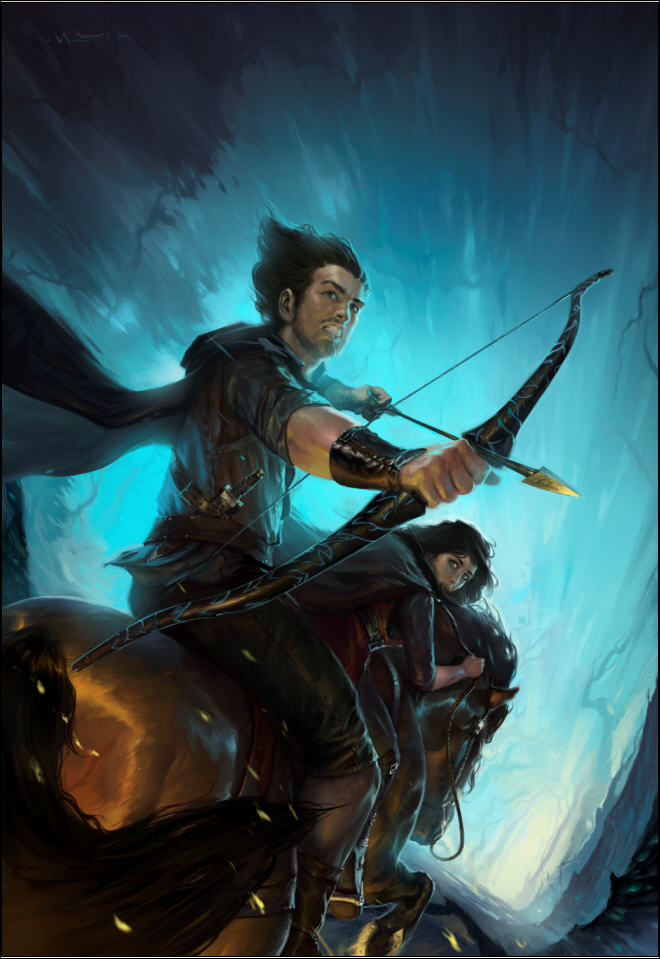
CurseV2FinalV1Today is a fine US holiday. And so I took the day off to write. I just added over 6,000 words to the final big battle climax of my novel. And what a climax it is. It’s almost 50,000 words long. I still have another 5-10k to go.

Folks, this is longer than a lot of short novels.

I guess it would be more accurate to say I’m writing act 3. The book will probably exceed 200k words. So 60k isn’t too long for the final act.

I will now sigh in contentment.

*sighs*

I’m enjoying the heck out of writing this.

At the same time, I’m hoping to figure out how to make book three in this epic fantasy series shorter so I can get the story out to readers in a more timely manner. I might be able to write two normal sized novels instead of one monster. I will think hard about it.

In the meantime, I hope to wrap this rewrite of act 3 up over the next few days. And then it’s just line and copy edits.

Share

Similar Posts

  • |

    The Pareto Principle, Form Follows Function, and Story

    There are a thousand things to “remember” when writing story. New writers who make lists of these things soon begin to drown in them. But I’ve come to realize that many of these “rules” don’t matter.

    They don’t matter because many ignore the function of story. And so you can’t know how and when to apply them, or if they’re even something you should apply in the first place. Furthermore, a good number that do tie back to function often have little impact.

    The more I develop and write, the more I begin to see that the key is to focus on a liminted number of fundamentals. To focus on the things that matter most.

    So what really matters when you’re writing a story?

    I’m going to be speaking for an hour at the Book Academy tomorrow. It’s at Utah Valley University. The week after I’ll be presenting all day at the American Fork Arts Council’s autumn writer’s conference. I will probably write up all my thoughts and post them to my site at some time.  But for right now this is where you can hear them.  

    I truly believe the Pareto Principle applies to writing. But you can’t go searching for those vital few factors until you know the effects they’re supposed to produce. Form follows function. And the function is something that happens in the reader.

    Here’s a nibble. This quote from David Howard is an example of what I’m talking about.

    “As we’ve seen, what the audience hopes for and what the characters hope for need not be the same thing. The same is true of our fears versus their fears. But how do hope and fear fit into the scheme of storytelling? Hope and fear are about the future. They derive from uncertaintly about future events in the story, future decisions the characters might make, future discoveries or revelations that might be unearthed, future outside forces and how they will influence the journey of the characters. When we discuss hope verusus fear in dramaturgical terms, this uncertainty is a function solely of the audience and its experience [my emphasis]. This is dramatic tension. We hope the man with the cobra in the shoe box won’t open the box; we fear he might and get himself or someone else bitten. We don’t know what will happen, but we know what might happen and therefore feel tension about those possibilities” (How to Build a Great Screenplay, 52).

    Readers buy novels because novels provide a service. They provide something to the reader. They DO something to the reader.  That’s why readers pay good money for them, and stay up late at night (well past smart bedtimes) with them, and spend hours of their lives reading them.  

    What do stories do? What are the key factors that have to be present in the stories for them to be able to do these things? How do you help readers hope and fear for what might happen?

    I’m no story guru, but I do hope to share some of the vital few factors I see in the presentations I’ll be giving this week and next.

    Share
  • It has begun

    The very observant will note that the progress bar for draf 4 of CURSE OF A DARK GOD has moved. Here’s the opening, although I’m sure it will change. We’re on our way, folks.

    It was well past midnight, and they were deep in enemy Fir-Noy territory.  There were eight of them: Talen, Sugar, River, and five of Shim’s soldiers, all of them staying back in the deep moon shadows at the edge of the wood, crouching low in the dry autumn weeds that had not yet been eaten down by the village livestock.  They had to be careful.  Talen, Sugar, and River all had sizeable Fir-Noy bounties on their heads.  And even though they wore weaves of might, being multiplied didn’t make their flesh impervious to arrows and blades. 

    This vulnerability had been made abundantly clear to Talen in his training.  In addition to his many fine bruises and the finger which had recently healed from a break, he wore a bandage around his arm where a soldier had cut him in practice two days ago with a spear. 

    The night shadows of the clouds played over the moonlit fields and houses and road that ran through the village of Plum.  The village where Sugar’s father had been killed and her mother taken and beaten.  The village where the Fir-Noy had burned her life to the ground.  The village that was their destination.

    Purity, Sugar’s mother, had hidden valuables there.  Weaves and maybe a codex of lore.  Talen and the others had been tasked to steal into the village and retrieve the items, right under the noses of the sleeping Fir-Noy.

    Except this wasn’t right.  They were supposed to have come out across from the ash ruins of Sugar’s old house.  “I think you’ve brought us to the wrong end,” Talen whispered to Sugar.

    “No, I’m just coming to get what’s mine first.”  Sugar pointed up the road to the entrance of the village.

    Talen followed her finger.  The Fir-Noy here had begun to build a wall around their village.  A wooden palisade atop a mound of dirt.  But she wasn’t pointing at the half-finished wall with its timber supports still showing like bones.  She was pointing at a tall pole that had been erected at the gate of the village.  Something had been fastened to the top of the pole.  Talen peered closer and saw a skull shining pale in the moonlight. 

    “That’s your father’s, isn’t it?”

    “You’re going to help me,” she said.  “He deserves better than that.”

    Share
  • |

    John guests on Writing Excuses season 3 episode 18

    writing-excuses-the-guys2-300x139

    Here’s the second episode I recorded with the Writing Excuses guys.

    In the first podcast we talked about putting and not putting ourselves in our writing and making characters who don’t all sound like the author. In this one, we talked about how to not repeat ourselves in ways that make the reader feel like they’re getting the same old same old.

    As usual, the guys had some great insights. Check it out: How to Not Repeat Yourself.

    Share
  • Your input please

    Dear Readers,

    I currently have two options for opening BAD PENNY, my thriller that I’ll be sending to my agent next week. I’m looking, of course, for the most interesting first page. Please imagine you’re in a book store or browsing online. Tell me which option you find most interesting and by how much (a little more, a lot more).

    Thanks!! 🙂

    OPTION 1

    The two men had been keeping back, playing it safe, giving the woman plenty of room on the deserted interstate. It was just after five a.m., the sun still about an hour off. Hardly a soul out here. Just them and her driving in the dark, the two men waiting for her to make her mistake.

    Jesus Goroza, the man with tats running over his limbs like demons, thought she was FBI.  Dan Meese, the driver, the man with the prison scar on his neck, wasn’t so sure. Wouldn’t the FBI have sent backup at the first sign of trouble? Of course, maybe she’d convinced her bosses she was clear, and they’d pulled back the cavalry. If so, she hadn’t been very smart.

    Up ahead the woman slowed then took the exit to a small out-in-the-middle-of-nowhere Utah town called Coalville. In a big city, there would have been cars. There would have been some bustle. There would have been witnesses.

    There were no witnesses here. Not on these streets.

    There were hardly any homes in this town. Meese figured there were at most a few dozen, and they were all strung out along a main road that stretched for what looked like ten miles. All of them were dark. A bunch of hick farmers dreaming about cows.

    A brightly lit Best Western hotel and a Texaco gas station stood on one side of the interstate. A lone Sinclair gas station stood on the other. The woman came to a stop then accelerated up and across the overpass toward the Sinclair gas station on the other side, the one that you couldn’t see well from the interstate. The one she obviously thought might give her cover.

    “Bingo,” Jesus said.

    In a big city, the Sinclair would have been ready for business. In this no-nothing town, it was dark and locked. The pumps, of course, were on. And the station’s sign with a green dinosaur on a white background towered above the place and shone out into the fading night.

    But there was no attendant standing guard over the cash and cigarettes to observe the woman. No one to see her stop and start the pump. No one to see her go try the bathroom door around the side. No one to see the two men pull in just a few seconds later.

    Meese said, “Looks like the offerings to your White Lady paid off.”

    Jesus pulled the semi-automatic from the glove box.  “I told you she wanted mescal.”

    Mescal offered up in a glass five days in a row along with prayer and cigarette smoke blown into the Lady’s skeleton face.

    “They want her alive,” Meese said of the woman they were following.

    “She’ll be alive,” Jesus said.

    OPTION 2

    Frank Shaw sat facing the owner of Cowboy Donut in a back office heaped with stacks of paper in yet another job interview that was starting to swirl the toilet.  Trying to get a straight job as an ex-con was a lovely experience. Kind of like being dragged behind a bus.

    No matter how tidy you looked or how sharp your resume was, it all came down to two questions: “Have you ever been convicted of a crime?” and “What were you in for?”

    Frank knew it would be stupid to lie about either. First of all, he was trying to go straight. Second, any employer who didn’t have a carrot for a brain was going to run a background check. So there was no use trying to hide.

    The sun-wrinkled owner of the Rock Springs, Wyoming doughnut establishment was one Ms. Mary Rogers. She was probably in her fifties and had two-tone hair that seemed to take its inspiration from a badger—all bleached up on top and dark underneath.

    Ms. Mary had just asked the question, and Frank had dropped his bomb—voluntary manslaughter, a security job gone bad. He’d been protecting the wrong kind of noun for the wrong kind of people, which led to seven fine years in prison.

    Now came the fun bus part, the Judas-Priest-there’s-a-criminal-sitting-across-the-desk-from-me part. First interviews were like first dates. And Frank had basically told this date he had an Ebola monkey virus that would make her eyes bleed—would she now like a kiss? That, of course, was yummy to women everywhere.

    Ms. Mary narrowed her eyes. “What else am I going to find on your RAP sheet?”

    “That’s it,” Frank said. “Just the one unfortunate incident.”

    “Murder is a pretty big incident.”

    “Manslaughter,” he corrected. “Not murder.”

    She made a noncommittal sound and looked down to study his resume a bit more like maybe something new would pop up there.
    Share

4 Comments

  1. I think that — in this age of ebooks — releasing a long story as shorter books makes a lot of sense. In fact, I think it could even be taken so far as to releasing portions of a story once a month (for, say $0.99/ea), and then when the entire story has been serialized that way, going back and releasing it as a book (or two or three), possibly with major changes and revisions. But that extreme may be difficult for a long story unless an author is extremely disciplined at outlining the entire story ahead of time. Or is okay with releasing a final book that is quite different than the serialized story.

    Regardless, I think your idea of releasing the rest of the story in shorter books is a good one.

  2. So, when can I give you money for this. I’ve been waiting a good long time for the second book in this series. I look forward to it. Keep up the good work. Also, bad penny was great.

  3. Ryan, if all goes well, you’ll be able to give me cash and enjoy the book this month 🙂

    I’ve had a number of unexpected delays after getting the rights back:

    – Learning how to get everything published in last quarter of 2013. It took waaaaay longer than I expected (2 months to figure it all out).

    – A life delay of a little over a month first quarter of 2014.

    – Plus I decided to rewrite act 3.

    There was just no way to plan for these things. Maybe I should give myself a 6 month pad on everything. Or maybe I stop sharing my internal targets and simply show progress until I reach the copy edit stage. And then firm up the date.

    However I do this going forward, progress is being made. I’m very close now.

  4. John,

    Thank you for the updates. It does help ease the angst of waiting for your next book in this series. I have been waiting since I picked up servant over three years ago. Keep up the amazimg work and keep the perserverance going. If the universe allows you to keep your current timeline, it would be an awesome birthday present for me.

Comments are closed.