|

Free stories from Year’s Best Fantasy 9 anthology!

Tor is posting ALL the stories in the Year’s Best Fantasy 9 anthology (published summer 2009) for FREE. Mine was in the second installment, but you can already get it here. What you want are all the others! For example, installment 3 has one of my favorite short stories I read last year: Kij Johnson’s “26 Monkeys and the Abyss.”

Here’s how to get them.

  1. Go to the Tor.com site.
  2. Scroll to the bottom of that post and click the “Year’s Best Fantasy 9” tag to see all of the installments.
  3. Click on each installment and download!
Share

Similar Posts

  • |

    New Workshop: How to Write a Story that Rocks

    Folks, the first tentative schedule for Life, The Universe, & Everything (LTUE) has been set. For the past few years I’ve been teaching a 2-3 hour workshop called “The 3 Things You Must Learn To Write Killer Stories.” I think I must have taught it over 15 times in different venues. Hundreds have attended and said they loved it.

    However, this year I’m going to be doing something different. I’m developing a new two-hour workshop called “How to Write a Story that Rocks.”

    I’ll be teaching it Thursday evening, February 11th from 5 PM – 7 PM at LTUE at BYU. It’s FREE and open to all.

    What I found was that a lot of new aspiring authors get lost in mountains of rules. But great storytelling isn’t about rules. They try to form stories with word counts, chapters, and weird plot diagrams. But stories aren’t about those things. They have a hard time knowing what to write next because they don’t understand how story works. In fact, some don’t know how to start at all. They just flounder in their piles of zing. Finally, even if they can get a bullet outline, they have a hard time turning that into a scene.

    So what we’re going to do in this workshop is this.

    1. I’m going to bring in some ideas for character, setting, and problem. We’re not going to generate from scratch as we’ve done in the past because I want to get to the next steps.
    2. Then I’m going to teach you how to go from idea to outline–we’re going to do it together, and you’re going to learn exactly how to know what comes next 
    3. Then we’ll go from outline step to scene sketch.
    4. Then from scene sketch to draft.
    5. At every step I’ll be pointing out key story development concepts and principles

    When we finish, you should be able to:

    1. Identify the essential story objectives and story development questions–get these right and the rest doesn’t really matter. This will include the HANDFUL of key things you need to worry about and develop with character and plot.
    2. Develop more likeable and interesting characters
    3. Develop more powerful story concepts (call it premise, problem, situation, whatever). Once you get this the story writes a lot of itself.
    4. Explain the real Story Cycle. Not Campbell’s mumbo-jumbo hero’s journey. Not the three, five, seven, nine acts. Not Freytag’s diagram. Story.
    5. Explain what it means to “move a story forward,” “increase the stakes and tension,” “complicate the plot,” “complicate the motive” and how that’s done using surprise, conflict, motive, and problem. Included in this are “turns,” “rugpulls,” and “reversals.”
    6. Use the Story Cycle concepts to generate a story bullet outline and take a bullet step idea and turn it into a scene.
    7. Explain the creative principles that help you generate stories more easily.

    Larry Correia will be there as well. So I’m expecting this to be a very helpful workshop. I’m going to do all I can to make it as good or better than the first.

    Share
  • David Morrell Workshop, June 6, 2008, Boise

    One of the things I love about writing is that there’s always something new to learn. There’s always new content and, therefore, lots of cool research, but there’s also a lot to learn about the craft. I have no illusion that because I now have a contract I’ve suddenly arrived as a master craftsman. This art is just too big.

    So you can imagine my delight when I saw that David Morrell is going to be giving a day-long workshop in my own backyard (out West, 5-8 hours is still in your backyard). I’ve signed up for Morrell’s workshop on June 6, 2008.

    He’s the guy who wrote Rambo and started Thrillers Inc. He was also a professor for many years.
    More on the Conference
    http://www.murderinthegrove.com/index.htm

    More on Morrell.
    http://www.shotsmag.co.uk/shots21/intvus_21/dmorrell1.html
    http://www.davidmorrell.net/
    http://www.writerswrite.com/journal/oct02/morrell.htm

    This was interesting.

    Ali: As a Professor of Literature at Iowa, what were your experiences in academia like? Did you tutor any students who became prominent in the fiction field?


    David : I have a Ph.D. in American literature and taught academic courses: the American Novel of the 19th Century, the American Novel of the 20th Century, American Realism, Hemingway and Faulkner, Hawthorne and Melville, that sort of thing. The University of Iowa has the famous Writers Workshop, but I had nothing to do with it. In fact, they hated the sort of books I wrote and hated even more that I earned money as a novelist. That was the official line. But in secret, students snuck to my office and asked me technical questions about craft or asked me to read contracts they’d been offered (to see if the contracts were reasonable). Sometimes they showed me their manuscripts. The most productive association of that sort was with Jon Jackson who later published a series of police novels about Detroit. My most gifted student was T. C. Boyle. He writes humorous literary novels and short stories that critics love. His latest is DROP CITY. I taught him nothing about writing – he was a genius. But he did ask me to direct an individual reading course that he needed in order to graduate. We had a lot of interesting discussions, and I’m thrilled by his distinguished career.

    Interestingly enough, T.C. Boyle was one of the writers that made life bearable for me while I was getting my BA in English. His novels, well, I never finished one of them. But his short work sings. Heck, his long work sings, but there’s not enough plot for my tastes.

    Share
  • Cover art for Servant of a Dark God

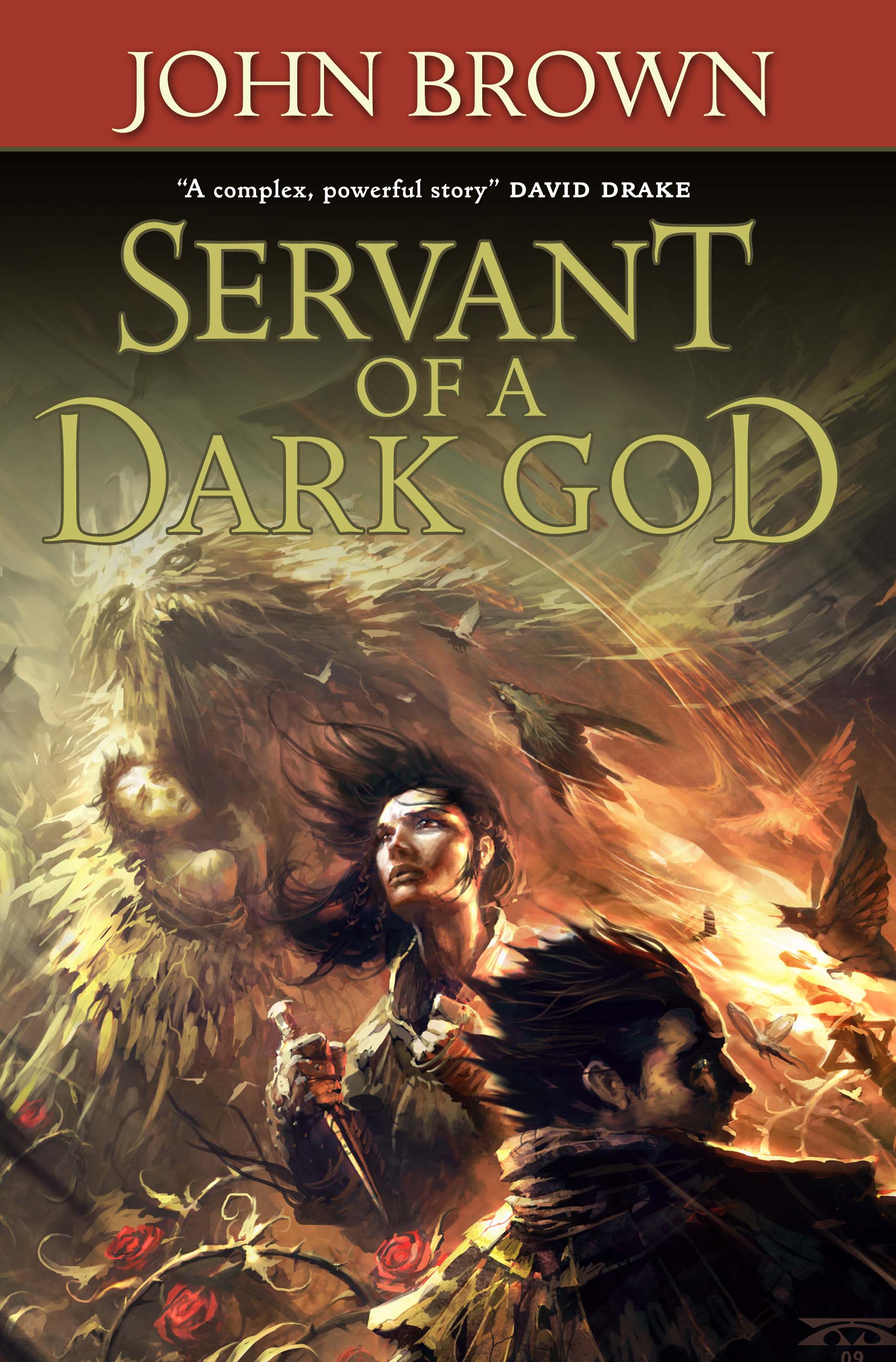
    servantdarkgod_comp

    I just got this from my editor. My first reaction was what?–No bronze brassiers, naked thighs, or gravity defying breasts?! I’m ruined! Then I remembered I’d given up writing books about bimbos with swords (alas, I really had some terrific mosquito scenes). 

    Folks, I think Swanland’s style is gorgeous, and I hope readers find this particular cover compelling. Click on it to see it full size. There are many things about this cover that I like, but one cool thing about the content of the illustration is that he worked in Sugar with the raveler. Those are, to date, my favorite weapons ever. In fact, Sugar herself looks, well, strong, beautiful, smart. Dang! Who wants to write about a bimbo when you’ve got a woman like that?

    (Of course, a bimbo with a sword could make a very good Legally Blonde meets Lord of the Rings. Humm. I’m tempted…)


    .

    Share

2 Comments

Comments are closed.