“From the Clay of His Heart” reprinted

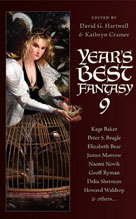
Cover_YearsBestFantasy9I loves me golem story. It was such a joy to write. Obviously, two editors found it a joy to read as well. So it was just reprinted in Year’s Best Fantasy 9 edited by David Hartwell and Kathryn Cramer and published by Tor.com.

The good thing is that there is a whole boatload of other great stories in this anthology including one of my favorites, Kij Johnson’s “26 Monkeys and the Abyss.”

Here’s the Amazon link.

Share

Similar Posts

  • Life, the Universe, & Everything

    For those interested I will be at the LTUE symposium at BYU all day Thursday, Feb 14th. I’ll be on the history and folklore panel at 10 AM, attending the Card workshops from 2 PM-4PM, and holding my own workshop–THE 3 THINGS YOU MUST LEARN TO WRITE KILLER STORIES–from 5PM-7PM.

    It’s Valentines, so bring your object of affection. (Yes, mannequins are allowed.)

    But what was I doing scheduling this on the love day to begin with? See, this is the one weakness of the male beast–he only remembers significant dates AFTER he commits himself foolishly.

    Share
  • Gollum was in my garden

    Four days ago I was on my hands and knees in the garden, muttering, “My ring. Where is it? Where is it!” 

    I could have been Bilbo out there among the tomatoes. I could have been Gollum—though I’d have to endure a long, worm-filled diet to play that role convincingly. 

    I’ve been married thirty-six years to a good woman. You’d think a wedding ring is just a ring. 

    But it isn’t. 

    Someone memed me Boromir holding up the ring on a chain and saying, “It is a strange fate that we should suffer so much fear and doubt over so small a thing.” 

    And I thought, how true! It makes me wonder if Tolkien ever lost his wedding ring. 

    For two days I searched the ground where I’d lost it—a long hedge of tomatoes and the sagebrush hill behind where I’d tossed split fruit. For two nights I went to bed feeling the absence on my hand, as if something vital had been taken from me. 

    Then, with the help of a Garrett ACE 250 metal detector I rented from a fine establishment in Logan, Utah, I found it. 

    It was just lying there in the open in a spot I’d checked half a dozen times. The detector beeped. And there it was. 

    My precious. My precious, precious reminder of thirty-six years with my admirable wife and our four wonderful daughters. It feels so good to have it back on my finger. 

    How strange that so many memories are wrapped up in so small a thing. It almost demands a new story about a magic ring. In fact, the experience might just influence the ending of ASSASSIN. That’s how writing works sometimes—life drops the ideas right in your tomato patch. 

    Speaking of ASSASSIN, it is coming along nicely. Ferran and company just turned a major corner with the help of a spunky kid in the city. And there’s an exciting scene coming up where all heck is about to break loose. 

    On another note, many of you have asked about GLORY, the fourth book in the Dark God series. It’s next in the queue. I’ll write that climax as soon as I finish ASSASSIN. I already have an opening, a rough outline, and plenty of notes—dogmen, dreadmen, Glories—the works. It’s coming, and I think the revelation of what’s really happening will surprise you. 

    Finally, I’m not dead yet, nor am I the fount of all wisdom, but I can say this: spend time with those you love, laugh with them, go on adventures. Because one day you’ll lose your ring—or some other small token bound up with all of it—and know exactly how precious those memories are. 

    Peace out, my fellow dreadmen and fell maidens. 

    Share
  • |

    The Pareto Principle, Form Follows Function, and Story

    There are a thousand things to “remember” when writing story. New writers who make lists of these things soon begin to drown in them. But I’ve come to realize that many of these “rules” don’t matter.

    They don’t matter because many ignore the function of story. And so you can’t know how and when to apply them, or if they’re even something you should apply in the first place. Furthermore, a good number that do tie back to function often have little impact.

    The more I develop and write, the more I begin to see that the key is to focus on a liminted number of fundamentals. To focus on the things that matter most.

    So what really matters when you’re writing a story?

    I’m going to be speaking for an hour at the Book Academy tomorrow. It’s at Utah Valley University. The week after I’ll be presenting all day at the American Fork Arts Council’s autumn writer’s conference. I will probably write up all my thoughts and post them to my site at some time.  But for right now this is where you can hear them.  

    I truly believe the Pareto Principle applies to writing. But you can’t go searching for those vital few factors until you know the effects they’re supposed to produce. Form follows function. And the function is something that happens in the reader.

    Here’s a nibble. This quote from David Howard is an example of what I’m talking about.

    “As we’ve seen, what the audience hopes for and what the characters hope for need not be the same thing. The same is true of our fears versus their fears. But how do hope and fear fit into the scheme of storytelling? Hope and fear are about the future. They derive from uncertaintly about future events in the story, future decisions the characters might make, future discoveries or revelations that might be unearthed, future outside forces and how they will influence the journey of the characters. When we discuss hope verusus fear in dramaturgical terms, this uncertainty is a function solely of the audience and its experience [my emphasis]. This is dramatic tension. We hope the man with the cobra in the shoe box won’t open the box; we fear he might and get himself or someone else bitten. We don’t know what will happen, but we know what might happen and therefore feel tension about those possibilities” (How to Build a Great Screenplay, 52).

    Readers buy novels because novels provide a service. They provide something to the reader. They DO something to the reader.  That’s why readers pay good money for them, and stay up late at night (well past smart bedtimes) with them, and spend hours of their lives reading them.  

    What do stories do? What are the key factors that have to be present in the stories for them to be able to do these things? How do you help readers hope and fear for what might happen?

    I’m no story guru, but I do hope to share some of the vital few factors I see in the presentations I’ll be giving this week and next.

    Share
  • Assassin is finished!

    On Wednesday, at 8:53 PM, I finished the first draft of Assassin. 

    It clocked in at just over 97,000 words, making it the biggest book in the Drovers series. Prey was 73,000 words, Outlaws 68,000, and Sura 84,000. 

    More importantly, Assassin finishes the story arc that began with Prey. I may return to Ferran and company for another arc in the future, but I wanted these books to have a real, satisfying ending. And now they have one, if only in first-draft form. 

    Nobody but me sees the first draft of what I write. For good reason. 

    I’ll let it sit for a week or two so I can come back to it cold and discover that I’ve changed people’s clothing mid-scene, used the word sit six times in three paragraphs, and committed other literary crimes. 

    Draft two goes to my beta readers, who report where they were excited, bored, confused, or questioned my grasp of reality. 

    Draft three addresses those issues and gets a thorough line edit, even though I’ve found the best way to discover spelling errors is to think you’ve found them all and then publish your book. At that point, the devils come out of hiding and begin dancing around on the page. 

    Dixon Leavitt, the artist who created the previous three covers, will be doing this one as well. 

    If all goes well, Assassin should be out for the holidays. 

    One of my favorite discoveries in the book was a lad named Weff. 

    I didn’t set out to write Weff. I didn’t know he existed. But I was up on the hill behind my house on one of my writing walks, walking and talking to myself about the story, when he suddenly appeared. 

    Broniss has streets paved with cobblestones, and the queen wants them kept clean. The problem is that horses, oxen, and other beasts have an unfortunate habit of leaving things behind. 

    So the city has children assigned to territories whose job is to keep those streets clear. 

    They’re called muck runners. 

    And Weff is one with an enterprising mind. 

    That’s one of the delights of writing for me. Sometimes you plan a character for months. Sometimes you’re walking along a dirt road talking to yourself and a manure boy shows up. And suddenly he must have a part in the tale. 

    While you’re waiting for the big wrap up, if you’re looking for an audiobook, I highly recommend Tim Curry’s reading of Garth Nix’s Sabriel. It’s a terrific fantasy to begin with, but Curry’s performance makes it even better. His rendition of Mogget is so enjoyable you may find yourself listening a second time. 

    If you’ve heard an audiobook performance you absolutely loved, tell me. I’m always looking for the next good listen. 

    Until next time, 

    John

    Share
  • |

    Lesson 8 finished

    If you write poopy-slow like me, you will finish 500-700 words of your draft in an hour. Let’s see what that means for various novel sizes.

    • 25,000 words: 50 hours
    • 50,000 words: 100 hours
    • 75,000 words: 150 hours
    • 100,000 words: 200 hours
    • 200,000 words: 400 hours

    And those requirements don’t count time you might need to spend re-imagining a piece or researching some gap in your knowledge or figuring out some knotty bit you couldn’t see was problematic when you first set out. A novel can be a big project and stretch over a few weeks, especially when you don’t have eight hours a day to write.

    In this lesson, you will learn that you need to treat the draft like what it is–a project–and use basic project management techniques to help you get the work done.

    Share