Everyone says you cannot copyedit your own work.
You’re an idiot if you try.
Because you’re mind auto-corrects eorrs, and fills in missing punctuation or words like “of” “the” and “a”. And often doesn’t care or know the house rules for capitalization. Etc.
(Did you catch all the errors in that paragraph?)
Except the brains of copy editors play this trick as well. That’s why some read the manuscript backward and others use arcane WordText code to suss out issues. And some change the font face. And some make multiple passes over a section, looking for dialogue issues the first time through, capitalization the next, and something else the third time. And despite all their work, you still find errors in the text.
I’m not saying editors aren’t any good. I’m just saying that our brains, for the most part, don’t care about the details. They just care about the communication, and they’re very good at ignoring the rubbish. And when it’s just the brain and the eye working together, the brain makes sense of the text, even when something’s wrong or missing.
So one trick to force the brain to see what’s actually on the page is to read your text out loud to yourself. It’s an excellent practice, except a human brain is still involved, and it sometimes still plays tricks. And sometimes we get lazy and start to read too quickly, and the next thing you know we’re subvocalizing and whipping along, missing all sorts of stuff.
So what can you do?
Well, a few book releases ago, I stumbled onto something. I invited an electric lady to help. And she was dynamite. (You can invite a man if you prefer the sound of those voices.)
I’m talking about inviting your computer to read aloud every word of your manuscript to you. And highlight the words as it goes.
I can tell you I’m never going back. These ladies have simply helped me see too many errors that were invisible to me and my beta readers who had editorial chops.
I use WordTalk, a free plugin for Microsoft Word for this kind of reading. The University of Edinburgh created it to help kids learn how to read. It allows you to select from the text-to-speech voices you have on your computer, set the reading rate, and it highlights the word it’s reading so you immediately see where the error is.
I set it at a slightly faster reading speed so my mind cannot wander during the reading and use the quick keys so I can start and stop and make my edits easily. And I always, always, always have my electric friend re-read any fixes I make because I can’t tell you how many times I’ve adjusted a sentence or paragraph and introduced more errors that I didn’t see, even though they were staring me in the face.
I must admit that the electric ladies can’t do everything. Having them read to you cannot help you spot errors you don’t know are errors in the first place. If you don’t know, for example, the conventions for capitalization of personal titles or the conventions for numbers (is it a “.44mm” gun or “forty-four millimeter”?) If you don’t have your own house rules for the many areas where you have a choice like in an epic fantasy (do you use “Dreadman” or “dreadman”?) If you don’t know any of that, you’ll blithely skip over a host of errors and only see the issues you know like the misuses of “rise” and “raise” or “lie” and “lay.”
So you have to learn the conventions or find someone who does (an editor). Or both.
Also, doing this type of reading will not help you see if what you’ve written is actually translating the scene in your head clearly and vividly to the page for someone new to your story. Only a fresh set of eyes can tell you where your story isn’t clear, believable, or interesting (at least to that one reader).
But for helping you spot the issues you do know, I haven’t found anything better. Give it a try.
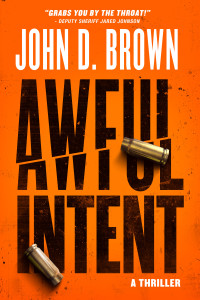
Oh, and the update on Awful Intent–Zira and I are almost finished with the copy edit! Which means the release is only days away.