|

Update and Shapechanger’s Wife

Assassin is moving along. I’m heading into the last quarter of the book, which is where the fireworks start. I appreciate all of you who have been so patient. My goal is to end this arc of the series with a bang. 

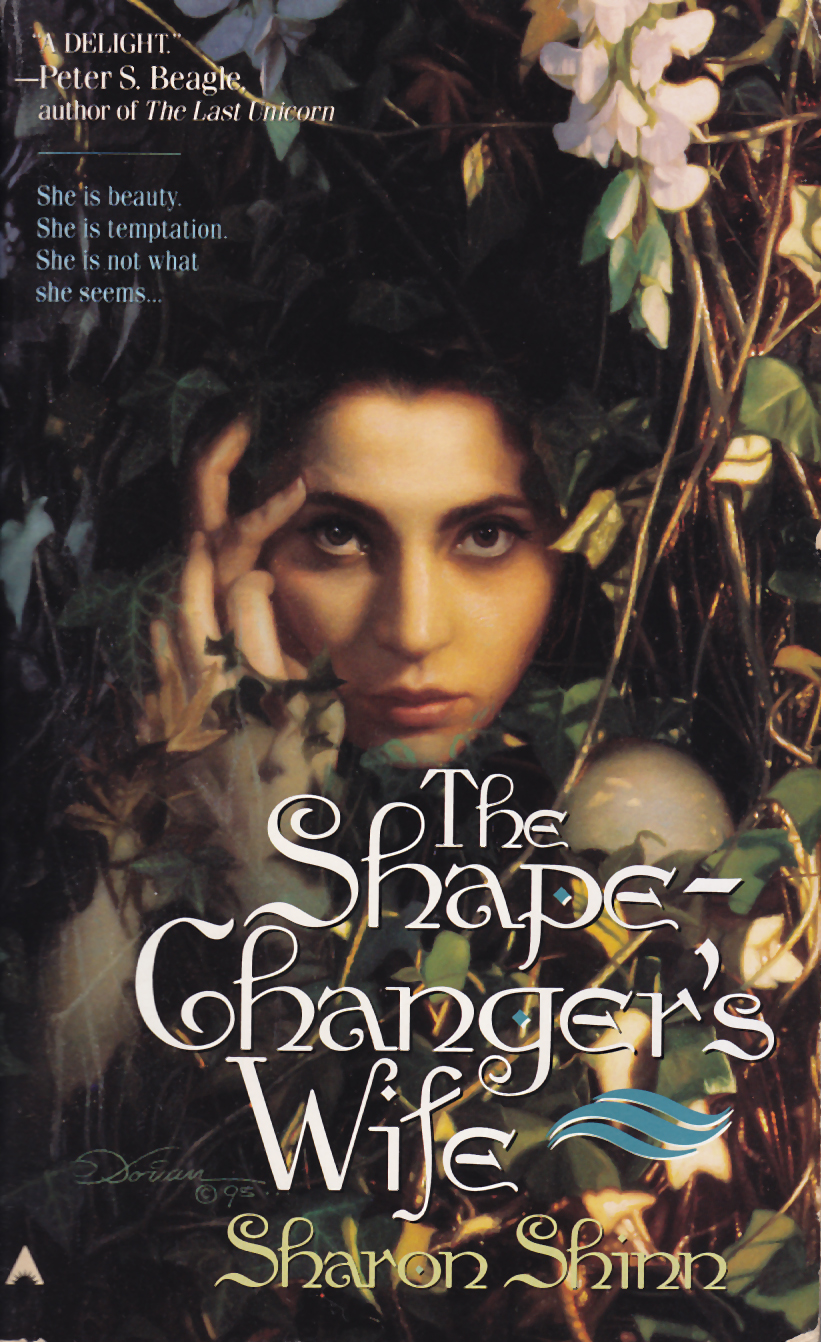
In the meantime, I’d like to recommend a fantasy novel. I enjoyed it many years ago and recently reread it, finding myself swept away with as much intrigue and delight as the first time. 

It’s The Shapechanger’s Wife by Sharon Shinn. 

The story follows an aspiring wizard named Aubrey who is nearing the end of his training. He asks his mentor, the wizard Cyril, to teach him transmogrification—the art of changing form—but Cyril refuses. Aubrey protests. Cyril knows the spells. He has cast them himself. Still, he refuses. 

Eventually, however, Cyril’s conscience gets the better of him. A well-rounded wizard should know every branch of magic, even the ones Cyril dislikes. So he writes to another wizard, a shape-changer named Glyrenden, and asks if he will take Aubrey as a student. Glyrenden agrees. 

As Aubrey sets off, Cyril gives him a warning: “Learn everything he teaches you so well you can cast his own spells back at him. Glyrenden respects only those stronger than he is, and those he hates. If you cannot beat him, he will destroy you.” 

And so begins the tale. 

There’s mystery, wonder, betrayal, loss, battle, and even love. Best of all, it’s a complete stand-alone novel, a rarity these days. 

If you’re hankering for a fantasy adventure that can be read in one volume, I think you’ll be very pleased with this one. 

Happy reading,  

John 

Share

Similar Posts

  • Assassin is finished!

    On Wednesday, at 8:53 PM, I finished the first draft of Assassin. 

    It clocked in at just over 97,000 words, making it the biggest book in the Drovers series. Prey was 73,000 words, Outlaws 68,000, and Sura 84,000. 

    More importantly, Assassin finishes the story arc that began with Prey. I may return to Ferran and company for another arc in the future, but I wanted these books to have a real, satisfying ending. And now they have one, if only in first-draft form. 

    Nobody but me sees the first draft of what I write. For good reason. 

    I’ll let it sit for a week or two so I can come back to it cold and discover that I’ve changed people’s clothing mid-scene, used the word sit six times in three paragraphs, and committed other literary crimes. 

    Draft two goes to my beta readers, who report where they were excited, bored, confused, or questioned my grasp of reality. 

    Draft three addresses those issues and gets a thorough line edit, even though I’ve found the best way to discover spelling errors is to think you’ve found them all and then publish your book. At that point, the devils come out of hiding and begin dancing around on the page. 

    Dixon Leavitt, the artist who created the previous three covers, will be doing this one as well. 

    If all goes well, Assassin should be out for the holidays. 

    One of my favorite discoveries in the book was a lad named Weff. 

    I didn’t set out to write Weff. I didn’t know he existed. But I was up on the hill behind my house on one of my writing walks, walking and talking to myself about the story, when he suddenly appeared. 

    Broniss has streets paved with cobblestones, and the queen wants them kept clean. The problem is that horses, oxen, and other beasts have an unfortunate habit of leaving things behind. 

    So the city has children assigned to territories whose job is to keep those streets clear. 

    They’re called muck runners. 

    And Weff is one with an enterprising mind. 

    That’s one of the delights of writing for me. Sometimes you plan a character for months. Sometimes you’re walking along a dirt road talking to yourself and a manure boy shows up. And suddenly he must have a part in the tale. 

    While you’re waiting for the big wrap up, if you’re looking for an audiobook, I highly recommend Tim Curry’s reading of Garth Nix’s Sabriel. It’s a terrific fantasy to begin with, but Curry’s performance makes it even better. His rendition of Mogget is so enjoyable you may find yourself listening a second time. 

    If you’ve heard an audiobook performance you absolutely loved, tell me. I’m always looking for the next good listen. 

    Until next time, 

    John

    Share
  • Where in the Sam Hill is Curse of a Dark God?!

    Because of so many reader requests, I think it’s time to explain.

    Alas, I must report that she ran off with a no-good tramp. I’m sure she’s realized her error. Either way, I’ve formed a posse. We’re hunting her down.

    That’s the true story. For those that want the boring press release that obscures the facts, you may read what follows.

    The first draft of Curse of a Dark God was delivered to the editor in August of 2009, two months before Servant of a Dark God was released. That draft had some issues with a few of the story lines. These issues crept (they did not run or slouch) into the text because the author, stressed about an aggressive deadline, decided to adopt the fix-it-when-you-finish-just-get-er-done-you’ve-got-a-freaking-deadline methodology of writing.

    But a book of 230,000 words is a big old momma. And if something in a beginning chapter is off, it wankers a whole heck of a lot of story that follows, much like a line of dominoes. But it’s not just one story line. This book had multiple interconnected story lines. So issues in one line rippled out into others. What this meant was that the changes that needed to be made weren’t wee things that could be dealt with in a few weeks. When the dust settled, it was clear the book required a substantial rewrite, even though the draft contained gobs of cool story.

    So much for that fix-it-later experiment. You can be sure the author won’t be using that on large books again.

    So the author wrote another draft of 245,000 words and delivered it in August of 2010. The story rocked. Unfortunately, there was a miscommunication on size (and there’s no use in having a drama about what was said and who was at fault and why fairies are always tiny hot chicks; despite our best efforts, life is full of bumps; the best thing to do is learn from them and move forward). The book actually needed to be in the 170,000 – 180,000 word range. Same as Servant of a Dark God.

    In a 10% edit, you’re tightening a story, cutting out the fluff. In an edit designed to reduce the book by 30% or more, you’re cutting off arms and legs and removing things like livers. The story can’t survive such cuts unless the thing was obese to begin with and just needed to go on a diet. Unfortunately, Curse of a Dark God draft 3 was fairly lean, given the amount of story it contained. It was NOT a candidate for Biggest Loser.

    The upshot is this third draft is going to be another major rewrite. Which means, given publishing lead times, that it’s going to take a number of months to get it on the shelves.

    (fricken, ricken, grumble, frag a friggen nack)

    Because I’m just starting on the outline, we don’t have a delivery date yet. As soon as we do, I’ll post it.

    I apologize to all of you expectantly looking forward to the next book. When I started this series, I promised myself that I would not leave my readers hanging. I was determined that my books would come out in a timely fashion. And I have been working like a devil to do just that, but sometimes things happen. What I can promise you is that this draft will go quickly. Furthermore, I already have book 3 outlined. It should go quickly as well.

    I know some of you are asking why? Why, the word limit? Aren’t there are plenty of monster books out there?

    There are. In fact, about half of Robert Jordan’s Wheel of Time books are roughly the length of draft 3. Publishers do sell fat books. However, the bigger the book, the harder it is to make it profitable.

    First, bigger books cost more. There’s the cost of the additional paper and editing, but there’s also the extra money to ship and store.

    Second, you can’t put as many copies out in the stores. You can’t because they take up more of the space that might be allotted to an individual book. So instead of being able to have stores stock four or five copies of a 120k novel, they can only stock two or three of a big old momma in that same space.

    Third, bigger books cost you, dear reader, more money. Sure, the publisher might eat some of the additional costs, but some of those costs will be passed onto you.

    So because of the increase in cost, the publisher needs to sell more copies; however, the limit on display space and the higher price make it harder to sell those additional copies and actually may lead to selling fewer copies.

    Do you see the bind?

    This doesn’t mean big books can’t be profitable. It just means that it’s not as easy. It’s a bigger risk. Part of me would want the publisher to take that risk. But the other part of me knows that slow and steady usually wins the race. Neither I nor the publisher want to gamble the long-term viability of the Dark God series. Now, if Tor was doing this all in paperback, this might not be such a big issue. But we’ve got the sweet hardback/paperback deal. And business projections have to be done in that world.

    So the short of it is that we’ve run into some business limitations, and it’s going to take me a bit more time to deliver.

    I wish I could announce a date at this time, but I can’t. I’ll finish up the outline for this draft and run that by the publisher around Christmas. Then it’s back to work. I promise that what you’ll get will be my best. And that’s what you want, anyway, even if it takes a bit longer to get it into your hands.

    Share
  • Book Academy schedule

    Thursday, September 30, 2010.

    All day writer’s conference at UVU in Orem, UT.

    Folks, this looks like it’s going to be an excellent seminar. Larry Gun-Crazy Correia will be there as well as Brandon Mull, Jeff Savage, Traci Hunter Abrahamson, Rob Wells, and a whole bunch of other great authors. You can see who will be doing what and where right here: Book Academy Agenda 2010 PDF. More details on the Calendar.

    You can find registration information on the Book Academy site.

    Share
  • My LTUE schedule

    Folks, I love LTUE. Love it. Alas, I will only be able to attend Friday. But I can’t wait to listen, present, meet new folks, and catch up with old friends. If you’re a writer in the area–whatever genre it doesn’t matter–you’re going to want to come. Link out to the site to see all the authors that are going to be there. Here’s my schedule.

    Date & Time Event Type Area Notes
    Thursday – Saturday, Februrary 17 – 19, 2011 Science Fiction & Fantasy & Writing convention Provo, UT Life the Universe & Everything held at BYU. It runs Thursday – Saturay, the 17th-19th. I’ll only be able to attend on Friday this year.  This is where SF&F authors, scholars, and fans gather and discuss the genre, writing, and have a whole bunch of fun. Details on the LTUE site. I will be presenting. See the rows below for details. 

    Romance vs. Story with Romantic Elements: Injecting romance into saving the world

    • Panel 
    • John Brown,  Ami Chopine, Stacy Whitman, Lynn Kurland
    • FRIDAY: 12 pm – 1 pm

    Plotstorming from Character: In some cases the plot of a book drives the characters. However, characters that instead drive the plot can make for a more compelling story. In this hour, we focus on how to grow your plot from your main characters.

    • Presentation
    • Paul Genesse (I want to hear what Paul has to say, I think this will be interesting)
    • FRIDAY: 3 PM – 4 PM

    Lessons on Story from THE HUNGER GAMES (and let me tell you, there are a lot of good lessons)

    • Presentation
    • John Brown
    • FRIDAY: 6 PM – 7 PM

    How to Get and Develop Killer Story Ideas

    • Workshop 
    • John Brown & Larry Correia (oh, yeah–it’s the dynamic duo)
    • FRIDAY: 7 PM – 8 PM

    EDIT 2/7/2011 9:45 PM: Scheduled has changed. The session on Hunger Games moved up an hour. And the story idea session moved back from 10 AM to 7 PM.

    Share
  • |

    Learn plot, character, scene, and more this Saturday, Oct 9!

    All you Utah and mountain area writers & teachers, or those close enough to travel, I will be presenting and conducting workshops from 9:00 am until 4:30 pm this Saturday, Oct 9th as part of the Autumn Writers Conference sponsored by the American Fork Arts Council and the National Endowment for the Arts.

    The sessions I’ll conduct include:

    • Finding and Working With an Agent
    • How to Write a Story That Rocks: First Principles & Story Concept
    • Creating Characters that Rock
    • Plot
    • Writing Scenes: The Basic Units of a Novel

    There are four other tracks. Find all the details, including cost and contact info, on the organizer’s site: CalebWarnock.blogspot.com. I’m totally stoked for this. I’ll be sharing what I think are the Pareto factors in each of these areas — things I wish I would have known when I started and would have shaved years off my journey to publication.

    A number of other authors will be there including:

    • Annette Lyon (women’s fiction and a new cook book called Chocolate Never Faileth)
    • Josi Kilpack (mystery and suspense)
    • LeAnne Tolley (health and wellness)
    • Scott Livingston (poetry)
    • Caleb Warnock (self-sufficiency)
    • Loraine Scott (mystery)
    Share

Leave a Reply

Your email address will not be published. Required fields are marked *

This site uses Akismet to reduce spam. Learn how your comment data is processed.