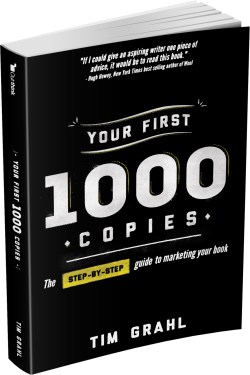
Indie Thoughts: Your First 1000 Copies by Tim Grahl

Your First 1000 copies by Tim GrahlDo you know what’s awesome about Your First 1,000 Copies by Tim Grahl?

He bases his advice on tests. Tests he’s performed with other authors and tests he’s performed with his own book.

For example, what’s more effective: advertising and posting our on places like Facebook and Twitter or a mailing list? Do authors really need to have a social presence? Or is that a bunch of bunk?

Tim has tested this question and shares what he’s found.

What about marketing? What’s the best approach to take to win new customers?

I think you’ll find his answer surprising. As a side note, I have to say I find his definition of marketing more insightful and practical than any I’ve come across. And I got a business degree!

How do you set up mailing lists and which ones should you use?

Tim tells you.

What should you blog about?

Tim shares his front-line insights.

What’s the quickest way to find new customers?

Tim discusses that as well. And it’s all put together in his framework or system he calls “Permission, Content, Outreach, Sell.”

If you’re an indie author, I think you’ll want to hear what Tim has to say. There are three books on indie publishing that I’ve found super useful. Your First 1,000 Copies by Tim Grahl is one of them.

Share

Similar Posts

  • When the workshop works

    From a workshop participant at MountainCon:

    I’m going to give a shout out to all the goodness I experienced. So if you don’t really care what happened at the con, you can stop after this paragraph and take this message away with you: Brandon Sanderson (who does Writing Excuses, has published several novels, and is the chosen one to finish Jordan’s Wheel of Time series) and John Brown (with a must buy novel coming up next year) are incredible teachers. If you ever get a chance to attend a class or workshop by any of them, don’t let it pass.

    We loves to hear these things, Precious.

    But we loves it just as much when we can make the students shiver with excitement: more here: http://www.amichopine.com/blog/?p=318

    To those who missed this run of the 3 Things You Must Learn to Write Killer Stories Workshop, know I’ll be holding it again. Check back to see when.

    Share
  • Orson Scott Card’s Literary Boot Camp

    If you want to learn how to write stories that move and entertain, you will do whatever it takes–crawl across broken glass, mortgage your dog, eat brown bananas–to get into Card’s week-long, literary boot camp. 

    This is the workshop that changed everything for me. And while Card will say it had nothing to do with him, he’s just trying to keep his head from bloating and making it so he can’t walk straight. I’ve spent almost the last 20 years in some form of teaching. Card’s workshop employs all the key principles that make it a killer environment for learning complex cognitive skills, i.e. writing fiction. And this  year it’s in San Diego.

    Apply! Do not delay! 

    Share
  • Advice to new writers

    Recently a fellow writer brought up this post by author Kameron Hurley. He has a lot of interesting things to say (and some cool covers in his sidebar). A Steve Martin quote features prominently: “Be so good they can’t ignore you.”

    That sounds like excellent advice, doesn’t it?

    Until you start to think about it.

    Are there authors out there who strive to be just okay? That set goals to be mediocre?

    “Marge, keep the kids away! Bring me no lunch. Because today, do or die, I am determined to write a middling tale about lukewarm characters with a so-so plot!”

    !?

    I believe our writer of measley aspirations just might just be a strawman.

    Be good enough they can’t ignore you, Martin says.

    Wow, sounds good. Except let’s test it out. Let’s take some of the least-ignored authors of our day.

    For millions of readers J. K. Rowling is NOT a great writer. And neither is Harper Lee. Or Steven King. Or Orson Card. Or Brandon Sanderson. Or Lee Child. Or Nora Roberts. Or whomever. Insert whom you will–the vast majority of the reading public ignores or eschews them.

    The vast majority of the reading public is not moved by them in the least.

    Stephenie Meyer is a great writer for some. She gave them such a moving experience they dress up and relive it all at balls. She’s a horrible writer for others. Most people haven’t read her or gone to see her movies.

    The Bible is THE most life-changing, most moving book that millions have read. For others it’s a piece of trash.

    It seems that following Martin’s advice is a really good way to lose a lot of time galavanting after shrubberies only to then have your throat ripped out by the Rabbit of Caerbannog.

    Woe is me, for I should have stayed home with my lovely wench and lovely children and eaten more peas and read about sparrows. Zounds, but the blood my mother gavest me, at nine-month cost, now flows silently onto the sterile rocks. . .

    You can create great product, stuff made with extraordinary skill, and still not be Great because you’re earth-shattering stuff speaks to and shatters only a small portion of readers.

    I say forget greatness!

    Just sing. And revel in the singing. And the new songs your voice can carry as your skill grows. And share that reveling with all who enjoy such singing.

    Because it’s not about greatness. It’s about the song.

    And then go home and enjoy the laughter and coversation of the woman/man at your hearth, the children/cats at your feet, and the lovely taste of the fresh green peas.

    (Dear me, I believe I just equated children with cats. And yet, does it not sound just right?)

    John, you ask, what about goals? What about being all you can be? Are you saying it’s okay to schlub your way through life and writing?

    You must choose your own path. But I would never say don’t have goals. Nor would I say don’t try to write the best book possible . . . for the particular type of story you’re trying to tell.

    I think we all benefit by singing our types of songs to the very best of our ability and then trying to enlarge that ability as much as we can.

    That generates more joy in the giver and the receiver.

    But the quest to be Great so some amorphous “they” (who is they?) can’t ignore you seems foolish. It disregards the idea that it’s impossible to write great books for all audiences. But that’s not its only problem. It also seems to be all about the writer, and not the sharing. Me-me-me is, ultimately, such a hollow prize.

    It seems to me that it’s so much better to quest after singing, not to be noticed, but to deliver a service that I and the reciever can both rejoice in together. And then to increase that joy.

    Share
  • The Novel Writers Academy – Do you want it?

    Are you tired of being educated ABOUT writing?

    Do you just want someone who knows what they’re doing help you do it?  

    Specifically, do you want to develop a killer story idea, outline it, and write the first 3 chapters with the guidance of a pro?

    If so, then here’s your chance to vote to have me create a course that will do just that. 

    Read on for more information…

    Educating versus Training

    When you’re educated about something, you can talk about concepts and principles. You can recall facts. But most people I know don’t want to be educated about writing. They want more than another class, podcast, video, or book about the topic.

    They want to be trained.

    They want to develop a killer idea, sketch it out, and actually begin writing. Not just watch or read about it. But they want some help.

    I’ve been asked many times if I would teach an online class or workshop, but I’ve put it off for years because I know that I don’t want to offer just another set of videos about writing.

    Of course, I will offer just videos. That’s all some people want.

    But I know there are others out there who want to go beyond that. They want on-the-job training. They want to develop a fun story, but don’t know the process well enough, and want someone who knows it to guide them.

    They want training.

    But training takes time. More than the time it takes to create videos or posts.

    That’s what I do, by the way. When I’m not writing novels, I work in corporate America training people to actually do things. Over the last 20 years I’ve trained people to do everything from give compelling presentations and speak Dutch to plan and schedule manufacturing plants and close their accounting books at the end of a financial period.

    And so I know there’s a difference between being educated about something and being trained.

    Just think about it. Do you want a surgeon who has been educated about surgery or one that’s been trained to perform surgery at a mastery level? Do you want a plumber who has been educated about plumbing, or one that’s been trained to plumb? Do you want your airplane pilot to be educated about flying or trained to fly, in all sorts of weather?

    Going to school and being educated is cool, awesome, and necessary. But we all know we have to go beyond that. We need to be able to actually DO things. Training requires you know concepts and principles, but it also requires you take the next step and actually do something.

    Do You Want Training?

    I’m willing to provide this on-the-job training, but before I develop and conduct this course, I need to know enough people are interested in it for it to be worth my time (it would probably be more sensible for me to focus exclusively on getting the books I need to write out the door, but I love to teach too, and had to figure out a way to do it).

    So here’s the test. If you want to take the class described below, sign up to express your interest.

    This does not obligate you to anything. It simply says that you are almost 100% sure you want to take the class, barring earthquakes, plagues of demons, or crazy in-laws.
    When enough people signup, I know it will be worth my time, and the love of teaching part of me will be able to convince the sensible part of me to do it.

    And then I’ll do a Kickstarter to make it official. Or I may just develop and release. We shall see.

    So, here’s more on the course.

    Your Novel’s Core: Develop a Killer Idea, Outline it, and Write the First 3 Chapters

    The first order of business is to determine if this course is right for you.

    Do you want to write a novel, but feel like you have no idea what you’re doing?

    Do you often get ideas for a character or setting or snippets of scenes and dialogue, but find they just never go anywhere?

    Are you tired of learning about writing, and just want someone who knows what they’re doing help you to do it?

    If so, this class is for you.

    This is not a theory class. Oh, we’ll talk about theory. You’re going to learn a ton of theory. But this isn’t about theory because I don’t care about theory. And neither, I suspect, do you. I care about developing an awesome story experience and sharing it with readers who enjoy it as much as I do.

    So I’m not interested in talking about it. I’m interested in doing it. And having fun.

    Which means that in this course you’re going to:

    • Develop at least 10 story ideas that beg you to write them
    • Select one of those ideas and create an outline
    • Write the first three chapters of that novel

    In order to do that, you will need to learn the secrets to:

    • A story idea that works and how to come up with one
    • Interesting characters and how to develop one
    • Transporting your reader to the story so they feel like they are witnessing the whole thing
    • Keeping readers on the edge of their seats
    • What story and plot are really about
    • Writers block and why it’s a gift (no, really, it is)
    • Knowing what comes next
    • Getting feedback from beta readers that’s actually helpful (and if you don’t know this, much of what you’ll get will be worthless)

    These secrets and many more. But remember: this isn’t a course about secrets. It’s a course about you actually improving your ability to generate story ideas, develop them into ideas worthy of a novel, and then write them.

    This means you need to not only produce, but also have someone who has the ability look at your work and guide you along. It means getting feedback.

    So I will be there helping you every step of the way. And if you’re writing in a genre I don’t know as well, I will loop in working authors who are successful in that genre to add their two cents.

    Fumbling in the Dark

    I started my novel writing career when I received a three-book, $50,000 deal from a major publisher. I am now an indie author with books that sell thousands of copies each year to readers all over the world. I’ve had publishers purchase and produce my books in audio. I’ve sold story rights to foreign publishers. I love developing and telling stories. And I love teaching others how to do the same.

    But when I started, years before that novel contract, I had no idea what I was doing. I didn’t know where to start stories, how to develop them, or even where they were supposed to end. And I didn’t have anyone to really help me. In fact, I remember asking one of my creative writing professors after class how you knew where to end your story. He looked at me, shrugged, and said, “I don’t know. I just end them.”

    What the heck?

    It was all a vast mystery. I loved stories, but I was clueless about what they were, how they worked, and how someone went about developing and writing one. I had a lot of fun, enjoyed my writing teachers (they were all great people), but I was never able to write something that hung together and felt like something you’d see in a movie or read in a book.

    But that didn’t discourage me. I kept at it. And over the years, I made a number of breakthroughs.

    What I discovered was that there are three things you must learn to write killer stories. You must learn:

    • What stories do to the reader
    • How they do that
    • And effective techniques for both developing and telling the story

    In this class, you’re going to learn those three things and the key principles for each, saving yourself all the frustration and discouragement that comes from trying to discover these insights by stumbling around on your own in the dark. With this class, you can cut years off the time it takes to learn how to write.

    When you know these three things, you will be able to write stories on purpose, instead of by accident. You will have power over your craft.

    You will see that instead of trying to remember a list of hundreds of “writing rules” or use “writing formulas,” many of which are nonsense, you’ll write by focusing on the simple and fundamental heart of what storytelling is all about.

    Course Outline and Price

    Below is a more detailed view of the course. My lessons are called quests because I’m expecting you to actually do something, not just watch.

    Quest 1: Discover what stories do, then create your personal story profile

    • The three things you must learn to write killer stories
    • Your personal story type
    • The three main reader responses you must generate
    • The big secret: trigger and delay
    • Genre
    • Sensitizing yourself

    Quest 2: Discover what you need at the core of your story, then perform a craft analysis of 2 of your favorite novels and report your findings

    • The story engine (without this, your story goes nowhere)
    • What makes characters interesting
    • The vital THOMR
    • The desire to gain or retain something specific
    • Formidable obstacles
    • Uncertainty
    • Surprise
    • The same but different
    • The 3 grunts

    Quest 3: Discover the secret to developing ideas, then develop 10 fully-formed story ideas that beg to be written

    • The 4 main creative principles you must follow
    • 5 super productive techniques for generating ideas
    • Creating a schedule and goals
    • Using the story engine job aid
    • Using the setting job aid
    • Using the magic job aid
    • Using the world building job aid
    • Using the character job aid
    • Using the formidable obstacle job aid

    Quest 4: Discover how to figure out what comes next, then develop your story sketch (outline)

    • The number of scenes for your story
    • The story cycle
    • Story turns
    • Trigger and delay
    • Structure, and why structure models so often fail to help

    Quest 5: Discover how to transport your reader to the story, then write your first three chapters

    • Techniques for telling your story so it’s vivid and clear
    • Narrative summary versus narrative detail and when to use  each
    • Effective description
    • Writing point of view, hot and cold
    • Orienting the reader
    • Transitions

    Quest 6: Discover the three main effects you should read for, then deliver a reader report for the first chapters of seven different novels

    • The 3 grunts (the secret that allows you to learn from other novels)
    • Reader report rules
    • How to get feedback for the rest of your project

    Quest 7: Discover your next steps, then create a plan

    • Methods to write quickly
    • What you need to do to publish independently
    • What you need to do to publish with a traditional publisher

    As you can see, in this course you aren’t going to just hear someone go on about theory. You’re going to define your type of story, surprise yourself by developing at least 10 solid story ideas that beg to be written (by you). Then you’ll select one of those ideas, sketch an outline, and write the first three chapters, all under my guidance, using the same practical, simple methods I use.

    Most important of all, you’ll actually stop thinking about writing and be well on your way to finishing your novel with a clear path to the end.

    Instead of dreaming about someday, you’ll enjoy the excitement of writing a novel right now.

    The cost of the course depends on what you want:

    • Access to all of the videos: $199
    • Access to all of the videos and two rounds of coaching on your story idea, outline, and first three chapters $399

    Not for everyone

    Having said that, you need to know that this class is not for everyone. If you are not willing to actually make time to do the work I ask, you will find no benefit.

    How much time will you need to spend?

    With all of the videos, reading, and development you’ll do, you should expect to take 30-40 hours. You can move through it at your own pace, but I strongly suggest you spend at least five hours per week. Any less than that, and you’re going to find it very difficult to keep your creativity hot enough to make dinner.

    Also, if possible, I recommend you take the course with a friend. You will progress so much more quickly when you discuss the lessons and insights and bounce your ideas off of each other.

    If you want to just watch the videos, that’s perfectly fine. If you want to actually develop a story and learn on the job, then you have to make time to do this awesome thing, just as you would if you wanted to learn how to dance, quilt, race cars, rappel, or paraglide.

    So if you aren’t in a position to make the time, I understand. Please don’t sign up.

    But if you’re interested, then click below to raise your hand as someone who is definitely interested. Once I see there are enough people interested, you’ll get the class.

    Yes, I’m definitely interested!

    If you’re interested, let me know by filling out the form below.

    This does not obligate you to anything. It simply says that you are almost 100% sure you want to take the class, barring earthquakes, plagues of demons, or crazy in-laws.

    * indicates required


    Share
  • Can authors make a living?

    A lot of folks hear I’m going to be published and automatically classify me with J.K. Rowling, James Patterson, or Dan Brown. Heck, I at least ought to be categorized with Joe Schmo who was featured on Oprah.

    And why shouldn’t they think that? Those are the authors they see. That’s what it means to them to be published.

    For those of us who have actually gotten a peek behind the curtain, we realize it just ain’t so. Those are best-selling authors. See my post on best sellers to understand the quantities that have to move to make a best seller. Those are huge numbers, but very few authors sell that many books.

    So what do you need to sell to make a living?  Let’s do some math.

    Let’s say you want to make $50,000, the median household income in the US at this time. I know, I know, that’s nothing in some places, but if you’re a writer you don’t have to live in San Francisco. So you want to take home $50k after taxes. That means you’ll probably need to make $62,000 before taxes. That’s our goal.  

    So here are some numbers with conservative royalties.

    What authors make on a paperback
    8% royalty (authors usually make 8 – 12 % on paperbacks)
    15% agent fee
    6.8% net royalty rate

    To net $50k with only PAPERBACK sales would you need:
    $911,765 in sales required in the year
    $7.99 per book
    114,113 books sold

    What authors make on a hardback
    10% royalty (it’s common to make 10-15%)
    15% agent fee
    8.5% net royalty rate

    To net $50k with only HARDBACK sales would you need:
    $729,412 in sales in the year
    $25.00 per book
    29,176 books sold

    If you have previous books that are still selling, they all count. Make foreign sales, they count. Can produce two books per year, maybe one in a different genre, they count. Of course, this doesn’t factor in discounts and the corresponding reduced royalty rates. Nor does it factor in costs of being in business for yourself, including taxes, insurance, etc. But this is enough to get a rough idea of numbers.

    100,000 paperbacks is a BIG number. However, you usually mix and match.

    Let’s say you sell 5,000 hardbacks. 5,000 x $25.00 = $125,000. $125,000 x .085 net royalty = $10,625. $62,000 – $10,625 = $51,375 to be made by the paperbacks when they come out the next year. At a 6.8% net royalty rate you have to make $755,515 or sell about 94,558 paperback copies.

    Here it is in an easy to read list. Given the hardback sales shown below, you’d have to make up the rest of the $62,000 with the paperback sales on the right.

    5,000 HB: 94,558 PB
    10,000 HB: 75,002 PB
    15,000 HB: 55,446 PB
    20,000 HB: 35,890 PB

    I know those seem like small numbers compared to the Publisher’s Weekly 2007 numbers I link to above. But most authors don’t sell that many books. Most authors are happy to sell 5,000 hardbacks.

    But it’s not all bad news. I looked at a few authors on the PW list comparing hardback and paperback numbers. It seems any given author will sell twice the number of paperbacks that they do hardbacks.  So perhaps selling somewhere between 15,000 to 20,000 hardbacks is the magic number.

    20,000 hardbacks is a lot. But it seems doable for a writer who has been publishing for a few years. It’s not the 700,000 of  a James Patterson. But it just might be enough to make, hold your breath, what the average household in America makes in a year.

    Share
  • Generating Story 9: Creative Q&A with Author Ian Creasey

    So how do writers use questions in their story development? Let’s hear first from Ian Creasey, whose short fiction has appeared in magazines such as Asimov’s, Realms of Fantasy and Weird Tales, and has been reprinted in several Year’s Best SF anthologies.  His excellent collection Maps of the Edge was published last year. 

    Stories Are Made Of Scenes

     by Ian Creasey

    I’d like to begin by thanking John for the opportunity to write a guest post about the technique of using questions to help create stories.  This is not a “where do you get your ideas?” post.  Rather, it assumes that you already have a basic idea, which you want to develop into a complete story.

    I’ll use one of my own stories to illustrate how the question technique works in practice.  The questions themselves are sufficiently general that they can be applied across a whole range of stories.  What tends to change is the order in which they are asked.  I find that stories sometimes start from an idea for a specific detail, in which case the process involves working backwards to develop the appropriate context.  In other cases, the initial idea is rather abstract, and the task is to flesh out the premise with sufficient detail.

    My example story is “The Report of a Doubtful Creature”, which was published in Orson Scott Card’s InterGalactic Medicine Show (November 2009).  I mention the publication date, because this was actually the seed for the story.  The year 2009 marked the bicentenary of Charles Darwin’s birth, and also the 150th anniversary of the publication of Origin of Species.  I live near the Yorkshire town of Ilkley, which Charles Darwin visited just before the first edition of Origin was published.  I therefore decided to write a story about Darwin’s visit to Ilkley, with the aim of getting it published in November 2009, exactly 150 years after the first edition of Origin of Species in November 1859. 

    So I had a story I wanted to write, without any notion of what its plot might be.  The technique of asking questions helped me to shape the story, and I’ll list some of those questions here. 

    Who is the story about?

    For my particular story, the answer is already in the premise: it’s about Charles Darwin.  But other times, it’s not immediately obvious who a story might be about — for instance, if the initial idea is to explore a technological or social development, then there is a wide range of people who might be affected.  In this case the standard advice is to ask, “Who is the most hurt by this development?  Who has the most to lose?”  That person is often a suitable protagonist (or antagonist) for the story.

    What is the story about?

    In this example, it’s fairly obvious that the story has to be about evolution.  There’s not much point in writing a story targeted for the anniversary of the Origin of Species, if it’s not about evolution!

    What is the conflict?

    The Origin of Species is a famously controversial book, symbolising a clear conflict between science and faith.

    Wow… so far it looks easy, doesn’t it?  It may appear that I’ve cheated by starting with several questions to which I already know the answer.  But in fact I’m illustrating the point that if you have the germ of an idea for a story, then there are already some questions and answers implicit in your premise, no matter how vague it may initially seem to be.  It can be useful to state these answers explicitly, to help crystallise the starting position.

    What is the specific example?

    This is what John calls a “power question”, a key question that can be widely applied, and which cuts right through to the essentials.  The question “what is the specific example?” can be asked in many contexts (e.g. in considering how to show characterisation), but I find it particularly useful when framed as, “How does the conflict manifest itself?”

    This isn’t mathematics: there’s no right or wrong answer.  But you need some kind of answer.  It’s a classic beginner’s mistake to write a story entirely in abstract terms: telling the reader about the conflict, without showing it.  Stories are made of scenes.  There should be at least one scene which dramatises the overarching conflict by putting a specific example onstage.

    A short story will typically hinge upon a single scene that illustrates the core of the conflict.  A novella or novel may require more instances, e.g. a small-scale scene near the beginning, and a large-scale scene toward the end.  But the principle of needing specific examples still applies.

    If I say that I’m going to write a story about evolution, and the conflict between science and faith, I’m speaking in general terms.  I need a specific example.  The device I chose was to have Darwin encounter a strange creature, which might possibly be a fairy.

    What are the stakes?

    This is another “power question”.  It’s a way of saying, “Why does this story matter?  Why should the reader care?”

    There are different ways of addressing the question, depending on whether you develop the story on a top-down or bottom-up basis.  If you start from specific details, then you may need to establish that those details represent important issues.  Conversely, if you start from the big issues, then you need to establish that your illustrative details are sufficiently representative.

    For my story, the question of evolution (i.e. science vs. faith) is already a high-stakes issue.  So the crucial task was to establish that my specific example adequately represented the issue.  Basically, if fairies exist — so what?  Why would that affect evolution?

    Here is the answer from the story, in Darwin’s words:

    “My theory of natural selection requires that life proceeds by common descent.  All creatures are related, however distantly.  So any particular creature must possess living relatives, of some kind; and ancestral forms should be preserved as fossils.  Any beast, however unprecedented to man’s eyes, must fit somewhere within the Linnaean taxonomy.

    “If fairies exist as material creatures, what genus do they occupy?  Where are their fossils?  (The fossiliferous strata contain an imperfect sample of past organisms, yet surely we could hope for one example to be retained from the entire fairy lineage.)  If the traditional description be correct — like a small man with wings — it is clear that fairies cannot fit anywhere within the existing genera of Mammalia.  We could only accommodate them within Animalia by supposing an entirely separate line of descent, one which has left no close relatives, no intermediate forms, and no fossils.  The evidence does not support it.

    “It would be simpler, therefore, to suppose that fairies were a separate creation.  After all, why should we require all creatures to be related?

    “We indeed require it, for if we allow that any creature may be a separate creation, then we must allow the possibility to all creatures.  How could I argue that a wolf must have descended from canid predecessors, if I cannot argue likewise for a fairy?  Any opponent could simply say, ‘The wolf was independently created in its current form, just like a fairy.’  I would have no refutation for such a critique.  Even those who accepted the Wolf might balk at the descent of Man from simpler progenitors, if given the excuse of the Fairy.

    “My hypothesis must explain all creatures, or it explains none.  Everything, or nothing.  The thought burned in my mind: If this fairy truly exists, it will destroy my whole Theory.”

    What choice does the protagonist face?

    This is another “power question”.  A story tends to feel more meaningful if the protagonist faces a genuine choice — a difficult decision.  The nature of the choice obviously depends upon the overall conflict, but its onstage manifestation is determined by the specific example that illustrates the conflict.  So when deciding upon an example, it’s helpful to bear in mind the choice that the example implies.

    In my story, what choice did Darwin face when he encountered the fairy?

    “A thought struck me that it would be simple to let the creature escape, thus avoiding the revelation of what it might be, and what it might imply.  The temptation seemed to hang in the air before me, needing but a single step to reach out and grasp.”

    Where does the encounter happen?

    Once the specific example has been selected, and its importance has been established, our questions move to the realm of practicalities.  We must decide how the example is “staged”.

    Stories are made of scenes.  The scene begins when the protagonist encounters the situation, whatever the situation is.  So the author’s task is to decide where and when that encounter takes place.

    For my story, I needed Darwin to see a fairy.  How could that happen?  Maybe he goes out for a walk, and simply happens to see one.  But that feels rather coincidental: too obviously contrived by the author.  Also, at the time the story takes place, Darwin is ill: he’s in Ilkley to take the “water cure”.  So he’s not likely to be wandering very far.

    I decided to introduce a secondary character: a woman who had captured the fairy.  She knew that Darwin was a famous naturalist, so she asked him to come and see it.

    It’s important for a short story to remain focused, and not become cluttered with too many characters.  It’s dangerous to answer every question by introducing a new character.  But in this particular case, it was a useful solution.  I started off with only a protagonist, Darwin.  He didn’t have anyone to interact with.  By introducing a secondary character, I allowed myself scope for dialogue, interaction, and contrast.

    Conclusion

    I’ve deliberately ended this post on an anti-climactic note, because although stories conclude with a climax, this doesn’t mean that the climax is the last thing you work out when writing it.  Personally I find it easier to begin by shaping the overall structure of a story, including the ending, before I work out all the nitty-gritty staging details.

    The questions that I’ve listed here are, obviously, not exhaustive.  But I hope they give an indication of how an abstract idea can be turned into a detailed narrative.  In my opinion the most important thing to remember is this: Stories are made of scenes.  The most useful questions are those which help you envisage a particular scene.  Once you can imagine the scene in your head, half the task of writing it is already done.

    John sez . . .

    So are you curious about his story yet?  If so, “The Report of a Doubtful Creature” is available to IGMS subscribers at http://www.intergalacticmedicineshow.com/cgi-bin/mag.cgi?do=issue&vol=i15&article=_003 . You can also learn more about Ian and his work at www.iancreasey.com.

    I’d like to thank Ian for taking the time to write up his process on this story. I though he made a number of interesing points. Did you notice what he said about envisioning scenes? Did you see that at least one of his questions is particular to this story and might not be used on any other?

    Understand the core principles. Get a list of core questions. But then realize you’ll need to use creative Q&A as you go with all sorts of questions, large and small.

    For more in this series, see How to Get and Develop Story Ideas

    Share

9 Comments

  1. Well, it works for his book, I guess. The question I have is how well it will work for your books! 🙂

  2. Interestingly enough, the things I’ve done that have worked the best for me are exactly the things he suggests have worked best for the dozens of authors he’s worked with. And the things he’s using for his own book. I stumbled onto his book after my launch, but it’s matching up pretty well against my experience so far.

    Yes. Almost there. This is the last big project. I ought to finish it today. I don’t think the copy edit will be as big as I originally estimated. Can’t wait to release it.

  3. It seems to me that the biggest divide in marketing is between fiction and nonfiction – and I can’t tell from the very rudimentary table of contents what this book is about.

    There is no indication about the content – in the table of contents!

    If I’m going to buy another book on how to sell my book, I have to know that there is at least a section where fiction, specifically mainstream (as opposed to genre) gets enough attention to be worth the price of a book.

    Don’t tell me a book is a book and it’s all the same. At least not if I’m expected to buy it. What is it about – and does it give me what I need?

  4. Alicia,

    Grahl focuses on a couple of methods he’s found useful for both fiction and non-fiction authors. And he gives examples of both.

Comments are closed.