Interview on A Motley Vision
In this interview William Morris of A Motley Vision: Mormon Arts and Culture asks the normal questions about the book, but he also asks about my Mormonism and how that affects my writing. Enjoy!
I’ll be giving two presentations at LDStorymakers this year.
“Vivid and Clear” — Despite the often repeated 11th commandment for writers—show, don’t tell—writers NEVER show. They can’t. It’s all tell, tell, tell. The trick is to tell in a way that helps your readers imagine the situation (action, thought, dialogue, description, etc.) with such vividness and clarity it triggers an emotional response. In this hour we’ll explore a number of simple but powerful prose techniques that help you do just that.
“Story Turns” — Story turns–cliffhangers, rugpulls, plot twists, reversals, surprises, revelations (and more)–are a core part of an exciting plot, pacing control, and making a reader want to turn the page. In this workshop we’ll explore the main types of story turns and how they work so you can use them in your writing. (They’ve got me scheduled to give this one twice.)
More importantly, I get to attend some very interesting looking presentations from other writers when I’m not on stage. I had a blast last year.
Luc Reid is the author of, among other things, Talk the Talk: The Slang of 65 American Subcultures. He is also the lizard king of Codex, which he started and of which I’m so happy to be a member. He’s always starting provocative threads on Codex, making us all think and reexamine the principles of story and the whole writing business. He recently posted some insights about what makes memorable stories. A lot of other fellow Codexians joined in the discussion. Happily, he asked me to share some of my thoughts on his site, ReidWrite. They begin as follows:
YOU’RE MINE, DEAR READER
Mwuhahaha.
Okay, maybe not. But you are wired to be mine. And you wouldn’t have it any other way.
Let’s back up. Luc wrote about writing memorable. I agree with the idea that the stories that produce a strong emotional reaction are the most memorable. In fact, I believe that triggering of emotion is THE reason why linear narrative that puts us into the trance has lasted so long in so many forms and makes so much money.
But can writers guide reader emotions? Or is it all just by accident?
Read the rest here: http://reidwrite.livejournal.com/8331.html.
BTW, when you’ve finished that, you might want to check out Luc’s new site, WillpowerEngine.com. It’s a place where he shares what he’s found in his research for his current book project, The Willpower Engine, on how self-motivation works. I think you’ll find a number of the posts there very interesting.
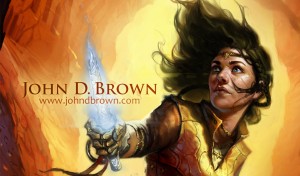
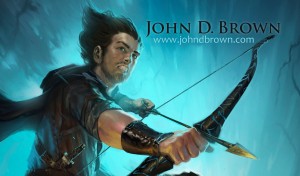
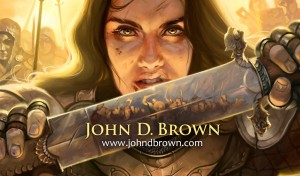
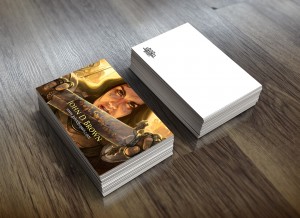
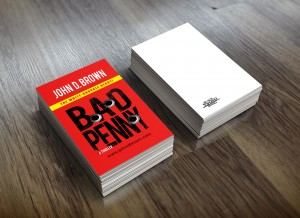
Devon Dorrity, who helped me put together my covers, just helped me put together some business cards. I’m pretty excited about them. I’m biased, but I think they look awesome.
Servant
Curse
Raveler
You can see here a mockup of how they’ll look. That bit on the back is the Blacksword Books logo.
I’m not sure about the one for Bad Penny. Devon liked it. Any opinions?
 I’ve finished chapter 17 of CURSE. I’m up to 50,000 words and have moved from the presentation phase into the struggle. And I’m stopping at this point to review the what I’ve got. I’ve learned that if the foundations of the story–the presentation phase–has fundamental flaws in it, you’re only going to create a HUGE rewrite mess if you push on.
I know this from experience. When writing the first draft of CURSE back in 2009 (oh my heck, it feels like forever ago), I ignored my Spideysenses and told myself I could fix anything that was wrong in post production. And it IS possible to fix many things afterwards–you can change scenes, improve clarity and transport, remove continuity errors, layer in character tags and things like that.
And it IS true that sometimes you do just have to write to the end to figure out the story. Sometimes you have to just write to the end, and do it in a substandard way, because if you don’t you’ll never finish anything. Sort of like sketching first and then painting. But if there’s something wrong with the basic premise of a story line, and you keep writing, then that story line affects everything it touches. The fractures ripple out all the way to the end of the book. And you might end up, like I did, having to toss a huge amount of what you’d written.
Which is not all bad. I learned a lot and invented a lot of cool stuff while writing that. But when you’re on a deadline, it can be a killer. And I’m not doing that this time. I worked out the big issues in my chapter outline.
So I’m pulling back and reviewing. I’m delighted with everything but the villain. He’s still not right. I love his chapters, the scenes. I love the name I’ve given him–Endless. But the structure isn’t right. I’ve inadvertantly created two main villains. And that’s not useful. Having two “main” villains doesn’t double the power of the opposition. It splits it. The villain/henchman model works well. But I don’t have that either. Over the next few days I’ll be rectifying the setup. Then moving forward.
For those of you who are writers, I thought you’d be interested to know that there were a few times these last two weeks when I dreaded the writing. I had a large problem before me or had to invent a new chapter (as opposed to using something from the previous draft), and a dread filled me. But I sketch/drafted my way to the end, and soon found the writing a joy again.
I can’t say enough about the sketch/draft method. I’ve found it works in creative activities OUTSIDE writing as well. When working up a lesson plan for my day job, designing landscaping for our house, developing a talking script for a sales call, writing a technical manual, or a hundred other things I’ve had to do–it’s always easier to work from something than create everything all from scratch.
Sketching allows me to create that first draft. And it allows me to do this without having to worry about quality. Sketches can be silly. Weird. Full of crap. They can be all this because I can throw them away. They’re not meant to be permanent. And so there’s no pressure to perform. There’s no staring at a blank screen or page. Sketching is a free-wheeling joy. It fills me up with ideas. And then, when I’ve got the general idea of what I want to do, I can start in on the “real” draft knowing WHAT I want to accomplish which leaves me free to think about the HOW. And if I run into problems and realize the draft isn’t going to work, or I run into something better, I just call the current draft a sketch (or “take” as used in the movie business) and move on to the real one.
Sometimes a chapter or section requires 1 sketch or take, sometimes I’ve run up into the 20’s. Sometimes I haven’t needed any at all. It’s not the number that’s important, it’s the process that has really freed me.
Here’s the latest version of the book description that will accompany the book on the various sites and on the back cover of the trade paperback. It’s purpose is to advertise: to let folks know the feel of the book and pique their interest.
A young man.
The girl he is hunting for using the dark and terrifying magic of Slethery.
And the monster who only wants to be free.
So begins the towering fantasy series that introduces an elaborate new world, a multifaceted system of magic, and a cast of compelling characters and creatures.
Trapped in a web of lies and ancient secrets, of right becoming wrong, the three must struggle not only against each other, but also a being of irresistible powers. A creature who is gathering her servants to oversee the impending human harvest.
If the three win, they will save those they love the most. If they fail, the clans of the land fall with them.
What people are saying:
~ Best Novel of the Year Whitney Awards, speculative fiction
~ Engrossing Publishers Weekly
~ Provocative Booklist
~ Starred Review! Library Journal
~ A great setting, a smart story Brandon Sanderson
Do you think you can do better? See anything to cut? Have some book descriptions you think work really well? If so, comment. I’d love to see what you come up with.
