Similar Posts

  • What changed in the author’s cut of SERVANT?

    Because a number of folks have emailed or posted asking this question, I figured I should address it in a post.

    This edit of SERVANT was signficant, but it involved mostly line edits, copy edits, resequencing, and one important adjustment and addition.

    Line edits are things that make individual sentences or paragraphs read more clearly. I made line edits to almost every page. I think most readers won’t notice these. But then that’s the point.

    Copy edits catch small things like typos and misspellings. There were a number of maddening copy issues that were introduced into the manuscript in the publisher’s version and others that weren’t flagged. I fixed a number of these and then had two copy editors read over the manuscript to find more. No book is perfect. I’m sure there are still some gremlins lurking in the text. But we caught a lot of the little buggers. 

    Resequencing is moving chapters or sections around and does affect the experience. The biggest resequence was switching the first eight chapters back to the original order I intended. This is an important change and will have a large effect on the reader for the first quarter of the book. Then there were three other smaller sections inside the story that needed to be moved around to make the chronology clearer and improve the suspense.

    The line, copy, and resequencing edits make up the bulk of the edits. But I did adjust and add a short section to the ending immediately after the climax to clarify a few things that should have been revealed in the first version and that lead into book two.

    What does this all mean?

    It means that while this is a superior version of the tale, the base story remains the same. I care about the stories of Sugar, Talen, Argoth, Hunger, and the dilemmas they face. So I did not change their tales. However, I did significantly change the experience of those tales for the reader.

    If you have already read SERVANT, you know everything that happens. However, you will want to get a hold of a copy of the new version to review the updated ending for the new information it includes.  To avoid spoilers and confusion, I will not be releasing the ending in a separate document. But if you sign up for my release notification, I’ll let you know when I have my release sale so you can get it cheap. 

    One final note. Because I feel this is a superior version of the story, and because I do not want readers to be confused about which version to read, I’m releasing it with a different title and different cover art. It will be called “Servant” and include the series label “The Dark God Book 1.” 

    I think readers are going to be very pleased with this version. I know I am. And then we can move on to “Curse,” the next in the series, followed by “Glory.”

    Share
  • SERVANT in Raley’s grocery in California

    It’s official. SERVANT is in grocery stores outside of Utah. Saber2gecko saw and purchased a copy in a Raley’s grocery in the San Francisco Bay area then very thoughtfully posted that fact here. That chain has 144 stores. So not only is that great news for the book, but it also just plain rocks. I lived in that area for a few years.  I love it down there. To know my book is circulating in the stores I used to shop is cool. Welcome to the Grove, California.
    Share
  • |

    The Pareto Principle, Form Follows Function, and Story

    There are a thousand things to “remember” when writing story. New writers who make lists of these things soon begin to drown in them. But I’ve come to realize that many of these “rules” don’t matter.

    They don’t matter because many ignore the function of story. And so you can’t know how and when to apply them, or if they’re even something you should apply in the first place. Furthermore, a good number that do tie back to function often have little impact.

    The more I develop and write, the more I begin to see that the key is to focus on a liminted number of fundamentals. To focus on the things that matter most.

    So what really matters when you’re writing a story?

    I’m going to be speaking for an hour at the Book Academy tomorrow. It’s at Utah Valley University. The week after I’ll be presenting all day at the American Fork Arts Council’s autumn writer’s conference. I will probably write up all my thoughts and post them to my site at some time.  But for right now this is where you can hear them.  

    I truly believe the Pareto Principle applies to writing. But you can’t go searching for those vital few factors until you know the effects they’re supposed to produce. Form follows function. And the function is something that happens in the reader.

    Here’s a nibble. This quote from David Howard is an example of what I’m talking about.

    “As we’ve seen, what the audience hopes for and what the characters hope for need not be the same thing. The same is true of our fears versus their fears. But how do hope and fear fit into the scheme of storytelling? Hope and fear are about the future. They derive from uncertaintly about future events in the story, future decisions the characters might make, future discoveries or revelations that might be unearthed, future outside forces and how they will influence the journey of the characters. When we discuss hope verusus fear in dramaturgical terms, this uncertainty is a function solely of the audience and its experience [my emphasis]. This is dramatic tension. We hope the man with the cobra in the shoe box won’t open the box; we fear he might and get himself or someone else bitten. We don’t know what will happen, but we know what might happen and therefore feel tension about those possibilities” (How to Build a Great Screenplay, 52).

    Readers buy novels because novels provide a service. They provide something to the reader. They DO something to the reader.  That’s why readers pay good money for them, and stay up late at night (well past smart bedtimes) with them, and spend hours of their lives reading them.  

    What do stories do? What are the key factors that have to be present in the stories for them to be able to do these things? How do you help readers hope and fear for what might happen?

    I’m no story guru, but I do hope to share some of the vital few factors I see in the presentations I’ll be giving this week and next.

    Share
  • Press Release – Utah Author Selected for Best SFF Stories 2008

    FOR IMMEDIATE RELEASE

    UTAH AUTHOR SELECTED FOR BEST STORIES OF 2008

    Will Present Keys to Successful Fiction at BYU Symposium

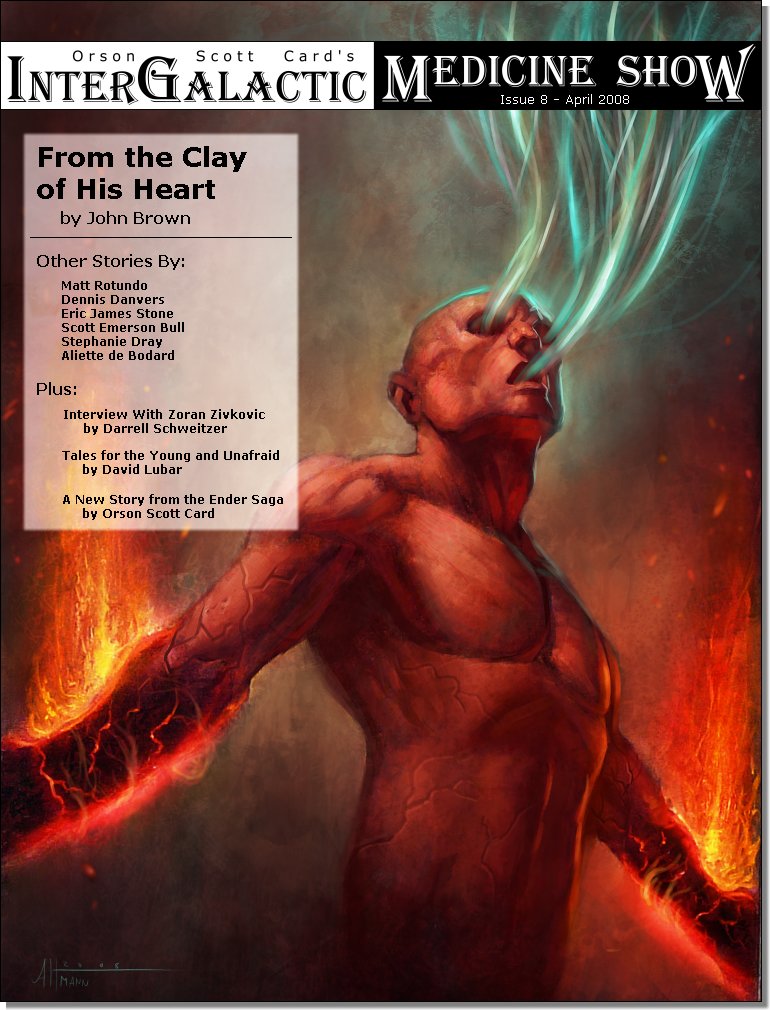
    LAKETOWN, UTAH |  February 9, 2009 |  Utah author John Brown’s novelette, “From the Clay of His Heart,” has just been listed as one of the best stories of 2008 by Locus Magazine, the main trade publication for the field of science fiction and fantasy. Locus Magazine selected its list from the hundreds of stories published and reviewed in 2008. Brown’s novelette will also be included in the annual Year’s Best Fantasy anthology edited by Hugo award-winning editor David G. Hartwell.

    “I’m thrilled with the recognition,” says Brown. “Still, I suppose you’d have to be a potato head not to squeeze some drama out of a story that’s a mix of religion, thieves, monsters, and love.”

    Brown will present his views on the keys to successful fiction in a lecture and workshop titled “The 3 Things You Must Learn To Write Killer Stories” at BYU on Friday evening, February 20, 2009 as part of Life, The Universe, & Everything, a symposium on science fiction & fantasy. Admission is free and open to all.

    John Brown is an award-winning Utah author. His epic fantasy, Servant of a Dark God, will be released in September 2009 by Tor, the largest publisher of science fiction and fantasy in the world. For more information on the author visit: http://JohnDBrown.com

    MORE INFO

    Click on image. Artwork for “From the Clay of His Heart” which will appeared in Locus Magazine’s recommended reading for 2008 and will appear in the Year’s Best Fantasy #9 edited by David Hartwell. 

    Share
  • Servant of a Dark God is a Whitney Award finalist

    Yea! Thanks to those of you who nominated. The judges have chosen Servant of a Dark God as a Whitney Award finalist. Of course, the four other books in the category are great. Here’s the list of finalists in my category:

  • Servant of a Dark God by John Brown
  • The Maze Runner by James Dashner
  • Wings by Aprilynne Pike
  • Warbreaker by Brandon Sanderson
  • I Am Not A Serial Killer by Dan Wells
  • Check out all finalists in all categories here. If you click on the Whitney Academy link on the top of that site, you’ll see all the folks who will be voting on the finalists.

    Share