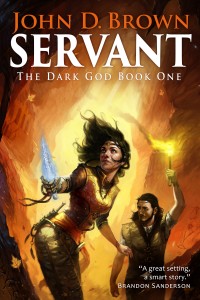
Kudos for Servant of a Dark God from author Mette Harrison

Mette Harrison is the author of Mira, Mirror, The Princess and the Hound and The Princess and the Bear (Orson Scott Card simply loves her work.) So she’s a great writer, but she is also someone who does not blurb books if she doesn’t like them. Heck, she has a hard time doing PR for her OWN work. So I was so very happy to see this review of  Servant of a Dark God.

John Brown’s book has all the great things about epic fantasy that I love. Full Review.

Share

Similar Posts

  • SERVANT in Raley’s grocery in California

    It’s official. SERVANT is in grocery stores outside of Utah. Saber2gecko saw and purchased a copy in a Raley’s grocery in the San Francisco Bay area then very thoughtfully posted that fact here. That chain has 144 stores. So not only is that great news for the book, but it also just plain rocks. I lived in that area for a few years.  I love it down there. To know my book is circulating in the stores I used to shop is cool. Welcome to the Grove, California.

    Share
  • |

    Update and Fage

    I passed the 90% mark today on SERVANT. It’s been wonderful going back through this story, remembering why I loved these characters so much. The cover too is coming along. I’m looking forward to revealing it in the near future. Right now everything looks like it will release on target, although that may change.

    While you’re here, you know I have been on a quest for delicious low-sugar yogurt for some time. I have found it at last. Behold.

    Fage 2 percent yogurt

    No Greek yogurt has a better taste or texture. And there’s no added sugar. Add some fruit and it’s heaven.

    It’s pronounced “fa-yeh.” Except, how do you pronounce that? Who comes up with product names nobody can pronounce? 

    But it doesn’t matter how you pronounce it. We luvs it, Precious.


    Share
  • Resist the SERVANT marshmellow

    Folks, please resist the SERVANT marshmellow.

    Me and my big mouth. I unwisely let it slip in a comment thread that I had Servant up on Amazon (it’s up early because I need at least 24 hours to make sure my purchase gets the ratings going and to make sure everything looks right). And some of you have gone out to purchase it, for which I love you, BUT I should have made clear that we’re still in the proof check phase. That means we’re carefully going over the beta version of the trade paper book and catching the errors you only see when it’s in book form (next time I’ll do the trade paper first and then the ebook). You might not notice the things we’re catching and will be happy with the proof version. But I hate thinking you’re getting anything but the best.

    If you’ve already purchased and don’t care, fine. If you do, Amazon has a liberal return policy. For the rest of you: DON’T EAT THE MARSHMELLOW. Give us just a few days. Make sure you’ve signed up for the new book release notification on the left. I’ll let you know when everything is ready to go AND on sale 🙂

    Happy holidays!

    Share
  • How to tell an author you don’t like their book

    Mette Harrison wrote a blog about how various authors respond when they read a book, don’t like it, and then the book’s author asks them directly what they thought of the book. 

    Here’s my response.

    As an author when I ask someone, especially another author, about their experience with my story, I’m looking for a data point to see how the book’s working or to get some insight. I realize others might be looking for validation. And, of course, I hope that everyone who reads my stuff finds nirvana even if I know that is not going to be the case. But I don’t ask unless I want data. And so I would hope they would report their experience accurately. I also hope they do it in friendly and helpful manner.

    So because that’s what I want, that’s what I try to do for others.  And the sandwich+ method has been one good way for me to do that.

    1. State something specific that works for me, e.g. “I love your character Bill because he’s so outrageous.”
     
    2. State the key thing that’s giving me trouble. For example, I might say, “I am having a hard time with the pacing.” But then I ALWAYS want to give the context of me as reader when it applies to my reaction, e.g. I’m a terribly impatient reader, I like to feel hope in what I read and know I don’t like as much despair as many other readers do, I can’t stand clowns (this is true: clowns are some of the scariest creatures out there, second only to crocodiles). The author should know these readerly things when they apply so the author can understand where the comments are coming from.

    If the book’s in pro shape and I think the issue is mostly my tastes, then it’s also useful to compare their work to another successful piece or author that had the same issue for me, e.g. “This reminds me of Twilight; I know people love it, but I just couldn’t get into that book either for the same reason.”

    I don’t think this is fluff. I think it’s part of being accurate. Our reality is what we focus on. And if I make a statement that leaves an author thinking I think the work is bad, then that’s not accurate because the truth is I think I’m not in the audience.

    If I think it’s a craft issue, then I highlight the main thing I think is causing the problem. A laundry list is usually useless. But thoughtful focus on the key issue can be very helpful. If I can’t tell whether it’s a taste issue or a craft issue, I admit it.

    3. State something else that’s working for me, e.g. “While I just couldn’t get past all those clowns freaking me out, I did think your chapter openers were compelling. I always wanted to read more, but then, alas, clowns.”

    4. The + is not just leaving statements hanging. Asking some sincere questions after demonstrates my genuine interest. And I am interested. If the book is unpublished, I might ask about their plans for the book, are they going to be doing another draft or shopping it, or if my reaction is common. If it’s published I might ask how it’s being received, what others are liking about it, and what’s next.  Maybe they tell me about another project they’re working on that sounds fascinating.

    This is what I’d want an author to do for me–be accurate, interested, and friendly. In such a context, someone having issues with a story is not such a big deal. It really isn’t.

    Share
  • Does anyone going to LTUE want “What Comes Next?”

    LTUE didn’t have enough slots to include the presentation in the schedule, but I’m willing to give it in the chat area by the lobby to folks who are interested. Probably on Saturday.

    So in “What Comes Next?” I share two tools I use that help me figure out where to start my stories and, well, what comes next all the way to the end. The second tool encapsulates, for me, the core of what story is all about.

    If you’re interested, let me know

    EDIT: I’m targeting 8-9 am on Saturday.

    Share