
Similar Posts
Join John on K-TALK radio, AM 630 – This Saturday 9 PM MTN
 Sector 5 is a new radio program on K-TALK radio, AM 630. It’s hosted by Dickie Shannon, a long-time DJ, and is all about science fiction, fantasy, aliens, paranormal–the weird, fantastic, and inexplicable. Dickie says it’s Garrison Keillor meets Art Bell. We’re going to talk about my book, writing, and weird crap. He takes callers. So be ready to share your stories and enjoy the fun!
- Saturday, April 17th, 9 – 10 PM Mountain
- Sector 5 program
- K-TALK radio
- AM 630
How to Write a Story that Rocks
Folks, a huge thanks goes to Stephen Nelson for putting all this together. You may kiss his hand when you see him.
This is a recording of “How to Write a Story that Rocks,” a two-hour seminar Larry Correia and I just put on at the annual BYU’s Life, The Universe, & Everything symposium. I think we had 130-140 people attend. This symposium is focused on writing fiction. And while the panels and presentations do include things specific to the science fiction, horror, and fantasy genres (both adult and young adult), a lot of time is also spent on story writing fundamentals that apply to ALL genres. So when I developed this workshop, I made sure I took the fundamental approach.
The two-hour seminar has been broken down into 12 segments. To switch between the segments:
- Hover your mouse pointer over the YouTube below
- Click the forward and back arrows that appear on the right and left sides to move to the next or previous segment, OR
- Scroll through all 12 segments and select the one you want using the playlist control at the bottom
If you prefer, you can watch all 12 on the How to Write a Story that Rocks YouTube playlist page.
I’ve found whenever I develop any presentation or training that it takes a few iterations and revisions before it’s the best it can be. This is the first iteration of this seminar. And so below this video I’ve provided additional comments on each segment explaining key concepts, principles, and techniques that we might have failed to discuss or convey as clearly as we’d hoped. Enjoy!
Handout
How to Write a Story That Rocks – Handout
Segment 1
It’s documented–right-wing gun nut Larry Correia sang “Kumbaya.” What’s next? The hugging of small trees? Oh, Larry, the disilluion. The disillusion.
The reason why I had Larry sing was not for his mellifluous performance, but to demonstrate the difference in reactions between him and our happy volunteer (“Country Road” by John Denver–this really was a love fest). The volunteer balked because he hadn’t taken any thought to know what to sing before he was commanded to do so. On the other hand, Larry and I had spoken before the seminar. So Larry had something to sing BEFORE he sang it. It’s a simple demonstration, but it illustrates a principle a lot of new writers forget. Writing is a performance. It helps to know what it is you’re going to perform before you perform it.
It’s one thing for you to tell yourself to write. It’s much easier to tell yourself to write the scene where the rancher finds out one of his illegal ranch hands has been kidnapped.
Now this doesn’t mean that you have to know everything. Or that you can’t write exploratory drafts to figure out what it is you want to write. But it does illustrate that whatever techniques you use, you’ll be a lot more effective in your writing when you have something to say first.
But what do you develop? What are the things that bring the story to life? How do you go about getting those things to say? That’s precisely what I wanted to address in the seminar. In the segments that follow, I try to:
- Explain what I’ve found are the most important things to develop, the things that define the essence of story, that make the story come alive in the writer’s mind–the things that really matter
- Demonstrate techniques to develop those things so you have something to say
Segment 2
I think this segment went fairly well. What rocks will different from person to person, even though there will often be a huge overlap between people. So it’s important for authors to seek to develop the kinds of stories that rouse their passion. Watch this interview with best seller Debbie Macomber to see what I mean. So I can’t tell you what to write about. Or if whath you think rocks will resonate with a large number of people. However, what I can do is share the techniques I use that have been most productive in helping me develop initial ideas into something that has much more power.
You can use the techniques to juice up any of the four parts of story. However, I will say that I find that the most productive, the most important parts, are character and problem. Plot and setting are important. I love them and work to juice them up. But when I get a good character and problem, that’s when the writing seems to flow the easiest.
And no, I don’t list theme as a part of story. Everyone talks about theme, but when I read what they have to say or press them for examples, it seems that it always either boils down to (1) a story element or topic that’s repeated, (2) a story problem/issue stated in an abstract manner, or (3) some moral situation. Les Miserables is about the “theme” of mercy versus justice. But saying justice versus mercy is just an abstraction of the story problem and dilemmas the story deals with. So, no theme.
Segment 3
Loved this bit about scenes from David Mamet: http://www.slashfilm.com/2010/03/23/a-letter-from-david-mamet-to-the-writers-of-the-unit/
Segment 4
I’ll be adding my comments to the rest of these segments over the next few days.
Segment 5
Segment 6
Segment 7
Segment 8
Segment 9
Segment 10
Segment 11
Segment 12
Dan Wells on Story Structure
Check it out: Dan Wells on How to Build a Story (story structure). I find Dan’s “start with the ending” technique helpful as well as thinking about a worst fears realized moment. Watch the videos and see if there isn’t something there that can help you develop your story idea.
You can get the PowerPoint of How to Build a Story on Dan’s site.
If you find this approach useful, you might want to check out what novelist Larry Brooks has written about the same material on StoryFix.com.
Sector Five Radio’s “Super Writers of the Universe” book signing
I’ll be signing September 25 with a whole bunch of other SFF authors. Come by and say hello.
Saturday, September 25, 11 am – 1 pm Book Signing West Jordan, UT Super Writers of the Universe and Friends from Sector Five Radio, AM 630 K-talk. 10 SFF authors, including me, Tracy Hickman, Dave Farland, Howard Tayler, Larry Correia, and Eric James Stone. Barnes & Noble – Jordan Landing
7157 Plaza Center Drive
West Jordan, UT 84084
801-282-1324
Saturday, September 25, 3 pm – 5 pm Book Signing Murray, UT Super Writers of the Universe and Friends Same 10 authors, but this time at Borders 132 East Winchester
Murray, UT 84107
Bad Penny – working title
I’ve decided to tentatively call the first book in my Frank Shaw series “Bad Penny.” This is the thriller I’ve been talking about. It’s a working title, so it may change.
As for progress, I’m close to 14,000 words. Huzzah! And I’m having a blast writing it. Every day I look forward to my writing time.
For those curious, the book takes place in Rock Springs, Wyoming. The plot will move it across eastern part of the state and then down into Colorado.
Frank Moses Shaw, ex-con . . .
Ah, folks. I’m just loving it.
I’m also generating options for a pen name. Althought I know there’s overlap between readers of epic fantasy and thrillers (hey, look at me!), I still think the genres are too different to try to spread a brand name across both. I read about Tess Gerritsen, who started in romance, using the same name for her thrillers, which is all I think she writes now. She reports that she had a number of the thriller readers pick up her romances and vice versa, and then get frustrated because her brand meant one thing to them, but they got another.
If I was writing thrillerish SF, like Card’s Ender’s Game, or thrillerish fantasy, like Correia’s Monster Hunter, then maybe the stretch wouldn’t be so far. For those of you who are thriller readers, I’ll be posting some possible names in the near future. I’d like your reactions on the options, so keep a look out.
As for CURSE OF A DARK GOD, no word yet from ye Editors. I’m expecting a reply March or April. Yeah, I turned it into my agent end of November. She submitted it to Tor in December. No, I don’t like these lead times any better than you do. But it is what it is. My job is to produce. My target this year is two novels–DARK GOD’S GLORY (book 3 in the series) and BAD PENNY. My stretch goal is to finish the working outline for the second Frank Shaw book (already have the premise) and actually start on it before the end of the year. We’ll see what happens.
Writing Update: Awful Intent
Folks, I just finished the first draft of my working outline for AWFUL INTENT. I’m stoked. Lots of research and lots fun and sometimes maddening work to get to this point. Here’s the current version of the summary, which will change.
Southeastern Utah. 30,000 square miles of red-rock desert and wilderness. One of the least populated places in the United States. The perfect place to hide just about anything.
Frank Shaw is just passing through. He was once an elite soldier, trained to see what others want to hide. Then he made some terrible mistakes and fell from grace. Except the old skills never went away: they were only heightened during his time behind bars. Which is why Frank notices the fearful woman in the McDonalds and the killer watching her.
Frank could move on. He’s got a life to put together and a sandwich to buy. But some things are more important than a Big Mac. Frank follows the man who follows the woman, and that one decision leads Frank to a ranch that isn’t a ranch and into a plot of awful proportions.
When Frank and the strong female Sheriff from the small town a number of miles away discover the truth, they try to get back and call for help, but the rancher is on to them and sends a private army out to hunt them down in the wilderness. Frank and the Sheriff will need to use all their combined skills to survive. Because time is running out, and thousands of lives are at stake.
My agent got back to me on BAD PENNY. I will be focusing on some tweaks over the next two or three weeks. Then we need to get that moving forward.
Finally, I know some of you are wondering about the DARK GOD series. And why wouldn’t you be with my earlier post? Things haven’t been finalized. Soon, Grasshopper. Soon.
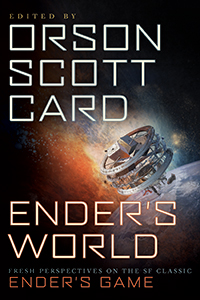
Ender’s World: Fresh Perspectives on the SF Classic Ender’s Game
 Smart Pop publishes smart, fresh, and engaging articles on the best of pop culture TV, books, and film, with a particular focus on science fiction and fantasy television and literature.
You want to hear what Scott Westerfield (Uglies, Pretties, etc.) has to say about Buffy? Go to Smart Pop.
What about Orson Card’s thoughts on Joss Whedon’s Firefly universe? Smart Pop.
What about the venerable Lawrence Block on Robert B. Parker’s Spenser series? Um, Smart Pop.
Strange. Do you see a pattern emerging?
Whether it’s Mad Men, House, Hunger Games, George Martin’s epic fantasies, Halo, True Blood, or Alias, Smart Pop gathers together New York Times bestselling authors, television writers, psychologists, philosophers, and others–folks who love of pop culture and have something worth sharing about it–and asks them to share their insights.
Recently, they’ve been putting together just such a collection on Ender’s Game. It’s called Ender’s World: Fresh Perspectives on the SF Classic Ender’s Game. It’s coming out February 2013. You can read more about it here.
I’m announcing this now because The Man was fortunate enough to be invited to contribute. I love Ender’s Game. LOVE IT. How cool is it that I get to write about it in an anthology edited by the folks at Smart Pop and Card himself? And then get to read what everyone else has to say, including military strategists Colonel Tom Ruby and Captain John Schmitt. As well as the little bits they’ll include on things like why the battle room is the shape it is and why they were recruiting kids.
But I’m also announcing this because in addition to the essays all we Ender-lovers get to write, Smart Pop is also going to include a series of Q&As with Scott Card, and they are currently soliciting the question from readers. FROM YOU. Right now.
You ever wonder about a character or part of the setting or event in Ender’s Game? Ever wanted to know what inspired Card? Ever wanted to ask any question at all about Ender’s Game? Now’s your chance. Just submit you question here: http://www.smartpopbooks.com/ask-orson-scott-card-a-question-about-enders-game/
You can see questions already submitted at Smart Pop’s Tumblr.
From a writer’s pov, I have to tell you that the folks at Smart Pop have been nothing but enjoyable and insightful to work with. I’m looking forward to this book!
8 Comments
Comments are closed.
It will be worth the wait.
Only if we all don’t die first.
UGH! Why are the oxen so SLOW?!?!?! Come on, oxen!
🙂
I figure I’ll throw my own verbal support 🙂 That makes at least three of us steadily supporting you 🙂
Thanks, Russell!
The best part about reading fantasy is that there are lots of books to keep me busy while I wait for the ones I truly love 🙂
Have I already officially made you a Dreadman, Bryce? Thanks for the love.