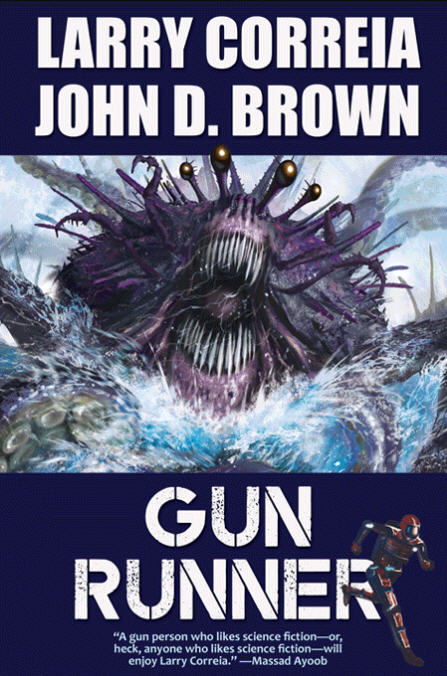
Gun Runner is out today!

Gun Runner on Amazon! Order here!
Autographed copies available from Uncle Hugo’s here!
Podcast discussion with the authors here!

The is 100% Brown and Correia, which means it’s action-packed, full of fun characters, and none of that navel gazing business.

It’s about a guy named Jackson Rook who works on a crew that smuggles weapons. They’re active in a righteous cause, helping the oppressed peoples of various planets stand up for themselves against the whoresons with the money and power.

But then Jackson learns something about the current job that turns his gut. And he begins to think they might just be working for the wrong team.

Will he be able to set things right when just about everybody and everything on the godforsaken planet called Swindle wants to kill him or turn him back into the monster he once was?

Read to find out.

If you like action and science fiction, I think you’re going to love this book.

Share

Similar Posts

  • Good Stuff! Two fun family and party games

    There’s nothing quite like the laughter and fun a good family or party game creates. And we discovered two games this summer that have brought hours of pleasure.

    The first is Just One. It’s for 3 to 7 players and takes about 20 minutes to finish.

    Now, I was skeptical of this game at first because it’s a cooperative party game.

    I mean, come on. Cooperation?

    No teams?

    No competition?

    What were we going to do—hold hands and sing Kumbaya?

    I was fully expecting to be bored out of my mind. Boy, was I wrong. There was suspense, laughter, and loads of fun.

    There are 13 rounds in each game. In each round, one player blindly selects the number of a word on one of the game cards. The other players each write a one word clue to help that player guess the word. However, if two or more players write down the same word, they have to remove that clue.

    So you’re trying to come up with one-word clues the others won’t that still help the guessing player. Some clues lead the guessing player off onto funny tangents. Others are just funny. And then there’s the suspense of whether someone else wrote your word and whether the player will be able to guess it from the clues that are left.

    Your goal is to guess all 13 words selected. And there’s a little score card that ranks what it means if you get 13, 12, 11, etc.

    As an aside, it’s crazy to me that the score card provided motivation. But it did. It was a delightful little brain hack.

    One Word is a quick, fun game. We’ve played it with a few as 3 and as many 8 players and had a ball each time. We are so happy to have it in the family game closet.

    The next is Fish Bowl. It’s for 4+ players. What this game does is take favorites like Taboo, One Word, and charades and mixes them together in a competitive game between two teams.

    Here’s how you play it. Each person writes up 5 to 7 different words or phrases on separate slips of paper, folds the papers, and puts them in a bowl. Then you do 3 rounds.

    Round 1 is like Taboo, where you can describe, but can’t say or act out the word or phrase on the paper. You select a team to go first. One person on the team selects the papers from the bowl and then tries to describe the word or phrase. The team has 30-45 seconds (you decide) to guess as many of the words as possible. When the time is up, it’s the other team’s turn. Back and forth you go, selecting a new team member each turn to give the clues, until there are no more slips of paper in the bowl. Then you count the number of slips each team got and move to round 2.

    In round two, you put all of the slips of paper back into the bowl. The team that went second in the first round starts this one. This time the person giving clues gets to share one word. That’s it. And the team has to guess it. Again, the team has 30-45 seconds to guess as many as they can.  Then it goes to the next team. And you switch back and forth just like you did in round 1, and when the slips of paper are gone, each team counts up their score.

    In round 3, you put all of the slips of paper back into the bowl. The time the person giving the clues has to act them out. No words allowed. You run this round just like you did the first two with  30-45  second turns, switching back and forth between the teams until all the papers are gone. At that point, the teams  total their scores for this round and then for all 3 rounds together to see which team won.

    If you don’t want to use paper, you can play a version online.

    Either way, it’s another fast, fun game. In fact, we played it last night. And laughed and laughed when one daughter was trying to get the other to guess “sling” and nailed her teammate in the head trying to act out a rock hitting Goliath.   Movies are great. But sometimes what you need is some delightful game fun. And I’m betting you’ll love these.

    Share
  • The MacFarlane (Tor), Correia, Hines Cage Match: Put It In The C Story

    Larry Correia is a big-booted barbarian who likes to fight in a cage. And a lot of us love to watch big-booted barbarians go at it.

    We like demanding matches. We like a little blood and good sportsmanship (of course, sportsmanship in the cage is different than in other venues). And we respect both sides for showing up and giving it their best.

    This last week Larry Correia battled with Alex Dally MacFarlane (and Tor, the silent partner, who thought her new column would be a great idea and has given her their big platform to talk) and Jim Hines. If you didn’t watch the match, here are the links.

    I’ve enjoyed reading the give and take in this fight. For me, the barbarians seem to have landed more blows (and done so with many more funny and memorable one-liners.) But that doesn’t mean Alex Dally MacFarlane shouldn’t crusade.

    And I mean crusade, as in battle.

    Underneath it all MacFarlane wants to change something. She wants to change hearts and minds. A lot of us want to change hearts and minds about various things. A lot of us will show up and risk getting bloody for such things in a variety of settings. Heck, Correia the Barbarian was even willing to spend two years of his barbarian life trying to change hearts and minds in a setting where big boots are not allowed (poor Correia, more sad puppies).

    But here’s the deal.

    If you want to win someone like me, you’re going to do it not by scolding or brow beating me or by mandating something and then trying to back it up with sticks.

    You’re going to do it by writing something so delightul that I cannot but help listen to you.

    You’re not going to tell me what I can’t write.

    You’re not going to tell me what I must write.

    You’re going to model writing that makes me want to write that thing.

    You’re going to be like Tolkien and spawn five decades of writers who want to do nothing more than imagine worlds filled with strange races and wonderous settings and weird talking tree men who have lost their wives.

    You’re going to invite like-minded folks to join you in creating wonders. Or in just having a good old time.  And not worry about other writers inviting folks to their creations, which might be totally different from yours.

    And those wonders and good times are the things that will work the magic.

    Miguel Sabido is a master of entertainment with message. Here’s a great piece in The New Yorker introducing him, his work, and methods. Notice what made his stuff so effective. The new ways of thinking he wanted to offer were never found in the A story. They were never found in the B story.

    Why?

    Because the number one thing the story had to do was suck people in (entertain).

    And so the new thing to consider was in the C story.

    MacFarlane, put it in the C story. And build a Middle-earth. Or a ring world. Or at least some vampires that sparkle.

    In the meantime, I’ve got a barbarian book on the shelf that looks like a mighty good time. I think I’m going to give it a read.

    Share
  • Black Hawk Down, Pete Blaber, Not Waving But Drowning

    A Ferocious Battle

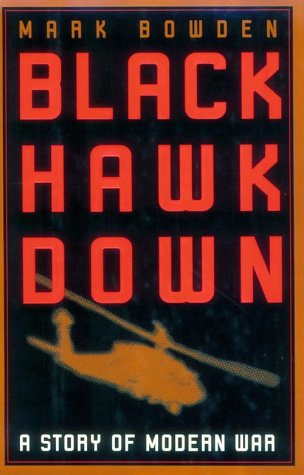
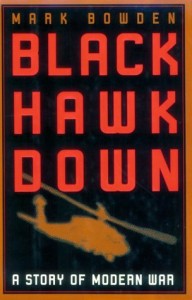
     I just finished reading Black Hawk Down by Mark Bowden. It is the most gripping account of any battle I have ever read.

    In 1992 a Somali warlord attacked and killed U.N. peacekeeping forces. As a result, the US put a $25,000 bounty on his head and attempted to arrest and try him for war crimes. On October 3, 1993, by the order of President Bill Clinton, a force of United States Army Rangers and Delta Force operators, the Army’s most elite warriors, set out to capture several lieutenants of the warlord’s militia in an area of the Somali capital city of Mogadishu that was controlled by the warlord.

    The force of about a hundred U.S. soldiers helicoptered in during broad daylight. They roped down to the streets surrounding the target building. It was supposed to take them no more than an hour. They would bag the warlord’s lieutenants, put them on a convoy of Army trucks that had barreled into the city and were waiting right around the corner, and get out.

    But the citizenry, loyal to the warlord, weren’t going to take it lying down. They began to swarm with guns and rocket propelled grenades. They attacked, almost heedless of the danger. One Somali with an AK-47 rode a cow out in a strange charge, a number of other Somali’s taking cover behind (yeah, he and the cow died). But the Americans were overconfident of their Black Hawk helicopters. They didn’t think the types of weapons the Somalis had could bring them down.

    One chopper was hit and crashed. Then another. A third and then a fourth were damaged and barely made it back to safety before they crash landed. As for the Rangers and D-boys, they were in for the fight of their life.

    The book tells the story of their courage, but it also brings in the point of view of a number of actual Somalis who fought and were injured. In the process, we get a view of the battle that is both thrilling and poignant.

    Bowden did an excellent job researching and writing this. I could not put it down. It does include some military grade profanity, but it wasn’t there to titillate or shock. I’ve talked to those who saw the movie based on this book, and I could tell the book is, per usual, better than the movie. If you’re at all interested in the military and the military operations we conduct overseas, let me recommend that you read this book. 

    Delta Force Commander Shares Insights
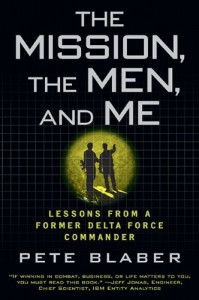
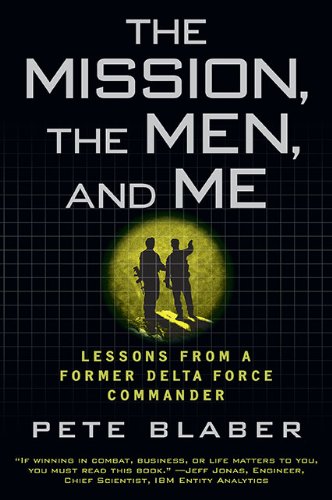
    Delta Force is the world’s most elite counterterrorist fighting force. Pete Blaber was a Delta Force operator that worked his way up to become a Delta Force commander and took part in some of the most dangerous, controversial, and significant military and political events of our time.

    During his time in uniform, he learned a number of lessons about life, about how we make decisions and act on them. In The Mission, The Men, and Me, Blaber writes about a number of the missions he conducted and the lessons he learned from them.

    The missions were conducted in Montana, Iraq, Bosnia, and Afghanistan. One featured a commander stupidly ordering Blaber to take his men into sure destruction. Another featured some of the first plans to capture Osama Bin Laden, before 9/11. Another included a man in a gorilla suit.

    The lessons Blaber draws from these experiences are fascinating and apply to more than military operations. For example, the lesson he drew from the operation featuring the gorilla suit is something I use every day with my writing. Anyone who leads or manages or works in groups will find other critical lessons. This was another book I couldn’t put down. Anyone interested in special forces will love this book.

    Not Waving But Drowning

    “Not Waving but Drowning” is a poem by female British poet Stevie Smith. It was published in 1957 as part of a collection with the same title. The work is her most famous poem and describes a man whose distressed thrashing in the sea causes onlookers to believe that he is waving to them, not drowning

    I hadn’t thought about this poem since I was a student at BYU. Then a local poet read it as part of his remarks at a conference I recently attended. The image and message lingered with me for hours. I thought about it off and on over the following weeks. This is, for me, an incredibly powerful poem. It needs to be read aloud, I think, to be appreciated. Not in some silly way, but with the appropriate feeling. I’m going to record a reading for my website, but you can read it aloud for yourself. Or have someone else do it for you. Then read it again.

    Nobody heard him, the dead man,
    But still he lay moaning:
    I was much further out than you thought
    And not waving but drowning.

    Poor chap, he always loved larking
    And now he’s dead
    It must have been too cold for him his heart gave way,
    They said.

    Oh, no no no, it was too cold always
    (Still the dead one lay moaning)
    I was much too far out all my life
    And not waving but drowning.

    How often does this happen? Those onlookers, caring only superficially, thinking it was too cold, thinking he was funning. But it wasn’t too cold. And his heart didn’t give out. He was struggling for his life, and they were too preoccupied to see it.

    Too preoccupied to really see. 

    I wonder. Is there someone around me, that if I just looked, just paused from my rush, I’d see they were much too far out, and not waving, but drowning.
    Share
  • Animals Make Us Human by Temple Grandin

    Which animals do you think have a better life: family dogs or cattle on ranches?

    Think about it. Cattle get branded and tagged and slaughtered. Some live only a year or two. Meanwhile, Fido gets the run of the house, a spot in front of the couch, and chew toys.

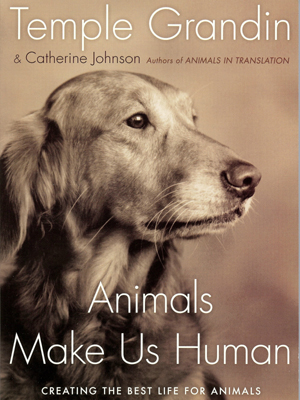
    You might be surprised to know that many cattle have it better than pampered family pets. That’s the claim Temple Grandin makes in her fascinating and practical book Animals Make Us Human: Creating the Best Life for Animals.

    Grandin is not a beef industry lobbyist working smoke and mirrors PR to make ranchers look good. She’s a practical, down-to-earth, get-your-hands-dirty animal scientist who has revolutionized the beef industry and had an impact on many others. She isn’t a vegetarian, and has no intention to become one. But she does love animals. And her insight and research has made the lives of millions of animals better.

    When people ask her how she can work in the beef industry instead of being an activist against it, she says that all things die. It’s the cycle of life. She has no problem eating animals. In fact, she believes that our relationship with the animals we use for food is symbiotic–mutually beneficial. But she also believes that if we’re going to raise them, or keep them as pets, we need to give these animals a quality life.

    So what do animals need for a quality life? Should we give our cattle rubdowns? Let our dogs roam through city streets? What do our cats and pigs and horses need? Is it freedom?

    Her answer, surprisingly, is that focusing on freedom really isn’t a good guide for trying to give animals a good life. Not because freedom is a bad thing, but because it’s too confusing. Instead, she believes that we should be basing animal welfare on the core, or what she calls the “blue ribbon,” emotion systems in the brain. The key systems are SEEKING, RAGE, FEAR, PANIC, and PLAY.

    The rule is simple: avoid stimulating the negative emotions; do stimulate the positive ones. In the book she shares what she knows about how to do that for dogs, cats, horses, cows, pigs, chickens and other poultry, wildlife, and animals in zoos.

    Grandin is always fascinating, and with her trademark style of stories and practical insights, she shares what the research and her more than 30 years of practical hands-on experience working with animals has taught her. You’ll learn why your chickens need a place to hide, even if you’ve fenced out every fox and skunk with thirty feet of concrete; what makes pigs happy; why clicker training is so successful with horses; why you might want to consider the color of your cat’s fur; why leaving your dog locked in the house with food and plenty of toys may actually be very stressing. You’ll even learn to look at zoo habitats differently. Each chapter focuses on a different animal and how to avoid the negative and stimulate the positive blue ribbon emotions. This is not touchy-feely fluff. It’s not the ranting and raging of someone who thinks the planet would be better of without humans. It’s the insights of someone who is rigorously scientific, down-to-earth practical, and passionate about animals.  

    In her own words: “Everyone who is responsible for animals needs a set of simple, reliable guidelines for creating good mental welfare that can be applied to any animal in any situation.” Read her book to find out what she suggests these should be. If you own pets or raise animals, I think you’ll love this read. If you’d like to sample the first chapter, you can at Grandin’s website:  http://www.grandin.com/

    Share
  • A Wowser Mouse & Financial Peace

    Dis Eez A Mouse

    I’m a Luddite, which means that even though I work in the software industry, I do not rush out to purchase the latest and greatest gadget.  Our family computer, for example, is running Windows 98, primarily because we purchased the computer itself in 1999.  In human years that computer is like 432 years old.  Maybe we’ll retire the old boy this year.  The point is that I don’t like to churn through tons of gadgets.  I want something to work.  I want it to work well.  And then I want to use it for a long time. 

    Recently, my mouse started acting up.  So I went out and found a new one.  I settled on a Microsoft Wireless Mobile Mouse 4000.  It comes with three parts: the mouse, an AA battery, which is supposed to last for up to ten months, and a tiny transceiver you insert into one of your computer’s USB ports.  The mouse has a great hand-feel.  The clicks are smooth.  If you want to take your mouse with you somewhere, there’s an easy storage slot inside the mouse for the transceiver.

    But the best thing of all is its BlueTrack technology.  This is not an ancient mouse with a track ball that you have to clean every so often.  It’s an optical mouse.  But unlike earlier versions of optical mice (why do I have a terrible urge to use “mouses” or “meece”?) that didn’t work very well on a number of surfaces, this BlueTrack technology works like a charm on everything I’ve tried it on, including glass. 

    You need a new mouse?  This is a good one.

    Dave Ramsey’s Complete Guide to Money

    If you’re like 70% of America, you are living paycheck to paycheck, which means that if you or your spouse (assuming you have one) were laid off, you would probably have difficulties meeting your mortgage the next month.  If you didn’t go into default on the house, you certainly would on other payments and bills. 

    You also have very little retirement. 

    You probably have around $7,000 in credit card debt.  Maybe a lot more.

    You also have a car payment or two.  Or, heaven forbid, a lease. 

    You might be house poor—the house payment is so large you can’t seem to do anything else. 

    You might have creditors hounding you. 

    You might be one of those folks throwing their money away on the lotto instead of investing it. 

    Did you know that if you invested $50 a month, an average of what many lotto players spend, in the stock market for 40 years, you’d very likely end up with $316,000 in the bank  (over the last 40 years of ups and downs, the annualized return of the market was almost 10%). You would have put in only $24,000 over that time period, which means you would have made $292,203!  But instead, if you’re a lotto player, you just throw all that out the window.  (No, you’re not going to win; not even maybe in your dreams.)

    You probably think your kids will have to take out loans to go to college. And you think that’s a good idea.  In fact, you probably think it’s a good idea to have a credit card just in case there’s an emergency because you don’t have any savings to cover any emergencies.

    The list goes on.  The sad part of this is that our finances cause us average Americans a lot of stress in our lives and marriages and families (even if we’re in denial) and very often heartbreak. 

    I know that a lot of us look at our financial chains and throw our hands up in despair—what can I do?  The mountain of debt and bills are just too high.  Besides, this is how everybody lives.

    But it’s not.

    There is a way out.  And it doesn’t matter how old you are, it’s not too late.

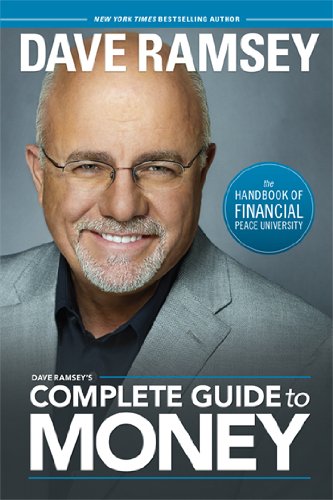
    Dave Ramsey has written his hands-down best book ever, which will take you step-by-step through the process of turning a financial mess into financial peace.  He’ll do it in a down-to-earth easy-to-read style. No confusing ten dollar words that make your head spin.

    Ramsey himself went through financial hell.  He was the guy that made all the mistakes with his money.  Lost everything.  Had collection agencies coming after him.  Didn’t know how he was going to feed the family.  He turned that all around.  Yes, he’s a millionaire, but more importantly, he has been working for the last twenty years to teach regular people with regular jobs the simple principles that lead to financial peace.  They’re becoming debt free and working their way towards huge net-worth.  

    You want a step-by-step plan?  You want to educate yourself about money and family finances from one of the nation’s leading experts?  Then go and purchase Dave Ramsey’s Complete Guide to Money today and start reading it.  You will not regret it.  If you already have his Total Money Makeover and don’t think this will be worth it, think again.  This goes into all sorts of things the Total Money Makeover doesn’t.

    Be free, people.  Be free.


    Related Stuff

    Look at the links and the video.

    Share
  • Buck, America the Vulnerable

    Buck

    About two years ago I was walking out in Round Valley and saw a rider on a horse coming down a hill through the brush.  I got to him just as he moved onto the road. Right away, I noticed that there was something a bit off with the horse’s gear—the rider was not using a bridle. The rider, Wayne Batty, was using nothing more than a rope harness that went around the horse’s head. I was amazed; how did you steer the horse without a bit in its mouth?

    I asked Wayne if I might walk alongside as he rode. He agreed, and then began to talk about training and riding horses. I stuck with him for little over a mile before I had to turn back. I learned in that short period that Wayne was able to communicate with that horse with small nudges. The horse also communicated to him many things with its stance, ears, the cock of its head. Most importantly, I learned they both had built up a trust of each other. Wayne’s methods were not based on fear, it seemed, but something else.

    It reminded me a lot of the fascinating and compelling The Man Who Listens to Horses, the autobiography of Monty Roberts, that shares Roberts’ life and his development of natural horsemanship methods. Unlike many training approaches which seek to break a horse’s will through harsh punishment-based methods that often veer into abuse, natural horsemanship employs methods that are much gentler and seek to build trust in the handler. Roberts can join up with (he doesn’t “break” horses) a wild or un-ridden horse, be up on the saddle calmly riding the animal, in an incredibly short period of time.

    But Batty and Roberts aren’t the only ones practicing this. These methods have been around some time. One of the most famous practitioners and teachers is Buck Brannaman, who found his years of being severely physically abused by his father actually provided some insight into training horses.

    Says Brannaman: “I’ve started horses since I was twelve years old and have been bit, kicked, bucked off and run over. I’ve tried every physical means to contain my horse in an effort to keep from getting myself killed. I started to realize that things would come much easier for me once I learned why a horse does what he does. This method works well for me because of the kinship that develops between horse and rider.”

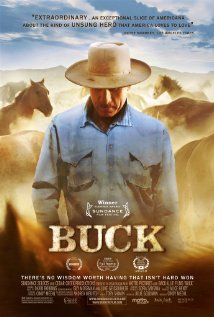
    Recently, a film was produced that looks at Brannaman’s life and methods. It’s called Buck and is worth every minute. If you love horses, you’ll love this movie. If you have a horse and think you might want to learn these methods, or just want to watch and listen, you might want to check out Brannaman’s teaching schedule at his site brannaman.com. He travels all over the country and is likely to hold a class within driving distance.

    America The Vulnerable

    A few years ago I received an email from my bank. At least, it looked legit to me. I opened it. It said it needed me to update some parts of my account and provided a link to the bank’s website. I clicked on the link, which took me to my bank’s website. At least, it looked exactly like my bank’s website. I entered my account number, login, and password. I made the requested changes and logged out.

    Two days later, somebody in Spain cleared every penny out of my account—thousands of dollars stolen.

    That email was a phishing (fishing) scam. The website had been a fake. I had willingly handed over my account number, login, and password to thieves.

    Luckily, the bank insures such thefts. But the problem of information security remains. Thieves living in Spain, or Russia, or LA, or China, can rob me blind from their bedrooms in their pajamas. They can do this because our information processing nowadays is increasingly tied to the internet.

    And they don’t just rob dopes like me, because it’s not just individual criminals who are in the business. Corporations and governments are in this business as well.

    They steal billions of dollars of trade secrets, engineering designs, and other intellectual property from American companies through computer hacking. They steal military secrets. For example, the US Navy spent years and about $5 billion dollars to develop a quiet electric motor for submarines that would make them incredibly hard to find and track. Chinese spies stole that technology. The Navy then spent billions more to develop a new radar for their top-of-the-line Aegis Cruiser. Chinese spies stole that, too.

    And they not only steal. Terrorists, crime organizations, and foreign governments can now insert malicious software into the computers that control, among other things, our electrical grid. They can use this in an attack, not just to shut the grid down for a while, but to destroy power generators. They can insert such software into our air traffic control system. Our train transportation systems. Our banks. They have already done this. They have already breached some of our most secure government systems.

    It sounds too far-fetched to be true, but it’s reality. Joel Brenner, who has served as the former senior counsel at the National Security Agency (NSA), the national counterintelligence executive in the office of the director of National Intelligence, and as the NSA’s inspector general writes about what he’s seen in America The Vulnerable: Inside the New Threat Matrix of Digial Espionage, Crime, and Warfare. In the book, he explains the cyber threats to individuals, corporations, and the country and what we can do about it. If you want a fascinating look into the next phase of crime, espionage, and warfare, and an introduction to some of the things you need to do to protect yourself and your company, and what we need to do as a nation, you’ll want to read this book.

    Share

2 Comments

Comments are closed.