World-building the history of a place

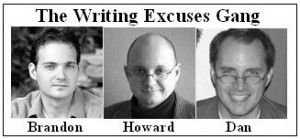
writing-excuses-the-guys2-300x139The Writing Excuses guys have posted another good podcast: this one on world-building a history.

I wanted to add a few comments. You’ll notice that a lot of the blurbs for my novel mention my world-building, so I guess it’s a strength in my writing. However, I don’t write huge world building documents in the pre-draft stage. I do write some history, of course. But I don’t think it would take up more than a few pages. A lot of world-building happens in draft.

It seems to me there are two levels of “history” and a lot of it can be done on-the-fly.

1. There are small hints of CHANGE in places and people.

Dave Wolverton taught me this one. You come upon an orchard in the woods that’s gone wild and is overgrown. It takes two lines to describe it and it gives a strong feel of past. The reader wonders who was there, what happened. Maybe you tell them. Maybe you don’t. You mention that the village Knight used to be fat but is wasting or vice versa. I find I can do these types of things usually on-the-fly as I’m writing. And I don’t need to know much about them. I just ask myself if anything has changed with the location or characters in the current scene.

A few touches of CHANGE throughout the novel give a strong sense of history.

2. There are events, groups, and individuals who impact or impacted your characters and their community in large ways.

There was a war with a neighboring country not five years ago. Your characters have to travel through that land, or maybe half the male population went to war and never came back. Or perhaps your character lost his sister in a drowning he could have prevented. Or he lost her to slavers. Or perhaps there is a secret police (like the Roman couriers) who arrived two years ago.

Again, many of these things can be thought up on the fly as you look for conflict and the stories of a place and community. However, I’ve found that it helps to ask a few key questions in the pre-draft stage to lay some (NEVER ALL) the groundwork.

— What kind of conflicts do these nations and groups have?
— What events have had a large impact on my character and his community? They can be terrible or wonderful events.
— Who in the community are my characters friends and enemies? What’s the history?
— What are the local and regional stories of events (or people) that were eccentric, odd, mysterious, dangerous, or revolutionary?

I never get all my answers up front. But I will get some. And then as I write I just keep in mind that it’s neat to indicate change every once in a while and to briefly bring up stories from the past that relate to the current matter at hand in the present story.

Finally, I really like the idea the Writing Excuses guys brought up of sharing multiple explanations for an event (multiple histories) when it fits and to include more than one cause, although I’m pretty sure the 80/20 rule applies to causation.


Is book marketing bad?

At CONduit I spoke with an author friend who thought that marketing was indeed a bad thing, especially marketing for YA, because said author felt it didn’t build an audience based on the merits of the book. It built one based on hype and buzz.  Instead of buying a book because it delivered a wonderful experience, readers would be buying only because it was what everyone else was doing. Furthermore, publishers only have so much money, and by choosing to put the dollars behind some books, they choose to let other books, which might deliver a better experience, languish.

I understand wanting to build a readership that’s based on love, not hype. But what I think my friend is overlooking is that you can’t love something if you don’t try it. And you won’t try it if you don’t know it’s there. Marketing and PR help make sure people know the book is there.

Yes, some readers might try it the first time because it’s what everyone is doing. But if the book is really that good, i.e. it actually delivers a wonderful experience for the target audience, then those readers will come back for another serving. They might look initially because everyone else is, but they’ll stay for love.

One of my editors just forwarded a link to “Not Quite a PR Campaign” by Sherry Thomas. Lots of interesting details there about what she does for PR, but probably one of the most important ideas she shares is the fact that marketing & PR don’t build an audience. A great story experience does that. However, marketing & PR can get the book in the audience’s hands.

What we all want to happen is word-of-mouth. PR doesn’t really create word-of-mouth, love does. But readers won’t read a book until they know it exists. So then the point of a PR campaign, if a PR campaign has any point at all, is to create awareness and hope that awareness will translate into love, once a critical mass of readers have read and enjoyed your book.

Readers may miss many high quality (i.e. they deliver a great experience to the intended audience) books because the lion’s share of the publisher’s marketing budget is being spent on a small group of books, and the author who gets the leftovers just doesn’t have the cash or know-how to do it themselves. But that doesn’t mean marketing is bad. It means that getting a big marketing push is like any other lucky break or opportunity.

I just started reading Guide to Writing Fiction by Phillys A. Whitney (a huge seller in the 1970’s and 1980’s). It’s a wonderful, slim, down-to-earth volume. She opens the book with a chapter called “Opportunity is Like a Train.” She maintains that her success did not come from starting with loads of talent. In fact, she says her ability was “modest.” She certainly wasn’t as gifted as many other authors she’d worked with in the writing groups of her youth. Nor did it come from immediate initial success. It came from being ready when opportunity knocked. 

Of course, I have been lucky. I’ve had extraordinary breaks come my way–along with some pretty bad blows and disappointments. There’s been bad luck too, but that doesn’t always show. Good fortune and unexpected opportunities are always coming along. Perhaps opportunity is like a train on an endless track. Now and then it makes a stop at your station, often without fanfare, and without warning.

…What is important is not the lucky break, the stopping of the train–that’s only part of it. Life is full of trains that stop. What counts is what we are doing with our lives when there is no opportunity and not a train in sight.

James Dashner is someone who is getting a big promo budget from Random House this year for Maze Runner. A very big one. But if you read his story about how he got published (links to all nine parts of the story are in his sidebar) and what got him to this point, you’ll see this promo train was a long time coming. 

Meanwhile, if the big promo budget ever stops at my station, I’m going to hop on. Until then, I will keep writing the best stories I can and make my current marketing budget (part publisher, part mine) go as far as possible. I’ll do the one for the love, the other because I can’t share the love if nobody even knows it’s out there.

CONduit report & some interesting numbers

CONduit is a conference for speculative fiction writers. This year’s conference was great. I was able to see and talk to a bunch of writer friends (Dave Wolverton, Dan Wells, Brandon Sanderson, Howard & Sandra Tayler, Eric James Stone, Ami Chopine, Darren Egget, Skipper Ritchotte, Mette Harrison), make some new ones (Lee Modesitt, James Dashner, Julie Wright, Aprilynne Pike, Larry Correia), plus chat with a multitude of others who are trying to break in. I also got to record with the Dragon Crawlers Radio guys. Nothing better than spending a weekend with a swarm of friendly and talented folks.

I’m amazed at the success some of these people are having:

  • Aprilynne Pike had an initial print run of 200,000 hardback copies and was #1 on the NY Times Best Seller list.
  • James Dashner is going to be one of the main events from Random House this fall. I’m expecting an equally large print of his Maze Runner.
  • Brandon Sanderson just signed a contract that was announced on Publisher’s Lunch for somewhere around 2.5 million for four books. Folks, this is amazingly large for our genre.

Of course, we already know Dave Wolverton and Lee Modesitt are some of the biggest sellers for Tor. Dan Wells is going to be big as well. And the Taylers have already got tens of thousands who read them regularly. They threw a great release party at this con.

Larry Correia has had some interesting success as well and came at it from a side alley. He self-published Monster Hunters International. He sold a few thousand copies (no mean feat, especially for a self-published book), with many of the readers coming from the armed forces in Afganistan and Iraq. The book was so good the owner of a large independent store in Minnesota, Uncle Hugo’s, called the editor of Baen Books up and told her that she was an idiot if she didn’t buy Larry’s book because he could sell the heck out of it. So she took a look, agreed, and Larry’s now under contract with a real publisher. It’s coming out in July.

In one conversation I learned the following about the Science Fiction & Fantasy genre.

  • 4,000 hardback copies for a title in a year is the rough break even point for Tor. You sell more than that, you’re okay. You sell less and Tor might have to drop you.
  • 10,000 hardback copies would be considered a very good seller.
  • 15,000 – 30,000 hardback copies and you are hitting the top of the midlist
  • Robert Jordan sold around 600,000 of each of his titles in hardback.
  • Depending on the time of year, 4,000 – 5,000 hardbacks sold in a week will put you in the top ten, even the top three, on the NY Times bestseller list.

As for me, I printed up some posters and book marks using Swanland’s art. The cover got a great reaction there. And that’s huge for me because, looking at that Gallup Poll blog I wrote, the cover is going to drive a lot of sales for a new author. I had a wonderful time giving my workshop. And I think I finally figured out which part of my novel I can use for readers. Oh, and if you get a chance to hear Eric James Stone read any of his short stories, take it. I’ve listened to him twice now and both have been well worth the 20 minutes.

Servant of a Dark God: Coming October 13, 2009

Tor Books’ production department has moved my book’s release date out one month. I’m getting so antsy to have it hit the stores, but October’s actually a better month, it being closer to the holiday season.

You still might be able to get it earlier if you pre-order. The books actually start shipping in the second half of September. But it takes a few weeks to get them out to all the stores.

Killer Story Workshop to be held at CONduit

I will conduct The 3 Things You Must Learn to Write Killer Stories workshop at CONduit this year. It’s being held at the downtown Raddison hotel. Here’s my schedule.

Friday, May 22nd

  • Culture-Building in F&SF:  3:00  PM  (with Lee Modesitt, Roger White, Dave Wolverton, Elisabeth Waters, & Brandon Sanderson)
  • The 3 Things You Must Learn to Write Killer Stories Workshop8:00 pm – 10:00 pm

Saturday, May 23rd

  • Mike Oberg asks questions from the audience: 4:00 PM (with Dave Wolverton, James Dashner, & Larry Correia)
  • Reading of Servant of a Dark God: 6:00 PM