The Meth Epidemic, The Marines

The Meth Epidemic

Mamphetamine is the most addictive illegal drug in America. Unlike marijuana, cocaine, or heroin, all of which are synthesized from easy-to-obtain plant material (cannabis, cocoa leaf, opium poppy), meth requires ephedrine or pseudoephedrine, which are very complex to make and require a lot of know-how and high-tech processing. The only folks who have that ability are legitimate chemical factories. In fact, there are less than a dozen such factories around the world that produce these chemicals. Which means it should be easy to stop illegal use at the source.

“Should” is the key word there.

When you’re trying to halt drug trafficking, you can work two sides. There’s the demand side and the supply side.

When you work on the demand side, you try to affect people’s desire and use.  For example, in the 1960’s the Federal Trade Commission, along with other government agencies and private groups, began a campaign against tobacco. Using government policy, public awareness, and education over the last forty years, these groups have significantly altered demand for tobacco in the United States. In 1963 more than half the nation smoked. 4,345 cigarettes were consumed per capita. But as these groups worked to affect demand, those numbers dropped steadily until by 2006 only 1,619 cigarettes were consumed per capita.

That’s astounding, folks. A whole culture was changed.

When you work on the supply side, you try to reduce the production and distribution of drugs. This can sometimes be almost impossible to do. For example, almost anyone can grow marijuana. And it takes very little knowledge to harvest and package the parts that are used.  Same with alcohol–home brewing has been practiced for ages. In both examples, the ingredients are easy to obtain and the processing is relatively simple and easy to hide.

But there are some drugs that are very difficult to produce. The key ingredient for barbiturates is one. In the 1950’s and 1960’s barbiturate abuse was increasing. But the government instituted some regulations on the legitimate businesses that produced these ingredients, and it reduced the amount available on the streets until we very seldom hear of barbiturates being used these days.

So where does meth fit in? Well, as I stated above, there are less than a dozen factories that create the key ingredients. Meth is a perfect candidate for supply side intervention. Unfortunately, regulation isn’t as easy as it may seem.

PBS’s Frontline recently aired “The Meth Epidemic” which explains the history of meth in the United States and the battle raging over its cure. If you’ve ever wondered about what meth is and how it affects our nation, you’ll want to watch this. I think you’ll find it eye-opening and well worth your time. Watch it for free here: http://video.pbs.org/video/1933783731.  

The Marines

The US Marine Corps is a fascinating organization with special capabilities. With the exception of the Coast Guard, they are the smallest of the United States’ armed forces, although they’re still bigger than the entire British army. Part of what makes the Marines unique is that they have the ability to rapidly deploy an independent task force (infantry, air support, ships) to almost anywhere in the world within days. Because of this, they are usually the first boots on the ground in any engagement. They pave the way and the Army and other branches follow to provide overwhelming and continuous force.

But the differences include more than their mission. The Marine Corps emphasizes authority and responsibility downward to a greater degree than the other military services. It members are, on average, younger. And its creed “Every Marine’s a Rifleman” has special implications for its commanders and troops.

In order to do some research for a novel I’m writing, I’ve been watching a lot of documentaries about special operations forces and the Marines. One of the best introductions to the Marines I’ve come across is the 2007 PBS documentary called The Marines. It examines what it takes to become a Marine and what it truly means to be one, outlining the rigorous training process that each recruit must endure to become a commissioned officer. I found it fascinating.

If you have ever been curious what makes the Marines different from the other branches of the military and what it takes to become one, you’ll want to watch this film. I couldn’t find it on the PBS site, but you can find it split into 10 parts at YouTube.com. Just go to site and search for “pbs the marines”.

Writing Update: 5/28/11 – Freewrites, Storylines, Proportion

I finished the next chapter of my outline, which turned into three chapters. Hurray for making progress. However, I’m going to need to make more time on a weekly basis if I’m going to meet my goal.

I’ve kept stats over the last four novels. My average is 500 words per hour during the drafting stage. That includes revising and doing quick researches etc. So sometimes I will write a smoking (for me) 800 or 900 words per hour. Sometimes I won’t finish a thing. When I’m all done it averages out to 500 words. I’m going to see if I can’t get 20 hours this next week and finish 10,000 words. 

Addition to last week’s post

 Do you remember last week’s post about the process of making it come alive in my mind first? Orson Card illustrates this as he describes how he prepared to write a story in his essay “How One Story Can Give Birth to Another“.

Spideysense, farmer’s faith, and freewrites

Last week when writing chapter 7, I finished, but felt something was off.  Years ago I would have freaked about writer’s block.  I would have told myself I sucked because the chapter was glucky. But not now.  It’s a gift.  So I stopped and talked to myself in a freewrite.  I had farmers faith that if I just kept working on it, something good would result. 

Here’s what I wrote in that freewrite. It’s an awful read for you, but it shows you just how sloppy and cryptic and freewheeling my freewrites are.

Okay, so I’ve written the stuff below and I could tweak it, I guess. But I keep having this nagging feeling that it’s not good. It’s not a compelling villain. I think he’s creepy and evil. And, truth be told, I don’t want to make him into something other than what he is—a total thrall to the Glory and the mother. So as the “pet” of the mother, what else could he be called? I don’t know.

I shall call you endless because you will be spared, you shall continue, whereas the rest will not. Blessing. Blessed. Grateful. What would you call a thing that did you bidding reliably? But enthralled. I am part of you, you are part of me, and so you may take my name.

He WOULD think—I am not like them. I am GRACED by the Mother’s touch. I have taken her into myself. Or she has graced me and so I have become more than I would be otherwise. I am obedient.

What else do you call pets or tools. Maybe that’s what she calls him. My skir master. The skir lord. My trowel. Harvester.

He’s over the harvest. Reaper. Or he’s the one that supplies food. Supplier. Gatherer. Cook. Chef. Hunter. Provider. Butcher. Slaughter.

So I like Endless with the whole part of him being part of her. But he could use that—”you’re just like us” “no, we are part of the XXX (what was the name I had for them?) endless. You are meat”

Devourers, Mothers, Sublimes

Okay, so do I go with Endless or Harvest Hope. Endless it odd, neat. What could I add to Harvest to do the same. Harvest Lord, King, Overseer, Meatman, Food provider, Feeder, Harvester, Harvest, Rancher, Collector, The Harvester. Harvest.

I think when you’re raised, you get a new name.

Rebellion.

Soul collector.

The Shepherd.

Harvest Prime

Bald Head

Laughter

Everlast

DIVINES

ID HIM AS THE MAIN HARVESTER

RIGHTEOUS ANGER

The issue was that his motive wasn’t working.  I had a feel for what I wanted him to be, and my Spideysense was telling me it wasn’t working, wasn’t interesting.  Thomas McCormack in his book calls this feeling for what you want in your story a “prelibation”.  What an odd term.  But it’s real. 

“Prelibation.  The desire for a certain effect on the reader.  It may or may not be followed instantly by an intuition of what item of narrative will cause that effect, and it’s important to see that intuition and the prelibation it is trying to serve are not the same thing. The intuiting of the narrative that will produce the effect-wanted is the work of the imagination” (p153 The Fiction Editor, The Novel, and the Novelist)

There’s more in his book. I recommend it highly. So, after that freewrite, I didn’t have a solution, but I’d pinpointed the issue, the prelibation. I took a break with kids into the big city. Came back and had my solution for a narrative that would do the trick.  Luckily, it was something I’d cut out of the outline. Back it went with some significant tweaks and was better than before.

Storylines & the Size of this Presentation Phase

For those who have read my series on suspense, at this point, the presentation of the problem for the main story and many of my sub-stories is complete.  Depending on how you categorize them, I have nine to eleven story lines (which makes it impossible to write this book in 100k words).  There’s one main story line that touches everyone—the Mokaddian threat.  Then there are other questions and issues I raise that set the reader up with the expectation for a resolution.

  1. Talen
    1. Mokad/Nashrud (external threat)
    2. Lusts (internal threat, mystery)
    3. Sugar (relationship)
  2. Legs: Vulnerability
  3. Sugar
    1. Talen (relationship)
    2. Urban (relationship)
    3. Ancestors (relationship, mystery)
    4. Mokad (external threat)
  4. Argoth
    1. Mokad (external threat)
    2. Nettle (relationship)
    3. Bone Faces (external threat)
  5. Eresh
    1. Flax (conflict relationship)
    2. The Creek Widow (relationship)

So most of these story lines have been presented, although not all. It took about 30,000 words to finish the presentation phase. I’m estimating 170,000 words, so that a presentation phase of roughly 18%.

There are a lot of story lines and characters to juggle. Sometimes I kick myself for having so many. Of course, I love them, despite the challenge they present. Nevertheless, I AM looking forward to writing that thriller with a limited cast.

Writing Update: 5/21/11 – visualize first, scene goals, the power of research

I finished two chpaters this week. I’m quite a bit behind my stretch schedule which has me finishing the beginning of August although not too far behind my my conservative schedule which has me finishing the end of September.  A few more weeks and we’ll see if I’m giong to meet the stretch schedule.

A lot of these first seven chapters are the same scenes as from before. Well, the same idea. But because enough has changed in the situations and because I’m writing some of the scenes from different points of view I have to rewrite them. So while I hope to catch up with some copy and paste from the last draft, I just am unable to do that here. 

Visualize –> Report

I thought I’d share one of my key methods for writing scenes. Here’s what I’ve found: when I can visualize the scene, it’s fairly easy to tell the reader what’s going on and to structure it in a way that achieves my purposes. When I can’t visualize it, I have nothing to tell. So for me the first thing I have to do is to see what’s going on. Then I can report as if I were there. Or if it’s from a more deep point of view penetration, I can report from my character’s eyes.

So the sequence is to visualize (do the things that help me get that visual, feel, sound, etc.) then report in a way that will transport the reader and present the things I feel I need to present because they’re cool or because I want to generate a specific effect. 

This is why I use the sketch/draft method. I sketch things out to get an idea of what’s going on first. Sure, I’ll discover details as I write. I’ll sometimes realize my first idea was off or wrong or won’t work. But if I don’t have an idea in the first place, I simply can’t write. It’s all a blank screen. One of the biggest causes of writer’s block is simply a lack of invention–of not having anything to write about because nothing’s in the mind of the writer.

First have something to say. Then say it.

Of course, you have to come up with the scenes in your mind before you have something to say. That takes some exploratory drafting, sketching, creative Q&A. You can see Orson Card doing some takes here in his writing lesson “Beginnings“, trying to help flesh it out in his mind. 

The main tool I use to sketch is the summary–a bullet point or chapter outline like a posted about last week. However, sometimes it’s not enough. Sometimes I need an actual map to block out who does what and where. This week, for example, I was writing about Sugar coming into a village. She needed to enter then encounter some dead bodies.  I spent something like 45 minutes typing hardly anything and then realized-duh!-I don’t know what’s going on, where she’s going, why. I can’t see this place at all. I needed helping visualizing it first, not in super detail, but enough so I could report.

So I took five minutes to sketch a simple map of the village, where she was when she entered, and where she was going, what was likely in the yards, the fences, etc. Once I saw it, I could then report, just tell what I saw as plainly as I could to the reader. I know these scenes fairly well, this being the FOURTH FREAKING DRAFT of this novel. And yet I’ve had to do some drawing for two scenes so far (the other drawing was for an ambush that wasn’t in the last draft). Because again, things had changed. And I had to see it before I could report it.

Other tools that help me visualize and hear are actual photographs of things or people. Or audio of people’s voices. I was struggling getting a character in my mind for my short story LOOSE IN THE WIRES. I was listening at the time to Susan Grafton’s O IS FOR OUTLAW and when the actor performed this one character, suddenly I HEARD it. Boom, the guy came alive in my mind. Once alive there it was relatively easy to put him down on paper. Again, I was just relaying it to the reader.

So I believe that what a writer must do is bring the situation to life in his or her mind first. It won’t be everything in exact detail. There’s a lot to be discovered in the writing. But it will be enough that it will feel like you’re simply telling something you saw or experienced.

Scene Goals

While writing, of course, I have objectives for my scenes. Sometimes I’ll do exploratory drafts, not having any goal except to see what happens and invent something cool. But that’s usually in my pre-draft stage. At this point I have a rough idea of where the story is going to go. I’ve already done a lot of the inventing. Now I have to translate it to scenes. And so I find having a quick list of objectives for the scene, along with my brief summary of what I’m expecting to happen, helps me visualize as well.

Here are two examples of what a list of scene goals might look like for me.  These were for two scenes in draft 3 of CURSE.

Example 1:

  • This is the time for her to make her HEROIC CHOICE. I want a heroic moment.
  • Terror of Legs being lost
  • Legs seeing her for the first time the next morning—he IS going to experiment because Urban is gone. Does he give something to her, his weave, twisted—Flax helped me.
  • Some tenderness
  • Last time with Mistress until the final battle

Example 2:

  • Skir battle coolness. Need some surprises
    • Ayten dragging off souls
      • Sees it below on the ship
    • Seafire
    • What cool skir thing could there be?
      • Whirlwind
      • What would happen if a skir dived?
      • Some missiles, stones in the wind
      • First sight of that. She ship has slingers etc.
  • Sugar having to choose to leave people, see the beginnings of harvest
  • Oh Crap moment at end—this is going to be bad
  • This is the setup for the next scene where She and  Urban are spying and after the assessment, he says, we need to go. And she’s in indecision, and he says I will wait until, and then I will leave.

They’re fairly simple.  Of course, I have other goals in mind that I don’t need to write down–“start and end with a hook,” or a rest, depending. “Transport the reader might be another,” meaning make sure I use what I know about presenting details. Another might be “bring the character on in an interesting way.” And because I generally know the big picture of what’s going to happen, I can focus on these other details as I write.

Research: Monster Zing & Visualize Method

Research is also a monster method for visualizing and for zing. I can’t tell you how much it has helped me in the past and on my current projects. In the thriller I’m working on where the main character is ex Special Forces, I could barely visualize anything. Some I’m reading books about it and talking to people who are in Special Forces and watching films about it. There’s no way I could build a story I cared about and believed in without research. I’m going to be doing a ride along with a cop, visit our state prison, and maybe talk to some ex-cons for this as well.

Tim Powers came to the Writer’s of the Future workshop I attended many years ago. He talked about many things. But research was one of them. In fact, one of the idea generating methods discussed in the workshop, one on which Hubbard himself had written a fine article that we read called “Search for Research” (click the Next or Continued link at the bottom to continue through all the pages of the essay), was about the power of research. So Powers recently did an interview about the latest Johnny Depp Pirates release , which is inspired by his book of the same title (which I read and loved), and restated what he did so many years ago:

Q: What inspired you to write On Stranger Tides?
A: I was already hooked into using real historical places for settings. And so I thought, you know you loved Treasure Island…And I thought I bet you can set a nice fantasy story in among the pirates, Black Beard, that crowd. So I read a million books (that is probably fifteen books) about that particular crowd of pirates that were in the Caribbean in 1718 like Stede Bonnet, Black Beard, and Anne Bonny.

What I always do when I’m writing a book is first I read all the history and biographies and things like that that I can find. And I look for stuff that’s too cool not to use. ‘Ooh that’s neat. Look at that. I like that.’ And I’ll write it down. And then I’ll find something else and say, ‘Oh wow this is great. You got to have a scene happening in this place. Oh you gotta use this guy.’ Eventually, I’ll have twenty or thirty things that are too cool not to use. And it’s kind of fun then because you say, ‘Well okay, here’s twenty or thirty parts of your book. You just have to connect the dots.’ And so I thought, ‘Ok, what was Black Beard really up to?’

So to sum up.

  1. Visualize, then report.  That’s what I’ve found I have to do. It makes it so much easier to write when I have a picture in my mind.
  2. Scene goals help me visualize the scene and what needs to happen.
  3. Research is a huge tool for helping me find zing and to visualize and invent something I can visualize. 
  4. The Sketch/Draft process (I explained it in last week’s post and in the interview with Maya Lassiter) is another work horse of a tool for helping me visualize and invent by degrees.

Maya Lassiter interviews The Man

Maya has one of the most quirky goat-loving blogs around. I dare you to read just one of her blogs. You can’t do it.  You’ll find yourself going back to read another. And another. Anyway, she’s been doing a series called “How Writers Do What They Do” where she interviews authors on the creative process. Mine’s the latest, but there are a lot of other interviews in the series you will want to read. Enjoy!

http://mayalassiter.com/2011/05/how-writers-do-what-they-do-john-brown/

La Brea Bakery Breads Cookbook, Very Young Girls

Divine Nature

I became a fan of bread when I lived in Europe. But not just any bread. I’m talking about the kind of bread with a crust that crackles and is chewy. With an inside that’s soft. Bread that doesn’t need anything on it, but makes you sing when you eat it with soup or a thin smear of butter. Alas, I came home and could not find such bread. It was all Wonder Bread nonsense and its many sandwich bread relatives.

Luckily, I married a gal who had lived in Europe as well. And who, for a few years, actually had some time to bake. It took some time to find a cookbook with recipes that worked. It took some practice. But she was finally able to recreate that crackle, chewy, soft (not the shattering, roof-of-mouth cutting stuff either). And we enjoyed great bread for a few years. Then she took a job outside the home and we’ve been relegated to American sandwich bread again.

Enter four daughters. Three of whom are working through a church program like the Boy Scouts that’s meant to help them develop key virtues. Each of the virtues requires they complete a number of tasks to educate them about that virtue. When they’ve completed the tasks for a virtue, they are to devise and undertake a ten hour project to help them practice what they’ve learned.

Recently, I sat down with my oldest to see where she was and found to my surprise that she still had a number of things to complete. As I reviewed the requirements with her, I pointed out that she’d fulfilled the requirements for all of these virtues many times over. But she refused to count her activities that might apply because she didn’t perform them at the time with the intent to fulfill the requirements. She wanted her accomplishment to be purposeful. She’s focused on the intent of the program, not the award for the award’s sake. (Where do such children come from?) I saw her point, applauded it, and went back to work trying to help her brainstorm what she could do.

We came to the virtue called Divine Nature, which states: “Be partakers of the divine nature. Giving all diligence, add to your faith virtue; and to virtue knowledge; and to knowledge temperance; and to temperance patience; and to patience godliness; and to godliness brotherly kindness; and to brotherly kindness charity.” Many of the activities revolve around womanhood and family. But it was the big project she needed to complete, one that “will help you practice what you have learned. This should be a significant effort that will take at least ten hours to complete.”

Some of the suggested projects had to do with service in the community, others with talents. Then I read: “Develop a skill you could use in your future home, such as cooking, sewing, making repairs, organizing, or designing.”

Cooking?

My bread soul stirred.

Cooking?! Baking is cooking.

Memories of crackling crust and soft centers filled the mind of my bread beast. “Bread!” I declared.

Luckily, Daughter Number 1 had also eaten her mother’s bread and missed it. “Bread,” she agreed. And we pulled the book out that my wife had found so useful, and began.

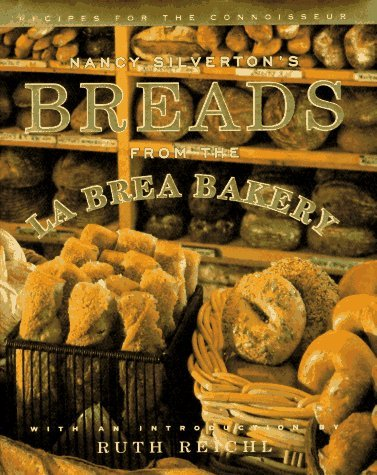
The book is Nancy Silverton’s Breads From The La Brea Bakery. Silverton is a master chef.  She owns and operates the Campanile restaurant and the La Brea Bakery in Los Angeles. Her bread is sought for all over the nation. Her breads and the breads she shares in this book are all made with a sourdough starter that she teaches you to make from scratch with grapes. Actually, you don’t make it, but feed it. Because it’s a living thing. And after a while it becomes almost like a strange family pet growing on the counter and in the fridge.

Some might hear “sour” and turn away, but Silverton explains how to keep the starter from becoming too sour. The result is a crackling, chewy, soft bread with a light tang that’s delicious. In fact, Daughter Number 1 just made bagels from the recipe in the book. There’s no tang at all. They’re the best bagels I’ve had. She’s also made the regular loaf, pancakes, and waffles from this same starter. They’re all delicious.

The book starts off with a lesson in bread making then shares about 60 recipes, everything from baguettes to whole-wheat sandwich bread to sourdough onion rings. The only downside to the book is that I wish it had more pictures. An illustration, for example, in the section on rolling bagels would have been helpful. But we found one on youtube, and it sufficed. And I will confess that I didn’t think once about pictures when eating the bread.

BTW, we’ve stopped calling this bread. Now, when it’s time, one of us will say, “I think it’s time to make some divine nature.”

Our Young Girls

I was recently reading about organized crime and their main activities.  In the section about what ties such groups have to prostitution, the authors reported that it’s estimated that 20% of all prostitutes are street walkers. Another 15% are call girls or escort service workers, and the remaining number, 65%, work in an establishment of some kind—massage parlors, brothers, bars, and hotels.  

The authors reported that most street walkers have a lover or companion relationship with their pimp. This didn’t make sense to me at the time. But after watching Showtime’s Very Young Girls, I now understand what they’re talking about.

This film is a documentary about teenage girl prostitutes in New York City and the GEMS (Girls Education and Mentoring Services) that helps them to find a new direction, which is not always easy.

One of the awful statistics the film reveals is that the average age of entry into street walker prostitution in the United States is just thirteen.

No, that’s not a typo. It’s thirteen. THIR-TEEN.

The film introduces us to Rachel Lloyd who dropped out of school and became a teenage stripper and hooker. But she got out. She changed her life and then started the GEMS program to help young girls who found themselves in situations like the one from which she escaped. Lloyd began the program in her apartment and eventually got funding to open a recovery center where girls can seek shelter while they’re trying to redirect their lives.

The film profiles a number of the girls working through the program. Some of these kids are kidnapped off the street and forced into the “life” as they call it. Some are lured away by pimps who initially act as if they want them to be their girlfriends, flattering them and showing them a good time, and only after they’ve been sleeping together for a while do the pimps then explain that they need to make some money.

Many of these girls come from broken homes. Many have grown up believing the sexual messages portrayed by the media. The girls are beaten and given drugs.

Some have been so psychologically manipulated by their pimps that they feel compelled to return. Others have successfully broken with their pasts.

And all of them are just kids. KIDS!

This is a movie that’s hard to watch. It’s not graphic in any way. It’s simply the subject matter. It’s also eye-opening and, while the problem is huge, does provide some hope. Thank the Lord for people like Rachel Lloyd. And for people everywhere who live upstanding lives and by kindness and good teaching save their children and others in their communities from this terrible waste. Rent this movie on Netflix. I think you’ll find it’s well worth the time.