|

Writing Update: 5/28/11 – Freewrites, Storylines, Proportion

I finished the next chapter of my outline, which turned into three chapters. Hurray for making progress. However, I’m going to need to make more time on a weekly basis if I’m going to meet my goal.

I’ve kept stats over the last four novels. My average is 500 words per hour during the drafting stage. That includes revising and doing quick researches etc. So sometimes I will write a smoking (for me) 800 or 900 words per hour. Sometimes I won’t finish a thing. When I’m all done it averages out to 500 words. I’m going to see if I can’t get 20 hours this next week and finish 10,000 words. 

Addition to last week’s post

 Do you remember last week’s post about the process of making it come alive in my mind first? Orson Card illustrates this as he describes how he prepared to write a story in his essay “How One Story Can Give Birth to Another“.

Spideysense, farmer’s faith, and freewrites

Last week when writing chapter 7, I finished, but felt something was off.  Years ago I would have freaked about writer’s block.  I would have told myself I sucked because the chapter was glucky. But not now.  It’s a gift.  So I stopped and talked to myself in a freewrite.  I had farmers faith that if I just kept working on it, something good would result. 

Here’s what I wrote in that freewrite. It’s an awful read for you, but it shows you just how sloppy and cryptic and freewheeling my freewrites are.

Okay, so I’ve written the stuff below and I could tweak it, I guess. But I keep having this nagging feeling that it’s not good. It’s not a compelling villain. I think he’s creepy and evil. And, truth be told, I don’t want to make him into something other than what he is—a total thrall to the Glory and the mother. So as the “pet” of the mother, what else could he be called? I don’t know.

I shall call you endless because you will be spared, you shall continue, whereas the rest will not. Blessing. Blessed. Grateful. What would you call a thing that did you bidding reliably? But enthralled. I am part of you, you are part of me, and so you may take my name.

He WOULD think—I am not like them. I am GRACED by the Mother’s touch. I have taken her into myself. Or she has graced me and so I have become more than I would be otherwise. I am obedient.

What else do you call pets or tools. Maybe that’s what she calls him. My skir master. The skir lord. My trowel. Harvester.

He’s over the harvest. Reaper. Or he’s the one that supplies food. Supplier. Gatherer. Cook. Chef. Hunter. Provider. Butcher. Slaughter.

So I like Endless with the whole part of him being part of her. But he could use that—”you’re just like us” “no, we are part of the XXX (what was the name I had for them?) endless. You are meat”

Devourers, Mothers, Sublimes

Okay, so do I go with Endless or Harvest Hope. Endless it odd, neat. What could I add to Harvest to do the same. Harvest Lord, King, Overseer, Meatman, Food provider, Feeder, Harvester, Harvest, Rancher, Collector, The Harvester. Harvest.

I think when you’re raised, you get a new name.

Rebellion.

Soul collector.

The Shepherd.

Harvest Prime

Bald Head

Laughter

Everlast

DIVINES

ID HIM AS THE MAIN HARVESTER

RIGHTEOUS ANGER

The issue was that his motive wasn’t working.  I had a feel for what I wanted him to be, and my Spideysense was telling me it wasn’t working, wasn’t interesting.  Thomas McCormack in his book calls this feeling for what you want in your story a “prelibation”.  What an odd term.  But it’s real. 

“Prelibation.  The desire for a certain effect on the reader.  It may or may not be followed instantly by an intuition of what item of narrative will cause that effect, and it’s important to see that intuition and the prelibation it is trying to serve are not the same thing. The intuiting of the narrative that will produce the effect-wanted is the work of the imagination” (p153 The Fiction Editor, The Novel, and the Novelist)

There’s more in his book. I recommend it highly. So, after that freewrite, I didn’t have a solution, but I’d pinpointed the issue, the prelibation. I took a break with kids into the big city. Came back and had my solution for a narrative that would do the trick.  Luckily, it was something I’d cut out of the outline. Back it went with some significant tweaks and was better than before.

Storylines & the Size of this Presentation Phase

For those who have read my series on suspense, at this point, the presentation of the problem for the main story and many of my sub-stories is complete.  Depending on how you categorize them, I have nine to eleven story lines (which makes it impossible to write this book in 100k words).  There’s one main story line that touches everyone—the Mokaddian threat.  Then there are other questions and issues I raise that set the reader up with the expectation for a resolution.

  1. Talen
    1. Mokad/Nashrud (external threat)
    2. Lusts (internal threat, mystery)
    3. Sugar (relationship)
  2. Legs: Vulnerability
  3. Sugar
    1. Talen (relationship)
    2. Urban (relationship)
    3. Ancestors (relationship, mystery)
    4. Mokad (external threat)
  4. Argoth
    1. Mokad (external threat)
    2. Nettle (relationship)
    3. Bone Faces (external threat)
  5. Eresh
    1. Flax (conflict relationship)
    2. The Creek Widow (relationship)

So most of these story lines have been presented, although not all. It took about 30,000 words to finish the presentation phase. I’m estimating 170,000 words, so that a presentation phase of roughly 18%.

There are a lot of story lines and characters to juggle. Sometimes I kick myself for having so many. Of course, I love them, despite the challenge they present. Nevertheless, I AM looking forward to writing that thriller with a limited cast.

Share

Similar Posts

  • In writing, profanity is a tool, but not the only tool

    In this week’s Writing Excuses comments, a poster named Sam asked:

    How do you, as writers, get past your own inhibitions concerning the use of profanity in order to write a character who does use it?

    Why get past them?

    Any given audience has values (as do you as a writer). Stomp on the values too much and you will make the readers so uncomfortable or angry that their discomfort will outweigh the draw of the story. They will put you down and never read you again. For one audience it’s gore. Another it’s explicit sex or vulgarity. For another it’s the bashing of a political stance or a particular demographic.

    If you or your audience is uncomfortable with profanity then say “he swore” OR find another way to convey the information the profanity does.

    Writing works by evoking types in the reader’s mind (as well as type resistors for surprise, curiosity, humor, etc.). Trigger a type and all the data associated with that type comes with it. Profanity is one way to trigger a type (or work against type) in the reader’s mind. But there are many other ways to evoke that same type, many ways to produce the same effect. Language, especially profanity, is a powerful and efficient method, but it’s not the only one.

    You want a mean cruel man? You can have him call his wife a “cu**” all the time. OR you can just show him doing something cruel to her or slapping her, e.g. he grabs her by the neck and makes her look at the food on his plate up close like some pet owners do to dogs when they crap where they shouldn’t–”Does that look like beef stroganoff to you? Stupid whore.”

    Look at Prison Break. Teddy needed to be scary. Profanity could have helped trigger his character. After all, cons use a lot of profanity. But Prison Break was prime time so the writers used other things to evoke the types they needed. Teddy worked for the purposes of that story. All of the cons did. They were believable. And all that without a deluge of profanity.

    Stay away from replacement profanity that evokes a different type. For example, if you had Teddy using “darn it” all the time, unless it was part of some particular character attribute, it would have not been believable because it evokes the wrong type, e.g. Ned Flanders.

    So if you don’t want to use profanity, don’t. Think about your objective and find another type trigger.

    Share
  • When the workshop works

    From a workshop participant at MountainCon:

    I’m going to give a shout out to all the goodness I experienced. So if you don’t really care what happened at the con, you can stop after this paragraph and take this message away with you: Brandon Sanderson (who does Writing Excuses, has published several novels, and is the chosen one to finish Jordan’s Wheel of Time series) and John Brown (with a must buy novel coming up next year) are incredible teachers. If you ever get a chance to attend a class or workshop by any of them, don’t let it pass.

    We loves to hear these things, Precious.

    But we loves it just as much when we can make the students shiver with excitement: more here: http://www.amichopine.com/blog/?p=318

    To those who missed this run of the 3 Things You Must Learn to Write Killer Stories Workshop, know I’ll be holding it again. Check back to see when.

    Share
  • David Morrell Workshop, June 6, 2008, Boise

    One of the things I love about writing is that there’s always something new to learn. There’s always new content and, therefore, lots of cool research, but there’s also a lot to learn about the craft. I have no illusion that because I now have a contract I’ve suddenly arrived as a master craftsman. This art is just too big.

    So you can imagine my delight when I saw that David Morrell is going to be giving a day-long workshop in my own backyard (out West, 5-8 hours is still in your backyard). I’ve signed up for Morrell’s workshop on June 6, 2008.

    He’s the guy who wrote Rambo and started Thrillers Inc. He was also a professor for many years.
    More on the Conference
    http://www.murderinthegrove.com/index.htm

    More on Morrell.
    http://www.shotsmag.co.uk/shots21/intvus_21/dmorrell1.html
    http://www.davidmorrell.net/
    http://www.writerswrite.com/journal/oct02/morrell.htm

    This was interesting.

    Ali: As a Professor of Literature at Iowa, what were your experiences in academia like? Did you tutor any students who became prominent in the fiction field?


    David : I have a Ph.D. in American literature and taught academic courses: the American Novel of the 19th Century, the American Novel of the 20th Century, American Realism, Hemingway and Faulkner, Hawthorne and Melville, that sort of thing. The University of Iowa has the famous Writers Workshop, but I had nothing to do with it. In fact, they hated the sort of books I wrote and hated even more that I earned money as a novelist. That was the official line. But in secret, students snuck to my office and asked me technical questions about craft or asked me to read contracts they’d been offered (to see if the contracts were reasonable). Sometimes they showed me their manuscripts. The most productive association of that sort was with Jon Jackson who later published a series of police novels about Detroit. My most gifted student was T. C. Boyle. He writes humorous literary novels and short stories that critics love. His latest is DROP CITY. I taught him nothing about writing – he was a genius. But he did ask me to direct an individual reading course that he needed in order to graduate. We had a lot of interesting discussions, and I’m thrilled by his distinguished career.

    Interestingly enough, T.C. Boyle was one of the writers that made life bearable for me while I was getting my BA in English. His novels, well, I never finished one of them. But his short work sings. Heck, his long work sings, but there’s not enough plot for my tastes.

    Share
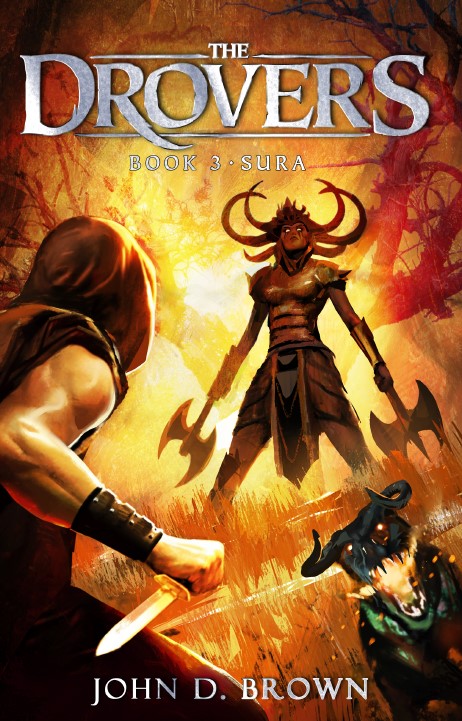
  • Sura cover reveal

    Behold the cover. A big thanks to Dixon Leavitt for the art.

    And here’s the description we’ll be using.

    Nobody in their right mind travels through this place.

    All Ferran wants to do is get the cattle to Broniss, get paid, and free his family from the threat of slavery. But an unexpected and terrible enemy takes most of the crew prisoner in the Blight.

    Ferran, Winwallom, and Sura, the fierce Mashadian girl none of the boys trust, must free them.

    But how will they when the trio is vastly outnumbered, they’re days from help, and other things lurk in the woods?

    I’m so excited to get this book into your hands. I had a blast writing it.

    If you don’t want to wait, Sura is now available for preorder.

    Share
  • Positive Review from James Maxey on Orson Card’s Intergalactic Medicine Show

    James Maxey is a writer I admire. For his work ethic. For the quality of his prose. For his imagination. His story “To Know All Things That Are In The Earth” is one of my favorites. So you can be sure I was pleased to find and read this today.

    I will say, in utter candor, that Servant of a Dark God is a work that truly stands out from other fantasy books on the market. What makes this book work so well is that it’s a story about family first, and a fantasy adventure second. Full review.

    Share
  • |

    Writing update: brainstorming the ending of Curse

    I’ve had a number of people ask me where I am with the second book. I have the progress bars on the side, but they don’t give any details. So I thought I’d start up a semi-regular post that would be something like a writer’s journal. We’ll see how it goes.

    Right now I’m working on the climax of CURSE OF A DARK GOD. For the last two weeks I’ve been struggling trying to figure out the flow. I knew in general what I wanted to have happen. I had some images and the general feel–spectacle, revelation, battle at the fortress–knew I had to fulfill some expectations I’d raised with four characters. But I didn’t know the exact steps of the scene, the back and forth. I also hadn’t figured out the exact details of some of the magic that would be used.

    I outlined the objectives and plans of the two opposing warlords and then the steps of the scene. I listed my objectives for the scene. I do this sketching, sometimes exploratory drafts, to help bring the scene to life in my mind. I find that until a scene is alive in my mind, it’s impossible for me to write. Anyway, over the course of two weeks I went through six takes of the scene, and it still didn’t feel right. I won’t give the details and spoil the ending, but it just wasn’t there and I was getting frustrated. I’m behind on my deadlines and a book’s ending it critical. I talked a few things over with Nellie and made some headway, but it just wasn’t there.

    So I called a brainstorm meeting. I’ve never done this before for my writing work. I mean, I’ve bounced things off individuals (mostly Nellie) many times and found good resolutions, but I’ve never had a group. However, I felt I needed some extra input to get my mind going down new paths. Lenn Johnson, Amy and Alex Lamborn, and Miles and Becky Pinter came over. I borrowed a white board and easel from my church and made gingersnaps. When they arrived, I sat them around our kitchen table with Nellie and had them riff on one question while I captured their answers and ideas on the white board.

    It was incredibly productive. Partly because they came up with some great ideas I’m going to use. But also because it got me thinking in a new way which allowed me to come up with an idea that resolved the main issue I was dealing with. That was last Thursday. The next day I sat down and outlined a scene that did everything I wanted it to, including giving me the “oh, baby” feeling. It feels right. I have the spectacle, the revelation, the fulfillment to the expectations for the characters. I’m excited to write it. Which means I can now move forward. This week and next I hope to finish. After that there are a few small things I need to insert and clean up. Then it’s off to my editor.

    BTW, I did some calculations. For those interested, in this draft, the third, I ripped out 50% of the draft two and completely rewrote it. New problem and situation for two of my three points of view, major changes, etc. I heavily revised above 20% of the remaining 50%. I’ve put in a little over 500 hours working on this draft over the last six months.

    500 hours  (remember, I still have a day job).

    I am a slower writer than many. But it still would have been a huge task even if I could write twice as fast as I do. I think this is a perfect illustration of three things. First, if you don’t fix some things you feel are off when you find them, you might find you have a massive amount of rework later. Second, sometimes you don’t recognize you have those issues until you’re well into it. Third, writing requires the author to make time. I think this is the most important one. And the one that probably kills most aspiring writers. The fact is that if you can’t make time, you ain’t going to write 🙂

    Speaking of making time as a new artist, watch this interesting interview with author Scott Turow.

    Share