Writing update: 5/16/11 – outlines & writing vividly

Finished chapter 5 of CURSE last Saturday. Huzzah!

The writing is a blast, even though it still requires work. Along those lines, I’ve been meaning for some time to write up the techniques and principles I use when drafting.  So I think I’m going to do a semi-regular post on a weekly basis where I share these tidbits as I run into them. It will be kind of like director commentary, although I’ll have to be careful not to toss out any spoilers.

This week I’ll talk about using chapter outlines and writing vividly. 

Bullet Outlines & Chapter Outlines

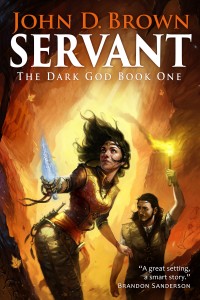
Up to this draft, what I’ve done is work from a bullet outline.  Each bullet is a short statement of what needs to occur.  Sometimes it’s very general about the story arc–presentation of the problem, struggle, and resolution.  Sometimes it’s a very specific step.  Sometimes it includes cryptic notes.  For example, here are some bullets for SERVANT:

  1. Talen goes to village, they suspect him
  2. Talen runs, sabin catches him by his hair and pulls him back, field stone size of liver. Plant idea of him catching Hatchlings
  3. Woods back home, freaked
  4. Father is not as concerned, strange, sends him out to field–Talen starts to think about catching the Hatchlings himself

As you can see, it gives me a roadmap (which often changes) so I’m not starting from nothing when I open up my chapter document.  But it’s very general.  When using this, I often have to use a number of takes to get the scene written because those first takes are me imagining the scene. In fact, my first take is usually a sketch of the scene with me blocking out my goals for the scene and how I expect the events to occur. However, in this last go at CURSE I wrote a chapter outline.  It took me about 25 hours, and the outline for CURSE ran 32 pages. I’ve pasted the first two chapters below.  You can see they’re still mostly in summary, but they represent the initial sketch of what’s going to happen.   

1.               The Village of Plum – TALEN

It’s past midnight, behind enemy lines. A thin moon hangs in the sky. Talen, Sugar, River, and five of Shim’s best soldiers crouch in the black shadows of the tree line running along the road to the village of Plum (Sugar’s former village), watching for soldiers or a village guard.

Talen jokes with Sugar, telling her he wanted a dance tonight, not a sneak behind enemy lines, even if it was in the dark. He’s more than half serious. As they’ve worked together over the last three months since the battle in the cave, he’s become attracted to her.

Also during those three months, the clans of the New Lands split into two factions. Five clans, led by the Fir-Noy, believed Shim, the leader of the Shoka clan, was being controlled by sleth. The remaining four clans followed Shim. The Fir-Noy faction immediately took up arms, initially to protect themselves, but they soon began talking about ridding the land of the sleth curse. Tensions rose, and in a series of altercations a number of people on both sides were killed. Now both factions have mobilized forces to establish pickets and patrols along a border between them.

A few days ago, Argoth received word from his spies that something was afoot in the Fir-Noy clan, as if they were preparing for a strike. Futhermore, they’ve decided to excavate the grounds about Sugar’s old house. Argoth knows Purity had her own cache of weaves under the hearth of her old home, the location of which she revealed to Sugar just before she died. Argoth has begun to train up an army of dreadmen for Shim. But he’s stretched thin. He needs all the lore he can get. So he’s sent Sugar and the others to retrieve the items before they’re lost. They’ve come on the evening of the annual apple dance festival, hoping the Fir-Noy would be less vigilant. So far, they’ve been right. In fact, Talen begins to feel like it’s been a little too easy.

As Talen and the others prepare to move forward, Sugar puts her hand on Talen’s arm. He can feel Sugar’s Fire and soul, and her touch only enflames his desire for both. He’s alarmed by this intensity, and finds it hard to focus, so he moves his arm away.

“You’re going to give me a boost up,” she says.

Up ahead in front of the Fir-Noy village stands a thick timber pole probably 11 feet high. Fastened to the top of that pole is what looks to be a skull.

“You brought us round the wrong side,” Talen says. Their objective was the ash ruins of Sugar’s burned out house, not this pole. 

“You can’t think we’d come all this way, and I’d leave without it.”

It’s her father’s skull. The only thing of his that remains. Talen, not wanting contact, motions at one of the taller soldiers with them. “He’d be taller.”

“Come on,” Sugar says and moves forward in a crouch. They move out of the shadows and into the moonlight, watching the village. Sugar climbs up on Talen’s shoulders and cuts loose the bonds holding her father’s skull. The whole time Talen’s desires make the experience uncomfortable.

Once Sugar has the skull safely in her sack, the group keeps to the deeper night shadows of the tree line and moves around the edges of the village fields until they come to a ditch. Along the way, one of the soldiers touches Talen, and he feels that same overpowering desire. Something is not right inside of him. He knows it. But there’s nothing to do about it now as they follow the ditch to the ash ruins of Sugar’s house.

Sugar and Talen sneak over to the hearth of the burned out home. River and the five Shoka soldiers take up watch. Soon Sugar finds the secret cache, but as she’s removing the items, they hear a sound come from one of the surrounding houses. Talen and the others stop and listen. Suddenly Fir-Noy soldiers burst out of the door. They overwhelm one of Shim’s soldiers and rush straight for the others.

Talen and the others turn to run, but Fir-Noy soldiers begin to pour out of four other houses. Then a Fir-Noy dreadman emerges and shouts it’s the boy that’s wanted. They can slaughter all the rest. It’s clear these soldiers were waiting for them, but there’s no way they could have know Talen and the others were coming, unless they were betrayed. 

2.               Hue & Cry – SUGAR

Sugar stuffs the last item in the secret cache into her sack and rises. The Fir-Noy are shouting, but River charges a gap in the quickly forming mob. She fights ferociously. The others race after her, Sugar and another soldier bringing up the rear. Sugar and the others are multiplied, but they’re not fast enough to avoid the soldiers completely, and Sugar is forced to fight and kick to break her way through. When she finally does break past the men, she finds she and the last soldier have been separated from the others and there’s no way to immediately join back up.

Sugar and the soldier run, but he’s wounded. He tells Sugar to run on without him. She refuses, then a company of Fir-Noy round the corner of a house. The soldier turns to face them and tells her once again to run. In her mind’s eye, Sugar sees the same situation unfolding before her as when the mob came after her mother and da. She ran then and regretted watching her father get butchered. She isn’t going to run now. Besides, she’s multiplied. So instead of running, she rushes over to the soldier and, with lore-given strength, picks him up, puts him over her shoulders, and, despite his protests, speeds away.

Sugar knows she won’t be able to outdistance her pursuers like this, but she also knows the villager Stout keeps a horse in the barn just ahead. She turns the corner on the barn, puts the soldier down, and tells him to get the horse. Then she darts back out into view of the soldiers following and leads them away. She glances back and sees the soldier slip into the barn. It’s the best she could do for him. If he can get on Stout’s horse, he’ll have a chance to escape.

Sugar looks to see how she might join back up with Talen and the others, but it’s impossible now. And while most of the Fir-Noy soldiers chased after Talen and the others, a good number are chasing her. Furthermore, others in the village are coming out of their homes. She speeds past them. All over the village dogs begin to bark, but she hears one cluster that sends fear down her spine. The villager Solem keeps a pack of prize-winning sight hounds. He emerges from a barn with his pack on a leash.

“There!” a man shouts. The barking of Solem’s dogs rises in pitch.

Sugar increases her speed then hears Solem. “Stu, boys! Take her. Get the wretch!”

The dogs shoot out after her.

So how has it worked?

So far it’s worked very well. Having that initial sketch done means I take a lot less time finishing each chapter.  However, it doesn’t change the general drafting process for me:

  1. The chapters still change as I write. I find cooler ways to accomplish what I need. I also run into things I haven’t imagined yet and have to invent them. For example, on chapter 2 when Sugar is having issues, I realized I didn’t know exactly where the houses lay in the village, so I had to sketch that. It presented opportunities and images.  For example, I thought about the Fir-Noy bowmen being on the roofs. I hadn’t imagined that before, but it was so cool to me, I had to put it in.  Then I felt I wanted Talen and her to huddle together at first. I had to run through a few options about how that played out before I found one that felt right.  
  2. I still find I need to sketch out my goals for the chapters and an initial blocking of what happens. This is much shorter than it’s been on previous drafts, but I still find it helpful. Blocking scenes helps.  This is me just figuring out where everyone is and how they move. Sketching this first helps me write faster.
  3. I still have to do takes, although I move through them more quickly.  

 As you can see, I find the sketch/draft method incredibly helpful.  Just like a painter, I sketch out what I’m thinking of painting. That might require a few sketches where I add in more details.  Then I switch over and begin to paint.


Writing Vividly

On another note, I read “Stories are made out of scenes; Scenes are made out of nouns” by author James Maxey again. I really like this essay. Everyone is always talking about verbs, but nouns are such powerhouses.

Speaking of which, here is the opening to Maxey’s “To The East, A Bright Star” which was published in Asimov’s.  It has one of my favorite beginnings. And part of the reason is what Maxey talks about with nouns.

TO THE EAST, A BRIGHT STAR

There was a shark in the kitchen. The shark wasn’t huge, maybe four feet long, gliding across the linoleum toward the refrigerator. Tony stood motionless in the knee-deep water of the dining room. The Wolfman said that the only sharks that came in this far were bull sharks, which were highly aggressive. Tony leaned forward cautiously and shut the door to the kitchen. He’d known the exact time and date of his death for most of his adult life. With only hours to go, he wasn’t about to let the shark do something ironic.  

Tony waded back to the living room. Here in the coolest part of the house, always shaded, he kept his most valuable possession in an ice-chest stashed beneath the stairs. He pulled away the wooden panel and retrieved the red plastic cooler. Inside was his cigar box, wrapped in plastic bags. He took the box, grabbed one of the jugs of rainwater cooling in the corner, and headed up the stairs to the bathroom. He climbed out the window above the tub onto the low sloping roof over the back porch.

This all reminds me of Swain’s thoughts on bringing the material to life, which I thought Maxey did so well in those paragraphs.

Few of us read voluntarily about the primer-level doings of Dick and Jane.  Simplicity is a virtue in writing, true; but never the primary virtue.

What is?

Vividness.

How about brevity?

It’s important too.  Within reason.

Within reason?

Who, just learning this business, knows where or when or how to be brief? In the wrong place, brevity can destroy you.

So?

As in the case of simplicity, brevity is never the heart of the issue. Vividness is.

How do you write vividly?

You present the story in terms of things that can be verified by sensory perception. Sight, hearing, smell, taste, touch–these are the common denominators of human experience; these are the evidence that men believe.

Describe them precisely, put them forth in terms of action and of movement, and you’re in business.

Your two key tools are nouns and verbs.

(p25 Techniques of the Selling Writer)

Of course, there’s more–the telling detail, metaphor, working memory overload, details from the point of view. But it all plays into being vivid.
Masters of Chaos, Chosen Soldier, and Teenage Boys

US Army Special Forces

Nobody can stand up to the US Military’s conventional fighting force using conventional tactics.  Yes, Russia and China have significant militaries and a fight with them would be bloody.  But it’s not likely we’re going to go to war with them.  Instead, as we’ve seen since the 1990’s, we’re likely to fight much smaller groups—Somali warlords, genocidal brutes in the Balkans, terrorist-supporting regimes like the Taliban, unstable dictators like Saddam Hussein, or Islamic extremists who aren’t associated with any nation. 

Those who do try to fight us conventionally get wiped out.  We saw that very clearly with Saddam Hussein.  Which is why the fight went underground.  In this type of war, when the bad guys are hiding among the good, we can’t just rush in and bomb the place to the stone age.  If we do, the local population will soon come to hate our presence and work against us.  And when that happens, we set ourselves up for defeat.

The best way to fight against insurgents is to ally ourselves with friendly portions of the populace who can identify who the insurgents are, which doors to kick in, and can actually kick those doors in themselves, if only they get some support and training. 

Because of this, a strong argument can be made that the US Army’s Special Forces are the most effective tool we have in winning the types of wars we’re likely to fight in the near future.

The US military has a number of special operations forces.  Those you’re probably most familiar with are the Navy SEALs, Delta Force, Rangers, Marine Force Recon, and the Army’s Special Forces (commonly known as Green Berets).  There are other groups like the Air Force’s Combat Control Team, the Army’s 4th Psychological Operations Group, and other black op units that the military doesn’t officially recognize. There is some overlap in the types of things these forces do.  However, each has its own focus, the thing it’s best suited for. The reason why the Army’s Special Forces are so valuable in our current environment is that one of their main missions, the thing they do better than anyone else, is conducting and fighting unconventional wars.

Along with all the other cool stuff that goes along with special operations work, Special Forces troops have to learn how to build rapport and trust because unconventional war is conducted through and by the indigenous population.  Special Forces troops not only have to know how to conduct high-risk missions, they have to be able to train others to do the same, which is why they are all required to learn a second language.  All this people work requires a more mature soldier.  And it shows: the average age of the SF operators is thirty-two, while the average age of a US Marine is nineteen.

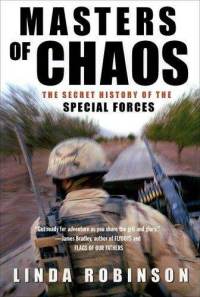
I just read two fabulous books on the Army’s Special Forces.  The first is Masters of Chaos by Linda Robinson. Robinson was given unprecedented access.  She traveled with them to the front lines and was allowed to interview and report as no other had been allowed up to that point.  She starts with a brief history of the SF and their training; she then details missions the Special Forces carried out from 1989 – 2003, including their work in Panama, El Salvador, Kuwait, Somalia, the Balkans, Afghanistan, and the second gulf war.  My eyes were opened to the significant role they’ve played in all these conflicts.  It was absolutely fascinating.

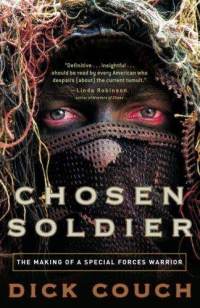
The second book is Chosen Soldier by Dick Couch. Couch, a former Navy SEAL and CIA case officer, is the only writer ever given the privilege to attend the many months of Special Forces pre-selection, preparation, selection, and qualification training from start to finish.  He was given “full access to all training, venues, students, and training cadres.”  Couch did not merely interview.  He and his wife moved to one of the few residential structures on base at Camp Mackall in North Carolina.  Couch went out with the SF candidates to observe first hand exactly what they did, and, in a number of instances, do it with them.

One of the things I loved about this book are the personal bios given about the backgrounds of the various candidates.  They are not at all what you’d expect—everything from bouncers to engineers to one fellow who had a degree in and a passion for Russian literature.  I also enjoyed the details he gave about the training.  There are about 1.2 million people in the US Army.  Only about 5,000 of them are in the Special Forces.  When you finish, you have a good feel for the types of things they learn and why about 80% of those who volunteer for training wash out.

I couldn’t put either of these books down.  If you decide to read them, let me also recommend you download and read Army Field Manual 3-05.20 Army Special Forces Operations as well, which is the Army’s “keystone manual for Special Forces (SF) doctrine” that “describes SF roles, missions, capabilities, organization, command and control, employment, and sustainment operations across the operational continuum.”  You can find it here: http://tinyurl.com/3ryt3o3.  For those who just want an overview of these forces, the Army has provided a great site here: http://www.goarmy.com/special-forces.html. 

The Boys of Laketown and Round Valley

Every school morning my wife and two oldest girls hunt.  They eat their breakfast perched high on a hill and watch for the quarry.  When it appears, a shout is raised, and the trio races to the car.  They blast out of the garage, perform an expert three-point turn, then Monte Carlo down the winding hill road.  Next, they attempt to set a land speed record on the straight shot into town, all in an effort to catch the big yellow school bus. 

Most days they make it.  The bus makes a few stops in town.  Sometimes they’re not so speedy and can only manage to catch the bus at its last stop.  Sometimes I join in on the hunt.  Most of the time I catch the bus at its last stop in town.  But this week I was quick enough to get them to the third stop in front of the middle school where most of the teens board the bus.  And I had the privilege to witness a class act.

The first time I arrived with my payload, all but two teen boys had already boarded.  We raced up to the bus, my daughters flew out of the car, and the two teenage boys from Round Valley stopped.  They did not get on.  They waited for my girls to hustle the length of the bus.  My girls got on, and the boys followed them in.

Odd.

The next day we got there a little bit earlier.  This time I witnessed ALL of the boys from Laketown and Round Valley stand and wait for all the girls to get on first.

What was this? 

I asked my girls about it.  They confirmed—it wasn’t a fluke.  While first initiated by the bus driver, the boys have the class to show this courtesy every day. 

Teenagers . . .

Bravo, Gentlemen.  Bravo.

It has begun

The very observant will note that the progress bar for draf 4 of CURSE OF A DARK GOD has moved. Here’s the opening, although I’m sure it will change. We’re on our way, folks.

It was well past midnight, and they were deep in enemy Fir-Noy territory.  There were eight of them: Talen, Sugar, River, and five of Shim’s soldiers, all of them staying back in the deep moon shadows at the edge of the wood, crouching low in the dry autumn weeds that had not yet been eaten down by the village livestock.  They had to be careful.  Talen, Sugar, and River all had sizeable Fir-Noy bounties on their heads.  And even though they wore weaves of might, being multiplied didn’t make their flesh impervious to arrows and blades. 

This vulnerability had been made abundantly clear to Talen in his training.  In addition to his many fine bruises and the finger which had recently healed from a break, he wore a bandage around his arm where a soldier had cut him in practice two days ago with a spear. 

The night shadows of the clouds played over the moonlit fields and houses and road that ran through the village of Plum.  The village where Sugar’s father had been killed and her mother taken and beaten.  The village where the Fir-Noy had burned her life to the ground.  The village that was their destination.

Purity, Sugar’s mother, had hidden valuables there.  Weaves and maybe a codex of lore.  Talen and the others had been tasked to steal into the village and retrieve the items, right under the noses of the sleeping Fir-Noy.

Except this wasn’t right.  They were supposed to have come out across from the ash ruins of Sugar’s old house.  “I think you’ve brought us to the wrong end,” Talen whispered to Sugar.

“No, I’m just coming to get what’s mine first.”  Sugar pointed up the road to the entrance of the village.

Talen followed her finger.  The Fir-Noy here had begun to build a wall around their village.  A wooden palisade atop a mound of dirt.  But she wasn’t pointing at the half-finished wall with its timber supports still showing like bones.  She was pointing at a tall pole that had been erected at the gate of the village.  Something had been fastened to the top of the pole.  Talen peered closer and saw a skull shining pale in the moonlight. 

“That’s your father’s, isn’t it?”

“You’re going to help me,” she said.  “He deserves better than that.”

Green light for CURSE

I just got word from my editor, and we’ve finally been able to agree on the outline!

Let us rejoice.

It took far longer than I’d planned. But I’m happy to move forward. I’ll finish up a couple of things I’m working on right now with the thriller and then begin production next week. I’m estimating I’m going to have to write about 130k worth of new material, which is basically enough to fill a normal novel. If I’m diligent, I can average about 7,500 words a week. That’s not super fast, but I do have a day job. So my initial target for delivering it is September 1st.

It then goes into the publisher machine. I’ll know in the fall what the release date will be.

This will also give me some extra time to develop the premise of the thriller. I hoped to have a rough outline by this point, at the very least the story problem. But it’s not quite there yet. So this will give me a little more cooking time. I’m still hoping to finish BOTH before the end of the year. At least two novels a year. That’s the goal.

Interview with Author Bradley Beaulieu

Bradley P. Beaulieu just had his first novel released on April 1st. It’s called The Winds of Khalakovo and is the first of three planned books in The Lays of Anuskaya series publishehd by Night Shade Books. In addition to being an L. Ron Hubbard Writers of the Future Award winner, Brad’s stories have appeared in various other publications, including Realms of Fantasy Magazine, Orson Scott Card’s Intergalactic Medicine Show, Writers of the Future 20, and several anthologies from DAW Books. His story, “In the Eyes of the Empress’s Cat,” was voted a Notable Story of 2006 in the Million Writers Award. His agent is Russell Galen.
Brad is a software engineer by day, wrangling code into something resembling usefulness. He is also an amateur cook. He loves to cook spicy dishes, particularly Mexican and southwestern. He lives in Racine, Wisconsin with his wife and two children. As time goes on, however, Brad finds that his hobbies are slowly being whittled down to these two things: family and writing. In that order . . .

I recently had the opportunity to interview Bradley. Among other things, we talked about how he broke in and how he comes up with his ideas. He also convinced me to use his picture method, which I’m finding very handy on my current thriller project.

***

JOHN: In your novel an elemental spirit attacks an incoming windship, murdering the heir to a kingdom. The person believed to be behind this is a child, an autistic savant. This sounds like Orson Card tale (grin). Did you come up with this character first, the magic, or something else. Tell us the genesis of the tale and this character in particular.

BRADLEY: The genesis of the book is actually from a series of postcards of fine art that I picked up in Edinburgh, Scotland. (I posted about it on my website if you’re curious to learn more.) I used that artwork to first generate and then crystallize my thoughts about the book. Initially, I tried not to let any one thing rule the brainstorming I would do from time to time. I didn’t even know who the main characters were at first. I was quite taken by the picture of the three sisters, though, and I knew right away, the moment I laid eyes on the original in the National Gallery, that they would play a major part in the novel.

But in the end it was the picture of the boy with the flaming brand that kept leaping out at me, calling for attention. The artist is Godfried Schalcken, and the piece is called A Boy Blowing on a Firebrand to Light a Candle. This character eventually became Nasim, the autistic savant. As I was studying the characters, I began to realize that this boy was not going to be a point-of-view character, but he was going to be a prime mover. In the end, he embodies much of what Winds is about. The story truly does revolve around him and his unique powers.

The brand that he holds in the painting also came into play. I didn’t know what the magic was going to be about. I hardly had a single preconception about the book going in. I just wanted the artwork to speak to me, to advise me as to what the story was going to be–from the characters to the world to the magic. The boy blowing on the brand got me to thinking about elemental magic, and I realized that Nasim was one who could do this without even thinking. It came as naturally to him as did breathing. That’s a difficult place to put a character, however. As a writer, you have to be careful of all-powerful things, and so I needed something to balance Nasim’s abilities. And this, of course, is where his disconnection from the world came from. Nasim, as written in the book, is often lost. He has difficulty relating to others in even the smallest of ways. This both limited his power and made him in some ways more dangerous and more scary than a calculating villain, simply because of the unpredictability.

I’d be remiss if I didn’t also mention Rehada, who started out as a somewhat minor character but grew into the most complex and perhaps the most compelling of my three main characters. Rehada came from Andrew Geddes’ Hagar. It’s another beautiful painting, filled with emotion. I was drawn to the fact that she was crying. I wondered why. I spent a lot of time answering that one question. After knowing that her people were essentially pacifists, I realized that Rehada was not. She felt she had betrayed her people and their ways because she had taken to the path of violence. It was from this, from that one single tear, that the entirety of the Maharraht–the fanatical splinter group that came to embrace violence as a means to an end–was born.

By this point, I understood that I wanted there to be an aristocracy of some kind, and I fairly quickly landed on a culture that was modeled loosely after Muscovite Russia. I don’t remember why, exactly. It might have been that the other artwork reminded me of Russian Czars a bit, but I think the biggest driver here was that I definitely didn’t want something that was centered around western Europe, because frankly that’s been done to death. I wanted something more unique, and I’d always sort of like the mystique and darkness that seemed to hover around that time period in Russia. They’ve always seemed like a hard people, a people that would do whatever it took to survive, but in the same light, they took time to live life fully when they could.

Given that I had the loose guidelines of the aristocracy, the peace-loving, indigenous Aramahn, and finally the will of the Maharraht to do whatever it took to regain the islands as their own, it created a crucible from which the story flowed fairly easily. I spend a lot of time building my worlds so that the conflicts within them come naturally, and that was definitely the case here.

JOHN: The description of the world and your process for getting into the story is fascinating. From the article on your site it sounds like using images was a new technique for you. Is that correct? And if it is, was your process previously to have some other physical object of which you’d ask questions?

BRADLEY: Yes, using artwork as a starting point was a new technique for me. I had no idea if it was going to work or not. An interesting thing came up when I was doing it, though. One of the things I learned at a few of the workshops I’ve been to (Writers of the Future and Orson Scott Card’s Literary Bootcamp) was to create stories in very little time using a few unrelated things as starting points. One unanticipated result of having restrictions in some areas (such as the elements involved in the story) is that it opens your mind in other areas. You’re forced to become more creative in some ways because certain avenues have been closed to you. I think it was the same with the portraits I used to represent the characters.

Before that, in the previous three novels I’d written, I didn’t really have any specific brainstorming techniques. I would start with a premise and perhaps a loose idea of the characters and a mood, and I would go from there, trying to stay true to those things as the story evolved and grew. Although part of the problem with those early stories was that I was young in my craft, I also think my brainstorming wasn’t very efficient. I think, as I alluded to above, that there were too many possibilities. I had trouble narrowing the story down, and it led to stories that were ok, but nothing great. Too often they became a bit generic. Nothing really stood out.

So while the artwork I used is one of a great many possible brainstorming techniques, I like the idea of challenging yourself with restrictions in order to force the story to stretch and bend in unpredictable ways.

JOHN: Wow. That’s a striking insight. I think I’ve found the same thing occurs when I run workshops or do my own brainstorming, but I don’t know that I’ve ever crystallized it the way you have. (See folks, this is why I love these interviews.) So I see _The Winds of Khalakovo_ will be published by Night Shade books. You’ve had quite a few short stories published, but this is your first novel. How did you make the sale? Did you have an agent? Was the editor someone you knew? Gives us a bit of the story behind this.

BRADLEY: As you said, I’d been making steady progress throughout the years in short story sales. I had attended a number of workshops, and I think my name had at least some recognition by editors, either from short stories I’d published or personal connections I’d made at conventions. As an aside, some people will say that you shouldn’t go and sell yourself at conventions. If an opportunity comes up, they say, and an editor or agent asks you what you’re working on, go ahead and take advantage of it. I don’t doubt that that’s good advice for some. Just not for me. I believe that editors and agents are at cons not just to meet with their authors and speak with agents, but to see who’s coming up in the field. They’ll get to know a certain percentage of the newcomers from their short sales, or even novel sales, but they can’t read everything. They can’t even read a small percentage of the fiction that comes out each year. So, frankly, it’s up to me to make them aware of who I am.

Now, that doesn’t mean you should be pushy. You should be friendly and businesslike. Keep things short and sweet and as casual as you possibly can. And that’s exactly what I tried to do. I approached Jeremy at World Fantasy in San Jose (2009) and told him I had an epic fantasy that he might like. I pitched it as “The Song of Ice and Fire meets Earthsea.” He asked me if I had an agent. I said no. Night Shade doesn’t normally take unagented mss (and I should probably ask Jeremy some day if he gets annoyed that I tell this story), but he said he liked the cool pitch and said to send it his way. Roughly five months later, I got an email from Jeremy, offering to publish the book. 

At that point, I moved quickly to find an agent, and believe me, agents will move quickly as well if you tell them you have an offer on the table. That doesn’t mean they’ll be clamoring to sign you up. It just means you have their attention. I was lucky enough to be picked up by Russell Galen of the Scovil Galen Ghosh Literary Agency. Russ and I are simpatico on a number of levels, and to be frank, as an agent he kicks serious ass, so I feel honored and blessed to be under his wing.

JOHN: What a great breaking in story. And you’re right, Galen is tops. So to give my readers perspective, did you approach a lot of editors this way? Or was Jeremy at Night Shade one of a select few? And did you encounter any annoyance? I know my editor, David Hartwell at Tor, doesn’t much like to be approached at cons. But obviously, that’s not the case with all editors.

BRADLEY: Well, I had not approached anyone else for Winds. However, I had previous novels, and I’d approached a variety of agents and editors over the years. Not scads of them, mind you, but a number of them, and there were more agents I spoke to than editors because the general rule of thumb is that you can approach and/or query multiple agents at the same time, whereas editors you typically ask for exclusives, even at the partial stage. I was also careful about who I approached, and when. I went to the Pikes Peak Writers Conference for several years. They had pitch sessions there, where you can sit down with an acquiring agent or editor and talk to them about your novel. I certainly took advantage of this, but I also wasn’t afraid to approach them outside of those sessions. At conferences in particular, I think the invited guests are open to being approached at the bar, at the dinners, and at the parties. Again, though, I tried to keep things as casual as I could, and I kept the pitch short and sweet so that they could determine quickly whether it was a project that interested them. Most often I got a “Sure, send me 50 pages” type of answer, but I got a few requests for fulls by doing this as well.

Conventions are another beast. It’s a looser environment than a conference, so I was much more choosy about when I approached agents and editors. I’ve never encountered annoyance, but I’ve certainly felt stiffness from those who perhaps would rather not be approached. I learned from this early on and adjusted my approach. I would try to meet them first and strike up a conversation and see where it went. Often, if you can just be humans with one another, the subject of what you write and what projects you might have ready will come up. Try to take that approach, because there’s nothing to put off an editor that already keeps unknown writers at arm’s length than the smell of desperation. In the words of Monica Geller, keep it breezy.

JOHN: Well, I’m excited for you. Night Shade is a great publisher. So I have one more question: what’s next?

BRADLEY: I’m contracted for two more books, so that’ll occupying my time for a little while yet. But I’ve started brainstorming the next project. (I like to let things germinate for quite a while, so it’s important for me to get my hindbrain working on these as early as possible.) I have two possibilities that I’m mulling over. The first is a science-fantasy called The Days of Dust and Ash. Think Nausicaä of the Valley of the Wind meets The Coldfire Trilogy. I’m excited about this story, because it’s a departure from what I’ve written in the past, though it will still be fantastic and wide in scope. The story focuses on a young girl who is summoned from the dust, a global consciousness that was created as the last great age of technology fell under a nanite plague.

The other is called From the Spices of Sanandira. I sold a novella with the same title to Beneath Ceaseless Skies last year, and it will be appearing sometime this spring. It’s a story that springs from Sanandira, a large desert oasis known for its caravan trade and spice bazaars. It’s got a strong Thousand and One Nights feel to it. The novel is not so much an expansion of the novella as it is a re-imagining of it. It will probably focus on a pair of twins: one boy, one girl. The sister is sold to one of Sanandira’s famed assassin rings at a young age. The boy (the protagonist) finds his sister by happenstance years later, and because of this chance meeting is drawn into the world of intrigue his sister walks every day.

***

 JOHN SEZ: I just love hearing how other authors work. As I said before, after this interview I decided to use the image technique myself on my current thriller project. Images of people and places and thing. I’m finding it helpful to help the story come to life. I also think Bradley’s breaking in story illustrates one key thing: work. And that’s exactly what I need to do right now 🙂