|

Radiolab’s “Parasites”

Radio and TV have incredible power. But until the last decade they were always constrained by time and signal power. You had to listen when the station broadcast it, and you had to listen where you could pick up the signal. 

Living out in the boonies we don’t get good radio or TV reception (no I don’t subscribe to satellite). Which is why the internet is so wonderful.

You can listen and watch almost anything when you want from almost any location–yes, even in Laketown, UT, Boonie Central. Millions listen to music, conservative talk, or libral talk (NPR) via the internet. I enjoy all three depending on my mood. But there’s so much more out there than music and blah blah blah, as much as I love it. For example, you can listen to the British BBC. You can listen to the Dutch. See what’s going on in Australia. Doesn’t matter that they are a number time zones away and all asleep when I’m working. I love the internet.  

One of the best programs I’ve heard in the last six months is the three-part “Parasites” presented by Radiolab. In a fascinating hour they address the following questions:

  • Parasites: are they evil, or are they awesome?
  • Should you get infected with hookworms?
  • Can parasites exercise mind control over their hosts?

Along the way they tell a number of amazing stories. Listen now. You won’t be able to stop.

Get zinged, Baby!

Share

Similar Posts

  • A happy friend is worth about $20,000

    This is based on research, folks.

    But we didn’t need scientists to tell us this. The old Frank Kapra films like IT’S A WONDERFUL LIFE that have been demonstrating this for years.  I think we need a new government measurement. We’d call it the GDH, the gross domestic happiness index. And then we can see who really is rich, e.g. my five bunko buddies cancel out your Lexus any day.

    Joking aside, this shows how much social interaction is built into our genes. And why we tend to tire of congenital whiners, complainers, and sadsacks. Not to say that people who are sad shouldn’t be. But that a happy friend or family member, who listens with kindness, can be a great boon to someone who is suffering.

    People with the most social connections — friends, spouses, neighbors, relatives — were also the happiest, the data showed. “Each additional happy person makes you happier,” Christakis said.

    “Imagine that I am connected to you and you are connected to others and others are connected to still others. It is this fabric of humanity, like an American patch quilt.”

    Each person sits on a different-colored patch. “Imagine that these patches are happy and unhappy patches. Your happiness depends on what is going on in the patch around you,” Christakis said.

    “It is not just happy people connecting with happy people, which they do. Above and beyond, there is this contagious process going on.”

    And happiness is more contagious than unhappiness, they discovered.

    “If a social contact is happy, it increases the likelihood that you are happy by 15 percent,” Fowler said. “A friend of a friend, or the friend of a spouse or a sibling, if they are happy, increases your chances by 10 percent,” he added.

    A happy third-degree friend — the friend or a friend of a friend — increases a person’s chances of being happy by 6 percent.

    “But every extra unhappy friend increases the likelihood that you’ll be unhappy by 7 percent,” Fowler said.

    The finding is interesting but it is useful, too Fowler said.

    “Among other benefits, happiness has been shown to have an important effect on reduced mortality, pain reduction, and improved cardiac function. So better understanding of how happiness spreads can help us learn how to promote a healthier society,” he said.

    The study also fits in with other data that suggested — in 1984 — that having $5,000 extra increased a person’s chances of becoming happier by about 2 percent.

    “A happy friend is worth about $20,000,” Christakis said.

    Here’s the full article.

    Share
  • Nethermore cover art reviews

    A huge part of science fiction and fantasy is the art. I’m always amazed at how powerful a cover can be. In fact, I remember buying the Thomas Covenant series because of those covers. I hated the hero. He drove me nuts. But those covers (and the other cool things) made up for it. So when I saw Isaac Stewart’s cover reviews, I had one of those V-8 moments. Of course, there should be reviews of cover art. There must be. And these are the most insightful AND funny reviews of cover art I’ve ever seen.

    Share
  • |

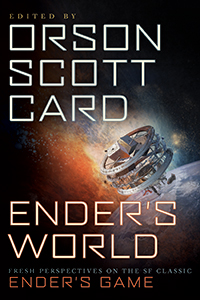
    Ender’s World: Fresh Perspectives on the SF Classic Ender’s Game

    Smart Pop publishes smart, fresh, and engaging articles on the best of pop culture TV, books, and film, with a particular focus on science fiction and fantasy television and literature.

    You want to hear what Scott Westerfield (Uglies, Pretties, etc.) has to say about Buffy?  Go to Smart Pop.

    What about Orson Card’s thoughts on Joss Whedon’s Firefly universe? Smart Pop.

    What about the venerable Lawrence Block on Robert B. Parker’s Spenser series? Um, Smart Pop.

    Strange.  Do you see a pattern emerging? 

    Whether it’s Mad Men, House, Hunger Games, George Martin’s epic fantasies, Halo, True Blood, or Alias, Smart Pop gathers together New York Times bestselling authors, television writers, psychologists, philosophers, and others–folks who love of pop culture and have something worth sharing about it–and asks them to share their insights.   

    Recently, they’ve been putting together just such a collection on Ender’s Game.  It’s called Ender’s World: Fresh Perspectives on the SF Classic Ender’s Game. It’s coming out February 2013.  You can read more about it here.

    I’m announcing this now because The Man was fortunate enough to be invited to contribute.  I love Ender’s Game.  LOVE IT.  How cool is it that I get to write about it in an anthology edited by the folks at Smart Pop and Card himself? And then get to read what everyone else has to say, including military strategists Colonel Tom Ruby and Captain John Schmitt.  As well as the little bits they’ll include on things like why the battle room is the shape it is and why they were recruiting kids.

    But I’m also announcing this because in addition to the essays all we Ender-lovers get to write, Smart Pop is also going to include a series of Q&As with Scott Card, and they are currently soliciting the question from readers. FROM YOU. Right now.

    You ever wonder about a character or part of the setting or event in Ender’s Game?  Ever wanted to know what inspired Card? Ever wanted to ask any question at all about Ender’s Game?  Now’s your chance. Just submit you question here: http://www.smartpopbooks.com/ask-orson-scott-card-a-question-about-enders-game/

    You can see questions already submitted at Smart Pop’s Tumblr.

    From a writer’s pov, I have to tell you that the folks at Smart Pop have been nothing but enjoyable and insightful to work with. I’m looking forward to this book!

    Share
  • Bees Sniff Out Land Mines

    The bee. We slather its delicious vomit on bread and muffins. We send colonies out to pollinate our crops. Now Colin Henderson and his University of Montana colleagues have partnered up with bees to “locate buried land mines” and do it more quickly and thorougly than any dog.

    “We can survey in one day what takes more than a week with dogs,” he says, “and humans stand 300 yards away.”

    Bees can find not only land mines, but also drugs and decomposing bodies. Oh, and they are smart enough to recognize a sugar daddy when they see one.

    Here’s the full article. Read it. Enjoy. Things like this are part of the wonderfulness of life.

    Share