Nethermore cover art reviews

A huge part of science fiction and fantasy is the art. I’m always amazed at how powerful a cover can be. In fact, I remember buying the Thomas Covenant series because of those covers. I hated the hero. He drove me nuts. But those covers (and the other cool things) made up for it. So when I saw Isaac Stewart’s cover reviews, I had one of those V-8 moments. Of course, there should be reviews of cover art. There must be. And these are the most insightful AND funny reviews of cover art I’ve ever seen.

Share

Similar Posts

  • Growing Your Own Replacement Parts


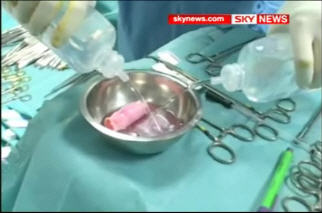
    This is simply incredible. Watch the video about Claudia Castillo growing a replacement to part of her windpipe with her own stem cells. She didn’t grow the complete tube, but nevertheless…

    Ms Castillo, who was born in Colombia, had suffered a tuberculosis infection that ravaged her airways, leaving her unable to do simple domestic tasks. Disease had caused her windpipe, or trachea, to collapse just at the point where it entered her lung. Without the pioneering operation in June, the lung would have been removed. Today she again has a normal life and is able to look after her two children. She can walk up stairs without getting breathless and has even been dancing.

    Oh, my. Can you believe this? What the future holds for all the folks with damaged parts…

    And does this mean as we age, we’ll be able to swap out the old for new? How will that affect aging? This is simply incredible.

    Share
  • Free Stories from Pros

    From Edmund Schubert, editor of Orson Scott Card’s Intergalatic Medicine Show:

    “During the month of February we are going to make one story from each of our first four issues available at no charge. Two stories will be set free on February 1st, and two more on February 15th. Just visit www.intergalacticmedicineshow.com and explore the table of contents; the free stories will be clearly marked.”

    Of course, having been published in the first issue and slated to be the cover story for the Spring 2008 issue, I can vouch for the magazine’s impeccable taste and the gigawatt entertainment buzz you’ll get from the stories they select.

    Share
  • |

    “How It All Came Crashing Down” by Peter B. Gardner

    Everybody knows that we got into this recession because banks began lending money to people who had terrible credit ratings, right? People who didn’t have to prove they even had a job. I mean, how long are you going to stay in business when you keep handing out dough to people you never hear from again?

    But is that all there is to it? And was it really just the fault of congress because they told Freddie Mac and Fannie May (the organizations that purchased loans) that they had to start purchasing these highly risky things? Or was it all those greedy Wall Streeters?

    In this must-read article, “How it All Came Crashing Down,” BYU econ professors explain how we got into this mess—and what we can learn from it.

    But that’s not the end of the story. Ira Glass and the folks at This American Life uncover deeper causes of the problem in their must-listen show “The Watchmen” (no, not the movie). I mean, come on, we were told these high-risk loans were as dangerous as milkshakes. Shouldn’t SOMEBODY have seen it?

    President Obama keeps saying that the root of the problem was that there wasn’t enough government oversight. Sounds good, doesn’t it?  We’ll get disinterested Uncle Sam to protect us from all these investment bullies. But if we dig a bit deeper, it appears that Uncle Sam was one of the major players at the root of the mess.

    Ouch.

    Read. Listen. They are two fabulous pieces.

    Share
  • Move over X-ray glasses; here come the T-rays

    Humans are blind. Really, think about all the things we cannot hear, see, smell, feel. Our world is so small. So when a device comes along that reveals a new part of the sensory spectrums we use, then I say, “cool!”

    Of course, when I was a kid, you’d see ads for the X-ray glasses in all the boy magazines along with ads for Sea Monkeys and whoopee-cushions.

    X-ray glasses

    Well, now they’re not just gimmicks. You’ve heard of x-rays, gamma rays, ultraviolet rays, infrared–well, here are t-rays.

    T-rays are emitted by all the objects around you, but they cannot be seen by humans. T-rays can go through just about anything except metal and water. People who spend serious time thinking about T-rays say this ability, the result of their short wavelengths, make them ideal candidates for certain types of medical imaging.

    Among other potential uses imagined are: safer versions of X-rays; scanning baggage at airports; identifying large biological molecules such as proteins, viruses and bacteria; and even measuring the effectiveness of facial moisturizers. Read article here.

    Here’s where t-rays fit on the electromagnetic spectrum.

    Light Sources

    And here’s the article that sparked it all today: Britain makes camera that “sees” under clothes. I guess one of those egg-head boys grew up and decided to make his dream come true, all in the name of science, medicine, and the Queen, of course.

    Share
  • |

    Ira Glass on Story and Surprise

    I found this a fascinating talk. It’s Ira Glass who is the executive producer of the This American Life radio program from Chicago Public Radio. It’s a show that merges true stories (and some short fiction) of everyday people, surprise, humor, and meaning. There’s a structure to the types of stories that they produce. It’s not a new thing. It’s used all the time in a venue many of us are familiar with. Maybe you’ll identify that venue immediately. If not, it doesn’t matter. Watch and listen. This is a fascinating talk and it highlights just how much humor, curiosity, and insight depend on surprise.

    Ira Glass at Gel 2007 from Gel Conference on Vimeo.

    Share