Servant of a Dark God on Sale?


Okay, okay. So I knew you could pre-order stuff, but I just never expected to see MY BOOK available 6 MONTHS EARLY! Target has Servant of a Dark God up for sale. It’s up on Amazon as well. I’m getting so excited.
Okay, okay. So I knew you could pre-order stuff, but I just never expected to see MY BOOK available 6 MONTHS EARLY! Target has Servant of a Dark God up for sale. It’s up on Amazon as well. I’m getting so excited.
Life, the Universe & Everything is coming up in a little over a month on Feb 12-14, 2015. It will be held at the Provo Marriott Hotel & Conference Center. Some reasons to go.
Number one. Toni Weisskopf, the editor and publisher of Baen Books, is the guest of honor.
Number two. LTUE and LDStorymakers are the best two cons in Utah for learning how to write, but LTUE is lots cheaper.
Number three. Lots of local authors will be there. It’s a great forum for hearing their insights and finding out what they’re doing.
I will be giving three presentations.
I hope to see you there.
Larry and I will be in Lone Tree (South Denver) and Loveland Saturday, December 5th. Drop by and say hello, buy one of our books as a gift, or just show up with your Klingon outfit and gun.
John Brown events at Barnes & Noble
| Saturday, December 5 1 pm – 3 pm |
Meet public, discuss book, signing–Brown & Correia | Loveland, CO | Barnes & Noble The Promenade Shops at Centerra 5835 Sky Pond Drive Loveland, CO 80537 (970) 663-9473 |
| Saturday, December 5 5 pm – 7 pm |
Meet public, discuss book, signing–Brown & Correia | Denver (Lone Tree), CO | Barnes & Noble Barnes & Noble Booksellers 8374 South Willow Street Lone Tree, CO 80124 (303) 706-9660 |
If you feel a bit lost or anxious about how to teach narrative for the new core, especially stories, I think I can help.
I’m an educator in the private sector and an award-winning novelist and short story writer. I’ve been teaching authors in various venues how to write for the last five years. I’ve been on writing podcasts with thousands of listeners, taught at a number of writers conventions, and had a series of articles published by the national Science Fiction and Fantasy Writers of America organization, an organization for professional authors. I’ve also been helping Nellie, my wonderful wife, teach her 7th and 8th grade language arts students the unit on short stories during that same period. We’ve taught it to twenty different classes and picked up a number of important insights along the way.
This last year I couldn’t help but examine all the materials Nellie brought home during the district’s writing program adoption investigations. Some programs looked very promising; others not so much. Some got some things about writing flat out wrong. Most of the programs had gaps.
Furthermore, because I work with so many people wanting to write, I know that it’s difficult to teach if you really don’t understand what stories really are and how they work. For lots of people, the subject matter can seem impenetrable. And yet writing stories is such a wonderful way to teach writing, especially because so many kids love it. You won’t find a kid who will spend extra hours writing a business letter or poem analysis, but you will find quite a few who will go crazy writing stories. And the whole time they’re practicing their writing skills.
The question is how DO you write a story?
What is a story?
How can you tell if it’s good?
How do you come up with ideas?
Where do you start?
And what the heck is this chart? Do writers really use this? (Not many that I know.)
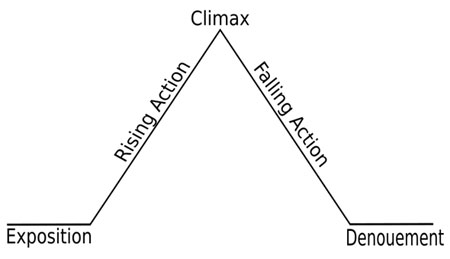
And does anyone think changing the diagram to look like Aspen, Colorado actually helps?
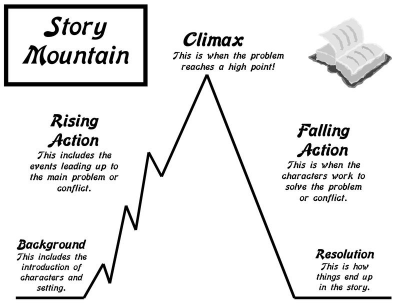
Hey, students—please make your story look like Aspen, Colorado! (Yeah, that’s going to be effective.)
And yet it’s not as difficult as it appears. Nellie and I have seen a lot of kids really get into writing stories. We’ve seen kids WILLINGLY going way beyond the assignment to write stories that are eight, twelve, twenty-five plus pages. And as they’re writing, they’re practicing grammar, spelling, structure, vocabulary, etc. without knowing it and having a great time. I know that if you enable your students, many of them will write, write, write. Especially in grade school. But also in the higher grades.
Stories can be a blast. The assignments can connect to many students. And the results can be wonderful. I’ve laughed out loud at some of the stories coming out of Nellie’s class. Others have been enjoyable on other levels.
But for this to work in your class, you need to know some key things. You need to understand the core of story and the story development process. You need a lesson plan that details everything step-by-step so your students don’t flounder. And you need to know some fundamental tips (secrets?) about teaching this content.
So I’m going to hold this day-long class for you. A full eight hours. And share everything Nellie and I have learned. This class will be for teachers at ALL levels (I’ll show you some ways to scale the complexity of what you’re doing). There will be NO cost. The only thing you have to bring is a pencil, paper, whatever program materials you have, and a willingness to have a good time.
When we finish, you will know how to write a simple story like the ones your students will write because, ta-dum, you will write one! AND you’ll have a step-by-step lesson plan that builds on whatever materials you have—an official program or one of your own. AND you’ll understand story better than 99% of the population. AND you’ll have a bundle of techniques to help your students. AND you’ll solve both world peace and maybe the lost sock conundrum.
Truly, I think that instead of feeling stress, you’ll actually be looking forward to teaching and writing stories with your students. If not, you may bring tomatoes and huck them at me, but please be aware that I will not stand still; to find satisfaction, you will have to be able to hit a moving target.
If you’re interested, just click the Contact John link under my photo in the left sidebar and send me an email letting me know.
Hope to see you in class!
GET READY FOR A FUN DAY OF LEARNING!
Topic: Teaching writing (narrative & the common core)
Who: Teachers (and writers at least 18 years old), seats are limited
When: Monday, July 29th, 8:15 AM – 5:00 PM
Where: Rich Middle School, 54 E 100 S Laketown, UT 84038
Materials you need to bring:
AGENDA
8:15 AM Arrive
8:30 AM – 9:20 AM
9:30 AM – 10:20 AM
10:30 – 11:20
LUNCH
12:00 – 12:50
1:00 – 1:50
2:00 – 2:50
3:00 – 3:50
4:00 – 4:50
I’ve had a number of people ask me where I am with the second book. I have the progress bars on the side, but they don’t give any details. So I thought I’d start up a semi-regular post that would be something like a writer’s journal. We’ll see how it goes.
Right now I’m working on the climax of CURSE OF A DARK GOD. For the last two weeks I’ve been struggling trying to figure out the flow. I knew in general what I wanted to have happen. I had some images and the general feel–spectacle, revelation, battle at the fortress–knew I had to fulfill some expectations I’d raised with four characters. But I didn’t know the exact steps of the scene, the back and forth. I also hadn’t figured out the exact details of some of the magic that would be used.
I outlined the objectives and plans of the two opposing warlords and then the steps of the scene. I listed my objectives for the scene. I do this sketching, sometimes exploratory drafts, to help bring the scene to life in my mind. I find that until a scene is alive in my mind, it’s impossible for me to write. Anyway, over the course of two weeks I went through six takes of the scene, and it still didn’t feel right. I won’t give the details and spoil the ending, but it just wasn’t there and I was getting frustrated. I’m behind on my deadlines and a book’s ending it critical. I talked a few things over with Nellie and made some headway, but it just wasn’t there.
So I called a brainstorm meeting. I’ve never done this before for my writing work. I mean, I’ve bounced things off individuals (mostly Nellie) many times and found good resolutions, but I’ve never had a group. However, I felt I needed some extra input to get my mind going down new paths. Lenn Johnson, Amy and Alex Lamborn, and Miles and Becky Pinter came over. I borrowed a white board and easel from my church and made gingersnaps. When they arrived, I sat them around our kitchen table with Nellie and had them riff on one question while I captured their answers and ideas on the white board.
It was incredibly productive. Partly because they came up with some great ideas I’m going to use. But also because it got me thinking in a new way which allowed me to come up with an idea that resolved the main issue I was dealing with. That was last Thursday. The next day I sat down and outlined a scene that did everything I wanted it to, including giving me the “oh, baby” feeling. It feels right. I have the spectacle, the revelation, the fulfillment to the expectations for the characters. I’m excited to write it. Which means I can now move forward. This week and next I hope to finish. After that there are a few small things I need to insert and clean up. Then it’s off to my editor.
BTW, I did some calculations. For those interested, in this draft, the third, I ripped out 50% of the draft two and completely rewrote it. New problem and situation for two of my three points of view, major changes, etc. I heavily revised above 20% of the remaining 50%. I’ve put in a little over 500 hours working on this draft over the last six months.
500 hours (remember, I still have a day job).
I am a slower writer than many. But it still would have been a huge task even if I could write twice as fast as I do. I think this is a perfect illustration of three things. First, if you don’t fix some things you feel are off when you find them, you might find you have a massive amount of rework later. Second, sometimes you don’t recognize you have those issues until you’re well into it. Third, writing requires the author to make time. I think this is the most important one. And the one that probably kills most aspiring writers. The fact is that if you can’t make time, you ain’t going to write 🙂
Speaking of making time as a new artist, watch this interesting interview with author Scott Turow.