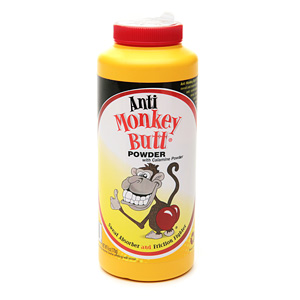
Anti Monkey Butt

Sometimes words fail me…

Anti Monkey Butt

With Calamine Powder

Sweat Absorber and Friction Fighter

Anti Monkey Butt® Powder is specially formulated to absorb sweat and minimize frictional skin discomfort. Helps to keep you dry and comfortable. Ideal for butt busting activities such as motorcycling, bicycling, horseback riding, truck driving, hiking, hockey, football, and baseball.

Indoors or outdoors, work or play, or on occasions when you sit on your butt all day. Don’t let your buns get red. Use Anti Monkey Butt ® Powder instead!

You can get your bottle of comfort for only $5.95

Share

Similar Posts

  • Laboratory Grown Meats?

    How would you like to eat cuts from slabs of meat grown from stem cells?  

    Give the cells some water, glucose and natural proteins. To make sure you have something that feels like meat you “exercise” the muscle with electrical pulses.

    Gross? Maybe. But someone is thinking about it.

    http://www.popsci.com/environment/gallery/2008-09/inside-vertical-skyscraper

    As with all zing, post story ideas in the comments.

    Share
  • A bit of Yiddish to warm the soul

    schnook, schnorrer, megillah, meshuga, schlump…

    Who can resist such words? I plan on working at least one of these into my conversation today.

    I’ve copied from last week’s Wordsmith.org emails.

    A language is the soul of its people. This is nowhere illustrated more profoundly than in the Yiddish language, the language of Jews of eastern and central Europe and their descendants. A tongue full of wit and charm, Yiddish embodies deep appreciation of human behavior in all its colorful manifestations. The word Yiddish comes from German Judisch meaning Jewish. But it is not the same as Hebrew, even though it is written in Hebrew script…

    …Many of the everyday English language words such as bagel, klutz, and kibitz are terms from Yiddish. This week we’ll look at a few other Yiddishisms that have enriched the English language.

    schnook (shnook) noun

    A stupid, easily deceived person.

    [From Yiddish shnuk (snout) or from German schnucke (a small sheep).]

    -Anu Garg (words at wordsmith.org)

    “A gun-toting schnook became an embarrassing crook when he robbed
      a Spokane dollar store Sunday. Seriously, if you’re going to commit
      a Class A felony, you might as well rob a Class A joint.”
      Frank Sennett; Dollar-Store Thief Bucks Common Sense; Spokesman Review
      (Washington); Mar 9, 2007.

    schnorrer (SHNOR-uhr) noun

    One who habitually takes advantage of others’ generosity,
      often through an air of entitlement.

    [From Yiddish, from German schnurren (to purr, hum, or whir), from the sound of a beggar’s musical instrument.]

    megillah (meh-GIL-uh) noun

    A long, tedious account.

    [From Yiddish megile (scroll), from Hebrew megillah, from galal (to roll).
    The term alludes to the length of the text in the Book of Esther which is read in its entirety, twice, during Purim, a Jewish festival.]

    -Anu Garg (words at wordsmith.org)

    “But the obvious challenge was to go through the whole megillah — to
      begin with the Andante in C Major, which Mozart wrote when he was five,
      and proceed to the bitter end, the Requiem.”
      Alex Ross; The Storm of Style; The New Yorker; Jul 24, 2006

    meshuga or meshugga (muh-SHOOG-uh) adjective

    Crazy; stupid.

    [From Yiddish meshuge, from Hebrew meshugga.]

    Today’s word in Visual Thesaurus: http://visualthesaurus.com/?w1=meshuga

    -Anu Garg (words at wordsmith.org)

    “Plenty of hip-hoppers want to be considered insane, but only Paul Barman
      wants to be known as meshuga.”
      David Segal; The Weirder, the Better; The Washington Post; Jun 25, 2000.

    schlump (shlump) noun

    A dull or slovenly person.

    [From Yiddish shlumperdik (unkempt, sloppy).]

    -Anu Garg (words at wordsmith.org)

    “‘You don’t want to dress up too much, but you don’t want to be
      a schlump,’ says Michael Kors.”
      Hal Rubenstein; Terrific Style by Age, by Size, by Shape, by Color;
      In Style (New York); Aug 2006.

    Share
  • AIG bailout, risk, and writing

    With the current financial “crisis” I kept wondering what went wrong. Read this article on the AIG mess from the guys at the Motley Fool. That explaination of the AIG mess is very interesting. The other part of this current financial mess, the loaning-of-money-to-people-who-were-idiotic-credit-risks and the making-me-foot-the-bill-for-someone-else’s-assumption-of-ridiculous-risk, those two parts torque me.

    So why am I posting this in the Zing and Writers categories?

    Because it IS zing to me. You could write a high-finance thriller about this. You could write about a character who leveraged himself silly and is about to lose it all–in a smaller sense. You could write, hey, wait a minute. I just read a book about something similar–THE CHAIRMAN by Stephen Frey. It’s a 2.5/5 star book. Good enough that I had to finish it. Although not good enough to make my recommendation list. 

    The point is that stories are about problems and conflicts. And this understanding of the insurance industry provides some fertile ideas for both problems and conflicts.

    And since I can’t get the blasted link to work, here’s the full deal.

    AIG’s Failure Is So Much Bigger Than Enron
    By Andrew Sullivan, CFA
    September 17, 2008 Comment (54) Recommend (124)
    Enron — reviled, fraudulent Enron — destroyed more than $60 billion of shareholder value.

    AIG (NYSE: AIG), which the government just took over, has destroyed $180 billion already — and it almost brought down our entire financial system.

    We don’t know money
    Which is ironic, given AIG’s old television commercials, in which the giant letters “A I G” displayed on the screen while text flashed underneath that culminated in the following phrase — all in capital letters:

    WE KNOW MONEY

    There were no smiling couples, young children at play, or lounging retirees. No, AIG was above that — it was better than that.

    But here’s a news flash, AIG: You don’t know money.

    If you did, you’d have realized a few things. Insurance is terribly simple, as long as you follow the Three Rules:

    Price your risk correctly.
    Invest conservatively so you can pay out claims when they come due.
    Don’t do anything else.
    Sit back and collect the spread. That’s it, folks.

    Seriously, that is it. Ask Warren Buffett, and he’ll probably tell you that if you follow those three rules, you’ll be fine. You won’t be the biggest or fastest grower, but you’ll be absolutely fine.

    The problems come when you get greedy and aren’t satisfied with the spread. And your greed can lead to certain actions that aren’t stated anywhere in the rules, including:

    Diversifying into fast-money proprietary trading.
    Leveraging your company 11-to-1.
    Neither of these is a goal of a well-run insurance company, yet AIG embraced both with open arms.

    Diworsifying
    But AIG self-destructed not because it screwed up in its insurance business. It didn’t fall into the trap of mispricing risk, as so many other insurers over the years have done. It also invested premiums fairly conservatively. So it followed Rules 1 and 2.

    Where it slipped up was in Rule 3. See, the folks at AIG thought they were so smart at insurance that they could start other capital-markets businesses … including proprietary asset management in things such as commodities, currencies, energy, interest rates, and the selling of default swaps on collateralized debt obligations (CDOs).

    This strategy worked beautifully — for a while. AIG created a separate business segment called Financial Services to trade in the aforementioned assets. This business had $204 billion in assets at year-end 2007, up from $60 billion in 1998.

    Operating income surged from $900 million in 1998 to $4.4 billion in 2005. Some of the moves it made were brilliant, such as the purchase of ILFC, an aircraft-leasing business. But the other trading businesses were the Medusa that turned the whole company to stone.

    Let me make one thing clear: Proprietary trading isn’t bad, in and of itself. Warren Buffett engages in it. But just like atomic weapons in the wrong hands, proprietary trading can do a lot of damage. The problem is when you start to get aggressive and don’t heed proper risk — when you start to speculate instead of invest.

    And there’s one other critical ingredient for disaster.

    The “L” word
    As in “leverage,” the sharp knife in corporate seppuku dramas. Leverage is, by my estimation, the No. 1 reason why companies fail.

    And compared with its peers, AIG had one of the sharpest knives around. Here’s how its leverage (assets to equity) stacked up against other insurance operations as of December 2007:

    AIG: 11 to 1.
    Markel (NYSE: MKL): 4 to 1.
    Berkshire Hathaway (NYSE: BRK-B): 2 to 1.
    Montpelier Re (NYSE: MRH): 2 to 1.
    Travelers (NYSE: TRV): 4 to 1.
    White Mountains Insurance (NYSE: WTM): 4 to 1.
    Chubb (NYSE: CB): 4 to 1.
    I would love it if someone gave me a rational, believable explanation of why leveraging your equity 11-to-1 is a good thing for an insurer. The sole job of an insurance CEO is to ensure that his or her company stays in business; the CEO’s job has nothing — absolutely nothing — to do with growing profits every year in a steady, smooth line.

    Surprises in insurance are almost always negative, so simply staying solvent is the overriding priority. A company can do just that by following the Three Rules.

    Two years ago, a few of my Fool colleagues had an interesting conversation with Chris Harris, the chief investment officer at reinsurer Montpelier Re. Harris noted that Montpelier invested its float primarily in U.S. Treasuries, Fannie and Freddie bonds (back when they were considered safe), and the like.

    When asked why he didn’t invest more aggressively, Harris said the company believed that it got all the risk it could handle on the other side of the fence, insuring against megacatastrophes.

    Even if you disagree, as an investor you have to recognize the judiciousness in this way of managing one’s business. An insurer that has to pay big claims from hurricanes Ike and Gustav and Typhoon Sinlaku — and additionally worry about the rapid decline in its investment portfolio as a result of the higher level of risks it has taken on — has a big problem.

    That insurer, folks, is AIG. And that big problem is now yours and mine.

    This really is bigger than Enron
    The edifice Hank Greenberg built has all come crashing down. Apparently, AIG didn’t realize that almost 40 years of 15% growth multiplied by a big fat zero equals just that: zero. It didn’t consider that its leverage left it exposed to a liquidity crisis, and it didn’t consider that its non-insurance businesses could bring down the whole company.

    In all fairness, management did not realize how much exposure it had to CDOs backed by subprime loans. This may or may not be true, but Buffett has famously stated that each one of these prospectuses has something like 15,000 pages, so it’s unlikely they were gone through in any great detail.

    But investing in things you don’t know is a huge risk, right? And that risk was compounded by having so much leverage. The fact is, the more leverage you have, the more careful you must be with the investments you hold, because your own capital structure is that much riskier.

    AIG did nothing of the sort. And so even though it has a rock-solid, wonderful insurance franchise, its greed and lack of care in its investing decisions took down one of the world’s great companies.

    What a shame. What a shame for all of the investors who lost billions thinking that this company was conservative. What a shame for taxpayers like you and me. What a shame for the United States’ reputation as a beacon of financial stability and conservatism.

    For Fool.com’s continuing coverage of this week’s events, check out “The Biggest Financial Story of the Past 50 Years.”

    Andrew Sullivan has no financial interest in any of the companies mentioned. Montpelier Re is a Motley Fool Hidden Gems selection. Markel and Berkshire Hathaway are Motley Fool Inside Value recommendations. Montpelier Re and Berkshire Hathaway are Motley Fool Stock Advisor picks. The Motley Fool owns shares of Berkshire Hathaway and has a disclosure policy.

    Share
  • Mumma, Cat of Death

    PIC02680

    I figured regular readers would want a break from all the book release news, as fascinating as it is. And so I present to you my photograph, “Mumma, Cat of Death.” (I need a new camera. The quality of this piece of junk is so stellar.)

    Mumma was a stray that showed up in our garage one day, freaked many of the long-timers, and then got pregnant. Up here in the ranch lands there are no such thing as spaying and neutering. There are a number of Toms, and, well, we were too slow with our communist population control program. So she had five cute kittens. Up until that time she was satisfied with catfood and an occasional bird or mouse. After that, she became Mumma, Cat of Death.

    What you see above is only PART of the catch of ONE day: a packrat, a ground squirrel, a bird (she ate it, what you see on that piece of white paper is what she left–one leg), and a rabbit. Notice, she’s looking away from her catches. I think she was eying a visitor’s toddler at that moment, deciding if she could take him down. Every day she hunted up a few meals. And these were not for show, not nice gifts left on the doorstep for the master. No, she’d bring them up from the fields, let them ripen a bit, and then start in at the head. But she wouldn’t always eat the whole thing. Sometimes she’d leave it for the kittens. Sometimes, she’d just leave it for the next day. She turned our garage into a scene of blood and carnage.

    So again: Mumma, Cat of Death.

    Share
  • Bees Sniff Out Land Mines

    The bee. We slather its delicious vomit on bread and muffins. We send colonies out to pollinate our crops. Now Colin Henderson and his University of Montana colleagues have partnered up with bees to “locate buried land mines” and do it more quickly and thorougly than any dog.

    “We can survey in one day what takes more than a week with dogs,” he says, “and humans stand 300 yards away.”

    Bees can find not only land mines, but also drugs and decomposing bodies. Oh, and they are smart enough to recognize a sugar daddy when they see one.

    Here’s the full article. Read it. Enjoy. Things like this are part of the wonderfulness of life.

    Share
  • Intelligence and Genetics

    Albert Einstein, an Ashkenazim Jew
    Albert Einstein, an Ashkenazim Jew

    I know that discussing genetic factors of intelligence is something many do not want to do because such notions have been used horribly in the past. And because there are groups who would like to continue such horrible abuses today.

    However, it makes no sense to me to avoid such discussions. There are so many things, from mental illness to physical strength, that have genetic factors that it’s just stupid to ignore data that suggest intelligence also has such factors.

    And so I offer you this paper from three folks at the University of Utah which “elaborates the hypothesis that the unique demography and sociology of Ashkenazim in medieval Europe [Jews descended from the medieval Jewish communities of the Rhineland in the west of Germany] selected for intelligence.”

    It may turn out the hypothesis of these researchers is wrong. But you’ll never know even what they’re proposing without giving it a gander.

    http://homepage.mac.com/harpend/.Public/AshkenaziIQ.jbiosocsci.pdf

    Share