Mumma, Cat of Death

PIC02680

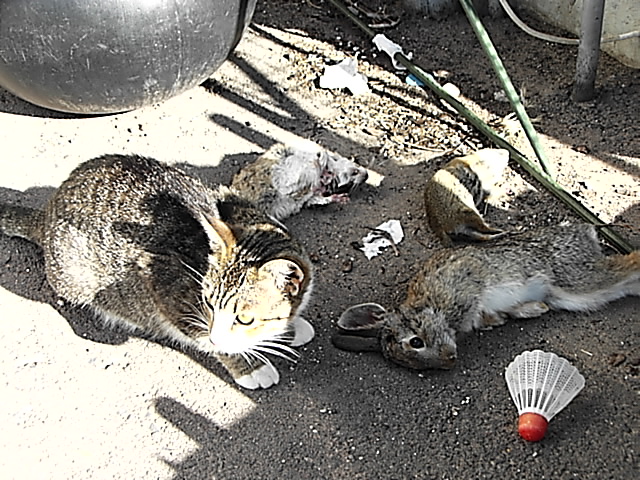
I figured regular readers would want a break from all the book release news, as fascinating as it is. And so I present to you my photograph, “Mumma, Cat of Death.” (I need a new camera. The quality of this piece of junk is so stellar.)

Mumma was a stray that showed up in our garage one day, freaked many of the long-timers, and then got pregnant. Up here in the ranch lands there are no such thing as spaying and neutering. There are a number of Toms, and, well, we were too slow with our communist population control program. So she had five cute kittens. Up until that time she was satisfied with catfood and an occasional bird or mouse. After that, she became Mumma, Cat of Death.

What you see above is only PART of the catch of ONE day: a packrat, a ground squirrel, a bird (she ate it, what you see on that piece of white paper is what she left–one leg), and a rabbit. Notice, she’s looking away from her catches. I think she was eying a visitor’s toddler at that moment, deciding if she could take him down. Every day she hunted up a few meals. And these were not for show, not nice gifts left on the doorstep for the master. No, she’d bring them up from the fields, let them ripen a bit, and then start in at the head. But she wouldn’t always eat the whole thing. Sometimes she’d leave it for the kittens. Sometimes, she’d just leave it for the next day. She turned our garage into a scene of blood and carnage.

So again: Mumma, Cat of Death.

Share

Similar Posts

  • |

    Black Chokecherry Syrup

    When you live where we do, you cannot hope to landscape likes folks in a warm suburb. First of all, at 6,000 feet with a min temp of -30 Fahrenheit you can’t grow a lot of warmer climate plants. Second, the deer seem to eat everything else you do grow. So we’ve been looking and I think I’ve found a tree to add.

    I actually found it earlier when I was biking around the beautiful Round Valley and had to stop and go back to revel in the delicious fragrance. But I didn’t know what it was at the time. I do now. 

    It’s the black chokecherry.

    It grows naturally up here. Has beautiful fragrant blossoms in the spring. And it produces fruit that can be made into a delicious syrup. Oh, the raccoons like it as well.

    Now when you eat the raw berry, unless you eat it late in the fall, you’re in for an astringent, alum after-punch. But we picked the berries up a canyon behind our town after the first frosts. In fact, many of our berries were wrinkled. They just fine raw. Even Lilia, my pickiest eater, enjoyed them.

    We picked about 1.25 gallon ice cream buckets of the stuff. Then we followed this recepie and made about 4 quarts of syrup.

    • 3 cups chokecherry juice (see first step)
    • 3 cups apple juice (not from a store, but cooked from apples)
    • 6 1/2 cups sugar
    • (I’ve heard some folks add 1/4 teaspoon almond extract for a stronger cherry taste)
    1. Wash chokecherries, place in a large kettle, barely cover with water and cook, covered, for about 30 minutes till the cherries are soft. Mash gently and strain the chokecherry juice through a sieve or cheesecloth.
    2. Do the same with the apples.
    3. Pour the juice into a large kettle; stir in the sugar.
    4. Cook on high, stirring constantly.
    5. Boil hard for 1 minute.
    6. Remove from heat and skim foam.
    7. To can: Pour hot syrup into sterilized hot jars to within 1/8th inch from top.

    It’s absolutely delicious on pancakes. 


    Share
  • Cats and monsters

    My second-to-youngest daughter came in the house telling me that there was a huge line of ants out in the garage.

    “Because there’s poop,” her younger sister says.

    I groan inside. Cats. There’s the whole wide world and a litter box to boot. They have to do it on the garage floor?

    I go out to clean it up before I go on my walk, and there is indeed a thick line of tiny ants. But they aren’t carrying away bits of poop for their fugus farm. It’s some hairball the cat has yakked up. Disgusting. So I get out the square-nosed shovel and scoop it up. But as I do its contents tumble and reveal themselves. There’s a spinal column of something significant with the last bit of ribs clinging to it. There’s hair, and I don’t think it’s the cat’s.

    I fling the stuff into the brush and sweep the garage clean.

    And then I start thinking.

    What if a kid came out and found this long trail of ants. She follows it. To this lump up in the brush. There are two magpies about. One perched on a piece of scrub. The other pecking at the lump. And in the lump is not some animal bones. No, it’s a long segment of human spine. And there’s half-digested Levis or some nylon windbreaker. And the whole mess is dark, compacted, and damp.

    There’s something out there that regurgitated this. Not a bear. Not a tiger. Those are too small. This thing has to be large. A dragon. No. Some ogre or troll. Something else. Something from the depths of the darkening woods. Something the villagers had forgotten. Maybe something that’s come through from some other place. But it’s here now. It’s close. And somebody died.

    Share
  • Leonard and Lady Randy (yes, that kind of randy)

    Maybe you’ve heard this one from Paul Harvey. Can you guess who it is?

    “Escape!

    Of all the positions in the field of journalism, that of war correspondent is perhaps most dangerous. Some are captured, some escape. Some die.

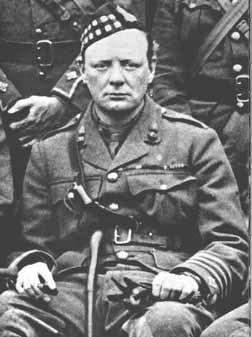
    Twenty-five-year-old Leonard Spencer was the London Morning Post’s newest correspondent. His assignment was the Boer War, in South Africa.

    Had young Leonard foreseen the peril awaiting him, he would probably have taken the assignment anyway. That’s how Leonard was.

    About twenty miles from Ladysmith, Leonard could hear the booming guns. He was aboard a British armored train that would take him as close to the front as he could get.

    The train got too close. There was a sudden crash. The train had struck a boulder on the tracks … a Boer booby trap. It was an ambush!

    Immediately, a fusillade of rifle fire followed. Surprised, British troops on the train fired back.

    And Leonard? Leonard ignored the gunshots and exploding shells. He jumped off the train, directed the British defense, helped to clear the wreckage.

    In fact, without the aid of this youthful correspondent from the Morning Post, the train might well have been lost and the British troops massacred.

    Instead, the wreckage was cleared, the train did pull out of the trap and carried a good many British soldiers with it.

    The one left behind to face the enemy…was Leonard! No, the story does not end sadly there.

    Leonard was captured, unharmed. Even though Leonard was technically a war correspondent, the Boer commander was sufficiently impressed with his bravery…to have Leonard thrown into prison at Pretoria.

    The Pretoria prison was among the world’s most carefully guarded strongholds. Still, that did not stop Leonard from plotting an escape with two other British captives.

    As darkness fell, the trio waited for their opportunity. It was now pitch black. The sentries exchanged their posts. Leonard sprang across an open area, hurdled a fence of barbed-wire mesh. When he looked back, there was no one. His comrades had missed their chance!

    Three hundred miles of hostile territory lay between Leonard and his freedom. For a while, he followed the railroad tracks to the east, stumbling alone, through the dark, dodging enemy patrols. Tired, hungry, thirsty…Leonard plodded long into the night, knowing that, each painful foot of the way, one false step could be his last.

    The night turned to day and back to night again, until the days and nights blurred.

    Finally Leonard reached a mining town. His luck wearing thin but holding, he knocked on the door of the only Britisher in the territory and was smuggled onto a train loaded with bales of wool.

    The train would carry him to the British consul. To safety.

    And that’s how Leonard Spencer, the London Morning Post’s fledgling correspondent, got his story…and his reputation for daring.

    History has all but forgotten this incident in his life in order to make room for later glory.

    The fortune that once seemed to be wearing thin had only begun…and one day rubbed off on all of England.

    For the young correspondent who once upon a time saved a British armored train and escaped the enemy under impossible circumstances…continued to do the impossible for the rest of his life.

    We knew him as Sir Winston Leonard Spencer Churchill!

    And now you know THE REST OF THE STORY.”

    Um, no, not even close. 

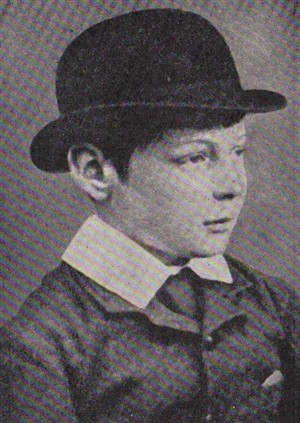
    When I read about the childhoods of famous historical figures I’m often surprised. For example, I’m still freaking out that Hitler was a street artist. So I ran across this article today about Winston Churchill’s childhood and his mother who was nicknamed “Lady Randy” for her promiscuity (rumored 200 lovers).

    She had no time for Winston. Other people raised him. Yet she wasn’t completely absent in his life. Apparently, she called on favors from previous lovers when Winston needed to learn French. Nevertheless, it appears Winston was raised without a father or mother, yet ends up being the kind of man who could lead a nation at war.

    This is fertile ground for drama of the best kind.

    I’m going to be seeking out some biographies. It’s going to be fascinating seeing how Winston pulled it off and who influenced and helped him along the way. 

    There’s one thing more. These facts aren’t all that drew me. What Winston wrote upon his mother’s death, well, it’s the finest poetry I’ve heard this last month.

    “I do not feel a sense of tragedy,” he said, “but only loss. Her life was a full one. The wind was in her veins.”

    That metaphoric power of that last sentence given her history and relationship with him–it’s stunning. 
     
    Read a summary of the documentary here.
    Share
  • |

    The Myth of Being More Productive by Multitasking

    One of my personal flaws is my monkey fascination. I am interested in too many things. For example, when I was at the university I wanted to major in English, History, Dutch, Art, and graduate with Honors.

    Um, no. That didn’t work. They finally wrote me a letter and said 220 credits was more than enough. And I would graduate the next semester with whatever degree I could cobble together.

    Of course, then I started my Masters of Accountancy and Information Systems program. (Some people never learn.)

    When I was in my Masters program I started an investment club, wrote fiction, and wanted to start a FSBO home business as well as a write a non-fiction book with 4 collaborators. Oh yeah, and I was supposed to be Mr. Mom with two kids at the time while my wife put me through school.

    All this did was stress my marriage to the point that my wife was considering giving me the pink slip. Of course, being so involved in so many projects I had no idea I was in danger of being layed off.

    No, over the years I’ve learned that simplicity and focus is divine. It’s good to say no to the million things that vie for my attention, even the many noble causes. It’s smart to put a lot of effort into a few things. Become an expert in one area.

    In business, I’ve watched some friends focus, focus, focus. They’ve put in their time and have become very successful at what they do. They’ve worked hard. . . at one thing. On the other hand, you have those of us who haven’t yet been able to give up that danged monkey brain. (Although I will give myself credit–for the last five years I’ve been trying to reduce. Trying to focus. I’m failing spectacularly. But I figure sooner or later my efforts will pay off.)

    The multitasking myth shows up not only in the general activities we engage in, but also in learning. I heard this NPR story on myth of multitasking and thought I’d share.

    Maybe less really is more.

    Share
  • Move over X-ray glasses; here come the T-rays

    Humans are blind. Really, think about all the things we cannot hear, see, smell, feel. Our world is so small. So when a device comes along that reveals a new part of the sensory spectrums we use, then I say, “cool!”

    Of course, when I was a kid, you’d see ads for the X-ray glasses in all the boy magazines along with ads for Sea Monkeys and whoopee-cushions.

    X-ray glasses

    Well, now they’re not just gimmicks. You’ve heard of x-rays, gamma rays, ultraviolet rays, infrared–well, here are t-rays.

    T-rays are emitted by all the objects around you, but they cannot be seen by humans. T-rays can go through just about anything except metal and water. People who spend serious time thinking about T-rays say this ability, the result of their short wavelengths, make them ideal candidates for certain types of medical imaging.

    Among other potential uses imagined are: safer versions of X-rays; scanning baggage at airports; identifying large biological molecules such as proteins, viruses and bacteria; and even measuring the effectiveness of facial moisturizers. Read article here.

    Here’s where t-rays fit on the electromagnetic spectrum.

    Light Sources

    And here’s the article that sparked it all today: Britain makes camera that “sees” under clothes. I guess one of those egg-head boys grew up and decided to make his dream come true, all in the name of science, medicine, and the Queen, of course.

    Share

2 Comments

  1. Think you would rent out that cat? My guess is that she would make a wonderful bird dog… err… bird cat… What I am saying is that I want to take that creature hunting and shoot what ever she misses. That little cotty makes me think of cooking up a pot of my famous bun-bun stew (called bun-bun because it requires two cotton tail rabbits). I love this time of year.

Comments are closed.