books

  • The Righteous Mind by Jonathan Haidt
    After this year’s presidential election I emailed my sister, a smart, super-competent, true-blue, bleeding-heart, save the weeds and snails liberal, who volunteered to do campaign work for Hilary Clinton in Colorado during the 2008 Democratic primaries and, of course, voted loudly for Obama in this last election.

    “Are you kidding me?” I asked. “How can anyone who doesn’t have a carrot for a brain want more of the same? I don’t get it. Obama? How can so many Americans be that gullible? I’m totally baffled.”  And that puzzlement wasn’t rhetorical. I was seriously baffled.

    “Are you kidding me?” she replied. “Mitt Romney? How could anyone vote for Mitt Romney?  Talk about baffled.”  She went on a rant listing all of Romney’s supposed deeds and positions of sooper evil and stupidity. Then she questioned how anyone could support that Hitler in his Mormon clothes.

    Okay, she didn’t say “Hitler,” but she did claim he was “evil” and “despicable.” And when I think of evil, my first thought is always of folks like Mitt Romney.

    Vicente Carrillo Fuentes, leader of the Juarez drug cartel, which is responsible for hundreds of gruesome murders each year and . . . Mitt Romney. Oh, yeah. They’re like brothers. In fact, wasn’t Romney’s dad born in Mexico? And, hey, one of Romney’s sons even knows Spanish. That boy wasn’t on a church mission there. No, he was making connections with the jefe!

    Sonia Montoya-Cadena, the one who ran a human trafficking ring in Denver exploiting young girls for sex and . . . Mitt Romney. Yeah, Romney’s just like that. If he could run slave brothels, he’d do it in a minute to make a buck. In fact, doesn’t Bain Capital own a couple of slave brothels in Greenland?

    I wanted to unload. I was prepared to destroy her with fiery analysis of the first order.

    Thundering analysis.

    Mountain crushing logic.

    She was so freaking blind.

    Except,

    She had never actually considered what I had to say in any of my previous emails. It never mattered how powerfully vast my brilliant logic was. She’d demonstrated wax ear time and again. All of my intellectual might never made a dent in her liberal force field. I brought blood and thunder, and it always seemed to bounce off her like bullets made of styrofoam.

    Nevertheless! Clinton? Obama? Save the gerbils?

    I made a comment that sent Smart Sister into DEFCON 5. Foolish me. Eventually, her liberal ire cooled and she decided to order comrade Putin to stand down and not push the big red button.

    Meanwhile, I started to think.

    I noted that if things didn’t change, the Republicans wouldn’t be winning the presidency any time soon. If they couldn’t beat Obama when the economy was in the tank, then there really was no hope. Which meant we are going to end up like Greece, with continuing inflation (which is not only an intentional, government-led annual pay cut on the disgustingly rich, filthy rich, and annoyingly rich, but also on the middle class, poor, destitute, and various and sundry hoboes everywhere), huge debt, stupid taxes, ridiculous health care, Soviet-style redistribution, blah, blah, blah.

    I asked myself, like all Republicans did, what could we conservatives do differently? Follow Obama’s example and improve our operations to get the vote out? Build up a conservative La Raza? Do the right thing with the children of illegals? Get someone willing to land more blows on the opposition (Romney could have decimated Obama in debates two and three, but he didn’t; he totally failed to define his opponent).

    Maybe it was in the messaging. Maybe what we needed to do was develop something that actually changed minds.

    At this point a faint ding sounded in the distance in my mind. A small light bulb suddenly flipped on and illuminated a dark cubby of my mind.

    Hadn’t I just read about studies showing how a soap opera in Mexico, a radio play in Tanzania, and sitcoms in America actually changed viewer attitudes and behaviors about literacy, HIV, and abortion? Didn’t I already know about the power of concrete and vivid storytelling? Not sermon-telling, but storytelling.

    Why, yes. Yes, I did.

    Had I not witnessed the use of storytelling on U.S. television for, what, fifteen years by those wanting to build sympathy for homosexuals? (A good thing, even if I disagree with some of the gay agenda.) And the cheapening of sex by others? (A bad thing.) And the clearly conscious promotion of many other attitudes and beliefs via various media programs?

    I determined there was something to this.

    If people were going to vote for fiscal responsibility in Washington, something like this was going to have to be done. It wasn’t going to happen in flame wars.

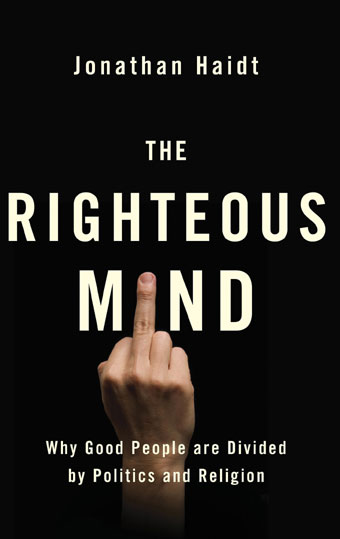
    About this same time I was browsing through the recent Radio West programs. I saw one called “The Righteous Mind.”  It was an interview of Jonathon Haidt about his new book The Righteous Mind: Why Good People Are Divided by Politics and Religion.

    Hey, wasn’t that addressing my question?

    The program blurb states: “Monday, our guest is the social psychologist Jonathan Haidt, whose latest book sets out to explain the root causes of the divisions in our society. At the heart of his argument is the idea that the human mind is designed to “do” morality. But when we separate into tribes – say political affiliations or religious denominations – we focus on different moral foundations. Haidt joins us to explain why he says we need the insights of liberals and conservatives to flourish as a nation.”

    I listened. And loved the program.

    Haidt shared a number of deliciously insightful things about how our mind works and how we choose our affiliations. He shared so many insights that I immediately requested his book at my library. The library ordered a copy for their collection. I, of course, was first in line to read it. I just finished the book.

    It’s one of the best books I’ve read all year.

    Haidt explains why my sister and I were both baffled by people who voted for the opposition candidate. He explains how human morality works. How our reason does not lead us to make the judgments we do, but instead more often acts like a lawyer to justify our positions to others.

    As soon as he explained that I saw how I had done that time and time again. For example, in this election cycle I blamed Obama for the economy. In the Bill Clinton re-election I vigorously argued that the President doesn’t have any effect on the economy and is lying if he takes credit for it. I’m not saying that Obama didn’t do things that might have hampered the recovery, but how did I know his actions exacerbated our problems? What evidence did I really have?

    Haidt explains that there are six basic moral bases then points out which ones drive liberals, conservatives, and libertarians, and how we can use that knowledge to disagree more constructively. He provides strong insights into how our reason and intuitions and judgments work, the evolutionary function of our morality, and how our wiring for group affiliation affects it.

    I didn’t agree with some of his conclusions. He sometimes takes his points too far. For example, he seems to suggest that people in cities are pre-disposed to be liberal. And that’s why they live there. Um, no. That’s not why they live there. They live in cities because that’s where the jobs are. The agricultural revolution made sure of that, remember? In his effort to explain the smaller biological basis of our beliefs, he also downplays the larger effect our families and groups have. But despite these excesses, he shares so many fresh and exciting ideas that they don’t matter. And he shares them all in such a fun and clear way that I couldn’t help but stay up late a number of nights reading this book.

    Do you know how much I wanted to trash Obama to my sister?  That Soviet-style central planner.  That drunken sailor spender.  That choom wagon pot head.

    And yet, you and I also know that will never work. I now know better why. Because of Haidt, I think I see a better way. I certainly see how I have done exactly what drives me mad about those who have drunk the opposition candidate’s Kool-aide. I see that I have my own conservative force field that deflects liberal bullets (and perhaps even blinds me to the truth sometimes). And why I need to watch my reason, that cunning lawyer part of my brain, as well as my intuition.

    Haidt, a liberal, has given me, a conservative, a great gift. I intend to use it. If you are interested in the two taboo topics of politics or religion, if you enjoyed Malcolm Gladwell’s book Blink or the Heath brother’s Made to Stick, if you want to find a better way to influence than flame wars (as fun as they can sometimes be), then I think you will enjoy the wonders Haidt shares in his fine book.

    Don’t just take my word for it. Listen to the Radio West program http://radiowest.kuer.org/post/righteous-mind for a taste of what awaits you.
  • Pew Study on American Reading Habits

    Pew Research Center just published the results of a national study surveying reader habits. It answers questions like:

    • Do folks read ebooks more often on cell phones, e-readers, or computers?
    • How many books does each age group read per year?
    • How do readers under 30 discover books to read? 

    Lots of great stuff. You can read the full survey here: http://libraries.pewinternet.org/2012/10/23/younger-americans-reading-and-library-habits/

  • |

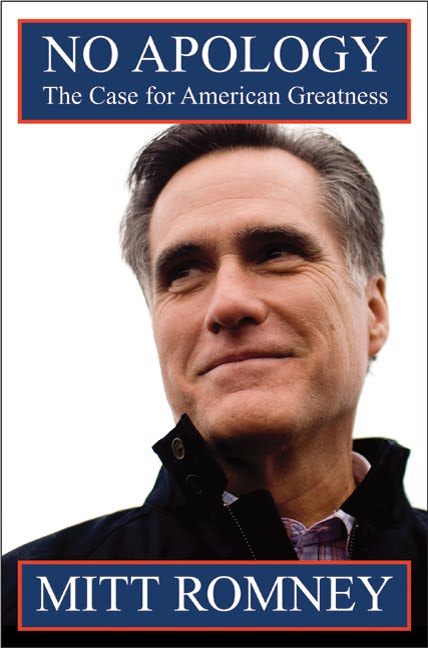
    No Apology

    The Book

    Political TV ads can be fun. And annoying.

    Debates can be fun. And maddening.

    You can indeed learn things about the candidates from watching the ads and debates. But fifteen and thirty second snippets of information really don’t give you the full picture. And sometimes they actually hide the facts, producing nothing more than informational smog.

    Recently, I decided I wanted to really know what Mitt Romney thought.  What he was about.  What he hopes to accomplish if he wins the presidency. If Mitt was someone in my neighborhood, I’d go visit the man, and we’d have a chat.

    I’d ask him about his ideas and past. I’d ask him to give me examples. Because of the nature of the issues at stake and the number of them, I imagine our chat would probably last a few hours.  It might stretch over a number of evenings.

    Of course, I’d want time to consider our chat and determine where I did and didn’t agree with him. I’d want to hear what others thought. And I’d want to look into his history, his successes and failures.

    But the first step would be to go to the man himself and hear him out.

    I hate it when people put words in my mouth. I’m sure Romney, or anyone else running, hates that same thing. If I were running, I’d would hope folks would take the time to hear me out. They may ultimately disagree with me on many or a few things. But I’d hope, as they are gathering information, that they would take the time to actually go to the source and listen to what I myself had to say.

    Unfortunately, I can’t walk around the corner and knock on Mitt’s door. But he did write a book that was published in 2010, and it’s probably the next best thing to talking to Romney at his kitchen table. The book is called No Apology: The Case for American Greatness.

    I’ll admit I thought it was going to be a dry guide book explaining his position on every hot political issue. It’s not a guide book.  In fact, he leaves a number of topics out. Nor was it dry.

    I also suspected it might be a scathing attack piece on the Obama administration. It’s not that either.  Not even close. He does criticize some things where he and Obama differ, but he also commends him on a few things. Either way, Obama is a very small part of the book.

    So what IS this book?

    Romney states its purpose in the introduction: it’s “about what I believe should be our primary national objective: to keep America strong and to preserve its place as the world’s leading nation” and “the course I believe we must take to strengthen the nation in order to remain prosperous, secure, and free” (2). It’s about his ideas on how to make sure America does not falter as so many nations have, but remains wealthy, happy, and productive.

    I finished the book yesterday. I found it interesting, personable, sometimes surprising, and insightful.

    I found Mitt Romney to be a man self-deprecating humor.  He’s also a thinking man, one who likes to look at data to see what it shows. It’s clear he’s a man who does NOT think he knows everything or has a monopoly on every good idea, but he’s also a man who demands evidence.  I also saw a man who is kind.  He doesn’t talk much about his 14 years of service as a lay minister in his church in this book, but you can see how those years changed him as he discusses helping the unemployed, out-of-wedlock births, and single-parent families.  Finally, I saw a man who loves, LOVES, America and is convinced she can remain the hope of the earth, but only if we do things that foster our strength.

    This book outlines what he thinks those things are.

    The book is written in a conversational and easy style with many examples from his personal experience, studies, and history. Romney’s record of accomplishments demonstrates his skills and hard work ethic. This book explains to what end he would apply that skill and work.

    If you’re planning on voting this November for the president of the United States, I think you’ll find this book very useful.  You may end up agreeing with many things he says. You may end up disagreeing with him on many points. But before you can do either, you need to understand what Romney’s position actually is.  And the first step in doing so is to fully hear the man out, in his own words, from his own lips.

    As a result, whether you end up deciding he’s your candidate or not, you WILL come away with important insights into the issues discussed.

    What’s Next

    I want you to know that I do not worship George, Ben, Tom, Adam or any of the other guys who formed our constitution and started this nation.

    They put their lives and fortunes on the line for what they believed in. And I am immensely grateful for what they did.  I enjoy tremendous freedoms because of their courage, determination, and sacrifice. Those guys, by-and-large, rock!

    But I do NOT believe that their words are scripture nor that their ideas are sacrosanct—merely to be accepted and not to be considered and questioned and disagreed with.

    Even so, these guys were gutsy and brilliant. They attempted something everyone thought would fail.  Something that HAD failed every time it had been attempted in their recorded history. But they pulled it off and changed the world.

    These guys believed in the common man. They believed that the educated common man was the best person to hold the reins of government. Thomas Jefferson thought up a rhyme to make the idea easy to remember.  He said, “If a nation expects to be ignorant and free in a state of civilization, it expects what never was and never will be.”

    I can’t argue with that.

    Of course, we’re not going to become experts on every policy issue. But we certainly can become informed on the broad principles and issues. And we can certainly become informed about the candidates.

    Because I found No Apology so useful, over the next few days I’m going to summarize Romney’s main points, chapter by chapter, here. I’ll also point out interesting ideas and facts he shares as well as share any questions, quibbles, or disagreements I have.

    I hope you find it useful. More importantly, I hope you read the book and join in the conversation.

  • YA Books Ratings and Publisher Arrogance (shh, it’s about the $$)

    I’m a bit irked.

    I wish I could talk to a publisher about this. I should talk to a Barnes & Noble corporate book buyer. But since I don’t have one handy, I’ll discuss it with you folks. Maybe I’m up in the night? You tell me.

    Here’s the deal. My wife is 7th and 8th grade language arts teacher. My wife is also a mom who loves books and wants her girls to read until their eyes bong out of their heads.

    So we go to find books for her students and for our girls and, jeez, wouldn’t you know it, but this YA book features masturbation and that one features lots of fine words like F*** and S*** and this one is about giving the guys a blow job (tee, hee, hee).

    Yeah, I know about YA saves. This isn’t about banning this or that content.

    It’s about the fact that I’m a parent. And, geez, I have a certain way I want to raise my kids. My wife is a teacher who needs to provide books to her students that aren’t going to piss some parent off. Why? Because she’s providing a service to that parent. Because she wants to keep her job. And because it’s her job to help parents improve their kid’s reading ability not tell them how to raise a family.

    So why in the Sam Hill can’t publishers rate their books?

    There are millions of their customers who would find this useful.

    Well, here’s one answer I was given by a writer friend I respect.

    Everyone in the industry is really pushing back against the idea of a rating system. Let me see if I can explain why.

    A friend of mine, ZZ [name removed], is the nicest person in the world. Volunteered for years at a prison to help people learn to express themselves by writing. Her older brother was a closeted homosexual for years, contracted AIDS, died too young. She wrote a book recently called [title removed], about a family in the restaurant business (as hers was) who have a “late” baby and the problems it causes for the older teens, one of whom is coming out as gay. It’s a soft, quite, sad, moving book. And it would be part of the “rating” system and banned from a bunch of schools. ZZ also wrote a book a few years ago about teenage pregnancy. Also beautifully written, kind, compassionate. But it would get tagged by schools as “inappropriate.” ZZ feels strongly that there are kids out there who need books, kids in your wife’s school system who need to be told they are not alone.

    I don’t see any way to have a system that distinguishes between books that I see as anchors to kids who need help and those books which I see as genuinely offensive and encouraging bad teen behavior by glorifying it. The only system I know is me recommending the best books I see. And I’d much rather see librarians and school teachers go through books on a case by case basis, deciding whether they personally think it fits the values in their community than to have someone else not attached to the community do the same thing.

    Uh huh.

    If this is accurate, it shows the industry’s stunning lack of creativity AND arrogance. Because if publishers really were listening to parents, they could come up with a solution.

    No, really. They could.

    Why, there’s already one out there. They don’t even have to expend even one creative molecule to find it.  

    Look at the Kids-in-Mind rating system: http://www.kidsinmind.com/. It rates movies 1-10 on sex, violence, and profanity (SVP).

    There’s no age stipulation in their ratings.

    Unlike other rating systems, there’s no “children under 13 not admitted.” No “appropriate for teens.” No recommended range for this or that group or this book is good and that one’s bad.

    It just rates the content and gives it a number. You, as the user, determine what level you’re comfortable with and then find the movies that fit.

    I’m a 4-10-4 on sex, violence, and profanity. You might be a 5-2-9. That’s not good or bad. It’s just what it is. More importantly, the rating allows me as a consumer to EASILY FIND AND PURCHASE THE PRODUCT I WANT.

    I know some folks have never heard of it, but consumer choice is a really cool thing.

    And if I hear about a movie that’s amazingly good, but I see it doesn’t match my normal levels, then I can make an informed choice to watch or not watch. The King’s Speech, for example, is a bit above my normal profanity setting. But this didn’t prevent me from watching the film (it was a fabulous movie, btw). SVP just gave me a couple of pieces of simple data I find useful as I make my choices. Data I’m already looking for.

    If publishers were to use a similar rating system, every librarian could peg the levels they wanted in their school and be done with it. As well as consider special cases. Teachers could peg the level for their classroom. Parents could search and find and buy. And they could guide their kids in their purchases as well.  

    Make it easy for them to go case-by-case. And don’t imagine librarians and teachers and parents are going to read every YA book published to find those that fit with their values. They don’t, can’t, do that now. They won’t in some utopian future. If you give them SVP ratings, it will help them spend their time, case-by-case, on books that they’re likely to buy. Which probably means they’ll buy more.

    Write about homosexuality, rape, whatever. But make it easy on the consumer to see if it’s the kind of product they want to buy.

    Some might say, but themes of homosexuality and rape and child abuse etc. etc. are important and would be automatically excluded!

    No, they won’t.

    You can write a story about those themes that scores low on SVP. You can write about those themes and score high. Themes are outside the SVP scale.

    Some parents, librarians, and teachers may want to avoid some themes. Others would seek them out.

    So, good golly, here’s an idea only a rocket scientist could come up with. OR someone who took the issue a tiny bit seriously and wanted to serve their customer. How about a little box under the SVP rating that contained “sensitive” themes.

    They don’t have to do what Scholastic does with its school catalogs and label them “mature” themes, which might suggest “mature audiences only.” They’re not “mature” themes. They’re not “bad” themes. They’re not “good” themes. They’re just sensitive themes.

    SVP and Sensitive Themes: four little pieces of data consumers would find oh so incredibly helpful.

    But no. The industry can’t be bothered with that. And, consequently, reveals its arrogance and total lack of respect for a HUGE portion of their customers.

    I guess they think librarians are mindless idiots. Never in a million years, if a librarian is tuned into the needs of her community and thinks a book on homosexuality would be important, would she search on that sensitive theme and her SVP ratings. And parents would never do that for sure (do you know how many gun-clinging troglodyte parents there are out there!?)

    I guess the industry thinks because it sits in an office in NY City that it knows everything about raising kids. It knows so much it must dictate to parents how to do it right.

    Yeah.

    Or maybe what this really shows is that the publishers have got a book they want to sell. They want to make a buck. And, dang it, this might hurt sales. Because then people wouldn’t buy things they didn’t want.

    They really don’t seem to care about what many of their customers want. Because if they did, and they realio trulio cared about these sensitive topics and saving the world, then they’d publish books high on the SVP because they’re just sooooo goooood, but they’d also publish books on those topics that are equally as goooood with SVP ratings that the majority of parents and school districts would be comfortable with.

    And they’d let the customer choose what they wanted to purchase.

    Customer choice. Customer service.

    Wow, what revolutionary concepts.

    They even might find that if you delight the customer, they’ll come back for more.

    I know, I know. I’m living in fantasy land; delighted customers coming back for more . . . as if.

    Question is: will the publishers listen?

    We’ll see. I truly hope I’m wrong about their arrogance and disregard towards huge swaths of their customer base. In the meantime, you might want to think about talking to the manager of your favorite book store about this. Strangely enough, books stores have a lot of pull with publishers.

    You also might want to look at Kids-in-Mind. It seems to make a lot in advertising. Looks like there’s money to be made in a review site like that for YA books. I know a lot of people who have said they wished they could just read books for a living. Anyone feeling entrepreneurial? Anyone?

    EDIT

    Two more points.

    First, what’s sensitive for one person may not be for another. But that’s the beauty of this. This only identifies subjects that would be sensitive for reasonable sections of the market. For someone with your reading tastes, you’d say, eh, homosexuality, big deal. That’s not a sensitive subject. For others, they’d say, hum, have to think about it.

    It’s just giving data. A respect and recognition of different tastes. Not a prescription of what someone’s taste should be. Or what people should or shouldn’t feel is sensitive subject matter.

    For this reason, I don’t think publishers would want to use the word “controversial” because that implies controversy. Just sensitive (or some other similar label). Or even “Potentially Sensitive Themes.” This is just giving data about content areas SOME parents might want to know about.

    Second, the SVP is not going to be 100% perfect. But something is much better than nothing. And having some clear standard for rating, whatever it is, pegs things so you can figure out where you are. As long as the raters are fairly consistent, then you can tell if something is close to the type of product you’re interested in. There will be goofs. No doubt about it. Huge goofs would be probably very infrequent because a ten-point scale allows you to make gradual distinctions. But I’ll take some goofs now and again over nothing at all.

    Furthermore, because it’s NOT age-based like the MPAA and prescriptive in the target audience, it’s not telling parents what to do. There is no “good for your kids” and “bad for your kids” rating. Just the level you’re comfortable with.

    Finally, some people object to ratings because “how can you boil a book down to a few numbers?” I don’t think this boils a book down. It’s only a couple of pieces of data about a book. Data parents are already looking for. The cover, recommendations, word-of-mouth, flap, description, buzz–these are all pieces of data as well.

    In fact, you and I exclude many books based on genre labels alone. And yet we don’t worry about a genre labels much. They’re useful pieces of information. Are they always perfect? No. But they’re by-and-large very useful. I don’t see that this is much different. Just another piece of data to help consumers find what they want.

  • 1491, 1493, and Greek Gods

    New Revelations About America

    A common idea taught about the Indians (and, yes, it appears when you can’t simply refer to their tribe, most prefer that term to “American Indian,” especially those in South and Central America) is that they lived in such harmony with the land, that they trod so lightly upon it, that the landscape showed hardly any sign of their passing. This is, after all, what we were shown in Disney’s Pocahontas and James Cameron’s more recent Avatar, isn’t it?  

    Many of us were also brought up to believe that there really weren’t that many Indians around anyway.  They were subsistence societies. There certainly were no cities comparable to those in Europe at the time. And especially not in places like the Amazon or Boliva.

    We were taught that the Indians traveled here by walking to America across the Bering Strait land bridge that stretched from Russia to Alaska during the ice age around 10,000 BC. When they arrived, the proceeded to eat a tremendous amount of meat, killing off all the mega fauna like mammoths.

    We were taught other things. But it appears that many of these things have recently been shown to be false. Sometimes dramatically so.

    For example, the Indians transformed their landscapes, tens of thousands of square miles of it, very often through burning, but also through other ingenious ways.

    There were far more Indians in 1491 than most folks know. Recent research suggests that Central Mexico was the most densely populated place on earth at the time, “with more than twice as many people per square mile than China or India.” The total population of the Americas in 1491, by some estimates, was between 90-112 million people, meaning that MORE people lived in the Americas than in Europe.

    Finally, it appears that the Indians were here twenty to thirty thousand years ago. They were here when Europe north of Paris was still uninhabitable and mostly covered by glaciers!

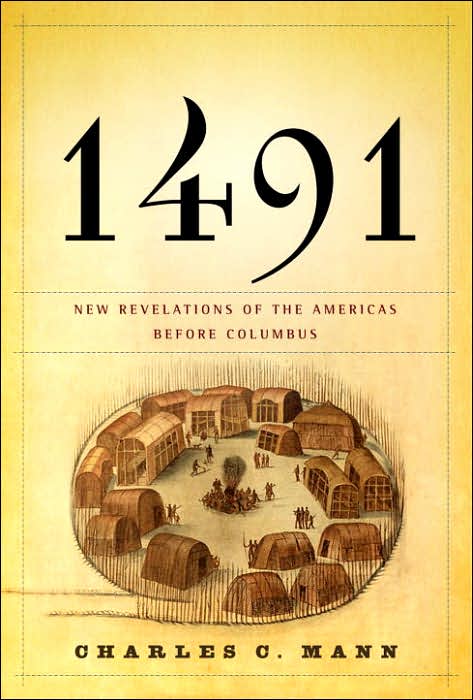
    Charles Mann describes these and a number of other fascinating findings in his book 1491: New Revelations of the Americas Before Columbus. He relays the information in such an engaging style that I found myself picking the book up at every chance. When I was finished, I wanted more.

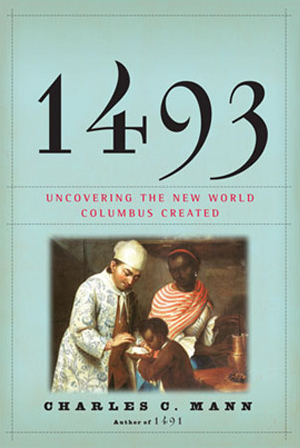
    Luckily, in 1493: Uncovering The New World Columbus Created Mann continues his history lesson. Except instead of focusing on the surprising things we’ve learned about the Indians in the last two decades, he focuses on the surprising impacts, both biological and financial, of linking the Western and Eastern hemispheres together. It’s the biggest event in the world, Mann suggests, since the dinosaurs died. Mann suggests that Columbus didn’t discover a new world–his voyage created one.

    The first part of the book examines the effect of the exchanges across the Atlantic (microbes  and tobacco). The next part focuses on the effect of the exchanges across the Pacific (silk, corn, and pirates). The third part shows the role of the exchange in the Agricultural and Industrial revolutions (potatoes, guano, and rubber).  The final part examines the consequences of the huge shift in populations caused by the Atlantic slave trade (Maroons, mixed-marriages, and freedom). As with 1492, the insights are both surprising and fascinating.

    If you like history, if you liked Guns, Germs, & Steel, then I think you will love these two books.

    EDIT: I just ran across a fabulous Doug Fabrizio Radio West interview with Charles Mann about 1493 called  The World Columbus Created.  Listen and enjoy!

    Divine Yogurt

    For years eating a serving of sweetened yogurt was like eating a box of Milk Duds (20 grams of sugar) or a Milky Way candy bar (35 grams of sugar). Yes, the sweetened yogurts have that much sugar. The only way to avoid eating literally like a kid in a candy store was to purchase plain yogurt and add some fruit or a squirt of honey. And, no, I will not consider eating yogurt sweetened with Splenda or Nutrasweet.  Artificial sweeteners make me gag. As far as I’m concerned, they are abominations that ruin the taste of everything they touch.

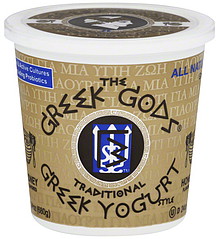
    So for many years I enjoyed my mix of plain yogurt and various add-ins. However, to my joy, I recently discovered a sweetened yogurt with only 15 grams of sugar (about as much as you find in a large banana) that tastes divine. It’s sweetened with real sugar and honey. And the mouth feel is sooooooo smooth. I’m sure this is because, unlike all the other yogurt manufacturers, these guys realized that, duh, fat actually makes things taste good and isn’t the  evil thing we’ve made it out to be. In just two bites it became my favorite sweetened yogurt. It’s called The Greek Gods Traditional Greek Yogurt. I’ve found another version—the vanilla honey—that only has 5 grams of sugar.

    Be aware that despite its name, this yogurt does NOT have the high protein content of other Greek style yogurts such as Brown Cow Greek Yogurt with 23 grams. Furthermore, not all the flavors have the low sugar content. Their blueberry and strawberry flavors, for example, have 35 grams. So check the labels first, and then treat yourself to yogurt that will have you savoring every bite.

    When I eat yogurt, it will still mostly be the plain Greek style with mixers. But when I want a special treat, you know I’ll be getting some from The Greek Gods.

    EDIT: 9/6/12 I now feel like Jerry Seinfeld in the episode when they found out the fat free frozen yogurt really wasn’t fat free. All the other yogurts I was looking at had serving sizes of 1 cup. The Greek Gods folks thought 1/2 a cup was the right size. That means that this super amazing low sugar yogurt had 30 grams of sugar per serving! It’s like eating a Snickers! I’m so disillusioned. Alas.