|

No Apology

The Book

Political TV ads can be fun. And annoying.

Debates can be fun. And maddening.

You can indeed learn things about the candidates from watching the ads and debates. But fifteen and thirty second snippets of information really don’t give you the full picture. And sometimes they actually hide the facts, producing nothing more than informational smog.

Recently, I decided I wanted to really know what Mitt Romney thought.  What he was about.  What he hopes to accomplish if he wins the presidency. If Mitt was someone in my neighborhood, I’d go visit the man, and we’d have a chat.

I’d ask him about his ideas and past. I’d ask him to give me examples. Because of the nature of the issues at stake and the number of them, I imagine our chat would probably last a few hours.  It might stretch over a number of evenings.

Of course, I’d want time to consider our chat and determine where I did and didn’t agree with him. I’d want to hear what others thought. And I’d want to look into his history, his successes and failures.

But the first step would be to go to the man himself and hear him out.

I hate it when people put words in my mouth. I’m sure Romney, or anyone else running, hates that same thing. If I were running, I’d would hope folks would take the time to hear me out. They may ultimately disagree with me on many or a few things. But I’d hope, as they are gathering information, that they would take the time to actually go to the source and listen to what I myself had to say.
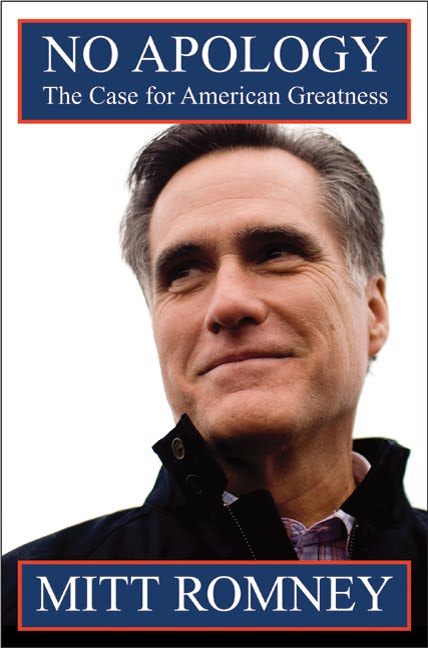
Unfortunately, I can’t walk around the corner and knock on Mitt’s door. But he did write a book that was published in 2010, and it’s probably the next best thing to talking to Romney at his kitchen table. The book is called No Apology: The Case for American Greatness.

I’ll admit I thought it was going to be a dry guide book explaining his position on every hot political issue. It’s not a guide book.  In fact, he leaves a number of topics out. Nor was it dry.

I also suspected it might be a scathing attack piece on the Obama administration. It’s not that either.  Not even close. He does criticize some things where he and Obama differ, but he also commends him on a few things. Either way, Obama is a very small part of the book.

So what IS this book?

Romney states its purpose in the introduction: it’s “about what I believe should be our primary national objective: to keep America strong and to preserve its place as the world’s leading nation” and “the course I believe we must take to strengthen the nation in order to remain prosperous, secure, and free” (2). It’s about his ideas on how to make sure America does not falter as so many nations have, but remains wealthy, happy, and productive.

I finished the book yesterday. I found it interesting, personable, sometimes surprising, and insightful.

I found Mitt Romney to be a man self-deprecating humor.  He’s also a thinking man, one who likes to look at data to see what it shows. It’s clear he’s a man who does NOT think he knows everything or has a monopoly on every good idea, but he’s also a man who demands evidence.  I also saw a man who is kind.  He doesn’t talk much about his 14 years of service as a lay minister in his church in this book, but you can see how those years changed him as he discusses helping the unemployed, out-of-wedlock births, and single-parent families.  Finally, I saw a man who loves, LOVES, America and is convinced she can remain the hope of the earth, but only if we do things that foster our strength.

This book outlines what he thinks those things are.

The book is written in a conversational and easy style with many examples from his personal experience, studies, and history. Romney’s record of accomplishments demonstrates his skills and hard work ethic. This book explains to what end he would apply that skill and work.

If you’re planning on voting this November for the president of the United States, I think you’ll find this book very useful.  You may end up agreeing with many things he says. You may end up disagreeing with him on many points. But before you can do either, you need to understand what Romney’s position actually is.  And the first step in doing so is to fully hear the man out, in his own words, from his own lips.

As a result, whether you end up deciding he’s your candidate or not, you WILL come away with important insights into the issues discussed.

What’s Next

I want you to know that I do not worship George, Ben, Tom, Adam or any of the other guys who formed our constitution and started this nation.

They put their lives and fortunes on the line for what they believed in. And I am immensely grateful for what they did.  I enjoy tremendous freedoms because of their courage, determination, and sacrifice. Those guys, by-and-large, rock!

But I do NOT believe that their words are scripture nor that their ideas are sacrosanct—merely to be accepted and not to be considered and questioned and disagreed with.

Even so, these guys were gutsy and brilliant. They attempted something everyone thought would fail.  Something that HAD failed every time it had been attempted in their recorded history. But they pulled it off and changed the world.

These guys believed in the common man. They believed that the educated common man was the best person to hold the reins of government. Thomas Jefferson thought up a rhyme to make the idea easy to remember.  He said, “If a nation expects to be ignorant and free in a state of civilization, it expects what never was and never will be.”

I can’t argue with that.

Of course, we’re not going to become experts on every policy issue. But we certainly can become informed on the broad principles and issues. And we can certainly become informed about the candidates.

Because I found No Apology so useful, over the next few days I’m going to summarize Romney’s main points, chapter by chapter, here. I’ll also point out interesting ideas and facts he shares as well as share any questions, quibbles, or disagreements I have.

I hope you find it useful. More importantly, I hope you read the book and join in the conversation.

Share

Similar Posts

  • Good Stuff! Three Days in Moscow

    Book cover, Three Days in Moscow

    I just finished Three Days in Moscow: Ronald Reagan and the Fall of the Soviet Empire by Bret Baier. It’s a New York Times bestseller that takes you into the world of Ronald Reagan, his rise to power in politics, and his role in ending the Cold War. And it does in a personable way with gentle humor throughout.

    I enjoyed the fascinating behind-the-scene insights about the personalities involved and the clarity about what really happened. And how the book brings Reagan to life, as if he’s almost there. Along the way you’ll also get insight into Mikhail Gorbachev, the assassination attempt on Reagan, and more.

    Baier is the chief political anchor for Fox News. In 2001, he became the station’s chief Pentagon correspondent and ended up traveling to Afghanistan 11 times and Iraq 13 times. In 2007, he became the station’s chief correspondent to the White House. More importantly, Baier seems to be one of the few journalists these days who is simply trying to get and report facts instead of spin. And that’s exactly what he’s done here.

    If you like biographies or history, if you want to know how the U.S.A. and the U.S.S.R. stepped back from decades of mutually assured destruction, if you want to get a view into how diplomacy is done, then I think you’ll love this book. And you’ll probably love it even more if you can listen to the audio book version, read by Baier himself, which also includes a recording of Reagan’s speech to the students at Moscow State University. I listened to it via the Overdrive account my public library provides. Baier’s reading was terrific.  

    Share
  • Harry Reid’s Chickens

    Are we all wearing Coke bottle glasses with this government shut down?

    First, it seems silly to me when reporters ask Americans who is causing the shut down. It’s like, duh, if either party just gave into the other party’s demands, we wouldn’t have the issue. Which means that BOTH parties are causing the shut down.

    Second, it seems a lot of folks have forgotten that this is precisely what should happen.

    What?

    Yes, our government is designed to allow these types of things.

    But, John, isn’t that just asinine?

    No. It’s not an oversight. I think it’s smart. Even if it causes some pain.

    Let me explain what it seems some in the media and elsewhere are forgetting.

    This is not a nation that belongs to a government. It’s not a nation owned by some lord or entity. This is a nation of individuals who decided to band together because we thought that banding together would allow us to protect our lives, liberty, and pursuit of happiness better than if we stood alone individually.

    This is a nation of individuals who said, you know, we think we can figure things out better together ourselves than having someone dictating to us what we’re going to do. We’ll get together and talk. We’ll argue. We’ll persuade. We’ll try to convince each other of our individual ways of thinking. And when enough of us are convinced that we should do something, we’ll act.

    We’ll set up a process for talking and making decisions that ensures everyone can be heard. It would be great if we could get 100% agreement on everything, but we know that’s not realistic. At the same time, we don’t like the idea of forcing our will on others. So we’ll make a compromise; we’ll set up the rules for making decisions so it requires that a good majority of us are in agreement before we can take action, especially on matters that are important to a lot of us.

    Finally, we’ll make sure no individual or group can take control and deprive us of this way of living. We did the monarch thing, and we’re done with that. We will not bow to any king ever again. We’re going to be very careful about this one item because a lot of bad things begin to happen when any one person or group gets too much power.

    So we set up the rules and started working together this way. And the basic premise under all of this is that we would respect each other’s free will. We’re a land of liberty. We’re a land where we get together and agree on a course of action. Not one where we impose our will on others.

    One of the main methods we used to ensure that no individual or group could take control of the rest of us and that a good majority of us must agree before taking a course of governmental action was to distribute the power to make and enforce rules. We did this in a wide variety of ways. We did this because power’s a slippery thing and easily abused. Furthermore, because we knew no system is perfect, we also set up a system of checks and balances so that if one person or group abused their power, we could stop them and force them to remember to respect the freewill that the rest of us have.

    So what has caused this shutdown?

    It’s very simple.

    A lot of Americans do not agree with Obamacare. By most polls, it’s a majority of Americans. They were not listened to when it was being developed. They were not listened to when it was made law. They feel it was passed, not with open discussion, but a lot of chicanery. They feel it’s not some minor regulation, but a very big thing that will infringe on their rights to live how they want to live.

    Now, it might be that all their fears are unfounded. It might be that Obamacare is going to usher in utopia. Many signs suggest it’s not going to do anything of the sort. But let’s just say it is the finest piece of legislation ever. Let’s say is a celestial piece of governing.

    That isn’t enough.

    It’s not nearly enough.

    Because this is not a nation that belongs to any group. We are a nation of individuals who have banded together, agreeing that we will talk things out amongst ourselves and only act when a good majority of us agree on a course of action. This is a nation that tries to tread lightly on each other’s liberty.

    But many of the folks in Washington back in 2009-2010 forgot this and forced this thing called Obamacare upon the rest of us; in doing so, they violated one of the basic agreements of our compact. If they had followed the underlying intent of our union, they would not have done what they did. They would have crafted legislation that a good majority of us could get behind.

    In 2010, those of us who protested this use of power voted in new folks into the House of Representatives to deal with the matter. In fact, when given the chance, Americans (both Republican and Democrat) in the heavily Democratic state of Massachusetts voted Republican Scott Brown into office, hoping to stop this legislation in the Senate before it became law. But Harry Reid didn’t listen. He didn’t care. He and Pelosi and Obama weren’t interested in allowing a full national discussion. He and the others were more concerned with getting their way. And so he used a parliamentary trick to force it through.

    This shut down is about one group of people forcing their will on the rest of us. It’s about using the checks and balances designed into the system to correct such errors. It’s about the chickens of some poor decisions coming home to roost.

    I know the shut down has caused issues. It’s a partial shutdown; 13% of the government. I think 87% is still funded and running. Still, I know it’s causing some pain.

    But none of that pain needs to occur. Everyone wants to fund cancer research. Everyone wants to help poor single mothers. Those things aren’t the issue. The issue is that not everyone agrees with Obamacare.

    If you’re a supporter of Obamacare, let me ask you this: if the tables were turned, what would you do?

    Would you not stare at the folks trying to force their will on you and say, hey, come on. We’re adults here. We all agreed that we wouldn’t do anything unless a good majority of us were convinced it was the right course of action. Let’s get together and come up with something a good majority of us can get behind.

    If you’re an opponent of Obamacare, you too should recognize that a good portion of your fellow citizens are clamoring to change the way things are. They’ve been clamoring for some time. Should you force your will on them? Or should you sit down and listen and try to come up with something that addresses the points we can agree on?

    I don’t know if the folks many of us voted to go to Washington will stick to their guns and correct this. I hope they do. And I hope that those on both sides who have forgotten one of the basic tenets of our social compact will wake up and remember we are banded together, not to game the system to get what we want, but to act on only what a good majority of us want.

    Share
  • Good Stuff! How to Make Meetings Work

    Do you regularly sit through meetings that seem to accomplish nothing?

    Meetings where people drone on and on and on.

    Meetings where people discuss and no decision is ever made.

    Meetings that always slide off topic.

    Meetings that should never have been held in the first place.

    In many cases, the reason these meetings stink is because those organizing them are not aware there’s any other way to hold a meeting. But there is. I was fortunate enough to have been exposed to it just out of college while working for a business consulting firm in San Francisco. (And why they didn’t teach this in my business degree I will never know!)

    After learning the simple and powerful principles, I was eventually paid to plan and facilitate meetings for clients. In some of these meetings they were making incredibly important decisions. I remember a client flying me and a colleague from San Francisco to Delaware for two days of meetings.

    You might be groaning at the thought. But they paid thousands of dollars to have us come and facilitate. And when we were done, the energy in the room was palpable. A number of those that were involved were astounded and said they’d never been involved in such productive sessions. They’d accomplished more in the hours we were there than in months of other meetings. They were happy and grateful we’d come.

    Think of that—happy and grateful for a meeting that went on for hours!

    When meetings are done right, the collaboration and synergy can be amazing. Now, you may think that some secret handshake is required to learn how to do this. Or that it’s only for those with some special knack. Or that it’s only for high-powered jobs. If you do, you’d be wrong.

    And that’s because you can learn the principles all for a few bucks. They’re laid out in perfect clarity in How to Make Meetings Work by Michael Doyle and David Straus. This is the book that was the source of our training sessions all those years ago. And I reread it every few years to brush up. The principles work in everything from a family council to a board meeting to class settings. I know because I’ve used the ideas in all of them. And when I fail to take just a few minutes to prepare, that’s when the meeting becomes, well, just another (yawn) meeting.

    If you hold meetings of any kind and want to improve them, give this book a try. I think you’ll be happy you did.

    Share
  • You want your kids to succeed in school? There’s one thing you can do…

    Did you know that there is one thing that kids can do outside of school that’s been proven, over and over, to lead to them doing significantly better in all other subjects?

    And I mean all subjects. Math, history, science, criminology, psychology—you name it.

    There’s one thing, and numerous research studies have proven it, that kids do that leads to them getting better jobs later in life.

    This one thing, proven by research, leads them to grow up to make more money.

    And it doesn’t matter if they start in a rich or poor family. This one thing leads them to greater opportunity. Over and over again.

    It’s a thing that kids actually can learn to love. For some it becomes as delicious as eating ice cream.

    The kids are back in school. Parents want them to do well. They want them to succeed. How wonderful that there’s one thing that parents can focus on that will so dramatically change their child’s life.

    And it doesn’t take long. Even just twenty minutes per day of this activity can change everything.

    Twenty minutes.

    Is there a parent anywhere that can’t find twenty minutes?

    So what is this one thing?

    Reading for pleasure.

    Notice I didn’t say reading for academic purposes. I didn’t say reading to finish homework. I said reading for pleasure. For the enjoyment it brings.

    And it doesn’t matter what the subject matter is. It can be fiction—fantasy, love stories, horror, action. It can be non-fiction—like material on bugs, robots, horses, motocross. It can be fairy stories or funny anecdotes. It can be short or long. The key is that they’re reading for pleasure.

    I know some of you might be saying, “But John, my kid doesn’t like to read.”

    That’s okay. You can change that.

    If you want to find out how to help your child learn to enjoy reading, let me recommend Raising Kids Who Read: What Parents and Teachers Can Do by Daniel T. Willingham, a professor at the University of Virginia whose research has focused on the brain and learning. In the book, Willingham debunks the myths about literary instruction and provides practical, engaging, research-based tips for sharing the joy of reading with kids of all ages.

    You can get a used copy for $13 bucks on Amazon.

    RaisingKidsWhoReadByWillingham

    While you’re waiting for the book to come, here are some things you can do start doing right now to help your child read for pleasure.

    First, start reading something fun or interesting with or to them every day. For little kids, this can be picture books. For older kids, this can be anything–an article from a magazine, funny stories online, or books large and small. If you want to start with a joke book, that’s okay. If you want to start by listening to a book on tape, that’s great too.

    Wait a minute? A book on tape? Isn’t that cheating?

    No.

    There are four keys to helping your child read for pleasure. They need to learn to:

    1. Decode the sounds letters make.
    2. Comprehend what’s meant, which is driven by their general knowledge of the subject they’re reading about.
    3. Enjoy reading.
    4. Identify themselves as a person who likes to read books

    When you listen to a book on tape, you’re doing numbers 2-4.

    Remember: the goal is not to improve the child. It’s not to get them a better job ten years from now. It’s not to make them wealthy. It’s to simply help them enjoy reading. Because once they enjoy reading, once reading for pleasure is something they see as one of the things they do, they will begin to read more and more. And as they read, they become better at reading, which leads to more enjoyment, which leads to more reading. Which leads to all of those other awesome benefits. It’s a virtuous cycle.

    So the first thing you need to do is simply start having a good time reading with them. You can read to them at bedtime, after dinner, on weekends. You can have them read articles to you while you’re making dinner or washing the dishes. You can have them read to your or themselves while you’re on the road driving somewhere.

    You can make a rule that they have to read with you for twenty minutes before they go play with friends or watch TV or play video games.

    And above all, you need to let your child’s interests drive most of the topics you read about. If they want to read about spiders and dinosaurs, then read about spiders and dinosaurs. If they want to read horror stories, then read horror. If they’re into skiing or horses or guns, then help them find interesting stuff on the topics they’re already interested in. And if they don’t like a book, teach them they can abandon it and go find another.

    And if you yourself are not someone who reads for pleasure, well, now’s the time to start. You can make reading for pleasure something your family does, just like families make enjoying boating or hunting or riding horses or eating Mexican food part of what they do.

    It’s never too late to start.

    And seeing that this is the one thing that has such an impact on your child’s success, is there really anything else that would be a better use of those twenty minutes per day?

    Reading for pleasure—who knew that having a great time could have so many wonderful effects? Start today. Don’t wait.

    It might take a little work. You and your child might run into a few unpleasant spots. But that’s true of anything. How many times do kids fall when learning to water ski or snow ski? How many times do they experience something unpleasant when practicing football or basketball or volleyball?

    So start right now. Figure out a time with your child. And begin learning to read for pleasure.

    Share
  • LTUE 2024 Writing Presentations

    Yesterday, I gave two presentations at Life, The Universe, and Everything, a SFF writers conference in Provo, Utah. A number of the attendees wanted copies of the presentations. I’ve linked to them below.

    There are two types of plots that power almost all successful commercial fiction. Are you using them in your stories? Do you know how they work? In this class, you learn both plot types, their key beats, the 3 big mistakes writers make, how to generate scenes, and much, much more. Come learn how to make plotting easier and deliver the ride your readers are looking for.

    My lecture notes.

    The #1 thing that slays more writing dreams than anything else is the writer’s own head games. In 2005 I fiddled with death. Cognitive therapy (and God and a good counselor) saved me. And gave me an explosion of insights about writing stories and the distortions that sabotage so many of us writers. In this class, you learn the distortions, the truth, and a tried-and-true technique for removing the distortions that anyone can follow. You don’t need to struggle anymore. Banish your writer’s block, fear, imposter’s syndrome, comparisonitis, and more. Come learn how to unleash your awesome creativity and have a blast writing.

    PDF of presentation slides.

    Share