Pew Study on American Reading Habits

Pew Research Center just published the results of a national study surveying reader habits. It answers questions like:

  • Do folks read ebooks more often on cell phones, e-readers, or computers?
  • How many books does each age group read per year?
  • How do readers under 30 discover books to read? 

Lots of great stuff. You can read the full survey here: http://libraries.pewinternet.org/2012/10/23/younger-americans-reading-and-library-habits/

Share

Similar Posts

  • |

    Indie Thoughts: Publishers know profit, but haven’t tapped best seller lists

    In The Business Rusch: Generational Divide Kris Rusch points out that the new on-demand and long-tail market for books has changed the duration of the opportunity a book has to be successful, but that it seems the industry still isn’t recognizing this in how they measure success.

    The problems come from the fact that those of us who run things—people in our forties, fifties, and sixties—use metrics that were developed by our parents for their world, that tightly controlled Mad Men world where everyone was expected to be the same, not just in what they wore or bought but in what they listened to or watched or read as well.

    The bestseller list?

    It measures velocity. (A good essay on this topic, “The Meaningless Metrics of Fame,”  came from Mike Briggs, husband of Patricia Briggs, earlier this week. I’ve also dealt with it.)

    Reviews?

    They only want new books, and then only at the time of release.

    Brick and mortar bookstores?

    They only have room for the latest releases, and then only the ones that are the most popular with their customers (whoever those folks might be).

    Books have come late to this fight. Books have been available on demand for only about four years now, in the U.S. In other countries, there’s been even less time.

    And we’re all still fighting over meaningless metrics, to use Mike Briggs’ term, because those metrics only measure things that were important around the water cooler, not things which are important now.

    What’s important now?

    She goes on to say:

    The publishing industry isn’t even talking about new metrics. That idea hasn’t occurred to traditional publishing, and indie (or self) published writers are constantly seeking validation from the old system—trying to figure out ways to game the bestseller lists or to get a fantastic review from somewhere that has old-world prestige . . . But at some point, traditional publishers are going to have to develop new ways to figure out which products sell well and which ones don’t. All of their systems—from sales figures (which measure books shipped not books sold) to bestseller lists to critical acclaim—are based on the old models.

    Kris is a very experienced with publishing, but her last point conflates internal accounting with marketing. Publishers DO know which products sell.

    The primary measure of success in a financial enterprise s not new. It’s been around for 100’s of years. And on demand and long-tail markets don’t change it.

    The measure is how much a product or service contributes in profit to the bottom line. You take revenues, minus expenses, and that’s the contribution that product (a book in this instance) makes to your total profit. Or to covering your fixed costs.

    Booksellers have measured the success of their books with actual or estimated profits for quite some time. Publishers already know which books sell well and which don’t. No accountant in the world is going to report books shipped as the measure of success. And they don’t. The very fact that publishers have a profit and loss statement and show returns on royalty statements demonstrate that. They look very closely at actual and estimated profits. And to they do this by channel, which is reflected in a small way when they break out ebooks on royalty reports. This is all basic accounting.

    Here’s an example. Until Ender’s Game the movie, Ender’s Game the book hadn’t appeared on any best seller list since it was first released. And its release was 30 years ago! Yet over the years Tom Doherty touted its sales numbers many times. Tom knew that book was gold. Of course, he did. Because he doesn’t use best seller lists to tell him what’s selling well. He knows those lists are marketing devices. He has the real data in house. Why would he need a list to tell him anything?

    And Tom isn’t going to use books shipped either. Tor may report those numbers to Publishers Weekly for marketing purposes, but he will always multiply that number by an expected return rate to estimate sales. He wants to do that. Because books shipped is meaningless to the bottom line and everyone knows it, including the auditors.

    Publishers are well aware of the long tail. They see it with books that have been rotated out of the brick and mortar channels but are still selling in the online ones. They report it in their annual statements. They know the online channels work differently from the brick & mortar ones.

    The measure of success is still the same as it ever was—how much profit is this property contributing to our bottom line?

    Marketing, however, is a whole other ball of wax.

    What the long tail and on-demand allow are marketing campaigns that are impossible in the brick & mortar channel. In brick & mortar you have a limited time to advertise (roughly 8-15 weeks). After that period, most books are rotated out of the store. This means that any marketing for those brick & mortar buyers MUST coincide with the period when the books are in the stores.

    But the online channels open up all sorts of other opportunities. You can market forever. And the contribution margin is always positive. The online and POD costs are easily recouped with each sale. (Publishers are well aware of this profit potential; this is why we have so many making grabs for backlists.)

    And I see publishers taking advantage of these new marketing methods. This last week I saw publisher books not currently stocked by brick & mortar retailers on BookBub, BargainBooksy, and Book Sends. And the industry isn’t totally focused on new books for reviews. I just had a large newspaper agree to look at my book that was published four months ago. Still, Rusch is right when she says that the publishers haven’t adapted one of their biggest marketing tools to take advantage of the new opportunities–they haven’t done anything with the best seller lists.

    Amazon has lead the way in creating new ways of marketing books to different types of readers with their best seller lists. These lists create the excitement of discovery.

    But every one else is still reporting weekly sales on the big lists.

    If I were a publisher, I’d be asking USA Today to provide more than just the weekly view of the top 150 books. And USA Today is THE list to watch because their numbers are not based on units shipped to a sample of stores, but actual sales. Here are some lists that readers would be interested in.

    1. Most anticipated this week: based on pre-order totals
    2. Most anticipated this month: based on pre-order totals
    3. Hot new releases: based on weekly numbers
    4. Hot new releases for the month: based on monthly numbers
    5. Books with legs: last 3 months; I know it needs a different name (grin)
    6. Best sellers of the last 12 months: annual total of units sold
    7. Best sellers of the last 18 months: total units
    8. Contenders: for each of the lists above show the next 150 books (I always want to see the next 100 books after the top 100 on Amazon’s lists; why not show readers the top 300?)
    9. Movers: for each of the lists above show those that have the biggest rise in percentage sales and meet some unit minimum (you don’t want to feature books with 2,000% increase because they went from selling 1 unit to 20), even if they don’t break the best seller lists
    10. Genre: allow all of this to be sliced by genre.

    Let the reader select the view they want to see!

    Avid readers will gravitate towards the shorter time periods. Those that read fewer books will gravitate towards the longer periods. Everyone who wants to discover something new will go to the contender and mover lists.

    This is about marketing. Not publishers measuring success.

    And then armed with those numbers guess what the publishers will do? They will go back to the brick & mortar venues and pitch to have some of these same books carried in the stores for the first time (some publisher books are printed digital first) or carried again.

    Share
  • Amano, Jason’s Deli, and The Hunger Games

    The first time I tasted real chocolate was when I was a teenager in Switzerland. Up until then, I’d only eaten American Hershey nastiness or the left over chocolates at my grandma’s that she’d poked the bottoms out of and passed over. You know what I’m talking about: those yummy mystery fillings with weird chewy bits that make you wonder if the chocolates weren’t designed by toddlers with too much food on their plates. As you can see, I didn’t have a high opinion of the stuff.

    But in the thin oxygen altitudes of the Swiss Alps, I lost my mind and let my sister convince me to try a big flat bar of Swiss milk chocolate with her. We broke off two little pieces. I prepared myself to yak, picked up my piece, and put the chunk in my mouth. She took a bite of hers, and we immediately looked at each other in surprise. We then proceeded to gobble the rest of that large bar and one other before we realized what we’d done. It was so smooth and creamy, so rich, so . . . hallelujah!

    After the heavens closed and I came back to my body, I decided maybe chocolate wasn’t such a bad thing after all. Still, nothing I could find in the States compared, and so the chocolate dream faded. Then I married a girl who came with a special IV that fed chocolate directly to her bloodstream. Needless to say, I’ve had plenty of opportunity to eat all manner of chocolate since then. I’ve even learned to appreciate dark chocolate.

    I found that there is chocolate that you eat as a snack (chocolate biscotti with milk), chocolate that can make a meal (chocolate cheesecake with strawberries), and chocolate that’s meant to be savored. We recently found one of the latter. And it’s not a Swiss concoction. It’s made in, of all places, Orem, Utah.

    The company is called Amano Artisan Chocolate. According to the company’s website: “In 1996 while on his honeymoon, the founder of Amano, Art Pollard decided that there had to be better chocolate than what was being produced in the United States or that of numerous imported varieties. Thus began his search for the ultimate chocolate, which is not bland or flat, but has superior flavor and texture.”

    Of course, my wife and I had to give it a try. I can report that it’s lovely. I prefer the rich milk chocolates; she likes the darks. Again, this isn’t chocolate meant for eating. It’s chocolate meant for savoring. You want to take it slow. Let the taste linger and the secondary flavor notes have their moments. Besides, you won’t need to devour it. My wife, who is about as hooked as any junkie, can get her daily fix of joy with just one little square. If you’re a chocolate lover, you’ll want to give it a try. You can order from their website at www.amanochocolate.com or visit their outlet store in Orem.

    *

    Because we live where we do, we have to travel two gazillion miles each year for shopping, movies, and to watch our kids play sports. After a few trips, burgers make me want to gag. Which is why I’m so happy I found a fabulous fast food soup and sandwich joint. It’s called Jason’s Deli.

    No, it’s not THAT kind of deli—one of those narrow little places full of weird smells and coolers displaying things not meant for human consumption. This is a soup and sandwich shop. Tall ceilings. Lots of tables. Yummy smells. And food that is reasonably priced and delicious.

    I just dragged my wife to the one in Orem this last weekend. She got a Mediterranean Chicken on flatbread with hummus and loved it. I ordered my favorite, their California Club—sprouts, avocado, cheese, and tender meat on a flaky croissant. I always get it with the vegetable soup and fruit, which comes with a small bit of dipping yogurt. And if I’m really hungry, I get a piece of their strawberry shortcake made with real whip cream, not the canned stuff. When you tire of all the same old joints, go to Jason’s Deli. They have locations in Layton, Salt Lake, Murray, and Orem. You can find addresses at www.jasonsdeli.com.

    *

    A week ago Friday, I brushed my teeth, sat down on my bed, and thought I’d read a chapter or two of a book and then go to sleep. At two o’clock a.m. when my wife came home, I was still reading. She got ready for bed. I moved into the bathroom and told myself I would read just one more chapter. Just one. At four o’clock a.m., I finished the book.

    Folks, The Hunger Games by Suzanne Collins is delicious ride from start to finish. It’s about sixteen-year-old Katniss Everdeen, who lives in a post-apocalyptic world in the country of Panem where North America once stood. In the book, the Hunger Games are an annual televised event where the government of Capitol chooses one boy and one girl from each conquered district to fight until only one is left alive. The games exist to remind the districts they have no hope of any rebellion. The problem is that Katniss’ younger sister, who couldn’t hurt a fly, gets chosen to fight. So Katniss volunteers to take her place. But Katniss’ troubles only multiply. Not only are most of the other 23 fighters bigger than she, but they include a young man from her community who has been nothing but kind to her.

    The book is written to young adults, but this is one of those stories like Twilight and Harry Potter that will please adults as well. It delivers moments of wonder, tenderness, and humor. There’s a love subplot. But it’s the poignant suspense that will literally prevent you from putting the book down.

    I loved this book so much, I immediately read it again as an author to see how she pulled it off and found myself having an even more powerful experience the second time. It’s a best-seller and is going to be made into a movie. But don’t wait. I’m not. There are two more books in the series. And both are in the mail (thank you, Amazon). Here’s to two more joyful (and sleepless) nights.

    Share
  • Gun Runner wins Dragon Award

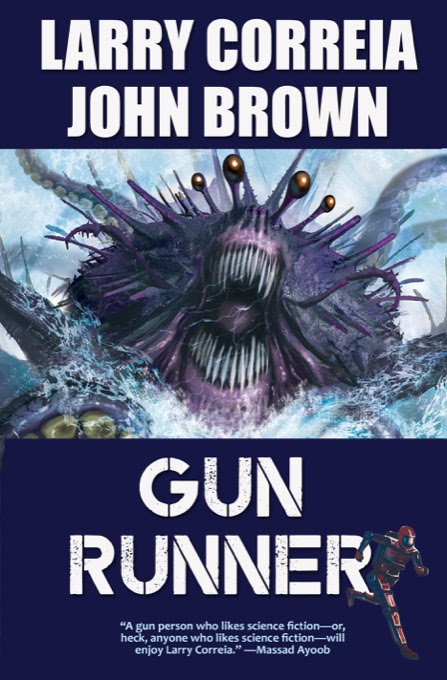
    I was very happy to receive news that GUN RUNNER, the novel Larry Correia and I wrote together, just won the 2021 Dragon Award for Best Military Science Fiction or Fantasy Novel.

    The Dragon Awards are a set of literary and media awards presented annually by Dragon Con in Atlanta, Georgia for excellence in various categories of science fiction, fantasy, and horror novels, movies, television, and games.

    And the cool thing is that these awards are voted on by fandom, meaning thousands and thousands of folks voted.

    Past winners have included authors such as Terry Pratchett, Brandon Sanderson, Rick Riordan, and Stephen King.

    As stated in earlier posts, the seed came from Larry’s eleven-year-old son, Joe.

    When Larry and I sat down to develop an idea for a workshop we were holding for Life, the Universe and Everything, a large annual writer’s conference in Provo, a number of years ago, Joe was listening in on the stairs.

    We settled on a genre, and then Correia asked, “Hey Joe, what’s cool?”

    Joe immediately popped up and said, “Giant robots, bandits, and murderers.”

    “We looked at each other and said, ‘Dang, that IS cool.’”

    Forty minutes later we had the key elements we needed for the story we’d use in the workshop. A number of years after that workshop, Baen Books wanted a collaboration from Larry, and that story was one of the first he thought of.

    Larry and I are both frequently asked to present at writers conferences. And one of the tips each of us shares to new authors is to loosen up and have fun. One of the keys to writing an entertaining story is to simply ask, “What’s cool?” And go from there.

    I’m thrilled and honored that those who voted selected Gun Runner for this award.

    Share
  • |

    Good Stuff! The actual Christmas story

    It’s interesting how many things we’ve added to the accounts we have in the Bible.

    For example, nowhere does the Bible say that Mary rode a donkey. Mary might have walked. Or rode in a cart. Or gotten piggy back rides. We don’t know. We do know that there is no donkey mentioned in the record.

    It also doesn’t say she had the child the night they arrived.

    It only says she was “great with child” when they made the roughly 80-mile journey from Nazareth to Bethlehem. And that “while they were there” in Bethlehem “the days were accomplished that she should be delivered.”

    So she had the baby sometime while they were there. That could have been during the first hour. But it could have also been a week or month later. We just don’t know.

    It doesn’t mention anywhere the word stable.

    Christ might have been born in a stable, or he might have been born in a cave, or inside the house, or out on the porch, or on the roof (lots of those places had flat roofs where they hung out). We just don’t know. What we do know is that he wasn’t born in a palace. And that they laid him in a manger because there wasn’t any room in the inn. An odd circumstance for a king.  

    Notice as well that there weren’t multiple inns.

    It just says “the inn.” And if you look up that word in the Greek, it’s translated as “guest chamber” in the other spots where it’s used in Luke. So they could have been talking about the one guest room in the house where they were staying. Either way, we don’t have anything that says there was a mean innkeeper who later regretted turning the couple away or that Joseph went door-to-door looking for a place.

    We have no record in the account of three wisemen.

    It just says “wisemen.” So there might have been two of them. Or twelve. We don’t know. And it appears they came sometime after Jesus had been born because they first saw the star of his birth in the east and only then set out to find him. They might have been coming from Persia, hundreds of miles away. Or they could have been living in Bethphage, a mile to the east of Jerusalem. Either way, they didn’t know they should travel to Bethlehem because it says they went and talked to Herod first, in Jerusalem, and asked “where is he that is born King of the Jews?”

    The question freaked Herod out (if you’re the current king, you kind of want to know who else is claiming your throne), and so he gathered all the chief priests and scribes to discuss it, and those guys said the prophecies said it would be Bethlehem. And so Herod met with the wisemen again and told them to go there. And only then did they go down to Bethlehem. So it doesn’t appear the wisemen were there the night of the birth.  

    There’s no record of camels hanging out with the baby either. Or sheep. Or goats. There’s not a lot there. But what is there is interesting.

    Now, I want to go on record stating I have no problem speculating about the event and imagining what it might have been like. I love to do it. Good grief, I write fiction.

    In fact, for many years I figured I needed to get in on the Christmas noun gig. You know what I mean. Every year we get heart-warming books about new Christmas nouns. We’ve had Christmas sweaters, Christmas jars, Christmas boxes, Christmas candles, Christmas carols. This year I see there’s one about Christmas fudge and other about a Christmas train. So I figured I’d do one. Mine would be about the Christmas rat. A little fellow who decided to snuggle up with the babe instead of giving him a nibble. One of these days I will get that hungry rat story written.  

    In the meantime, while there’s a lot of good stuff we’ve added to make the event special, it’s also nice to know what the record actually does say. Whether you’re Christian or not, it’s helpful when dealing with others to know what was recorded about this event that is so significant to the largest religion in the world.

    And so the last bit of good stuff I recommend this month are the two brief accounts we have. The first one is in Matthew 2:1-16 and tells the story of the wisemen. The other is in Luke 2:1-20 and features some shepherds.

    Merry Christmas!

    Share
  • Murder, Courts, and Bart D. Ehrman

    I’m going to talk a bit about some murderers in Detroit, Jesus, and a couple of books I recently read that I think are just awesome.

    MURDER

    Highers BrothersSo, the murderers.

    Let me start by asking this question: can you establish the truth in a court of law?

    Is that what the judge and jury are deciding? The Truth, with a capital T?

    Think about Tommy and Ray Highers, brothers from Detroit. They were convicted of murder. Open and shut case. No parole. They were two nasty buggers who shot a man down over some dope.

    But then twenty-five years later (last year, in fact) they were back in court because new evidence had come to light that undermined the original conviction. For the curious, this fascinating Dateline episode reveals the amazing way the evidence came to light and what happened because of it: http://www.nbcnews.com/dateline/full-episode-graduation-night-n72666. Watch it. You’ll be happy you did.

    So the Truth. Capital T. Can you establish that in a court of law?

    No.

    What the justice system does is try to determine which story about the evidence available is the most convincing.

    It’s about telling and judging stories.

    There are many types of evidence folks use when telling their stories. Some of it is very strong. Some is so unreliable, like hunches and hearsay, that the court won’t even allow it to be presented.

    Whatever the evidence, the fundamental nature of this is that you can often tell a number of different stories using the same set of data, the same evidence. Sometimes the stories are variations with minor differences. Sometimes the stories are radically different.

    It’s like having only some of the pieces of a 100 piece puzzle. You look at the four, twenty, or thirty pieces you have and imagine what the rest of the puzzle looks like. And then you invent something that seems reasonable.

    You invent it.

    And if that story meets certain standards of proof, then our system allows the authorities to take certain actions. If the standard of a “reasonable suspicion” is met, it allows a police officer to stop someone. If the standard of “probable cause” is met, a higher standard than reasonable suspicion, an officer can arrest you. If a jury in a criminal case decides the defendant is guilty “beyond a reasonable doubt,” an even higher standard of proof, then the justice system authorizes the authorities to sentence the defendant.

    But at no time does the system seek to establish the absolute truth, the truth with a capital T. It only seeks to establish some level of probability that the story being told about the evidence is true.

    All of this is made more complex because what’s “reasonable” is based on other people’s opinion. We have guidelines and rules to help folks be “reasonable.” But reasonableness is still affected by culture, background, history, etc.

    It’s still opinion.

    OTHER PUZZLES

    What other realm of knowledge works like the justice system and consists of inventing stories about missing parts of the puzzle?

    Well, history does.

    In fact, if you think about it, history is what courts do. The processes and principles of our justice system guide everyone involved in how they go about telling the stories that make up that specific type of history.

    And all historians (lawyers, judges, and juries included) have no means of establishing the absolute truth.

    They can’t use science. Science requires you conduct experiments and reproduce results. But how is a historian going to reproduce the same events? What, they’re going to get Lincoln shot all over again and let the rest of us watch it? Dang, John Wilkes Booth did shoot the man. We all saw it happen down in the lab.

    Sure, they can use science to date a manuscript, or determine what something is made of, or establish some other fact. But all science is doing is providing facts about the pieces of the puzzle you have. About the claims the evidence makes.

    But science can’t fill in the missing pieces of the puzzle. It can’t tell the story. The historian has to invent the story that makes the pieces all make sense.

    And then the rest of us determine if that story, that sketch of the full puzzle, is reasonable.

    But that isn’t all there is to it.

    STANDARDS OF PROOF

    Think about conspiracy theories like the ones that claim that the US government perpetrated the 9/11 bombings. Conspiracy theorists are practicing history. They are inventing a story that seems to fit the evidence available to them.

    But what happens when you have only five or ten pieces of a 1,000 piece puzzle? What happens when you don’t thoroughly vet the evidence? What happens when someone screws around with the evidence? And I’m not just talking about tampering or invalidating it by thoughtless handling (contaminating DNA, for example). Folks with the best intentions have biases. In fact, we all have biases that lead us to include and exclude various pieces of evidence based on whether they support or oppose the ideas we want to believe.

    Jonathan Haidt explains these biases in his excellent book The Righteous Mind. He explains that with things we want to believe, we often use the standard of “Can I Believe It”?  We look for anything at all that would allow us to believe our position. If we find it, even if it’s flimsy, we discount all the other evidence that may point another way and conclude we have met the burden of proof for our view.

    For things that we don’t want to believe, we often use the standard of “Must I Believe It”? When falling prey to this bias, we look for anything at all that would undermine the thing we don’t want to believe, even if that evidence is flimsy. If we find it, we ignore all the other evidence, even if there’s a mountain of it pointing another way, and claim we have met the necessary burden of proof.

    In court there are all sorts of procedures and standards that need to be followed to help us avoid invalidating evidence or falling prey to our biases. Those procedures and standards don’t remove all risk. But they do remove a lot.

    Which court system would you want to be processed through? The current American justice system or the medieval witch trials?

    Oh, for sure I’d want to be someone accused of witchcraft back when a claim of “I saw her as a witch in my dream” was admissible, as was the test of poking a mole on the accused’s body with a needle to see if said witch flinched enough. I’d be so happy to go back to the days when a confession obtained by torture was incontrovertible evidence.

    So when practicing history, it’s important to have some guidelines, some rules to establish which bits of evidence are more likely (not guaranteed, but more likely) to be reliable. And it’s important that when folks tell their story, they not only share the evidence, but also all the assumptions they’re making.

    JESUS

    Where does Jesus of Nazareth come into all of this?

    Misquoting Jesus by Bart D Ehrman

    Well, Jesus has affected the world more than any other person who has lived on it. The stories we tell about him (the history we have practiced about him for the last 2,000+ years) have changed the world. And those stories will continue to affect us, especially folks in Western cultures, on everything from foreign policy to which clothes think are fit to be worn in public.

    Who was Jesus? Did he really exist? Was he a god? What did he really teach? Have his teachings been changed?

    These are all fundamental questions. And for the last two-hundred years historians have been re-examining the pieces of the puzzle, finding new pieces, and telling new stories to explain it all.

    Some of these historians believe in Jesus as a god. Some don’t. Either way, the conversation is fascinating.

    Jesus Interrupted  Bart D Ehrman

    I just read three historical books about Jesus that were awesome. AWESOME. Not because I agreed with all of the author’s conclusions, i.e. his stories. I don’t. But because of the way he practiced his history. The way he told his stories. And because what he shared gave me new insights to my stories about Jesus.

    The three books, all by Bart D. Ehrman, a professor of religious studies at the University of North Carolina, Chapel Hill, are:

    1. Misquoting Jesus: The Story Behind Who Changed the Bible and Why
    2. Jesus Interrupted: Revealing the Hidden Contradictions in the Bible (And Why We Don’t Know About Them)
    3. Did Jesus Exist? The Historical Argument for Jesus of Nazareth

    I’ve read the Bible many times, and I’m a believer. Of course, the question is a believer in which story?

    Did Jesus Exist Bart D Ehrman

    What Ehrman so engagingly makes clear is that there have indeed been many stories about Jesus. In fact, the gospels (Matthew, Mark, Luke, and John) and the writings of Paul (most of the rest of the New Testament) seem to all portray a different man and message. Not only do they say things that flat out contradict each other on some details, but if you look at each book separately, each author seems to have a slightly different take on Jesus.

    Furthermore, it appears that what we now have has changed over time. For example, it seems the last twelve verses of Mark were not in the oldest manuscripts. There have been other changes. One of the more notable ones occurs in John 5:7-8.

    Our earliest texts say:

    “For there are three that bear record, the spirit, and the water, and the blood: and these three agree in one.”

    But later texts say:

    “For there are three that bear record in heaven, the Father, the Word, and the Holy Ghost: and these three are one. And there are three that bear witness in earth, the spirit, and the water, and the blood: and these three agree in one.”

    Nowhere else in the New Testament do we have anything that states that creedal doctrine so explicitly. Did John write that? Or was the extra material added to make the idea of the trinity scriptural?

    And what do we make of the fact that we have no manuscript that dates to anywhere close to when Jesus lived? We have some small fragments of manuscripts with a few verses of John, Revelation, and Matthew dated around 150 AD. But the oldest manuscripts we have that contain the majority of any of the gospels are for the gospels of Luke and John, and these are dated around 200 AD. The oldest manuscripts with the full New Testament are dated around 350 AD.

    That’s more than 300 years after Jesus died!

    Have you played the game of telephone? Are we sure that the oral traditions that were written down weren’t changed? What happened to the books mentioned in the Bible that we don’t have now? For example, Jude mentions a prophecy of Enoch that we don’t have in our current Bible. Are we sure that the copyists didn’t add to the text like it seems some did to John?

    And what about the term “Christ”? It’s actually the Greek word for “messiah” which just means one anointed with oil to perform a special service for god. Christ wasn’t Jesus’s last name. It was a title: Jesus the anointed one.

    The anointed ones in those days were kings and prophets and priests. It appears most of the historical sources suggest that a “messiah” to the Jews of that time was someone who would throw off foreign rule and establish the kingdom of Israel as David had. In fact, there were a whole bunch of people who claimed to be messiahs. Here’s a nice list: http://en.wikipedia.org/wiki/Jewish_Messiah_claimants.

    Judas Maccabeus was considered a messiah because he threw off Greek rule in 164 BC. But then around 63 BC Israel was taken over by Rome. And Rome wasn’t too keen on revolts, so around 4 BC they crucified Judas the Galilean for claiming to be the messiah, the king of the Jews. Crucifixion, it seems, was the punishment reserved for seditionists. They crucified Jesus and a whole bunch of other guys claiming to be the king of the Jews. And their crimes were written on a board above them, which is why they hung the words “King of the Jews” over Jesus’s head on the cross. Here’s the criminal, and here’s his crime. These other messiahs were not claiming to be a god that came to earth to atone for sins, but anointed by God to throw off foreign rule and establish his earthly kingdom again.

    Jesus talks a lot about the kingdom of God. Was Jesus just another one of the seditionists?

    Ehrman examines these and many other questions as a historian, providing all sorts of insights.

    But the fabulous thing is that he doesn’t just tell his story. He gives his evidence. Exposes his assumptions. And in all three books he explains the guidelines or “rules” historians use to when trying to determine which stories are more likely and which evidence is more reliable.

    I was enlightened, challenged, and delighted. I learned things about Jesus’s life and times that have helped me understand what I read in the Bible better.

    LIMITS

    Of course, the historical method has its limits.

    Historians, because they are looking for explanations (stories) that are more probable, automatically select against things that are improbable. They exclude miracles. They exclude any story that says Christ was actually resurrected.  They may establish that a lot of folks thought he was resurrected, but they don’t have any methods to establish something like a resurrection actually occurred. And so they ignore it. Historians exclude modern revelation. If someone today were to have a visitation from Jesus as Paul did, the historians would exclude that.

    But we all know that truth is sometimes stranger than fiction. We all know that sometimes the less likely thing is exactly what occurred.

    Historians are looking for what is most probable. Not what actually happened. Because they can’t go back and time and verify their story.

    Excluding “improbable” things changes the types of stories the pieces of the puzzle support. For many of us, me included, we do accept evidences many historians don’t as pieces of the puzzle. And because we have these pieces, we’re able to tell different types of stories.

    The cool thing about Ehrman is that he explains this. He’s not trying to hide anything. Instead, he’s explaining how to approach the Bible from a historical point of view, and where the principles of the historical method lead him.

    And I have found that those methods in his hands have a lot to offer.

    If you’re someone who is interested in religion–as a believer, agonistic, or atheist–you will love these books. Ehrman himself was once an ardent believer, but is now agnostic. However, his respect for believers, including other scholars in his field who believe in the divine Jesus, comes through loud and clear. Ehrman has no axe to grind. He is simply sharing the stories of Jesus that make sense to him and many other historians. And he does it in a very interesting and easy-to-read style.

    If these books sound like something you want to try, I’d start with Misquoting Jesus, move to Jesus Interrupted, and then finish with Did Jesus Exist? And if you enjoy those, let me recommend two more of Ehrman’s books. The first is The Lost Gospel of Judas Iscariot: A New Look at Betrayer and Betrayed, which looks at the discovery and content of a very ancient manuscript that calls itself The Gospel of Judas. The second is Lost Christianities: The Battles for Scripture and the Faiths We Never Knew, which explores the variety of Christian faiths that existed in the few hundred years after Jesus’s death.

    Happy reading!

    Share
  • Good Stuff! Three Days in Moscow

    Book cover, Three Days in Moscow

    I just finished Three Days in Moscow: Ronald Reagan and the Fall of the Soviet Empire by Bret Baier. It’s a New York Times bestseller that takes you into the world of Ronald Reagan, his rise to power in politics, and his role in ending the Cold War. And it does in a personable way with gentle humor throughout.

    I enjoyed the fascinating behind-the-scene insights about the personalities involved and the clarity about what really happened. And how the book brings Reagan to life, as if he’s almost there. Along the way you’ll also get insight into Mikhail Gorbachev, the assassination attempt on Reagan, and more.

    Baier is the chief political anchor for Fox News. In 2001, he became the station’s chief Pentagon correspondent and ended up traveling to Afghanistan 11 times and Iraq 13 times. In 2007, he became the station’s chief correspondent to the White House. More importantly, Baier seems to be one of the few journalists these days who is simply trying to get and report facts instead of spin. And that’s exactly what he’s done here.

    If you like biographies or history, if you want to know how the U.S.A. and the U.S.S.R. stepped back from decades of mutually assured destruction, if you want to get a view into how diplomacy is done, then I think you’ll love this book. And you’ll probably love it even more if you can listen to the audio book version, read by Baier himself, which also includes a recording of Reagan’s speech to the students at Moscow State University. I listened to it via the Overdrive account my public library provides. Baier’s reading was terrific.  

    Share