The Face of Mechanical Genius
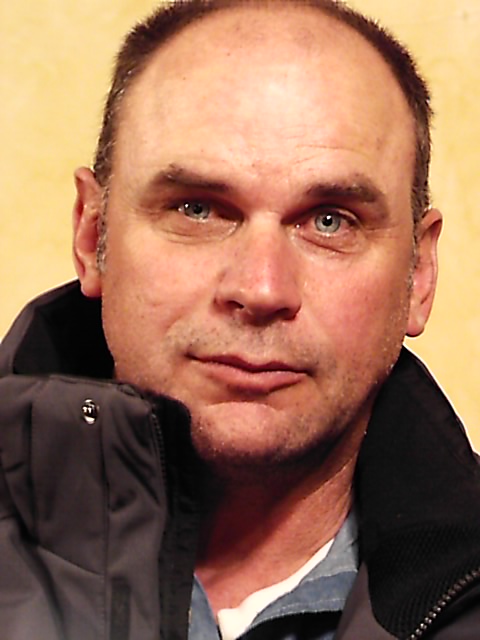
This is Warren Ellis.

I heat my house with radiant heating. When we built this place, Nellie, I, and the girls laid down yards and yards of tubing. Then the mudmen came in and covered it all up with concrete. We run hot water through that tubing. That water it heated by a boiler, which also heats the water for sinks and showers.

About two and a half weeks ago our boiler quit working. We called the guy who sold it to us. It worked again for one week and went out again. Then again. And again. Now if we lived in the valley and it was summer it wouldn’t be an issue. But we live at 6,000 feet, in the mountains, and it’s winter. We just got four inches of snow two days ago. Needless to say, heat is important.

Well, four technician visits, $600, and many hours later, we still have problems. The blasted boiler conked out again tonight just as Nellie and I were about to take showers to go to a dance for adults our church was putting on.

So we brought in the big guns. We called Warren. Now Warren fixes cars. He fixed our fridge. He’s worked on everything from computers to furnaces. So Warren arrives. In less than 10 minutes the @#!$ boiler was working again. And we now know exactly what the problem is so the Lochinvar boiler rep can’t tell us to look for something else and that it’s an installation error (yes it’s a Lochinvar Knight boiler–remember that boiler buyers). Genius. Absolute genius.

I offered to give Warren a big old kiss–hey, hot water’s important, almost as important as a wife who doesn’t have to take a cold shower in the morning. Warren refused. 

So here’s a wet one for ya, Warren. You’ve done your work to further world peace.

Share

Similar Posts

  • The blessings and horrors of manure lagoons

    California cows start passing gas to the grid

    By Nichola Groom, Tue Mar 4, 2008 6:30pm EST

    RIVERDALE, California (Reuters) – Imagine a vat of liquid cow manure covering the area of five football fields and 33 feet deep. Meet California’s most alternative new energy.

    Read the full article

    Man drowns after falling into manure pit

    By Ben Winslow Deseret Morning News Published: January 19, 2008

    A man apparently drowned after falling into an iced-over manure pit at a Cache County dairy, authorities said….Deputies said the pit is about 8 feet deep and is filled with cow manure, moisture and ammonia from the urine, giving it a “soupy consistency.” “It is loose quicksand is what it is,” Bilodeau said. “You can’t swim in it. You’re almost completely incapacitated in it.”

    Read the full article

    Share
  • AIG bailout, risk, and writing

    With the current financial “crisis” I kept wondering what went wrong. Read this article on the AIG mess from the guys at the Motley Fool. That explaination of the AIG mess is very interesting. The other part of this current financial mess, the loaning-of-money-to-people-who-were-idiotic-credit-risks and the making-me-foot-the-bill-for-someone-else’s-assumption-of-ridiculous-risk, those two parts torque me.

    So why am I posting this in the Zing and Writers categories?

    Because it IS zing to me. You could write a high-finance thriller about this. You could write about a character who leveraged himself silly and is about to lose it all–in a smaller sense. You could write, hey, wait a minute. I just read a book about something similar–THE CHAIRMAN by Stephen Frey. It’s a 2.5/5 star book. Good enough that I had to finish it. Although not good enough to make my recommendation list. 

    The point is that stories are about problems and conflicts. And this understanding of the insurance industry provides some fertile ideas for both problems and conflicts.

    And since I can’t get the blasted link to work, here’s the full deal.

    AIG’s Failure Is So Much Bigger Than Enron
    By Andrew Sullivan, CFA
    September 17, 2008 Comment (54) Recommend (124)
    Enron — reviled, fraudulent Enron — destroyed more than $60 billion of shareholder value.

    AIG (NYSE: AIG), which the government just took over, has destroyed $180 billion already — and it almost brought down our entire financial system.

    We don’t know money
    Which is ironic, given AIG’s old television commercials, in which the giant letters “A I G” displayed on the screen while text flashed underneath that culminated in the following phrase — all in capital letters:

    WE KNOW MONEY

    There were no smiling couples, young children at play, or lounging retirees. No, AIG was above that — it was better than that.

    But here’s a news flash, AIG: You don’t know money.

    If you did, you’d have realized a few things. Insurance is terribly simple, as long as you follow the Three Rules:

    Price your risk correctly.
    Invest conservatively so you can pay out claims when they come due.
    Don’t do anything else.
    Sit back and collect the spread. That’s it, folks.

    Seriously, that is it. Ask Warren Buffett, and he’ll probably tell you that if you follow those three rules, you’ll be fine. You won’t be the biggest or fastest grower, but you’ll be absolutely fine.

    The problems come when you get greedy and aren’t satisfied with the spread. And your greed can lead to certain actions that aren’t stated anywhere in the rules, including:

    Diversifying into fast-money proprietary trading.
    Leveraging your company 11-to-1.
    Neither of these is a goal of a well-run insurance company, yet AIG embraced both with open arms.

    Diworsifying
    But AIG self-destructed not because it screwed up in its insurance business. It didn’t fall into the trap of mispricing risk, as so many other insurers over the years have done. It also invested premiums fairly conservatively. So it followed Rules 1 and 2.

    Where it slipped up was in Rule 3. See, the folks at AIG thought they were so smart at insurance that they could start other capital-markets businesses … including proprietary asset management in things such as commodities, currencies, energy, interest rates, and the selling of default swaps on collateralized debt obligations (CDOs).

    This strategy worked beautifully — for a while. AIG created a separate business segment called Financial Services to trade in the aforementioned assets. This business had $204 billion in assets at year-end 2007, up from $60 billion in 1998.

    Operating income surged from $900 million in 1998 to $4.4 billion in 2005. Some of the moves it made were brilliant, such as the purchase of ILFC, an aircraft-leasing business. But the other trading businesses were the Medusa that turned the whole company to stone.

    Let me make one thing clear: Proprietary trading isn’t bad, in and of itself. Warren Buffett engages in it. But just like atomic weapons in the wrong hands, proprietary trading can do a lot of damage. The problem is when you start to get aggressive and don’t heed proper risk — when you start to speculate instead of invest.

    And there’s one other critical ingredient for disaster.

    The “L” word
    As in “leverage,” the sharp knife in corporate seppuku dramas. Leverage is, by my estimation, the No. 1 reason why companies fail.

    And compared with its peers, AIG had one of the sharpest knives around. Here’s how its leverage (assets to equity) stacked up against other insurance operations as of December 2007:

    AIG: 11 to 1.
    Markel (NYSE: MKL): 4 to 1.
    Berkshire Hathaway (NYSE: BRK-B): 2 to 1.
    Montpelier Re (NYSE: MRH): 2 to 1.
    Travelers (NYSE: TRV): 4 to 1.
    White Mountains Insurance (NYSE: WTM): 4 to 1.
    Chubb (NYSE: CB): 4 to 1.
    I would love it if someone gave me a rational, believable explanation of why leveraging your equity 11-to-1 is a good thing for an insurer. The sole job of an insurance CEO is to ensure that his or her company stays in business; the CEO’s job has nothing — absolutely nothing — to do with growing profits every year in a steady, smooth line.

    Surprises in insurance are almost always negative, so simply staying solvent is the overriding priority. A company can do just that by following the Three Rules.

    Two years ago, a few of my Fool colleagues had an interesting conversation with Chris Harris, the chief investment officer at reinsurer Montpelier Re. Harris noted that Montpelier invested its float primarily in U.S. Treasuries, Fannie and Freddie bonds (back when they were considered safe), and the like.

    When asked why he didn’t invest more aggressively, Harris said the company believed that it got all the risk it could handle on the other side of the fence, insuring against megacatastrophes.

    Even if you disagree, as an investor you have to recognize the judiciousness in this way of managing one’s business. An insurer that has to pay big claims from hurricanes Ike and Gustav and Typhoon Sinlaku — and additionally worry about the rapid decline in its investment portfolio as a result of the higher level of risks it has taken on — has a big problem.

    That insurer, folks, is AIG. And that big problem is now yours and mine.

    This really is bigger than Enron
    The edifice Hank Greenberg built has all come crashing down. Apparently, AIG didn’t realize that almost 40 years of 15% growth multiplied by a big fat zero equals just that: zero. It didn’t consider that its leverage left it exposed to a liquidity crisis, and it didn’t consider that its non-insurance businesses could bring down the whole company.

    In all fairness, management did not realize how much exposure it had to CDOs backed by subprime loans. This may or may not be true, but Buffett has famously stated that each one of these prospectuses has something like 15,000 pages, so it’s unlikely they were gone through in any great detail.

    But investing in things you don’t know is a huge risk, right? And that risk was compounded by having so much leverage. The fact is, the more leverage you have, the more careful you must be with the investments you hold, because your own capital structure is that much riskier.

    AIG did nothing of the sort. And so even though it has a rock-solid, wonderful insurance franchise, its greed and lack of care in its investing decisions took down one of the world’s great companies.

    What a shame. What a shame for all of the investors who lost billions thinking that this company was conservative. What a shame for taxpayers like you and me. What a shame for the United States’ reputation as a beacon of financial stability and conservatism.

    For Fool.com’s continuing coverage of this week’s events, check out “The Biggest Financial Story of the Past 50 Years.”

    Andrew Sullivan has no financial interest in any of the companies mentioned. Montpelier Re is a Motley Fool Hidden Gems selection. Markel and Berkshire Hathaway are Motley Fool Inside Value recommendations. Montpelier Re and Berkshire Hathaway are Motley Fool Stock Advisor picks. The Motley Fool owns shares of Berkshire Hathaway and has a disclosure policy.

    Share
  • Are Squirrels Smarter Than We Think?

    I miss the squirrels we had at the old homestead. No, that’s not hyperbole. Until two years ago the six of us lived in a 900 sf home my wife’s grandmother homesteaded for. But that’s beside the point. We had squirrels there. They chittered, ran about, tossed apples down at my girls when they tried to inhabit the hammock.

    For those of you not from Utah, you might be wondering why this is such a big deal. If you’re from the East you might be thinking I’m nuts. But out West trees are few and far between, which means so are the squirrels. So we loved our squirrels, but then they got into our neighbor’s fifth wheel and he promptly killed them all.

    Alas.

    But here, for your pleasure, are squirrels using their god-given intelligence to do what they were bred to do–steal and eat.

    Of course, they are squirrels.  Not quite geniuses yet.

    One of my stories either needs a squirrel who steals candy bars or a character who is constantly setting up obstacle courses for the varmits.

    Share
  • The path to?

    Is this not delicious? I found it on istockphotos.com and couldn’t stay away. I want to be on that trail. I want to know what’s around that bend. Holy moly, the feeling of this photo is just marvelous.

    So I bought a copy. It’s by stellalevi.

    Wicked Tree Path

    Zing, Baby!

    Share
  • |

    Story zing method: fiddling with knobs

    One of the most basic way of coming up with story ideas is to take a familiar story or thing, list out what’s commonly associated with it, then start changing some of those elements.

    For example, you list out all the normal things for vampires–the coffins, black, bats, sucking blood, etc.–then you begin to twist. What if the vampire wears, instead of black, some styling plaid? What if it isn’t a person but a rabbit (whoops, that one’s been done)? What if instead of gothic places like catherals you find him in a trailer park? What if instead of being dangerously suave, he’s a drunk?

    Do you see? You can do this with anything.

    In this interview, Matthew Sturges talks about how he did just that with the movie The Dirty Dozen and ended up with with Midwinter, a novel about prisoners given another chance. According to Sturges, “In the case of Midwinter, the beginning of the story was, ‘What is prison like in Faery?'”

    Read the whole interview. I think you’ll find it enlightening.

    Share