I re-sequenced the beginning and three other spots that had me scratching my head on how the first edition had gotten it wrong. I added a chapter to the ending to make it flow as it should. And tightened small things on almost every other page.
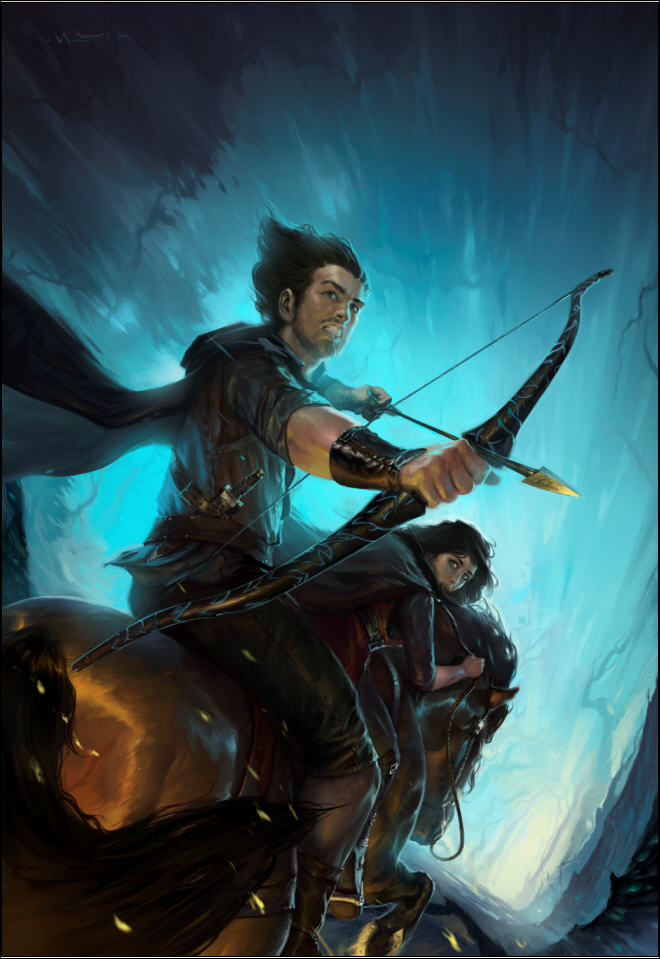
Holy schmoly, has this been a ride. I projected the CURSE OF A DARK GOD to be 140,000 words. When I blew by that, I projected it would be 170,000. Today I just typed the last word of the first draft. It’s 230,000 words. For reference SERVANT OF A DARK GOD is 170,000 words.
The bad news is that while I’m really happy with this draft, it IS a first draft and needs some editing. I’m also behind schedule. I hit 140k words just a few weeks after my original deadline (in March), so I pride myself on knowing how fast I can write, but at that point I had, unknowingly, about a normal novel’s worth of material left to write. Obviously, I haven’t quite figured out yet how to estimate the size of these bigger works. The problem is that instead of getting a month or even two to revise, I’ve got two days. Then I have to turn it in to my editors.
The good news is that my editors haven’t canned me, yet. 🙂 And that they have great insight into story. And that I should have plenty of time to fix and polish this thing to make it shine. I just don’t like turning in first drafts. My goal with book three is to get back on schedule.
Having told you my scheduling woes, I am very excited about the characters and storylines and expect readers to enjoy this as much or more than the first in the series. However, I do wish I could get this process down so that I was 99% of the way there in one draft. There are some authors who can do that. Perhaps that will come with more experience. Until then, I get to enjoy revision.
Here are my stats:
550 hours to write, from pre-draft to the end, not including thinking thinking on walks and drives and discussion time with my wife who saved me thrice.
The bulk of the writing was done in a 24 week period. I averaged 17 hours per week during that time. This is on top of my day job.
For those who don’t know, an average young adult book as from 40,000 to 80,000 words. An average adult novel is from 70,000 – 120,000 words. I’m very pleased I was able to finish this monster. I might not be the fastest writer, but what this tells me is that I should be able to finish two big novels a year if I should ever be so lucky as to go full time.
Working on the copy edits of BAD PENNY today and passed the 75% mark to general rejoicing.
You normal folks may now go back to work. For you passionate grammarians, my fab copy editor marked a hundred uses of “then” in my manuscript.
No, I wasn’t having issues with the then/than confusion.
I was having issues when using “then” when tying two clauses together. The question: did I always have to use “and” with “then”?
EXAMPLE 1: “Frank backed out of the parking stall then rumbled out onto Dewar Drive.”
Was “then” naked without an accompanying “and”? Should I make it read as “Frank backed out of the parking stall and then rumbled onto Dewar Drive”?
And if it doesn’t need the full “and,” does it need at least a comma for a miniskirt so it reads “parking stall, then rumbled out onto . . .”?
EXAMPLE 2: “The tension ratcheted up, then Senor Zombie’s eyes slid to the side.”
Can you use “then” as a coordinating conjunction? Or must it always be used with “and,” as in “the tension ratcheted up, and then Senor Zombie’s slid to the side.”
I looked in the Chicago Manual of Style. I looked in Garner’s Modern American Usage. I could not find the answer. So I emailed Annette Lyon, author of There, Their, and They’re: A No-Tears Guide to Grammar From The Word Nerd.
Saint Annette’s response:
Your first example is correct as is, with no AND: “Frank backed out of the parking stall then rumbled out onto Dewar Drive.”
The only time you grammatically need AND before THEN is if we’re connecting two independent clauses, because THEN isn’t one of the conjunctions that can do that. You’ll find those in a text box in the book, and they include AND, OR, FOR, NOR, YET, BUT, SO.
The only issue in the above sentence is whether to use a comma before THEN. The current stylistic trend is to leave out the comma, so you can leave it just like you have it above. Some people balk at that and want the comma for the pause it provides. Depending on the house style guide, that may be something you can argue, or maybe it won’t be. Neither is really grammatically more correct; the comma before THEN is more of a style issue.
In the next example, we do need AND or some other conjunction from the list, because both sides of the sentence are independent clauses. So this would be wrong: “The tension ratcheted up, then Senor Zombie’s eyes slid to the side.”
But this would work: “The tension ratcheted up, and then Senor Zombie’s eyes slid to the side.”
To avoid the issue altogether, we can rephrase it. A couple of variations:
-The tension ratcheted up when Senor Zombie’s eyes slid to the side.
-Senor Zombie’s eyes slid to the side; the tension ratcheted up. (Semicolons replace conjunction + comma)
Rules of thumb:
-If you’ve got 2 independent clauses, don’t use THEN as the conjunction. Add AND or another one.
-It the sentence has just 1 independent clause, THEN is enough by itself.
Thank you, Annette.
And wouldn’t you know, I opened A Wanted Man by Lee Child, and what did I see? A bunch of then’s illustrating exactly what Ms. Lyon suggested.
“Reacher heard the roar of the shot, quieter than some, but still deafening in a closed room, and simultaneously he heard the wallboard explode above and behind his head, and then he hit the floor, knees first, then his hip, then his side, sprawling, down low behind the counter, out of sight.” (159)
I think all I’m going to see while reading for the next while are the then’s.
Folks, I have moved into making the line edits, which means we are on the home stretch. The manuscript is 888 pages long. I expect it to take 40-50 hours to make all the edits I marked. However, you have to remember that has to be worked in around my day job. Then we do the copy edit. I expect my portion of that will take another 40 hours. And then I take a day off work to create the book in the POD and ebook formats and publish. We are oh so close!
A cracking good story idea requires five critical elements.
Until you have all five, you’ll struggle to plot. You’ll write a few scenes and run out of gas. You’ll feel like the story just isn’t going anywhere.
And that’s because it isn’t. It can’t. A story isn’t a story without all five elements.
However, once you develop these five things, your story will suddenly roar to life. There are a few other elements that are important as well, but these five things form the core of the story setup.
In this course you’re not going to merely learn about all of those story elements. You’re going to go deep and learn what can only be learned by actually doing the work and developing story idea after story idea with personal one-on-one feedback from someone who knows what they’re doing.
When you finish, you won’t just know story theory. You will be a story idea machine. And you will be that because you have put in the work. The right work.
Again, this is not a course full of lectures and videos. This is a course where you’re going to work. And develop the insights and skills that only come from doing the work.
You’re actually going to:
Come up with story setup after story setup after story setup
And improve them with one-on-one feedback.
It’s going to:
Eliminate years of you wandering about in the story wilderness trying to figure things out on your own.
Put you miles ahead of other writers who have no idea what’s really at the core of story.
You are going to learn how to develop killer story ideas on purpose instead of on accident. Which means you’ll be able to do again and again. Reliably. Like clockwork.
Course details
The focus of the class is not on learning about story, although you will do that. The majority of your time will be spent on developing stories.
You can’t become a carpenter by watching videos and reading books about it.
You have to get out on the work site, cut wood, and pound nails. You have to make the mistakes all beginning carpenters make, get feedback, and improve.
The same goes for writing.
And you’re going to work in this class. You develop 21 story setups. In fact, you develop more because the 21 are just the ones you turn into me. And with each one your skills, insights, and abilities grow.
In the beginning, your setups will be bare bones. By the end, they’ll be fully developed setups that beg to be written. Setups you can use to immediately write the first draft of your novel, whether that’s in outline or chapter form.
Here’s what you do each week.
Week 1.
Uncover the secrets of what’s really at the heart of story and how to generate ideas.
Define your genre requirements
Create story setups 1-3
Week 2.
Uncover the secrets to compelling characters
Create character sketches
Create story setups 4-7
Week 3.
Uncover the secrets to formidable obstacles
Create story setups 8-11
Week 4.
Uncover the secrets to interesting casts
Create story setups 12-15
Week 5.
Uncover the secrets to managing multiple storylines and series
Create story setups 16-19
Week 6.
Create story setups 20-21. These are your capstone projects where you apply everything you’ve learned and take it to the next level
In this class you develop story idea after story idea after story idea. You are going to be marinated in the work of developing characters, THOMs, goals, obstacles, settings, casts, and more. And because of that, each week will not only bring an explosion of insights, but new skills and abilities.
Every week you get two private, one-on-one, live sessions with me where you get encouragement and feedback on what you’ve developed. And you’ll have access to a private Facebook group where you can apply the principles to brainstorm even MORE ideas for each other’s stories.
At first you might feel a bit shy and worried about your ideas and abilities. But you’ll soon get over that. By the end of the course you’ll be one of those people that can generate terrific ideas easily. And you’ll be able to do that because you will have put in the work to become a different writer.
What’s the price?
Hours of one-on-one instruction from a professional editor or author costs thousands of dollars. An MFA program can cost $25,000 to $30,000 or more!
But this course won’t cost anywhere close to that.
Plus you’re going to learn things here you’ll never get in an MFA program (I know. I was accepted into a top-ranked program).
The cost of this course is $799. And I personally guarantee your results. You’ll be totally oh-my-gosh-I’m-so-happy-I-took-that-class satisfied, or I’ll give you your money back. No questions asked.
Now’s your chance to stop spinning your wheels. I can’t tell you how much I wish I’d had something like this when I’d started:
The secrets about the true core of story.
The secrets about how to come up with ideas.
Actual work with personal one-on-one feedback.
Laser focused on what actually matters, not a bunch of ridiculous writing rules.
When you finish, you will be a story idea machine.
You won’t know plotting. That’s a different course and set of skills. You won’t know how to write chapters. But you’ll know how to create the engine that powers all the rest of that. You’ll know how to create the core that makes awesome plots and chapters possible.
If you want to take this course, click the button below and contact me. I will tell you exactly how to apply.
I’m not going to be able to accept everyone who wants to take the class. I have a very strict limit on the number of students I can work with. So you need to get your application in before the deadline of midnight, December 11th.
Sector 5 is a new radio program on K-TALK radio, AM 630. It’s hosted by Dickie Shannon, a long-time DJ, and is all about science fiction, fantasy, aliens, paranormal–the weird, fantastic, and inexplicable. Dickie says it’s Garrison Keillor meets Art Bell. We’re going to talk about my book, writing, and weird crap. He takes callers. So be ready to share your stories and enjoy the fun!
…unless you already have. 🙂 I’m not sure if the chapters 1-4 that you have up are from the new line-edit version, or from some older draft.
You impatient thing! 🙂
It still needs a copy edit. But know that the first chapter is what I have on the sample page–the hunt converging on Sugar’s house. You won’t notice huge changes in those first chapters. Most of the edits there were indeed line edits, fixing spots to make the sentences and action sequences flow a bit better.

 Sector 5 is a new radio program on K-TALK radio, AM 630. It’s hosted by Dickie Shannon, a long-time DJ, and is all about science fiction, fantasy, aliens, paranormal–the weird, fantastic, and inexplicable. Dickie says it’s Garrison Keillor meets Art Bell. We’re going to talk about my book, writing, and weird crap. He takes callers. So be ready to share your stories and enjoy the fun!
Awesome!
Can you post the first chapter now?
…unless you already have. 🙂 I’m not sure if the chapters 1-4 that you have up are from the new line-edit version, or from some older draft.
You impatient thing! 🙂
It still needs a copy edit. But know that the first chapter is what I have on the sample page–the hunt converging on Sugar’s house. You won’t notice huge changes in those first chapters. Most of the edits there were indeed line edits, fixing spots to make the sentences and action sequences flow a bit better.