|

“How It All Came Crashing Down” by Peter B. Gardner

Everybody knows that we got into this recession because banks began lending money to people who had terrible credit ratings, right? People who didn’t have to prove they even had a job. I mean, how long are you going to stay in business when you keep handing out dough to people you never hear from again?

But is that all there is to it? And was it really just the fault of congress because they told Freddie Mac and Fannie May (the organizations that purchased loans) that they had to start purchasing these highly risky things? Or was it all those greedy Wall Streeters?

In this must-read article, “How it All Came Crashing Down,” BYU econ professors explain how we got into this mess—and what we can learn from it.

But that’s not the end of the story. Ira Glass and the folks at This American Life uncover deeper causes of the problem in their must-listen show “The Watchmen” (no, not the movie). I mean, come on, we were told these high-risk loans were as dangerous as milkshakes. Shouldn’t SOMEBODY have seen it?

President Obama keeps saying that the root of the problem was that there wasn’t enough government oversight. Sounds good, doesn’t it?  We’ll get disinterested Uncle Sam to protect us from all these investment bullies. But if we dig a bit deeper, it appears that Uncle Sam was one of the major players at the root of the mess.

Ouch.

Read. Listen. They are two fabulous pieces.

Share

Similar Posts

  • The Meth Epidemic, The Marines

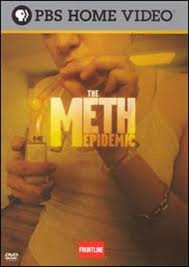
    The Meth Epidemic

    Mamphetamine is the most addictive illegal drug in America. Unlike marijuana, cocaine, or heroin, all of which are synthesized from easy-to-obtain plant material (cannabis, cocoa leaf, opium poppy), meth requires ephedrine or pseudoephedrine, which are very complex to make and require a lot of know-how and high-tech processing. The only folks who have that ability are legitimate chemical factories. In fact, there are less than a dozen such factories around the world that produce these chemicals. Which means it should be easy to stop illegal use at the source.

    “Should” is the key word there.

    When you’re trying to halt drug trafficking, you can work two sides. There’s the demand side and the supply side.

    When you work on the demand side, you try to affect people’s desire and use.  For example, in the 1960’s the Federal Trade Commission, along with other government agencies and private groups, began a campaign against tobacco. Using government policy, public awareness, and education over the last forty years, these groups have significantly altered demand for tobacco in the United States. In 1963 more than half the nation smoked. 4,345 cigarettes were consumed per capita. But as these groups worked to affect demand, those numbers dropped steadily until by 2006 only 1,619 cigarettes were consumed per capita.

    That’s astounding, folks. A whole culture was changed.

    When you work on the supply side, you try to reduce the production and distribution of drugs. This can sometimes be almost impossible to do. For example, almost anyone can grow marijuana. And it takes very little knowledge to harvest and package the parts that are used.  Same with alcohol–home brewing has been practiced for ages. In both examples, the ingredients are easy to obtain and the processing is relatively simple and easy to hide.

    But there are some drugs that are very difficult to produce. The key ingredient for barbiturates is one. In the 1950’s and 1960’s barbiturate abuse was increasing. But the government instituted some regulations on the legitimate businesses that produced these ingredients, and it reduced the amount available on the streets until we very seldom hear of barbiturates being used these days.

    So where does meth fit in? Well, as I stated above, there are less than a dozen factories that create the key ingredients. Meth is a perfect candidate for supply side intervention. Unfortunately, regulation isn’t as easy as it may seem.

    PBS’s Frontline recently aired “The Meth Epidemic” which explains the history of meth in the United States and the battle raging over its cure. If you’ve ever wondered about what meth is and how it affects our nation, you’ll want to watch this. I think you’ll find it eye-opening and well worth your time. Watch it for free here: http://video.pbs.org/video/1933783731.  

    The Marines

    The US Marine Corps is a fascinating organization with special capabilities. With the exception of the Coast Guard, they are the smallest of the United States’ armed forces, although they’re still bigger than the entire British army. Part of what makes the Marines unique is that they have the ability to rapidly deploy an independent task force (infantry, air support, ships) to almost anywhere in the world within days. Because of this, they are usually the first boots on the ground in any engagement. They pave the way and the Army and other branches follow to provide overwhelming and continuous force.

    But the differences include more than their mission. The Marine Corps emphasizes authority and responsibility downward to a greater degree than the other military services. It members are, on average, younger. And its creed “Every Marine’s a Rifleman” has special implications for its commanders and troops.

    In order to do some research for a novel I’m writing, I’ve been watching a lot of documentaries about special operations forces and the Marines. One of the best introductions to the Marines I’ve come across is the 2007 PBS documentary called The Marines. It examines what it takes to become a Marine and what it truly means to be one, outlining the rigorous training process that each recruit must endure to become a commissioned officer. I found it fascinating.

    If you have ever been curious what makes the Marines different from the other branches of the military and what it takes to become one, you’ll want to watch this film. I couldn’t find it on the PBS site, but you can find it split into 10 parts at YouTube.com. Just go to site and search for “pbs the marines”.

    Share
  • For those whole love ENDER’S GAME

    Enders World Essays SmartPopThere’s a special joy in sharing a wonderful experience with someone else. There’s a delight in reliving the experience afterwards, in recalling key moments and quoting funny or cool lines. This is especially true of books. One of my favorite book experiences is Ender’s Game. Which is why I’m so happy to announce that Smart Pop is about to release a collection of articles written by folks sharing their experience with that book.

    You get to hear from Eric James Stone about how the book should have ended. You get to hear from Matt Nix (creator and producer of Burn Notice) how the book was a guide to his life. You get to hear from Colonel Tom Ruby why he made the book mandatory reading for the Air Force’s Air Command and Staff College.

    There are 11 other articles from Neal Shusterman, Captain John F. Schmitt U.S.M.C., Mary Robinette Kowal, Hilari Bell, Ken Scholes, Mette Ivie Harrison, and many others. There are Q&A sections. And there is Card’s own introduction in which he explains what Ender’s Game is really about for him. All of these articles are wonderful reads.

    If you loved Ender’s Game like I did, you’re going to enjoy this book. You can get a free PDF excerpt from the book that includes a few of the Q&As from Card along with the full version of my essay “The Monster’s Heart.” To download the PDF, just scroll down to where it says “Sign Up for Free Chapters & Book Updates”: http://www.smartpopbooks.com/book/enders-world.


    Share
  • Hornswoggle & Happiness

    Since we now know that happiness is contagious and that a happy friend is worth $20,000, I figured I’d provide a practical means of infecting you with some mild levels of joy so you could increase your value. Hey, who needs stinking bionics to become the million-dollar man?

    Have you ever noticed that using some words elevates your mood?

    No?

    Trust me. Words do have power. And I am sure researchers could prove that if you used a certain number of words like “schlub,” “smithereens,” and “diddly” each day, you could raise your happiness level by some statistically significant amount.  And even if they couldn’t demonstrate this, that would only prove that some scientists are made of styrofoam. But we knew that already. The point is that there are some words that are so delicious, goofy, or beautiful they must be preserved at all costs. If only for their happy-making ability. And in that light, I present to you “hornswoggle.”

    (HORN-swog-uhl)
    MEANING: verb tr.: To cheat, hoax, or deceive someone.

    Hornswoggle.

    USAGE: “Now, however, some special interests are out to hornswoggle residents, and they’re stooping low to do it.” Lauren Ritchie; But Doctor, Your Name is on the Mailer; The Orlando Sentinel (Florida); Oct 4, 2006.

    Aaaah, I’m feeling better already.

    You can use this too. See: “Son, don’t try to hornswoggle me,” “That dude’s a hornswoggler,” “Joe’s auto-body is a hornswoggling den of mechanical iniquity.”

    Now add to that skedaddle, discombobulate, and flummadiddle. (If you want definitions, just visit this list from wordsmith.org.)

    Take them home with you. Use them. Spread the happiness around.

    Share
  • The blessings and horrors of manure lagoons

    California cows start passing gas to the grid

    By Nichola Groom, Tue Mar 4, 2008 6:30pm EST

    RIVERDALE, California (Reuters) – Imagine a vat of liquid cow manure covering the area of five football fields and 33 feet deep. Meet California’s most alternative new energy.

    Read the full article

    Man drowns after falling into manure pit

    By Ben Winslow Deseret Morning News Published: January 19, 2008

    A man apparently drowned after falling into an iced-over manure pit at a Cache County dairy, authorities said….Deputies said the pit is about 8 feet deep and is filled with cow manure, moisture and ammonia from the urine, giving it a “soupy consistency.” “It is loose quicksand is what it is,” Bilodeau said. “You can’t swim in it. You’re almost completely incapacitated in it.”

    Read the full article

    Share
  • 1491, 1493, and Greek Gods

    New Revelations About America
    A common idea taught about the Indians (and, yes, it appears when you can’t simply refer to their tribe, most prefer that term to “American Indian,” especially those in South and Central America) is that they lived in such harmony with the land, that they trod so lightly upon it, that the landscape showed hardly any sign of their passing. This is, after all, what we were shown in Disney’s Pocahontas and James Cameron’s more recent Avatar, isn’t it?  

    Many of us were also brought up to believe that there really weren’t that many Indians around anyway.  They were subsistence societies. There certainly were no cities comparable to those in Europe at the time. And especially not in places like the Amazon or Boliva.

    We were taught that the Indians traveled here by walking to America across the Bering Strait land bridge that stretched from Russia to Alaska during the ice age around 10,000 BC. When they arrived, the proceeded to eat a tremendous amount of meat, killing off all the mega fauna like mammoths.

    We were taught other things. But it appears that many of these things have recently been shown to be false. Sometimes dramatically so.

    For example, the Indians transformed their landscapes, tens of thousands of square miles of it, very often through burning, but also through other ingenious ways.

    There were far more Indians in 1491 than most folks know. Recent research suggests that Central Mexico was the most densely populated place on earth at the time, “with more than twice as many people per square mile than China or India.” The total population of the Americas in 1491, by some estimates, was between 90-112 million people, meaning that MORE people lived in the Americas than in Europe.
    Finally, it appears that the Indians were here twenty to thirty thousand years ago. They were here when Europe north of Paris was still uninhabitable and mostly covered by glaciers!

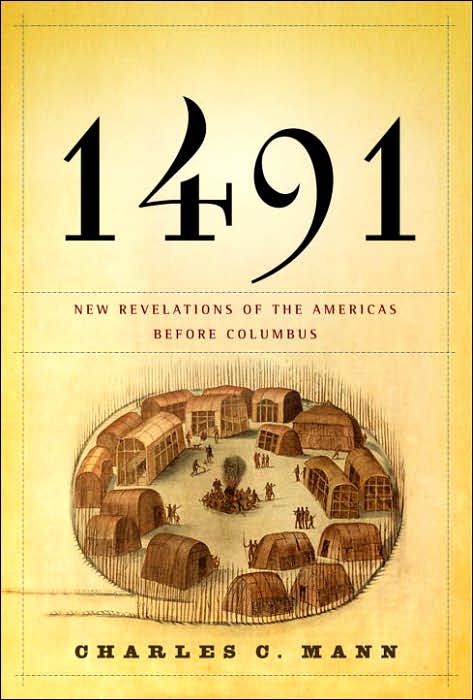
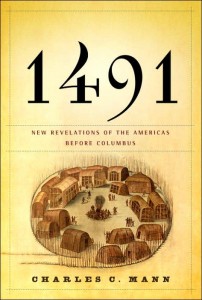
    Charles Mann describes these and a number of other fascinating findings in his book 1491: New Revelations of the Americas Before Columbus. He relays the information in such an engaging style that I found myself picking the book up at every chance. When I was finished, I wanted more.

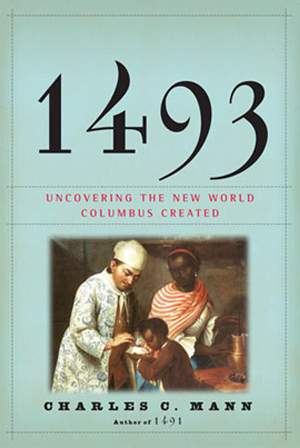
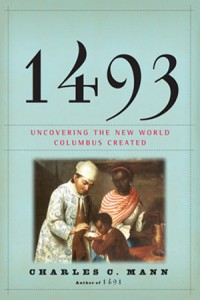
    Luckily, in 1493: Uncovering The New World Columbus Created Mann continues his history lesson. Except instead of focusing on the surprising things we’ve learned about the Indians in the last two decades, he focuses on the surprising impacts, both biological and financial, of linking the Western and Eastern hemispheres together. It’s the biggest event in the world, Mann suggests, since the dinosaurs died. Mann suggests that Columbus didn’t discover a new world–his voyage created one.

    The first part of the book examines the effect of the exchanges across the Atlantic (microbes  and tobacco). The next part focuses on the effect of the exchanges across the Pacific (silk, corn, and pirates). The third part shows the role of the exchange in the Agricultural and Industrial revolutions (potatoes, guano, and rubber).  The final part examines the consequences of the huge shift in populations caused by the Atlantic slave trade (Maroons, mixed-marriages, and freedom). As with 1492, the insights are both surprising and fascinating.

    If you like history, if you liked Guns, Germs, & Steel, then I think you will love these two books.

    EDIT: I just ran across a fabulous Doug Fabrizio Radio West interview with Charles Mann about 1493 called  The World Columbus Created.  Listen and enjoy!

    Divine Yogurt
    For years eating a serving of sweetened yogurt was like eating a box of Milk Duds (20 grams of sugar) or a Milky Way candy bar (35 grams of sugar). Yes, the sweetened yogurts have that much sugar. The only way to avoid eating literally like a kid in a candy store was to purchase plain yogurt and add some fruit or a squirt of honey. And, no, I will not consider eating yogurt sweetened with Splenda or Nutrasweet.  Artificial sweeteners make me gag. As far as I’m concerned, they are abominations that ruin the taste of everything they touch.

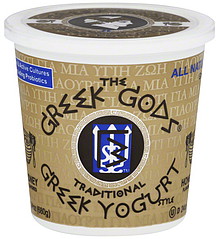
    So for many years I enjoyed my mix of plain yogurt and various add-ins. However, to my joy, I recently discovered a sweetened yogurt with only 15 grams of sugar (about as much as you find in a large banana) that tastes divine. It’s sweetened with real sugar and honey. And the mouth feel is sooooooo smooth. I’m sure this is because, unlike all the other yogurt manufacturers, these guys realized that, duh, fat actually makes things taste good and isn’t the  evil thing we’ve made it out to be. In just two bites it became my favorite sweetened yogurt. It’s called The Greek Gods Traditional Greek Yogurt. I’ve found another version—the vanilla honey—that only has 5 grams of sugar.

    Be aware that despite its name, this yogurt does NOT have the high protein content of other Greek style yogurts such as Brown Cow Greek Yogurt with 23 grams. Furthermore, not all the flavors have the low sugar content. Their blueberry and strawberry flavors, for example, have 35 grams. So check the labels first, and then treat yourself to yogurt that will have you savoring every bite.

    When I eat yogurt, it will still mostly be the plain Greek style with mixers. But when I want a special treat, you know I’ll be getting some from The Greek Gods.

    EDIT: 9/6/12 I now feel like Jerry Seinfeld in the episode when they found out the fat free frozen yogurt really wasn’t fat free. All the other yogurts I was looking at had serving sizes of 1 cup. The Greek Gods folks thought 1/2 a cup was the right size. That means that this super amazing low sugar yogurt had 30 grams of sugar per serving! It’s like eating a Snickers! I’m so disillusioned. Alas.

    Share