The main thing about villains

The main role of villains and antagonists in stories is to generate suspense, anxiety, and fear in the reader. They make it possible for us to worry that the hero will not be able to avoid a significant threat or remove a lack. There are other effects–mystery, poignancy (about the human situation like in Les Mis). But those are secondary.

For the main things to happen the villain has to be a credible, significant, and immediate threat…all the way through the book until he or she is smushed or wins.

If he’s not credible, the reader realizes there is no real threat. If the threat is not significant, who cares? If it’s not immediate, again, who cares?

So how do we make a villain like that? We make him or her smart, powerful, a few steps ahead of the hero, and dedicated to doing something we root against (because it’s just plain wrong or because we love our hero and want the best for him and the villain is pitted against him). He has to be able to put the hero on his heels most of the way through the book, and our poor hero is scrambling to adjust.

You can have all sorts of villains–liked by many or few, kooky or calculating, eccentric or plain, noble or sadistic–just as long as they remain significant, immediate, and credible threats. The minute they lose threat status, the game’s over because at that point fear, anxiety, and suspense in the reader vanish.

Share

Similar Posts

  • |

    The Pareto Principle, Form Follows Function, and Story

    There are a thousand things to “remember” when writing story. New writers who make lists of these things soon begin to drown in them. But I’ve come to realize that many of these “rules” don’t matter.

    They don’t matter because many ignore the function of story. And so you can’t know how and when to apply them, or if they’re even something you should apply in the first place. Furthermore, a good number that do tie back to function often have little impact.

    The more I develop and write, the more I begin to see that the key is to focus on a liminted number of fundamentals. To focus on the things that matter most.

    So what really matters when you’re writing a story?

    I’m going to be speaking for an hour at the Book Academy tomorrow. It’s at Utah Valley University. The week after I’ll be presenting all day at the American Fork Arts Council’s autumn writer’s conference. I will probably write up all my thoughts and post them to my site at some time.  But for right now this is where you can hear them.  

    I truly believe the Pareto Principle applies to writing. But you can’t go searching for those vital few factors until you know the effects they’re supposed to produce. Form follows function. And the function is something that happens in the reader.

    Here’s a nibble. This quote from David Howard is an example of what I’m talking about.

    “As we’ve seen, what the audience hopes for and what the characters hope for need not be the same thing. The same is true of our fears versus their fears. But how do hope and fear fit into the scheme of storytelling? Hope and fear are about the future. They derive from uncertaintly about future events in the story, future decisions the characters might make, future discoveries or revelations that might be unearthed, future outside forces and how they will influence the journey of the characters. When we discuss hope verusus fear in dramaturgical terms, this uncertainty is a function solely of the audience and its experience [my emphasis]. This is dramatic tension. We hope the man with the cobra in the shoe box won’t open the box; we fear he might and get himself or someone else bitten. We don’t know what will happen, but we know what might happen and therefore feel tension about those possibilities” (How to Build a Great Screenplay, 52).

    Readers buy novels because novels provide a service. They provide something to the reader. They DO something to the reader.  That’s why readers pay good money for them, and stay up late at night (well past smart bedtimes) with them, and spend hours of their lives reading them.  

    What do stories do? What are the key factors that have to be present in the stories for them to be able to do these things? How do you help readers hope and fear for what might happen?

    I’m no story guru, but I do hope to share some of the vital few factors I see in the presentations I’ll be giving this week and next.

    Share
  • |

    Awful Intent Update: The power of having the electric ladies read to you

    Everyone says you cannot copyedit your own work.

    You’re an idiot if you try.

    Because you’re mind auto-corrects eorrs, and fills in missing punctuation or words like “of” “the” and “a”.  And often doesn’t care or know the house rules for capitalization. Etc.

    (Did you catch all the errors in that paragraph?)

    Except the brains of copy editors play this trick as well. That’s why some read the manuscript backward and others use arcane WordText code to suss out issues. And some change the font face. And some make multiple passes over a section, looking for dialogue issues the first time through, capitalization the next, and something else the third time. And despite all their work, you still find errors in the text.

    I’m not saying editors aren’t any good. I’m just saying that our brains, for the most part, don’t care about the details. They just care about the communication, and they’re very good at ignoring the rubbish. And when it’s just the brain and the eye working together, the brain makes sense of the text, even when something’s wrong or missing.

    So one trick to force the brain to see what’s actually on the page is to read your text out loud to yourself. It’s an excellent practice, except a human brain is still involved, and it sometimes still plays tricks. And sometimes we get lazy and start to read too quickly, and the next thing you know we’re subvocalizing and whipping along, missing all sorts of stuff.

    So what can you do?

    Well, a few book releases ago, I stumbled onto something. I invited an electric lady to help. And she was dynamite. (You can invite a man if you prefer the sound of those voices.)

    I’m talking about inviting your computer to read aloud every word of your manuscript to you. And highlight the words as it goes.

    I can tell you I’m never going back. These ladies have simply helped me see too many errors that were invisible to me and my beta readers who had editorial chops.

    I use WordTalk, a free plugin for Microsoft Word for this kind of reading. The University of Edinburgh created it to help kids learn how to read. It allows you to select from the text-to-speech voices you have on your computer, set the reading rate, and it highlights the word it’s reading so you immediately see where the error is.

    I set it at a slightly faster reading speed so my mind cannot wander during the reading and use the quick keys so I can start and stop and make my edits easily. And I always, always, always have my electric friend re-read any fixes I make because I can’t tell you how many times I’ve adjusted a sentence or paragraph and introduced more errors that I didn’t see, even though they were staring me in the face.

    I must admit that the electric ladies can’t do everything. Having them read to you cannot help you spot errors you don’t know are errors in the first place. If you don’t know, for example, the conventions for capitalization of personal titles or the conventions for numbers (is it a “.44mm” gun or “forty-four millimeter”?) If you don’t have your own house rules for the many areas where you have a choice like in an epic fantasy (do you use “Dreadman” or “dreadman”?) If you don’t know any of that, you’ll blithely skip over a host of errors and only see the issues you know like the misuses of “rise” and “raise” or “lie” and “lay.”

    So you have to learn the conventions or find someone who does (an editor). Or both.

    Also, doing this type of reading will not help you see if what you’ve written is actually translating the scene in your head clearly and vividly to the page for someone new to your story. Only a fresh set of eyes can tell you where your story isn’t clear, believable, or interesting (at least to that one reader).

    But for helping you spot the issues you do know, I haven’t found anything better. Give it a try.

    Oh, and the update on Awful Intent–Zira and I are almost finished with the copy edit! Which means the release is only days away.

    Share
  • Indie Thoughts: Tend Your Garden

    From Joe Konrath.

    Your ebooks function much like a garden.

    One rare occassions, a plant will thrive with little help from you.

    Others may whither and die no matter how much help you give them.

    But the majority need to be constantly tended. Planted, watered, fertilized, weeded, pruned, mulched, replanted, harvested. In other words, lots of work.

    Ebooks aren’t a Mr. Popeill invention where you can set it and forget it. Quite the opposite. You need to pay attention, and keep active, or your garden won’t thrive.

    Everyone experiences slow downs in sales. It’s inevitable, and it seems to be cyclical, but not in any sort of way I’ve been able to prodect. Sales seem to rise and fall for reasons unknown.

    But if you’re doing what you can to make your books discoverable, you have a better shot at sales than those authors who self-publish then self-ignore.

    Here are some tricks to tend to your garden.

    1. Change prices. As an indie, this is one of the biggest advantages you have over the legacy industry. You decide what the customer pays, and this is powerful. Don’t be afraid to weild that power by experimenting with prices, both lower and higher.

    2. Newsletter. There is no excuse why you don’t have a newsletter. People who sign up are actively looking for your titles. Make them aware a new title exists.

    3. Sales. Unlike a change in price, a sale only lasts for a short time. KDP Countdown is what I’m currently using, because it offers 70% royalties when I drop the price. I’ve been pleased with my results.

    4. Advertising. Bookbub and Booksends are the ones I use regularly. If you’ve had success with another company, list it in the comments.

    He names eleven tips. Link to the rest at JA Konrath’s blog.

    This goes back to something Blake Russell said in the myth posts I pointed to a few posts ago. There are some folks who suggest that you can either write the next book or you can promote the current one.

    Folks who suggest it’s either/or leave me scratching my head. Why not do both?

    Applying to BargainBooksy or BookSends takes less than 30 minutes. Sending a review copy out to a decent review site takes about the same amount of time. If I spend just one hour a week on promotion, I can do all three of those things each month plus something else.

    Some folks suggest that promotion doesn’t work when you only have a few books out. And forget about it if you only have one. Promo can’t do anything for you if you only have one book out. At least, not as much as completing the next book can.

    Let me ask a question.

    If I open a McDonalds down some back road where nobody sees it and nobody travels, do we think that releasing a second McDonalds down some other back road where nobody travels is going to increase sales?

    Nobody is going to go down those roads except by accident.

    Is that how McDonalds or Walmart or whatever company you want to name built their vast empire? They did it by accident? How about the diner everyone loves in your town? They hid it at the end of a dirt road, told nobody about it, definitely did not put up a sign (good grief, not a sign), and, shazam!–the customers started rolling in?

    Mcdonalds11

    Some folks say, no, you’re missing the point. The purpose of a promotion is to get people to buy other books in your list at higher prices, so if you don’t have a lot of other books, your promotion can’t do anything for you.

    Using loss-leader or sampling strategies with one book to sell others is certainly a smart thing to do. Because it works. With cheeses at Sam’s Club, with books, with a lot of things. But is that really the only thing you’re trying to do?

    How about building a base of readers who have some degree of loyalty to your brand? You don’t need ten books to start to do that. You don’t need two books. You can start with one.

    I started two series last December—a thriller and an epic fantasy–and (writing gods willing) will be releasing book 2 in the fantasy series this month. Since December I’ve sold close to a thousand in each series. It was easy to see that at least half of my sales, maybe more, came because of some type of promo. I know this because I watched the numbers.

    This means I now have hundreds more folks waiting for book two than I did for book one in both series. I’m going to be releasing book two in both series with a bigger customer base than I would have had without promo. Why would I not want to start at a higher level for each successive book?

    More readers means more word of mouth. Why wouldn’t I want more word of mouth about my books?

    More word of mouth means higher odds that an influencer will hear about, try, like, and then promote my books. In fact, I’m looking at at least double the odds. Somebody remind me: why wouldn’t I want those better odds?

    One of the main keys to this business is to get a big enough customer base so that the word of mouth takes on a life of its own. I am building that base more quickly with promo than without. Why would I want to build that base more slowly?

    Finally, I have twice the money I would have had otherwise to invest in promo and covers and editing etc. Or just go spend on my wonderful wife and girls. Why wouldn’t I want this revenue?

    Traditional publishers have built reader bases for an author one book at a time, often spaced a year apart, for decades. They put money into the promo that works in in-store venues: covers, pre-release reviews and the necessary ARCs, catalogs, a sales team, and co-op visibility in the stores. And while that promo didn’t guarantee anything, it made the odds more likely the book would get readers to sample and build that reader base.

    Why shouldn’t we put money into the promo that increases the odds for online stores?

    What business out there can’t benefit from good promo?

    Of course, the next question is what methods of promo work? There are a many methods that are a waste of money. But not all of them are. I think it’s our job as entrepreneurs to test and find ways that are effective a la The Lean Startup by Eric Ries.

    Anyway, Konrath’s advice to not self-ignore, and Blake’s “do both” approach make a lot of sense to me.

    Share
  • What Robinson Wells Learned Last Year

    Look, this is just an excellent post by Robinson Wells: Five Things I’ve Learned In The Last Year About Writing.

    I kept finding myself saying yes, yes, yes!

    Yes! I hate “networking” too. Icky, icky, icky. Like squishy underwear. Like buddying up to someone to get them into your network marketing downline. Like flies in soup. I love how Robinson replaces that with the real deal. I think I’m going to summarize him every time anyone asks me about networking. 

    One point. I do think he might be overstating the you-need-to-know someone deal. It’s easier, sure. But Larry Correia didn’t know anybody. He just wrote a book a lot of people in a certain demographic loved. I didn’t know my agent from Adam. Didn’t know my editor, but did have an endorsement from one of his authors. But that didn’t get me any deal. It probably got me, at most, a fair consideration. I can name others who didn’t know a soul. In fact, go to the facts and figures page in the On Writing section. Look at the author polls there. A lot of authors didn’t know a soul. Of course, knowing someone can help.

    Yes! Be cheerfully flexible. Oh, my gosh. This is such a good approach. And I’m living it right now, although there have been a few moments when I’ve had to regroup for a moment to capture the cheerful.

    Yes! Sometimes the thing you love doesn’t work for the project. Sometimes it does. I would advocate making sure you get to the root of the issue. But we’re artists. If the thing we don’t love doesn’t work, we can create a new thing to love. That’s what it means to be creative.

    Work! Yes! It’s amazing what happens when you work.

    Good stuff.  

    I’m so bullish on this, I say Robinson for President.

    Of what, I don’t know. But he should be President, of something.

    Share
  • Generating Story 11: Creative Q&A with Author Janci Patterson

    I was introduced to Janci Patterson at a local convention by author Sandra Tayler (some may know Sandra because of her husband Howard who does the online Schlock Mercenary comic).  Janci told me she’d just signed with a YA publisher. That was exciting. I asked her what her novel was about. She told me, and I immediately hated her because it sounded like such a fun idea, and I wanted to not only read it, but also write the story myself. Luckily I have a few scruples and did not pay the local Klingons to off her and drop her body in the Great Salt Lake for the brine shrimp to feast upon.

    BTW, did you know that back in the day hucksters placed this ad in Boy’s Life magazine?
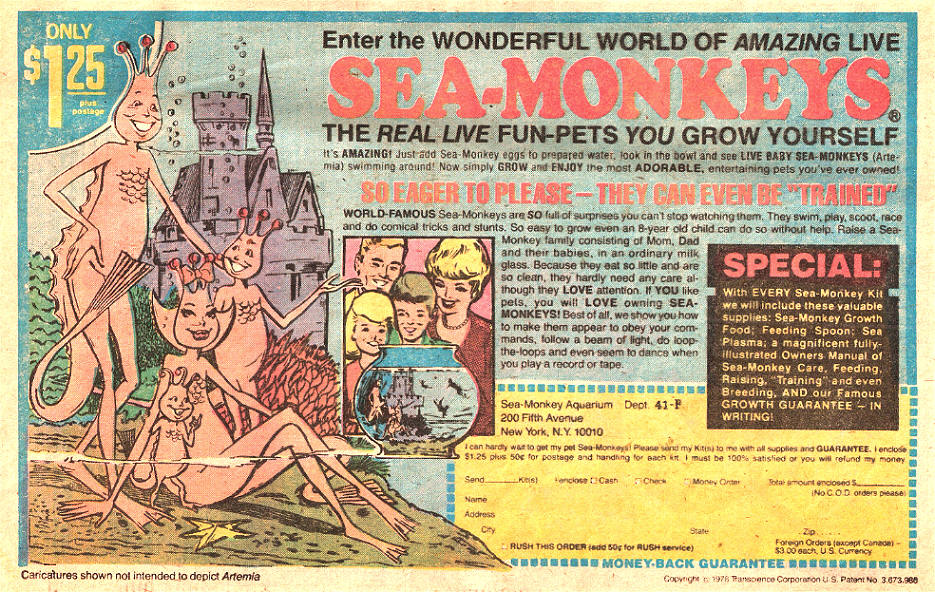
    Look at that cute sea-monkey family. Look at the picture of the human family watching the sea-monkey family swim around a castle in a bowl. Click on it. See it large.

    As a young lad, I, as every good Boy Scout should, subscribed to the magazine. I saw that ad over and over.  Who wouldn’t want a sea-monkey? So I saved up my money, earned by watering plants and trees at a nursery in the hot Utah summer sun, and ordered me a family to put on my own shelf.

    The aquarium came. It was not a bowl and did not have a castle. But, hey, there were real live sea-monkey eggs right there in the packet. They weren’t just fantasy creatures! I mixed in the water and salt and dropped the eggs in. I can’t tell you how excited I was. Days later the eggs hatched. And what did I have?

    Brine shrimp.

    BRINE SHRIMP!

    I could have had my mom drive me to the lake where I could have scooped up a million of them. For free. That was, I believe, my first great disillusionment. The first great step from child to adult.

    Alas, sea-monkeys . . .

    Anyway, back to story. Janci was one of those Codex Writers who shared how she used Q&A to develop her killer story idea. She agreed to share it with you. Here’s Janci.

    ***

    The idea for CHASING THE SKIP started with a game of existential questions.  That’s like Twenty Questions, only with no question limit and much more confusing subject matter–like the Pythagorean theorem, or gas prices.  My husband and I like to play the game on long road trips, since a really good round can take two or three hours to play out. 

    On this occasion, I chose a bounty hunter.  It took Drew about five minutes to guess that one–not my finest subject ever.  But after he guessed it, we started talking.  I knew that bounty hunters still existed, but I had no idea how chasing down a fugitive could be a part of our contemporary justice system.  Just what is it that bounty hunters did, anyway?  How did it all work?

    After our road trip, that question stuck with me, so I began to do some research.  What I discovered fascinated me.  A bounty hunter could legally chase down his mark because of the bail bond process.  In order to be released from jail before a pending trial, an arrestee had to put up bail money as collateral, to ensure they returned for their trial.  Since most people can’t afford to post the full bail amount, a bondsman will post it for them, in exchange for a smaller fee.  When the arrestee skips bail, the bondsman is out the money–unless he can get bring the arrestee back.  In fact, he’ll have that person sign away their constitutional rights to privacy in addition to paying the fee.  He’s allowed to go find them if they don’t show up in court.  He can even break and enter to do so–dragging them out against their will.  But the bondsman is a busy man, so he signs those rights over to a bounty hunter, and off the bounty hunter goes, chasing down the skip.  If a person is good at it, bounty hunter can be a legitimate career.

    As I researched, I knew I had the beginnings of a story.  This had all the elements–reality with a touch of danger, crime with a touch of justice.  I wanted to make it work. 

    But I write YA novels, and no bondsman would sign on a teenager to go after his skips.  That would have all kinds of negative legal ramifications, and even if it didn’t, no reader would believe it. Enter my Creative Q&A, the question I always ask when I’m doing idea development for a novel: where can I put a teenager in this?

    Answer: she couldn’t be the bounty hunter, but she could be the bounty hunter’s daughter.

    That posed its own problems, of course.  No dad in his right mind is going to haul his daughter along on the road with him as he tracks down skips.  (Or, in question form, what would make a dad in his right mind bring his daughter into such a dangerous situation?)  I needed a crisis, so he had to bring her along, had to track down the skip, had to keep going with all of it, even when things got rough.  And if I could work in some interpersonal drama, all the better.

    And so it was that Ricki became abandoned by her mother, forced to ride along with her bounty hunter father, a man she barely knows, as he chases down a skip who is more dangerous than his usual mark.  Why would he take this particular job with Ricki along? 

    Ricki would like to know that, too.

    ***

    John Sez: ins’t that a great idea?  I hate Janci.

    While we’re hating her, did you notice that she got some random bit of zing playing 20 questions with her hubby? She followed it up by doing some research.  After doing that, she had a lot more zing. She also knew she had a general topic for a story.  She knew she had the beginnings of a story because her zing meter was going wild. 

    But she didn’t have a story yet.  She had a vocation, which is nothing more than a bit of setting.

    To have a story you need character, problem, plot, AND setting.  So she whipped out her Creative Q&A tool to help her find a character.  And the question she asked was one she’s found is very productive for her. It’s a basic question. But it’s an excellent question. And from that Q&A she started to develop the rest of the story parts.

    The take away isn’t that playing 20 questions on road trips is the key to story ideas.

    It isn’t that one question Janci asked, as fundamental and productive as it is.

    It’s that the principles we’ve been discussing in these posts work. Develop the 6 Core Parts. Think about objectives. Start anywhere. Hunt zing. Generate your own zing. Use Creative Q&A. Work on the various parts using whatever tools you have until you have developed enough that the story comes alive in your mind.

    I hope she sells a million.

    For more in this series, see How to Get and Develop Story Ideas

    Share
  • Read and report for effect, not rule compliance

    At a recent writer’s conference I was on a panel and someone asked what the pros and cons of writing groups were.  Writing groups can save AND kill your writing. So beware.

    Workshop Benefits

    Writing groups are great for:

    • Encouragement
    • Deadline motivation
    • Having fun with other authors
    • Getting a chance to think about and discuss craft
    • Testing your work

    The benefits listed above can all be huge helps to a writer. However, there are two traps that many individuals fall into. You want to avoid both of these because they are plagues that can not only infect, but kill your writing.

    Workshop Plague 1: submitting for fixes instead of effect

    The first problem occurs when a writer forgets that the purpose of sharing your work with the group is NOT to have them tell you what to do. It’s to test your product on readers who are likely to be in the audience for that particular type of story (please note the last part of that sentence as well).

    But in many groups this isn’t what happens. The writer submits his work and then hopes it does well. If it does, he purrs and goes his way rejoicing. If it doesn’t, he figures the group will tell him what to do to fix it. In such groups the readers often arrive with a list of “you shoulds” or “I woulds.”

    • The dialogue here is clunky, you should…
    • These characters are stereotypes, I would…
    • You have infodumps here, here, and here: you should…

    This all sounds great, right?

    Wrong.

    This tells a writer very little that’s worthwhile. What was the problem all these shoulds and woulds are trying to fix? You can’t tell. And not knowing the problem, you don’t know if the fix is really going to work. In fact, the suggested fix might be completely wrong for the story. You are the story designer. YOU have to figure out what’s really wrong and then select the right fix.

    Case in point: at this conference another author told of a time her editors came back and said the novel needed to be shorter. It was too slow. In reality, the novel was too short. The real fix was to make it longer. She was skimming the surface of the story in summary and needed to go deeper. She made it longer, and the story worked. But if she had been looking for fixes instead of symptoms she would have done the exact wrong thing for her story.

    The most productive thing a writer can hear is what effect the text was having on the reader. Was the reader bored, lost, or feeling it was made up? Or was the reader surprised, intrigued, fascinated, freaked out? In short, did it do what the story was supposed to do to the reader?  An accurate report of the reader experience is invaluable. But a list of shoulds and woulds by the Fixits is not. You want symptoms, not diagnoses and presecriptions.

    Of course, when you understand the symptoms, you can very easily open it up to the group for suggestions on ways to fix it. Sometimes brilliant solutions arise from such discussions. Sometimes they don’t. Othertimes, they simply provide a way for the writer to work it out in his own mind. But in the end, YOU as writer have to do what’s right for the story you feel in your gut.

    One time to be especially careful of this is when you submit revisions of a story to the same group. Here’s why: when someone says a revision lacks blood and vitamins, it may be this is actually the case. But it also might simply be a case of diminishing returns, e.g. the first ice cream cone you eat is great, the second okay, the fourth begins to make you sick. Would the movie you just saw on Friday night be just as powerful if you saw it again on Saturday? And then again on Monday? I know it’s not exactly what’s happening, but it’s similar. After reading a manuscript multiple times, a reader sometimes can see nothing but the stitching.

    Furthermore, a reader will often get revision ideas that jazz them about the story only to find the author was jazzed about some other revision idea. And that can often disappoint. And if this multiple revision reading goes through multiple cycles, I’ve found it becomes harder and harder for the reader to avoid becoming a director of sorts, the author trying to perform to their taste. I done this far too often to people feeding me multiple revisions. 

    There’s an easy way around this one: simply avoid submitting any individual story to the same set of readers more than once.  However, I don’t want to suggest you should NEVER submit revisions to the same set of readers. Orson Card submits all his work, originals and revisions, to his wife Kristine. I submit mine to my wife and editors. Many writers have trusted readers. Just be aware that submitting multiple revisions can very easily lead to our chasing someone else’s opinion instead of writing the story we feel in our guts.  Tread with caution.

    Workshop Plague 2: reading for rule compliance instead of effect

     The second problem occurs when you have readers who have forgotten that the ONLY thing that matters is effect. Many times writers will build a list of writing rules as they learn the craft. And they will forget that the rules are, by themselves, meaningless. Please see my post on Rules vs. Objectives. These well-meaning folks come, not with an accurate report of their reading experience, but with a list of your rule violations.

    So instead of hearing that the story immediately pulled the reader in but that by page four the reader’s mind was wandering, the reader points out that you started the story with dialogue and you shouldn’t do that. Or that you used said-bookisms, which was a very flabby and naughty thing to do. Or that you had more than one point-of-view in the chapter. Or that you chapters were too short or too long. Or whatever it is that that particular reader has in their rule book.

    This kind of feedback is worthless. I don’t care if my story started with dialogue. What I want to know is if it pulled the reader in. And when I say “reader” I mean  one who is looking for a story, not for rule infractions. What you want is an accurate report of the reading experience. That’s it. Both the good and the bad.

    Here’s an example of what I try to do when I read and report. It’s not the only way, but it illustrates what I’m talking about.

    1. I read the story as a normal reader. No pencil or pen in hand. I’m just thinking: okay, I hope this is good.
    2. I read until I’m bored, lost, or (hopefully) turn the last page in delight. Some folks may wonder why I wouldn’t read to the end of everything I’d agreed to report on. Simple. If I’m bored or lost I’m OUT of the story and cannot judge the effect of what follows as a reader. Maybe I’m bored because of the craft. Maybe I’m bored because I’m not in the audience for that kind of story. If this is the case, my experience doesn’t matter. You wouldn’t give a romance to a thriller reader and then expect them to love it, would you? Well, authors are no different. Just because we write doesn’t mean we automatically love everything (please see my blog Is 90% of Everything Crap). 
    3. I write up my experience, making sure I accurately report who and what I was interested in, what delighted me, what bored me, where I was lost, or didn’t believe etc. I’m also very particular to clearly separate  the things that had a big effect on my experience versus those that had a small one. For example, some confusion in an exchange of dialogue might be a small thing. Confusion in a whole chapter is a big thing. As a writer I don’t want a laundry list. I want to get a sense of proportion. And I want to know if the reader generally enjoyed the story or not. It’s one thing to know the story is busted. It’s another to know that it works, but has a few paint spots.  
    4. If I did not read through to the end, I do so now. Or maybe I skim. Just to get an idea of the whole story.
    5. Then I ask myself what I think this story was trying to do. What kind of an experience, what kind of delights was it offering up to the reader? Suspense, delightful characters, romance, wonder, cool textual pyrotechnics, etc.
    6. Having an idea of what the story was trying to do, I see if I can’t diagnose the problems and think of some ways to fix them.
    7. Finally, I give my report to the writer. I include #3. Then I add #5 and #6, stating that here’s “what I think the root of my issues were and some ideas that might help.”

    You might do it differently. Just make sure you focus on accurately reporting your experience reading for effect, not rule compliance. Once you have a number of reports you can see what’s working and what isn’t. If one out of ten people has an issue with a certain part, I may or may not ignore it, depending on my own judgment. However, if four to seven of them have an issue, I’m probably going to fix it.

    So writing groups can be wonderful. Just be careful to avoid these two plauges as if they were, well, plagues.

    Share