Then you want to be in Provo, Utah this Thursday, Friday, and Saturday, February 11-13th, and attend Life, The Universe & Everything, the annual science fiction and fantasy writing conference. (I think students get in free.)
If you live within a reasonable driving distance (I’m 2.5 hours away and consider that reasonable), then you should do everything you can to get down there. It’s going to be a blast. It and LDStorymakers are THE best conferences for writing that I know of in Utah, Nevada, Idaho, Wyoming, Colorado, and Arizona. And if you’re into SFF, then it’s the one. I mean, just check out the list of guests.
I’ll be on the Role of Magic in Your Story and Distributing Your Novel panels. Look at the schedule and check out the guests who will be on those panels with me. Yeah. Awesome.
And then I’ll be presenting Vivid and Clear by myself and Succeeding as a Writer with L.L. Muir, which is going to reveal some things that will surprise a lot of people.
BTW, L.L. Muir is the best kept secret success story in Utah at the moment. She’s selling thousands of books, pleasing thousands of readers, and making, well, you’ll have to come to that presentation find out how much money she’s making. And what the secrets to her success are.
Melissa Mead lives in Upstate NY with her husband and cat. Her stories have recently appeared in IGMS and Daily Science Fiction. She’s a member of SFWA, Codex, and the Carpe Libris Writers Group: http://carpelibris.wordpress.com/. She too had a story to tell about using questions to help her develop her published stories. I think it’s worth sharing.
Melissa
My Double Dragon novel Between Worlds (Double Dragon Publishing) came about because of a reading mistake.
You see, I’d come across the word “cantrip.” Not being a D&D player, I’d never heard it before, so I went to the OED and looked it up. The first definition said “A minor spell or incantation.” The second said “A mischievous trick,” but somehow I misread it as “A mischievous sprite.”
Oh wow- a mythological being I’d never heard of! I ransacked the library looking for any reference to those mischievous sprites. Didn’t find any, of course. Finally I decided that if I couldn’t find them, I’d make them up. So I started asking myself “What are Cantrips?” From the definition, I figured they must have some minor magical powers, and were most likely small.
So why hadn’t we heard of them before? Perhaps they were hiding.
Why were they hiding? Perhaps something awful had happened between humans and Cantrips long ago, driving the Cantrips underground. Literally.
Then why we were hearing about them now? Something must have happened that made staying hidden more risky than coming above ground. Starvation? Underground isn’t the best place to maintain a steady population. But that’s not very dramatic or personal, for story purposes. Maybe, in addition, there’s an outside threat.
Ok, so someone needs to confront this threat. One person, so we have someone to focus on. Someone more adventurous than your typical Cantrip.
And so Miska, and all the Cantrips, brought a new form of mischievous sprites to the world.
All because of the question “What the heck is a Cantrip?”
John Sez
First of all, notice she followed her zing. She stumbled upon this new creature and started to research. Her research didn’t provide much, of course. But following that impulse is key.
Next, did you notice she kept asking why? Why don’t we know about Cantrips? Why did they go underground? Why are they returning? That’s a motive or cause question.
There’s no way you’d use those exact questions in your story. But you WILL want to know WHY things are they way they are. You will want to know motives and causes, internal and external. You’ll want to know WHY your hero is facing this problem, WHY the antagonist is working against her, WHY the hero decides to tackle the problem instead of ignore it or run away. When the hero reacts and makes a decision to do X, you will want to know WHY (as well as WHAT’S THE RESULT). Same with the antagonist. When building setting, you might find it useful to ask things like WHY did they build a village here or WHY is my character a tailor? Do you see?
In addition, I’ve found that replacing “why” with “what” seems to be more productive to me. So “what led or caused my character to be a tailor” helps me more than “why.” “What’s motivating the antagonist” helps me personally more than “why is he doing this?” That might be my own weirdness, but I think “what” subtly leads me straight into nouns and situations and values and beliefs. Try it on and see if it doesn’t help you.
Finally, did you notice her use of objective. The story about overpopulation in the underground didn’t interest her much. She wanted something with an active antagonist. Something that could focus on a character. Knowing that objective, she started generating options that might fit the bill. Which lead to the cool idea of a new type of mischevious sprite.
Follow zing. Use the “what” (why) to identify cause and motive. If you can, state your objective; the clarity will give your wonderful mind a focus for its generating powers.
Okay, I lied. I was going to get into idea generation techniques, but decided to do one more short post on development objectives. Actually, I suppose this is a technique.
In the last post, I said one of the main objectives of your initial story development is to have the story to come to life in your mind. I explained that the best method I’ve come across up to this point for making that happen was to focus on developing the 6 core parts. Then I explained in general what I’m shooting for when developing those parts at the outset of a new project.
You can use a number of different types of documents to capture your thoughts on those 6 core parts. You might end up with a rough two-page sketch of the story. You might write brief character bios of some sort. You might bullet the general steps of the plot. Maybe you create a map. There are a lot of types of documents you can use to capture what you’ve developed. And often the creation of those documents not only captures what you’ve developed, but helps you develop the parts in the first place.
I want to suggest a “document” that will help you capture and develop the essence of your story setup.
This is ONE tool. It is not THE tool. There are many ways to capture the essence of your story. There are many tools that can help you clarify your thinking. But I think this is a good one because it forces you to get right to the core of your story and clarify it in a compact manner.
An idea that’s core and compact has great power because it focuses the mind.
There are so many things to juggle when writing a story that it’s easy to get lost in the weeds. I’ve found I become so much more productive when I know the core situation that’s driving the story.
There are a lot of things that drive reader and author interest. There might be a thematic question, fascinating characters, genre stuff (chase scenes, romantic scenes, scare the soup out of you scenes), humor. One of the main things that rivet readers to the page are the hopes and fears they have for our characters.
A reader’s hopes and fears are driven by presenting:
An event that causes
An interesting and likeable character to
Face a compelling and concrete problem—a threat/danger, lack/hardship, opportunity, or mystery.
The character decides he must try to solve the problem (which results in the character goal the story revolves around)
And struggles against significant opposition.
That’s the core of the story setup. As David Howard puts it: “there is one basic dramatic circumstance: somebody wants something badly and is having difficulty getting it.”
Of course, stories provide a lot of delights that require you to do more than define the person and the thing they want. But the setup is at the heart of a lot of what readers go to story for. Part of the initial development of a story should focus on helping you clarify this central dramatic situation.
So here’s a tool to help you do that. I read about it years ago in Dwight Swain’s Techniques of the Selling Writer, which was written in 1965. Swain calls it the “Starting Line-up.” I read about another version of the same thing more recently in Dan Decker’s Anatomy of a Screenplay written in 1998. He calls it the “Story Line.” The hugely published romance writer Leigh Michaels calls it a “Framework” in her On Writing Romance: how to craft a novel that sells. The agent Donald Maass calls it the “premise of a novel” in an interview published in Agents, Editors, and You by Michelle Howry. Jim Butcher calls it a “Story Skeleton.” Let’s look at each of these variations.
Swain’s “Starting Line-up”
Swain asks you to include five elements:
Focal character
Situation
Objective
Opponent
Threatening Disaster
These are to be cast into two sentences.
Sentence 1 is a statement that establishes character, situation, and objective.
Sentence 2 is a question that includes the opponent and disaster and can always be answered in a clear yes or no
Here are his examples.
John Storm
Sentence One
When humans suddenly begin to grow to twelve-foot height [situation],
John Storm [character]
tries to find out why [objective].
Sentence Two
But can he defeat the traitors in high places [opposition]
who want to kill him [threatening disaster] in order to make the change appear to be the result of an extraterrestrial plot?
Irene Boone
Sentence One
Lonely, frustrated, and tired of living in a home where she’s treated as an unpaid servant [situation],
widowed Irene Boone [character]
wants to marry widower Frank Dawes [objective].
Sentence Two
Will she lose this chance for happiness [threatening disaster]
because her selfish sanctimonious daughter, Connie [opponent] accuses her of immorality?
Dale Boulton
Sentence One
Sick of the conformity and hypocrisy that go with his highpaid job, and with a modest life income assured [situation],
Dale Boulton [character]
decides to retire ten years early, to go live on a shanty-boat and poke through crumbling river ghost-towns, in fulfillment of a boyhood dream [objective].
Sentence Two
Can he make the break successfully, when his hostile wife, Sandra [opponent],
fights him all the way and, finally, threatens to have him declared incompetent [threatening disaster]?
Decker’s “Story Line”
Decker requires three components:
The main character described by an adjective
The inciting event or decision that propels the character into the story
The main character’s objective, stated in concrete terms
You can add other components—other characters described by an adjective or other important events or decisions. He prefers you start with a “when.”
Here’s an example.
When a booksmart savings and loan bailout accountant takes over the business he is assigned, he discovers it is a bordello and teams up with the Madame using his business skills to fend off a hostile take over and save the business.
Another.
When a blood thirsty killer and his gang are coming to kill him, a strong-willed, decent cop must fight them over the objections of his pacifist bride who will leave him if he does.
Another.
When he is given a factory full of doomed Jewish workers, a greedy, opportunistic Nazi deceives his taskmasters to save them.
Another.
After a tornado carries her off to a strange land, a spunky teenaged girl must face a series of challenges to get home.
More.
When his blundering uncle throws their building and loan company into insolvency, a despairing small town banker with low self-esteem has to find a way to save the bank.
Leigh Michael’s “Framework”
Michaels suggests four elements in her framework, although she doesn’t stipulate a specific form.
This definition summarizes the four crucial basics that make up a romance novel:
A hero and heroine to fall in love
A problem that creates conflict and tension between them and threatens to keep them apart
A developing love that is so special it comes about only once in a lifetime
A resolution in which the problem is solved and the couple is united
She then lists a number of questions to help an author think about those four elements. The document that could capture this is a summary of the answers to those questions.
Donald Maass’ “Story Premise”
Donald Maass was asked what he looks for in a query or pitch. Like Michaels, he doesn’t specify a form, but does include some basic elements.
I’ll tell you exactly what I need, and I can get this information after just a few questions.
First of all: What type of novel are we dealing with here? Mystery? Mainstream? Young adult?
Second thing: Where and when is it set? Contemporary? Historical? Magical place? A real place?
Third: Who is the main character?
And lastly: What is the basic problem that the character faces?
Those things wrapped up together are the premise of a novel, and I know right away if it’s the kind of work I handle, if the idea sounds original, if the main character is sympathetic, and whether I care about the problem. That’s all i need. If all those things are a go, then I want to read the work. It’s as simple as that.
Most authors might perceive this as additional pressure. It’s exactly the opposite. What is means is that their job is much, much easier than they think.
If you think about a query, this is something that should be contained in a few short paragraphs.
The story skeleton is a description of the main plot of your book, broken down into its simplest elements. . . The story skeleton (also called a story question) consists of a simple format:
*WHEN SOMETHING HAPPENS*, *YOUR PROTAGONIST* *PURSUES A GOAL*. But will he succeed when *ANTAGONIST PROVIDES OPPOSITION*?
For instance, look at Storm Front. (Yes, I’ll use my own books as examples, because I’m just that way. 😉 Also, I’m more familiar with them than I am with almost any other writer.) Storm Front’s story question:
****************************
When a series of grisly supernatural murders tears through Chicago, wizard Harry Dresden sets out to find the killer. But will he succeed when he finds himself pitted against a dark wizard, a Warden of the White Council, a vicious gang war, and the Chicago Police Department?
****************************
See! It’s oh-so-simple! Almost to the point of looking ridiculous–and I have no doubt that some of the people reading this article will think that it *is* ridiculous. They’re wrong. 🙂 This is a fundamental description of the core conflict in your tale–and stories are all about conflict.
Go read his whole essay.
My Version: “The Story Setup”
Did you notice any similarities in the examples above? Character, inciting event, problem, goal, opposition. Let’s go back to the core of story I listed.
An event causes
An interesting and likeable character to
Face a compelling and concrete problem—a threat/danger, lack/hardship, opportunity, or mystery.
The character decides he must solve the problem (which results in the character goal the story revolves around)
And struggles against significant opposition.
Written even more succinctly:
Character
Inciting event
Problem
Goal
Opposition
I like the idea from Swain and Butcher of projecting us forward using a question. I like the idea from Decker and Butcher to use “when” to state the inciting incident. I also like adding in the character adjectives. I like Michael’s and Maass’ focus on problem. But I also like flexibility. My version uses key elements of the others as guidelines, keeping it simple and core by limiting the statement to 90 words.
Here’s one for The Incredibles.
Bob is a frustrated retired superhero, living a boring life as an insurance claim processor. When he gets an offer to do illegal superhero work on the sly, he decides to take it and pursue a double life, even though he’s forced to lie to his wife about it. But his dream job employer is actually trying to settle and old score and kill him. Will he lose his family when he’s drawn into a showdown with a super villain that has him outmatched?
In many longer works there are often more than one story running. Sometimes the main character has an external conflict and an internal one. Or maybe a related subplot. Sometimes other characters have related B, C, D, and E story lines. In Curse of a Dark God, for example, I have at least eight story lines that I have to braid into each other. To keep them all straight, I found it very helpful to list out the five elements for each. The goal isn’t to make these into slick marketing tools: they’re to help me focus my efforts. However, I find that when they include all the elements, they have great power to pique my interest.
Here’s one of the “inner” conflicts of Curse.
Talen has escaped the clutches of the Mother, but something is growing inside of him. When he begins to hunger after the Fire and soul of those around him, he realizes he’s not all human. Will he be able to resist the growing and overpowering desires, or will he become the very thing he’s fighting against?
Here’s one of the related “outer” conflicts.
The Mother of Mokad wants Talen—to make him into a thrall or devour him. He escapes the first attempt to capture him, but will he be able to shake the Mother’s powerful hunter and his dreadmen now that he and his sister are on their own?
Here’s a third story line in the book, the big external plot.
Argoth is trying to build up an army of sleth that can free mankind. But the Mother of Mokad sends her Guardian to exterminate every last one of them. Will Argoth be able to defeat Mokad’s vastly superior army, especially when the Guardian has infiltrated his ranks?
But Argoth has another plot line for the reader to worry about.
Argoth damaged his son. Nettle’s condition is growing worse. A foreign Divine offers to heal Nettle in exchange for Argoth’s allegiance. Will Argoth betray those around him and save Nettle? Or will he let his son die and lose him to the perils in the world of the dead?
Here’s one of Sugar’s.
When Sugar sneaks behind enemy lines to retrieve some items her mother left for her, she’s given the opportunity to learn a powerful lore and use it to scout for Argoth’s army in the world of the dead. But each time she uses it, she comes closer and closer to death herself. Will she be able to survive as she’s asked to serve in more and more dangerous situations?
Here’s her inner conflict. I wanted to develop a moment of dilemma for her just as I did Argoth.
Sugar wants to keep her brother Legs safe. But as Mokad’s army arrives, it becomes apparent Argoth doesn’t have a chance. She and her brother might not survive. Sugar’s been learning the lore with a handsome and battle-hardy loremaster who saves lore users who have become true sleth. When he asks her to sail with him and his crew before it’s too late, Sugar has to decide if she will flee and abandon her friends or stay and fight and risk losing everything in this world and the next.
Now you see why it’s virtually impossible to write such a book with so many story lines in the normal 100,000 words. And why I question my sanity in trying to write it.
Anyway, there’s much more to writing a fascinating and compelling story than capturing a story setup, but I’ve found that working on stating the simple core of the story clarifies many things for me and makes me much more productive. I developed a short statement of all my story setups early on in the writing.
There are a number of ways to capture the story setup. Let me suggest you give one a try. And if you aren’t to the point where you have enough material to capture a story setup yet, that’s fine. That’s what development is for.
One last note. If you want to read an expanded description of how one writer develops story ideas, read Write Away by New York Times Bestselling author Elizabeth George. I loved the book.
Bonus: Miss Snark Happy Hooker Examples
Miss Snark was the pseudonym of an agent who I believe was Janet Reid of the JetReid Literary Agency. When she was incognito, Snark had a blog. On her blog she’d often invite people to submit their story statements used in queries to hook editors and agents to ask for more. These entries were called “Happy Hookers.” Snark would rate them on her crap-o-meter, sometimes giving comments and suggestions. Let me suggest you read 50 or 100 of those hooks.
As you’re reading, look at Mrs. Snark’s comments. But more importantly, note the hooks that excite you and the ones that don’t. Because, frankly, Snark is just one person with one person’s tastes. In this exercise, you’re not trying to figure out what she likes. You’re trying to see what story elements work for you. So don’t be dissuaded by her tastes. Identify the hooks that interest you and the ones that don’t. Ask yourself where they were unclear, unbelievable, or boring. After you’ve done a few, you’ll start to see story patterns and ways to capture your own story setup that will be useful to you.
Some folks say ebooks will foist a terrible problem upon readers–they’ll soon have to wade through mountains of crap to find a book to read. It will be a terrible chore. J.A. Konrath gives his answer to this lament. Kris Rusch gives hers.
Here’s mine: there will NEVER be a tsunami of crap facing a reader looking to buy ebooks or any other kind of book. Ever.
Why?
REASON 1
Buyers REFUSE to look at seas of choices–crap or otherwise. Shoppers always seek to limit choices (too costly to look at everything) and use a number of methods to immediately narrow those choices down: recommendations, reviews, what’s on the shelf, etc. (For a fascinating look into a few facets of how we make choices, listen to this Radio Lab espisode.)
For example, when shopping for vanilla you don’t go searching through the 500 brands available online and in various stores–Mexican, Vodka, American, Rum, organic, generic, brand, etc. It’s just not worth the time. Something on the shelf is usually GOOD ENOUGH.
Likewise, nobody cares to look at 150,000 titles to find the best. They don’t have the time. In fact, they don’t need to. They can usually find a number of books that are intriguing enough in the “smaller” selection any given vendor sets before them.
In the case of Amazon ebooks, that selection is the best-sellers, the ads, and the this person bought that.
Nobody ever sees the 4 gazillion books. Ever. They don’t want to.
REASON 2
Vendors can’t display a gazillion choices, even if they wanted to, which they don’t (studies have actually shown that providing shoppers too big a selection leads to FEWER sales).
And no, just because Amazon says it have 2 quintillion titles for sale that does not mean they’ve been displayed. You only see a handful of titles at a time.
Even if you scroll through the various lists, you are rarely looking at more than a dozen choices at a time. You’ll probably see less than 200 titles total any given time you go shopping.
Vendors NEVER display a tsunami. EVER.
REASON 3
Readers have MORE THAN ENOUGH leads to fill their capacity for reading. Even if they wanted a sea of options, they wouldn’t wade through them because they don’t have to–it’s too easy to find something to read.
Leads are everywhere. There are recommendations from friends, family, reviewers, celebrites, and Amazon’s this person bought that. There are leads from best-seller lists (another type of tacit recommendation). Leads from browsing.
Readers have leads coming out their ears.
This is important because the number of leads any given reader has far excees that reader’s capacity for reading.
How long does it take you to find one book that looks interesting? From browsing or recommendations or whatever?
Minutes.
Maybe if you’re having a really bad day, it takes an hour. But it takes so much longer to read one story than it does to find one you want to read. That’s why we all have two year’s worth of books to read in our queues.
So. There is no sea of crap. There NEVER was or ever will be one for any given reader.
Buyers avoid selection seas like the plague. Vendors don’t provide such seas anyway. And readers don’t need them–they have more than enough leads which turn out to be exciting enough to fill up all their reading slots and more.
So I’m up to 20,000 words on the next novel. The working title used to be Lord of Bones, but that doesn’t fit it right now. So the title has now changed to The Drovers. It may change again. This is the first book in an epic fantasy series that has the potential for many, many novels.
It about a retired, deadly mercenary named Borros who is trying to live the good life as a man of cattle, and smuggling blackmeal (a forbidden magic substance) on the side. A war with Osson, the kingdom across the sea, is imminent. And Borros has contracted with the king’s agent to deliver 250 head of cattle to the capitol city to help supply the king’s army. But then the crew he hires turns on him and tries to kill him and steal the herd. He and the camp cook defeat them, but there’s no way he can drive the cattle by himself, not where he’s going. He goes to the next village to hire a new crew, but the men refuse. And he has no choice but to hire a crew of boys. A week into the journey, far beyond any place they could get help, something begins to stalk them. And he and the boys are going to have to use all their wits and skills to survive.
BTW, I talked to Stacy Hague-Hill today and got the release and due dates.
Book 1
Revisions due May 15th, 2008
Final due July 1, 2008
Hardcover release Sept 2009
Paperback release Aug 2010
She said because it’s my first novel and because it’s a trilogy they want to make sure they properly lay the groundwork, getting cover quotes, working up excitement, etc. And that’s why there’s such a space between the contract, final delivery date, and HC release. Although the schedule repeats for every book. On the one hand, I wish they were coming out on a 9 month schedule. On the other hand, I think my focus should be making these three books the very best they can be. And this gives me the time. Besides, there will be a HC release and then a paperback and so each book will get two pulses each year. Although the paperback is released usually right before the second book comes out.
Book 2
Draft due Feb 2009
Final due July 1, 2009
Hardcover release Sept 2010
Paperback release Aug 2011
Book 3
Draft due Feb 2010
Final due July 1, 2010
Hardcover release Sep 2011
Paperback release Aug 2012? Not sure.
That’s a ways out there. Holy cow.
2011?
I haven’t planned anything out that far into the future since college and that wasn’t really planning but a lifestyle (grin).
Almost everyone reading this knows what they like in a car. We know what we want a car to do. We can talk about acceleration, voom-voom styling, and handling. Some of us could talk about how engines and transmissions and tires all work together to create those things. We could get really technical.
But how many of us could then go manufacture a tire? Or the paint we’re going to put on the car? How about a windshield?
No?
Well, what about one little bolt? Just a little bolt. Can you do it?
There’s a difference between knowing what a thing is supposed to do, how it works, and actually building it. A lot of people can talk about the first two topics and have no idea at all about the third.
It’s the same with stories.
There are three things we have to learn to write killer stories.
What a story is supposed to do.
How the 5 parts of story—character, setting, problem, plot, and text–do that
How to come up with and develop a story idea in the first place
We authors talk a lot about the second thing. You have books and blogs galore on dialogue, plot, characters, structure, grammar, world-building, setting—you name it. Heck, the big series I wrote last year about the key conditions for reader suspense was all about how story works.
Some of us talk about the first thing. And really there’s no point in blathering on about the how-to’s if we don’t know the what-for’s, which is why I tried to highlight one of the core what-for’s in my series on suspense.
But as important as those two things are, none of it matters if we don’t know how to put it to use. We’re not reviewers or editors. We’re creators. We’re writers—the ones that invent the story in the first place. And let me tell you, knowing how a story works and how to invent one are two very different things.
I didn’t know the principles of invention when I was first starting out. And that gap in my knowledge was one of the things that held me back for years. In fact, I almost gave up my dream of writing stories because of it.
Very early in my attempts to start a career I wrote a story that won an award and $2,000. I was flown out to Cocoa Beach, Florida for a week-long workshop with amazing pros. Was published. And then I went home, finished another story (yea!), and proceeded not be able to finish another thing for five years.
Five years.
FIVE. YEARS!
And I tried.
After five years of failure you begin to wonder if maybe you didn’t get the wrong memo (what am I doing at this empty warehouse?). Your family begins to wonder that as well. You realize life is short and there are a lot of other things you could be spending your time on. You begin to think that only an idiot would spend more time on this. And you’d probably be right.
Unless, of course, you realize that what’s keeping you back isn’t a manifestation of cosmic will. Rather, it’s just a lack of understanding.
That’s what happened in my case. Just a few days before I gave up on all my dreams, the light was turned on for me. I learned some key, but simple, principles of invention that I hadn’t known. You can read the whole story here. After I learned these principles, my production took off like a rocket.
And so what I want to do in this series is share those principles with you. Hopefully, this will unleash your abilities. You might find a huge audience for your stories. You might find only the family dog will stick around to listen to them. The popularity of your stories is a separate matter. But you can’t even find out how big your audience will be if you don’t know how to finish.
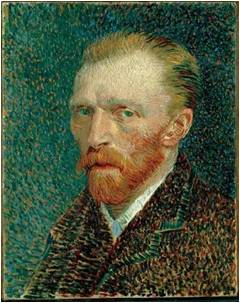
So let’s start. A lot of people think that creativity is about passion. When they think of creativity, they think of someone like this.
Look at him. Brushed velvet jacket. Beard. Rakish devil-may-care hair. And that gaze. Look at that gaze! It’s full of passion. It’s coming off him in waves. In fact, we all know his inner world is a vast tempestuous sea of passion that sends ideas crashing in great surges onto the rocky beaches of his soul. And those earthly forces cannot be contained. No, he must write them, write them, write them. That’s the face of a man who will channel fire onto the written page because if he didn’t, he would surely burn.
Or maybe not.
Maybe creativity is about being like this guy.
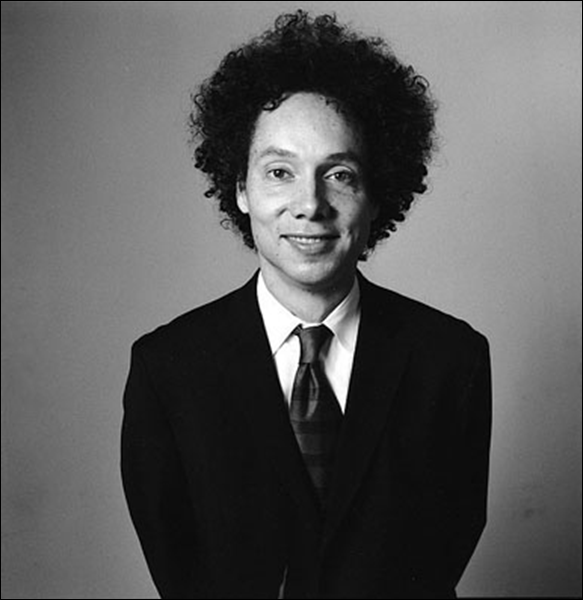
Hello, Malcolm Gladwell. Look at him. There are so many ideas in that great blaze of brains they trip over themselves trying to get out. There are so many they kinked his hair with their electric heat. Oh, fecund mind!
Or maybe not.
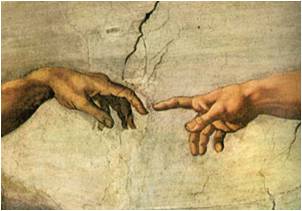
Maybe creativity is all a function of being blessed.
Or maybe it’s about alcohol (or some other chemical). After all, isn’t that how Ernest Hemmingway did it?
Booze Makes Ernie Reel Smart
Or it’s about being mentally unstable.
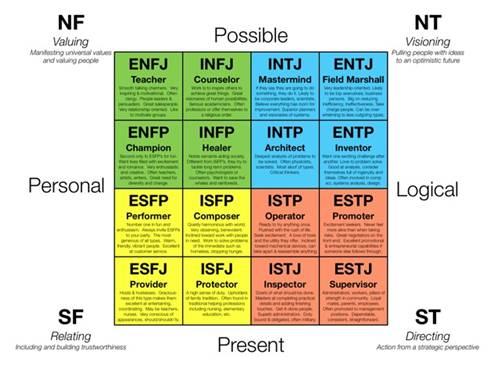
Or it’s about having the right personality type. I remember the day of woe when I learned that I was an ENFJ but that the “natural” writers were all ISFPs!
Alas, me being a blockhead was all scientific
Or it’s about being eccentric.
Patrick Rothfuss shows us the key is crazy beardage and an Alice in Wonderland chair
Or it’s none of that. It’s about being born to it.
I wrote my first novel when I was six
Right? All of those things are what creativity is about. And if, as so clearly demonstrated by those pictures, you don’t have passionate hair, well then, forget about it. Except here’s Larry Correia, a New York Times bestseller, who has no passionate hair whatsoever.
I keep guns in my basement
Huh?!
How could that be?
Here’s how. All those ideas above about creativity–they’re rubbish. Creativity has nothing to do with passion or hair or whether you wear Argyle socks.
Nothing.
Let me show you the face of creativity.
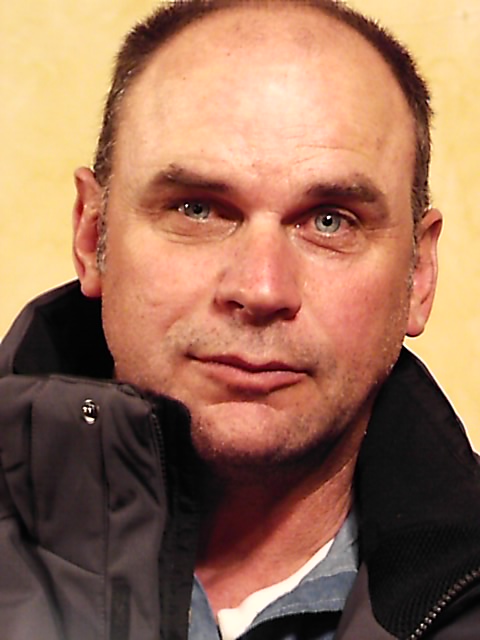
That is Warren Ellis. Warren is my brother-in-law, except when he’s not (do not ask me to explain this). One day our fridge started to drip. The freezer would cycle through its normal thawing, and all the water would drip down into the fridge and soak up our egg cartons and pool in the vegetable crispers. It was a mess.
We defrosted the freezer we weren’t supposed to ever have to defrost, but the problem persisted. So we called Warren because he fixes things.
Warren came to our house, looked the fridge over. He declared that the freezer’s drain tube was plugged. We thought up a few ideas for cleaning it out, none of which were any good, then Warren asked if we had an air compressor. We did and hauled it in.
Warren plugged it in, let it build up the pressure, and then held the compressor nozzle to the bottom end of the tube. The compressed air went in. The obstruction flew up and out and landed on the counter. The obstruction was a fat fly that had crawled in there, gotten stuck, and died.
We poured a quart of water into that freezer, and it all flowed down into the catch pan at the bottom. Warren fixed our freezer with an air compressor.
Folks, that is creativity.
What did Warren have? He didn’t have passionate hair; I can tell you that. No. He had an objective. He knew basically how fridges worked. And he came up with a couple of options to fix the issue.
Let’s look at another example. Here’s Ed Smylie.
Ed was like Warren. He ran into some problems. Actually, the astronauts in Apollo 13 ran into some problems. Ed was tasked to help solve them. One of those problems was the fact that the astronauts were running out of air.
Ed and the others designed the solution in two days. The ground crew relayed the instructions to the flight crew. The lunar module’s CO2 scrubbers started working again, saving the lives of the three astronauts on board. Of the experience, Ed said that he knew the problem was solvable when it was confirmed that duct tape was on the spacecraft. “I felt like we were home free”, he said. “One thing a Southern boy will never say is: I don’t think duct tape will fix it.”
Ed and his crew saved the day. The made a round peg fit into a square hole. How did he come up with such a creative solution?
Ed had an objective. He knew how the CO2 scrubbers and the shuttle worked. He knew about duct tape. He came up with options.
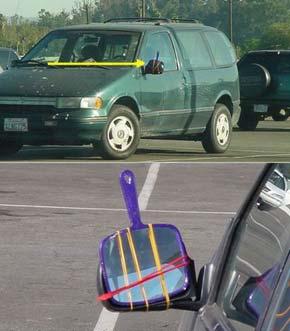
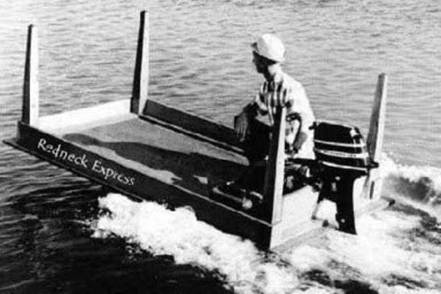
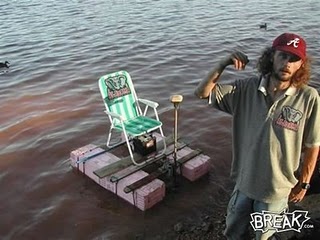
Let’s look at a few more examples of this. I know you’ve seen some of these.
That is creativity. So is this.
And this . . .
And this . . .
Or this, if you don’t need to go so fast . . .
Smaller size, for trolling
And this . . .
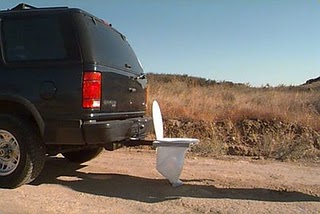
And this, which is officially called a Bumper Dumper . . .
Do you really want to dig?
These fine folks had a goal. They knew the basics of how things worked. They came up with some solutions.
That’s all there is to creativity. Three things. You need to have an idea of what you’re trying to do. You need to have a basic knowledge of how things work. And you have to know how to come up with some solutions to meet your objective.
Not so mystical, is it?
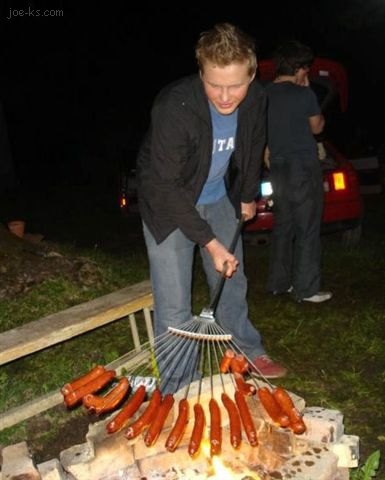
But I can hear some of you complaining. Writing is different. It’s a whole other world. It’s Fiction, which is so significant we must capitalize it. It’s passion. It IS mystical. This is a matter of the heart. It’s not a fridge or space ship or some dumb hotdog roast. You cannot compare these things.
Except I can because they’re the same. It doesn’t matter if you’re trying to invent a different recipe like the folks at Cook’s Illustrated, or decorate your house, or come up with a way to keep the squirrels out of your bird feeders, or make people weep in a movie theater.
What I’ve found is that when we have troubles coming up with ideas, we probably don’t know what our objectives are. Or we probably lack some understanding of how fiction works. Or we don’t know the principles of generating options.
And so we conclude it’s a mystery. It’s arcane lore.
But it just ain’t so. Can you create a redneck toilet? Then you can write a story.
Now, it’s true that a lot of people feel their way through this. They don’t know what they’re doing, but they do it. I did that. Remember: I won an award. But then I couldn’t repeat it. Couldn’t find that groove I’d stumbled into.
I don’t want to stumble around hoping to get lucky. I want to make a living at this. And if I’m going to make a living, I need to produce. Regularly. I can’t be bumbling around, hoping to create something by accident.
The good news is that we don’t have to create by accident. We can create on purpose. There are principles to invention. When we learn them, our productivity will shoot through the roof.
Finding a solution to Apollo 13’s issues might seem impossible to us. But they weren’t impossible to Ed Smylie because Ed had an objective; he knew how things worked up there; and knew how to come up with options.
My intent is that when you finish this series, you’ll know what Ed Smylie knew, except for stories.
I and five of my writer friends are driving over from Boise to attend. Two of us came over last year and were blown away, so I’ve been beating the drum since November.











I and five of my writer friends are driving over from Boise to attend. Two of us came over last year and were blown away, so I’ve been beating the drum since November.
Wohoo!