Why capture zing if you don’t use most of it?

I agree that the ability to develop and finish a story is more important, and rare, than coming up with or capturing random ideas, especially since “ideas” can be something as small as a two word sentence from your daughter or the colors on some weird bug that you found hiding out in a teacup in your cupboard. Finding one of those is like finding one brick for a 50,000 brick house. Big whoop.

I also agree that ideas captured in a journal or file of some sort is NOT the only way to start developing a story. Getting a prompt or story parameters, writing to specifications, is obviously a perfect spot to begin as well (e.g. get me a SF story no longer than 6,000 words by Dec 15th that includes a bug). It is, if you think about it, just another type of starter idea. Going from image to story parameters or from parameters to story images–I don’t think the order matters. They’re both aspects of the story that need to be eventually developed. And we all know that stories can start from seeds of all types–character, image, line, issue, setting, problem, technology, AND parameters. What makes a prompt for a real gig powerful is that it pushes you farther down the path from one brick to house. It does this because a huge part of getting a story written depends on making decisions, getting specific. And on getting the motivation to buckle down and finish the thing.

I’m also going to bet that for all writers MOST of the elements (dialog, plot, character, setting) of any story are generated during the pre-draft planning (including research) and drafting–during the actual writing. Not by continually ransacking idea files like some people do their closets, trying to find pants, shirts, and shoes that will make an outfit. Like most anything else, we generate things (ideas in this case) only when they’re needed.

It’s true we have to care about and believe in what we’re writing. But I don’t think how any story gets started is significant. Partially because no matter how big the initial idea, it’s still small compared to everything else that must be generated. But more importantly because I think just starting is the key, whether that’s motivated by shot of zing or a deadline or whatever. I say this because I’ve found that zing strikes me more when I’m on the move working.

So if the vast majority of captured ideas are never used, why observe and capture at all?

Here are my personal reasons.

1) Because when I fail to consume new sights, people, ideas, and experiences, I tend to keep using the same things over and over in stories–lines, descriptions, plot turns, etc. Doing this actually helps me see new possibilities and go beyond my current ken.

2) While I forget most of what goes into the file, I don’t forget everything. When I’m working, the context of the story often evokes memories of some of these things I’ve captured.

3) Because when I’m on the lookout, I tend to see more. And current idea captures are a great source for random juxtaposition for the current project. I’m writing a story, go on a walk, and see in the snow a raccoon splayed out spead eagle on the side of the road like it’s been sacrificed, its belly torn open, the cavity completely hollow, four thin, almost translucent, ribs rising to the sky. There is some blood, but not much, and where it has fallen the snow is Valentine pink. There’s nothing else around the animal but a multitude of bird tracks and a few dark strings of disconnected and frozen gut. Because this signals story idea to me, I stop and pause to get more details. I write them up, look a bit closer, sketch it. And the impossible to imagine random detail goes into the current story to work its magic.

4) Because being on the lookout just brings more zest to my life. The universe offers up a small wonder or dread to me, and if I’m trying to be alert, I’m more apt to see it, cherish it, if only for a moment, and go my way rejoicing.

Share

Similar Posts

  • On writing lesson 5 is up

    In lesson 5, I share insights on creativity that elude many who start down the path of writing. Not knowing them can cause a lot of frustration and convince writers to quit. Don’t be frustrated. You’re going to learn:

    • What creativity really is
    • How it actually works
    • What it requires
    • And two of the main tools that will help you practice it–hunting zing and creative Q&A

    Here it is: Lesson 5: How do you get and develop ideas?

    Enjoy!

    Share
  • Edward Bear Shares More Proofreading Secrets

    Mr. Edward Bear (pseudonym) shared an awesome secret for sussing out quote issues in a previous post. He’s back with a nifty way to help spot spelling issues.  It helped me spot a number of inconsistencies in Bad Penny, which I recently fixed. Take it away, Mr. Bear.

    * * * *

    Augmented Proofreading 2

    Last time, I mentioned checking spelling and spelling consistency, and this note is to fulfill my promise.

    To begin with, I’ll admit freely I do not recommend just running a spieling chucker over the text. And yes, I’m using the phrase deliberately. The spelling checker in the program I’m using to write this just waltzed right past it, despite the fact that neither word makes sense in this context. I got started trying to get some mileage out of spelling checkers a while back, when I realized that OCR scanners will work like hell trying to find a word and probably will come up with a word, but it will be the wrong word. Over at Project Gutenberg, they use the term “scanos” as an analogue of “typos.”

    The other adversary is consistency of spelling and usage. Examples might include “canceled” and “cancelled” or variant possessives, such as “Jones’” and “Jones’s” in the same text, or simply variant spellings of the same character’s name, such as “Erik” and “Eric.”

    So what do I do for these sorts of problems?

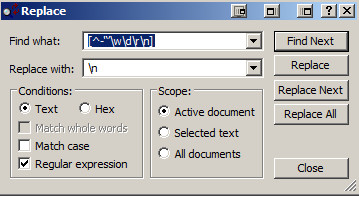
    What you need is a list of all the unique words in the story, and it’s easy with a dollop of regex. (See the first post on this topic. The one I’ve taken to using is the following:

    [^-‘‘’\w\d\r\n]

    This one I can explain, since I wrote it. 🙂

    What it says is to look for any individual characters within the brackets([]). The leading caret (^) says “Nope, they should not be in this list.” Following that are the hyphen(-), the straight  quote(‘), and the opening and closing curly single quotes(‘’). After that, it’s any character that would normally be in a word (\w), any digit (\d), any carriage return(\r) or any new line aka paragraph terminator (\n).

    And what you do with the above is to set Textpad (see previous post again) to replace all of them with a newline (\n) character.

    Here’s what the search and replace box in Textpad looks like for this:

    Augmented Proofreading image001


    Notice that the “Regular expression” box is checked. And then you choose “Replace All”.

    The result is to turn this:

    Once upon a night we’ll wake to the carnival of life
    The beauty of this ride ahead such an incredible high
    It’s hard to light a candle, easy to curse the dark instead
    This moment the dawn of humanity
    The last ride of the day

    into this:

    Once
    upon
    a
    night
    we’ll
    wake
    to
    the
    carnival
    of
    life
    The
    beauty
    of
    this
    ride
    ahead
    such
    an
    incredible
    high
    It’s
    hard
    to
    light
    a
    candle

    easy
    to
    curse
    the
    dark
    instead
    This
    moment
    the
    dawn
    of
    humanity
    The
    last
    ride
    of
    the
    day


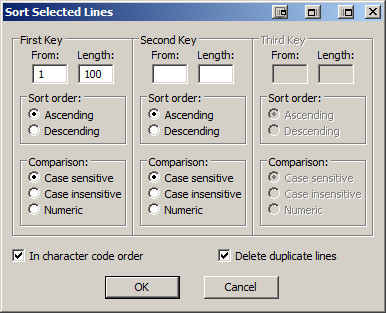
    For a book, this means what you have as a multi-thousand line long document and LOTS of repeated words. The next step is to lose the repetitions by sorting the list. For TextPad,  you’ll find Tools->Sort on the menu bar, and I generally set the sort up as the following:

    Augmented Proofreading image002

    This is a case-sensitive sort and “Delete duplicate lines”, of course, gets rid of all the duplications of words like “a”, “an”, and “the”.

    For the above text, you get:

    It’s
    Once
    The
    This
    a
    ahead
    an
    beauty
    candle
    carnival
    curse
    dark
    dawn
    day
    easy
    hard
    high
    humanity
    incredible
    instead
    last
    life
    light
    moment
    night
    of
    ride
    such
    the
    this
    to
    upon
    wake
    we’ll

    34 unique words.

    And here’s the payoff for all this funky text munging: Run a spelling checker over this, and it will find typos, of course, but it will also generally complain about most names, which aren’t generally kept in spelling checker dictionaries, and it will also show you words and their variants, nestled fairly closely together. Here’s an example from one of my projects:

    Swiss-born
    Take
    Talking
    Tallmadge
    Tallmadge’s
    Tarelton
    Tarleton
    Tarleton’s
    Tavern
    Tecumseh
    Tell
    Ten
    Thames

    The spelling checker landed on Tallmadge and its possessive form, but do you notice the “Tarelton” on the list? That’s the time for the Aha!, and you can fix the “Tarelton” form. The same thing applies to possessive variants and any other variant form you find.

    As with the last post, I’ll be peeking in on the comments and answering any questions that come up.

    Share
  • Wise reader instructions

    I value accurate reports from readers who are (a) in the audience for my books and (b) approach the book as honest readers, not critics, nigglers, axe grinders, toadies, or flatterers. I just want accuracy. In How to Write Science Fiction & Fantasy, Orson Card calls these types of folks “wise readers.” When I find one, I cheer because not every reader has time, ability, or interest. And their reports are usually very helpful.

    I know a lot of aspiring authors ask friends and family to read their work. And I know that many people can easily become wise readers with a little direction. So I thought I’d share with you what I ask of my wise readers. Maybe you’ll find it useful with yours. Here’s a revised version of a letter I just sent to one who has agreed to read draft 3 of CURSE. Every author’s a bit different in how they approach readers. Some just say, read it and tell me what you like and what you don’t. But I like to provide a bit more guidance. And I wanted to make sure this reader understood exactly what I was looking for. It might be a bit much for some, but I wanted to make sure it was clear since this was his first time reading a full book for me.

    Thanks so much for agreeing to read this draft! What I want at this point is to see how I’m managing the reader experience in 3 areas: (a) the characters, (b) each chapter and scene, and (c) with the book as a whole. So  I’m hoping you just read, and as you go along make quick marks or comments when you’re delighted or bumped. I’ve listed the types of delights and bumps I’m talking about below. Please know I’m not providing them for you to use as a checklist, i.e. it’s not my intent to have you actively search for these things like a Where’s Waldo. You may feel some of these things. You may not. I just want you to be aware of them in the back of your mind as you read and to note when you experience them. In the end, I simply want an accurate report of YOUR experience. Accuracy is key to me.

    I find with my own reading that it’s often hard to respond to the story as a regular reader if I’m always stopping to write lots of detailed comments. It seems to knock me out of the reader’s trance. So don’t feel like you must stop at the end of each chapter to assess your experience or be exhaustive in detailing your every reaction. Just make your quick marks and comments as you go, then review and write up your report when you’re done. If you feel the book’s too big to do it all at the end and actually remember what your marks and comments meant, then break it up into chunks of 100 pages or every few chapters. Whatever works for you. 

    Sometimes, despite our best wishes, we are just not in the audience for a specific book. If the book just isn’t working for you, do not read past the point where you would normally put it down. Pushing yourself beyond that point will only drive you nuts, and it won’t provide me with anything useful. So just stop there, be happy, and write your report. Remember: the most useful thing to me is accuracy. 

    As for the report, give me a summary of your general and specific reactions. For comments on specific parts or lines, it’s critical for me to know page numbers so I can go back and see exactly which part you’re talking about. Write your explanations on the specific page of the manuscript. They don’t need to be long. For example, if a page introduces too many names and you couldn’t keep track of the people and started to get confused, you might underline all their names and write “huh? too many names, can’t keep track.” If a character does something that makes you cheer, you could circle the paragraph and write “yes! yes! yes! Go Talen.” Just so that it’s clear to me what your reaction is and what your reacting to.  

    Please know whatever your reactions are, they are just as valid as anyone else’s. It’s my job to review all the reports and decide what they mean and whether they indicate I need to make any changes. Whatever I decide, know that it means a lot to me that you took the time to read and report with accuracy. 

    So, any of the following types of things count as bumps and delights. You might have others you experience as you read. Feel free to mark and comment for them as well.

    DELIGHTS
    I want to know what IS working with the characters, scenes, chapters, and plot as a whole. So any parts–story, people, or things–that elicit a strong reaction of the type you see below.

    Characters

    • You really like or enjoy them
    • Intrigued or fascinated by them, want to know more
    • Great lines
    • Envy them or think, oh man, that would be so cool to be able to do that or be there or have that skill/ability
    • Sympathize with, root for
    • Dislike, hate, root against

    Story

    • Suspense, anxiety, stress, dilemma
    • Curiosity
    • Mystery
    • Surprise
    • Cool!
    • Wonder or awe
    • Insight, poignancy
    • Sadness
    • Triumph, stand up and cheer moments
    • Laffs or grins
    • Dread, horror
    • Great action, stunts, adventure
    • Romance
    • Compelling “Dude!” chapter or scene beginnings, ends, and story turns

    Text

    • Vivid descriptions
    • Poetic beauty in the prose

    Overall

    • Did the story build well for you, bang bang in the climax, and then leave you wanting to linger and enjoy the rolling credits? Did it leave you feeling “wow” or “that was great?” If it didn’t quite make it, then give me an indication of how much on a scale of 1 – 10
    • What were the most interesting parts of the story for you?
    • Did you feel resolution and a strong tug to read more, come back to the world?

    BUMPS

    “Huh?”

    • It’s not clear what’s going on, who’s doing it, or why.
    • You really don’t understand something and you think you’re supposed to.
    • Too many terms, names, etc. and you’re getting lost or feel like you need a diagram.
    • The text itself doesn’t make sense, or it clunks badly.
    • The book contradicts itself.

    “Come on!”

    • Something just doesn’t ring true.
    • It’s just not how things work, e.g. John, there was no FBI in 1638 in China.
    • The character’s actions don’t feel logical given the situation, e.g. um, why would she do that? I’d just X and, boom, it would be over. She was stupid.
    • You just don’t buy some plot turn. It doesn’t make sense. Was too easy. Seems to ignore all sorts of things in the story.
    • A character is irritating or annoying you.

    “Yawn” or “What, that’s it?!”

    • Things are starting to get boring.
    • You start to skim the blah blah blah to get to the good stuff.
    • You were built up to expect something and instead got a fizzle. This could be some mystery, a character, an insight, conflict, the ending, etc.

    Please note that this list might change depending on the type of story I write. And the reader. For example, if I wanted a content or technical expert to report, then I’d be asking him or her:

    • Anything not ring true
    • Anything too cool or intriguing that I’ve left out.

    If the book was focused more on a romance, then I’d probably provide a slightly different list of delights. Horror would require yet a different version. Not too different. But the emphasis would probably be elsewhere. The key is in me knowing the type of experience (entertainment & drama) I’m trying to provide, what I’m trying to test, and giving the wise reader enough examples that they know what I mean by “delights” and “bumps.”

    EDIT: 11/27/12

    And here are the Beta Reader Instructions I gave to the latest batch of noble souls who offered to beta read BAD PENNY.

    Let me explain what I need you to do as a beta reader. This is basically a test screening. All I’m looking for is to have you give the novel a test ride, and then report back your experience. I’m not talking about giving feedback on small stuff like grammar and spelling. I’m talking about reporting your experience with the big story things like characters and plot.

    For plot, you simply report chapter by chapter if you were still interested and wanted to keep reading or if the story started to become a bit long (yawn). Were there any parts that stood out to you as particularly interesting, funny, heart-pounding, or suspenseful? Any that stood out as a bit dull or didn’t ring true?  Was the ending satisfying?  Did the beginning grab your interest? Anything you were uncomfortable with? There’s no wrong answer. It’s just a report of your experience. And an ACCURATE report is what I’m after.

    For characters, you report what you felt towards the main characters and any bit characters that stood out to you. Who was funny?  Who was likeable?  Who were you rooting for?  Who did you hate or fear or mistrust?  Were there any characters who are just so dumb or annoying you wanted to smack them? Where there any character moments that didn’t ring true or stood out to you as particularly entertaining? 

    Please remember: I want you to read only what you have time for AND interest in reading. If that’s one chapter, bully. Five, excellent. The whole thing, awesome. If you get a few chapters in and find it’s just not your type of story, that’s not a problem. Don’t read another word. Knowing that is helpful information as well. YOU determine the length of your test ride. I value whatever input you have to give. 

    I’m hoping to get all responses back by November 1. So send whatever you have by then.  Also because I will be shopping this to publishers, I must ask that you not copy, share, or distribute the manuscript in any way without my written permission.

    If I was looking for expert fact checking from one of the individuals, as opposed to a general story report, I’d add somethhing like this on the front.

    Let me explain what I need you to do. This is basically a test screening. All I’m looking for is to have you give the novel a test ride, and then tell me where it doesn’t ring true with your experience with [enter expertise] or where I’ve missed a detail that might be cool. Chapters 9-10 and probably 22-24 are the ones where your expertise with [enter expertise] would come in.

    If you think you’d like to provide input as a reader on the story as well, I would welcome that. I’m not talking about giving feedback on small stuff like grammar and spelling. I’m talking about reporting your experience with big story things like characters and plot . . .

    I’m hugely grateful to my beta readers. Some are shy about giving their report. Some aren’t. Either way I usually ask some clarification questions and then save all the gold they just gave me to use in my final draft.

    Share
  • |

    Why you can’t popularize literary fiction

    T.C. Boyle is one of my favorite writers. He saved me in my undergraduate program. I was buying the The Best American Short Story, Pushcart, and O’Henry anthologies. I was reading for my coursework. And so much of it bored me to death. And then one day I began reading “The Ape Lady in Retirement” and my eyes hung out because finally the text was interesting. Finally someone wrote a story I could read start to finish.

    I immediately bought his anthologies–Greasy Lake, If The River Was Whiskey, Descent of Man. I was in heaven. Now, not all of his stories worked magic on me. But when I was having a hard time finding one story in a whole anthology, his books seemed like a treasure trove.

    He didn’t do as well in his novels. Oh, the writing was just as good. The characters and descriptions just as odd and stunning. But he didn’t keep my interest. The problems never built into anything. Nevertheless, I loved him.

    I’ve been having a brief conversation with him and the fan boy in me is delighted to finally talk to this guy. And after reading an interview with him, I realize why he probably spoke to me. While the other literary fiction authors were following the tastes of the fringe group, Boyle at least wanted to entertain.

    In his interview he says.

     Everybody has forgotten that literature, like all art, is, at root, entertainment. It is supposed to entertain you. It’s not supposed to be some conundrum to be resolved by some professors in the university. It’s not a game. It’s not masturbation. It’s art. And I think great art is great on all levels. But the first level on which it must be great is that it must be entertaining.

    Amen, brother Boyle. Amen!

    I’m in a top-20 MFA program in the West.  And I think it’s odd that many in these MFA writing programs, mine included, totally miss the boat on what readers want and bemoan it when nobody comes to buy their stuff. They don’t get it’s about entertainment. About being moved. About much, much more than the language.

    Here the full Boyle AWP interview.

    However, I still think he misses the mark. In it he says about bestsellers:

    But it’s mainly vampire books and Tom Clancy and all the rest of it. I don’t understand why we can’t make our books more available to everybody-not by compromising what we do, but by popularizing them, getting them out to the public.
    He also says about editors and MFA programs:
    I think that now we don’t have great editors. We have editors who are basically trying to hold on to their jobs and who publish good books once in a while. They’re basically cheerleaders for the books. They’re not editors, really. They’re incapable of being editors; they don’t need to be. Because editing is done-self-editing is done-through the apprenticeship in the writing programs. Nearly everyone from my generation on to your generation and beyond will have been through an MFA program. It’s just the way it is now. It’s a different world. It’s essential.

    I’d like to suggest that Boyle, despite his love of entertainment, still misses the mark in his interview because you cannot popularize something that only appeals to a small market. The reason why Stephenie Meyer, Patterson, et al sell exponential circles around folks like Don DeLillo or Louise Erdrich is because Meyer and gang are very good at delivering what the largest portions of the reading public want. They deliver types of entertainment that DeLillo and Erdrich do not. (And I mean “entertainment” in a very broad sense.)

    We could point at the Oprah effect (whether you like it or not, Mr. Cold Mountain) and say that’s not true. It’s all PR and marketing. But that assumes publisers are idiots. And while some of them may be, I think it’s an extreme assumption. Publishers are in it for the love AND money. And you can be sure that the board of directors is looking for smart, money people to lead the companies. You don’t make money, you’re fired.

    Which means that IF the publishers found literary fiction sold like hotcakes they’d promote it like hotcakes. But literary fiction too often fails to entertain anybody but a handful of fringe readers. And so trying to popularize it can only have a limited effect. When people are thirsty, not many are going to pass up tall glasses of ice water for the pickled jalapenos at the end of the line.

    Meyer, Clancy, Grisham, Roberts etc are masters of entertainment. And, like it or not, that’s the main reason the small portion of the public who actually read go to fiction.

    I think it’s fine to cater to the fringe audience if that’s your pleasure. But I think it’s ridiculous to think such fare is better than what most people enjoy. Or that it deserves any special veneration. The MFA programs I’m familiar with seem, by and large, to miss the point. Instead of teaching the meat of fiction (entertainment) they focus on teaching students to serve up the parsley with great pomp. And when the customers go elsewhere to get the meat they crave (or the salad for you vegans), they respond by saying the customers are simply too dumb to get it or have no taste.

    Now, I’m not saying the folks I work with in the MFA program are idiots. Or jerks. Almost everyone I’ve met has been extremely nice and smart. They have great insights. But there is a strong pressure in that culture, amost a moral pressure, to think about fiction this way. And it’s based on their tastes.

    I think we all do this. 90% of what’s out there is crap. But it isn’t, really. The truth is that 90% of what’s out there simply doesn’t appeal to us. And so because it doesn’t deliver the goods, it’s crap to us. The problem is when we don’t realize the difference and begin to think that because we don’t have the taste for something that it’s garbage.

    It’s not.

    And that’s one thing the gentle and smart people in my program have shown me. I’m just as liable to make this mistake as anyone.

    So what MFA programs need to do is teach fiction. The meat. As well as the parsley. They need to teach all the genres, not just one. Alas, for the meat you have to go to communications departments to even talk about it. And then hope you find someone like Dolf Zillman, Bryant Jennings, Jenefer Robinson, or Peter Vorderer.

    Which leads me to the next point. Boyle is wrong about editors and writers. The majority of the authors that actually sell never set foot in an MFA program. MFA’s teach students to write for a small fringe market. And so they’ll dominate that fringe market, but not the big markets. Not what most people actually read.

    Since I haven’t worked with any editors in that so-called golden age of editing, I cannot comment on the difference. But I do know that the editors I and other authors have worked with do many edits on the projects they oversee. They are thorough. They want it to be the best story it can be. It’s true they won’t take something that’s a complete mess and work on it. But why should they? There are so many better manuscripts out there it only makes sense.

    Anyway, I love Boyle. Probably becasue he loves plot and story as much as language. His shorts saved me in my undergrad program. They were one of the few interesting things I read. I just am dismayed that these writing programs are so far off in the weeds.

    Share
  • LDStorymakers Presentation

    I’m at LDStorymakers this weekend. Had a wonderful time yesterday facilitating idea generation for the magic systems of eight writers who all had some really cool stuff.  Today I will be giving my presentation on banishing writer’s doubt, fear, and block using cognitive therapy.

    For those who want the slides, here they are.

    Banish writers fear doubt and block with cognitive therapy (PDF)

    Enjoy!

    Share