What Comes Next?

At the UAA conference in Springville, Utah this Saturday, I’m going to be sharing two tools I use that help me figure out where to start my stories and what comes next.

The first is simply a quick and dirty method for figuring out a ballpark estimate of how long my story will be. But the length is not stated in words or pages for the simple reason that stories aren’t made up of words or pages.

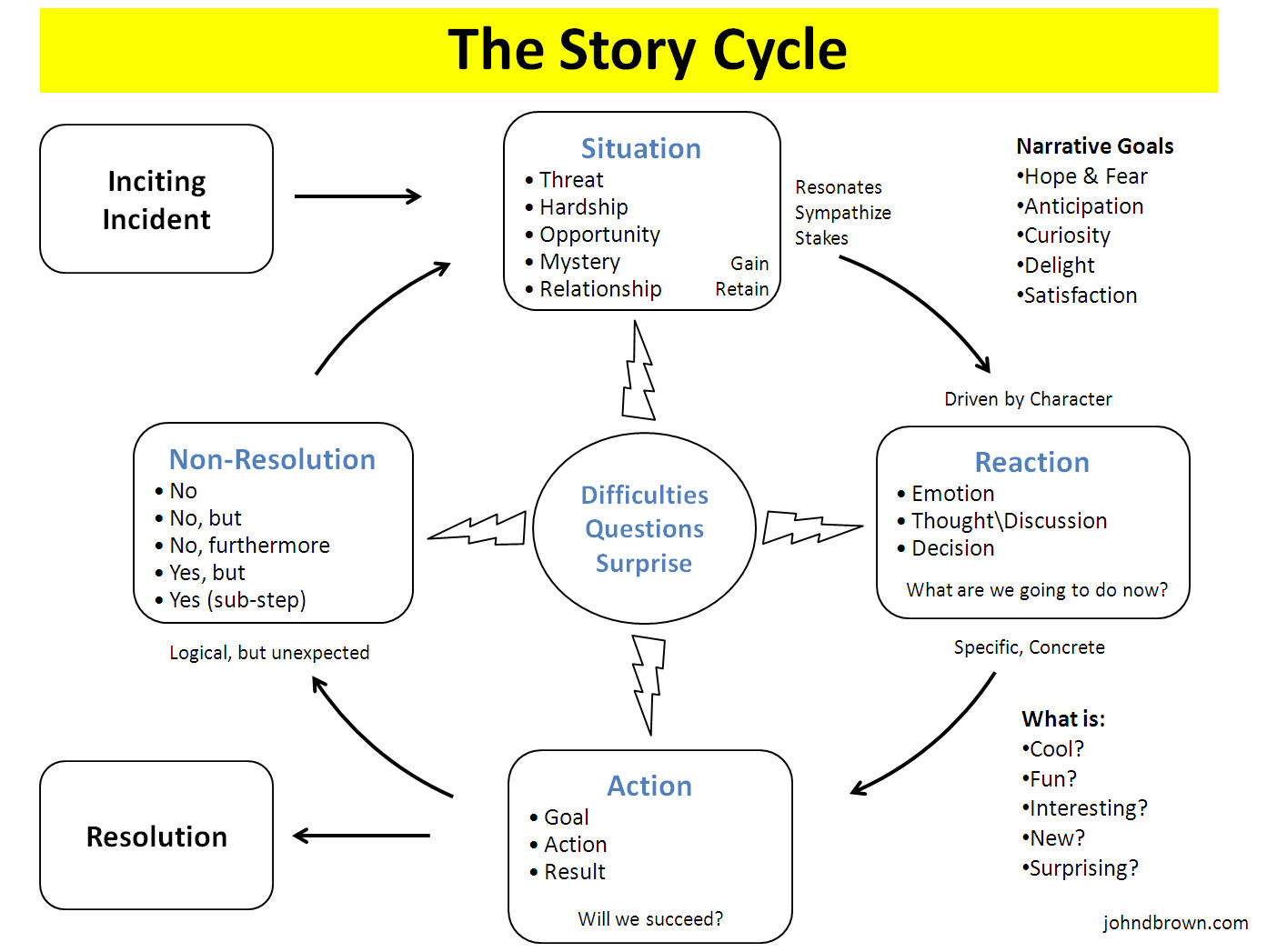
The second is what I call The Story Cycle.

WhatComesNextbyJohnDBrown

Everyone always wants a copy of the presentation. So here’s the PDF of “What Comes Next?”: WhatComesNextbyJohnDBrown_Print

Enjoy!

Share

Similar Posts

  • How do you know when to start drafting?

    This week’s Writing Excuses was an interesting topic. I’ve had similar questions from folks as I give my workshop on writing fiction. Here are some additions to the excellent comments made by our fearless Three.

    Can you plan for a single draft?

    In my experience and those of other published writers I know, wanting to start to draft only when you’re ready to begin writing THE draft that will take you clear to the end is only going to land you into a bog of dither.

    Here’s why. It’s almost impossible to know if this attempt at the hill is going to work until you make the attempt at the hill. Much of the story creation, even for those who do a lot of the creation in summary/outline form first, still takes place in the drafting. And you never know if something you create while drafting is going to throw a monkey wrench into the whole thing.

    Nobody I know who does a lot of development in the outline/summary form (and I’m one of those) has ever written a satisfactory novel without having to continually modify the original outline or abandon it altogether. David Farland tells a story of getting to the ending of one novel, the ENDING, and only then seeing a new ending that was going to be so much better than the one he planned. Which meant he needed a different beginning. Which meant a rewrite. And so he started the whole freaking story over.

    Writing is like blazing a trail

    Writing a novel is like seeing a far off destination that you’ve never been to before and to which there are no roads. You’ve got to make a trail to that destination. So when you set out you may be able to see a path for a mile or so, you may even have tried to get an overview of the terrain, but you must reconcile yourself to the fact that you are going to run into an impassable bog, or a cliff, or killer bees–you’re going to have dead-ends and backtracks.

    No matter what you do, it’s gonna happen. It’s just part of the nature of blazing trails. Even if you scout out possible routes, some of those routes are just not going to work when the wagon train finally gets there.

    This isn’t to say we must all become draft-only writers. There is HUGE value to some of us in having a starting line-up or knowing the ending or having the bare bones of the plot or having done a good deal of world building. For myself, I’ve learned I never get very far down any path if I don’t have a number of strong ideas for all the parts of story–character, setting, problem, and plot. But I only learned that by setting off time and time again and each time immediately having to stop. And new writers will never learn what they need, as was said, until they just start.

    So if the reality is that every author is going to have hiccups and course changes along the way, then it’s far more important and useful and efficient, not to wait for the perfect moment to draft, and draft the story only once, but to just start drafting.

    But how much pre-draft work is too much?

    Okay, for those of you who want a specific number, let me help you. A new writer recently posted a question wondering if she migh have world-builders disease. Here was my response.

    —

    Ms. X, one way to approach your diagnosis is to determine how many books per year you want to write. Because world-builders disease is only a malady in certain circumstances.

    If you don’t care about output and simply enjoy building worlds, then maybe you’re like Tolkien. He started The Book of Lost Tales in 1917 and didn’t finish THE HOBBIT until 1937 (20 years). He didn’t finish LOTR until 1949 (another 12 years). In this is your situation, then you are hale and hearty and have many years of enjoyment ahead of you.

    If you DO care about output and want to write one book per year, then I’d suggest you get some drafting treatment immediately. Here’s why: you now have only 26 weeks to finish.

    But wait: take out 4 weeks for vacation, sickness, relatives, and mosquito infestations. You now have 22 weeks.

    Assume you get 2 good hours of writing 6 days a week for 12 hours a week. Assume further that you can get a conservative 500 words of finished product per hour, or 1,000 words in 2 hours. (Sure you may be able to write faster than that in any given session, but when you go back and fiddle with it the next day and the next, you have to accout for that.)

    At this rate it will take you 17 weeks to finish a 100,000 word novel. And that’s only if you keep your story furnace hot with consistent hours each day.

    But wait: that’s only a FIRST draft. You now need to let it sit a bit. Reread it. Send it out to readers. Then REVISE. You only have 5 weeks to do that!

    Of course, your inputs to the equation might differ. But if your goal is a book a year, you need to get cracking. Most of your development will come as you write. It’s exciting and lovely. Don’t miss it. Get your starting line up written out in the next three days and then take the plunge.

    Share
  • |

    Watch The Secret to Making Plotting Easier Now

    For those that struggle with plotting your novels, you can now watch The Secret to Making Plotting Easier.

    It’s a recording of the hour-long lecture of goodness I delivered to an audience of over 140 writers at Life, The Universe and Everything last week.

    I’m happy to report that when it was over, a number of those in audience gushed quite profusely about how helpful it was.

    Enjoy!

    Share
  • “Vivid and Clear” video, bootleg style

    Michael Barker generously offered his time to mash up the audio and PowerPoint for my LTUE presentation “Vivid and Clear.” He didn’t have tons of tools so ended up playing the audio on his computer, clicking through the presentation as it played, and recording the event with his iPad as a movie. So the result isn’t Hollywood. But it’s not bad for a bootleg (grin).

    You can find it in seven-part Vivid and Clear (almost…) series on YouTube. Enjoy! And here’s the Vivid and Clear v2.

    He’s now working on Story Turns. Stay tuned for more.

    BTW, a big thanks goes to Aaron Allred who recorded the audio.

    Share
  • Plot Basics

    In the comments to this week’s writing excuses on the 3 act structure, a writer asked if the try/fail cycle would really work with her chase story because her folks do not “fail to solve the problem” every time so much as “escape by the skin of their teeth”.

    I thought this was a great question because we ARE often led to believe that the characters need to fail in each attempt. But if we look at a number of stories we’ll see that this isn’t the case. The hero is NOT always failing in his scene or sequence goal. In fact, much of the time he succeeds. So how does plot really work? Here’s my post.

    [edited for clarity]

    Jen, fwiw:

    A few things finally opened up acts and plot to me. Maybe they’ll be helpful to you. I say this because a chase would work the same as anything else. I’ll just start at the beginning, although I’m sure you know a lot of this.

    1) Story is about someone solving a problem. The problem is one of happiness (danger or lack on some level–physical, social, freedom, etc.) or mystery.

    2) The reason why we tell stories about problems is because the solving of problems, if done a certain way, evokes suspense, surprise, and curiosity in the reader, and then a release of emotional tension. Why we humans like that ride, I don’t know. But we must keep this in mind when dealing with #1 because these effects are the main effects the bulk of people go to story for.

    3) Plot is simply the actions the characters take, the results of their action, and what they decide to do next. Except this can’t be any old action and result. It has to be action and result that builds the anxiety of suspense, surprise, and the mystery or puzzle.

    4) There are four possible answers to the question of “did the hero’s action solve the problem?”: yes, no, yes but, no furthermore.

    For example. Yes, you killed the monster. No, you didn’t. Yes, you killed the monster, but it bit you and now you have the virus that’s going to turn YOU into a monster. No, you didn’t kill the monster furthermore you woke up its mumma.

    Of those four possiblities, only the last two build suspense and curiosity. The first removes it totally. So it’s out. And a no answer leaves suspense unchanged. All you’re doing is delaying things with that. What you want to do is ratchet it up.

    So if you want to build suspense then when a character takes an action, that action has to make things worse. They may escape by the skin of their teeth, but now the federal police know where they are (yes-but). Or not only did they not escape the police, but now the mafia, the real bad guys, know where they are (no-furthermore). These escalations and complications to the plot/problem continue until the hero’s plan is in total shambles and it appears he really is done for. That’s when they get one last shot at it.

    If someone is trying to escape you don’t need a different plot structure. Their actions simply need to make it harder and harder and harder. Their plan needs to start to come apart. Things go wrong. Things they didn’t plan for make it worse. Someone double-crosses them or goes AWOL. We need to see them walking into dangers they didn’t plan for. If you go back and look at Prison Break season 1, you’ll see this all over the place in the last two episodes.

    5) Acts are just a nifty way of breaking up the problem solving process into parts. In act 1 (the beginning), as stated, you introduce the problem and show that the character won’t or can’t walk away. Often a big reversal or reveal (a big yes-but or no-furthermore) marks the end of that act. But the key thing is that the hero MUST act. The stakes or too high or they simply can’t get away.

    Now in act 2 (the middle) the hero says, aha, this is the real problem. Let’s try to solve it. Act 2 is a breeze to write IF you think about escalations and complications and nasty surprises–yes-buts and no-furthermores. He takes an intelligent action. BAM. It gets worse. And as these complications pile up we see that the hero comes to a point where his plans are in a shambles and the problem looks almost certain to squash him for good. In Star Wars, sure they saved the princess, but they led the empire to the secret base and the death star is going to blow them away (a grand yes-but).

    In the last act, the hero straps on his guns and trys one more thing. Sometimes it helps to think of acts 1 and 2 as the hero reacting and act 3 as the hero finally getting the inititative, although it appears to be almost too late, and strapping on his guns. In Star Wars they do this. They’re running, running, running, and then they attack the death star. But the odds are slim. And they only have one little chance.

    Remember: the odds are slim at this point and things get worse not because this is how problems are solved. Many get solved on the first try in real life. But because solving a problem in this way produces maximum suspense, surprise, and curiosity–the chief effects readers go to stories for. Any time you see a new plot structure or theory, you need to ask yourself what effect it has on the reader. If you can’t see any, junk it.

    So you might have three acts, four, five, seven (all variations I’ve seen). It doesn’t matter. An act usually ends with a huge change in the nature of the problem. See Robert McKee’s STORY. But the number of acts isn’t the issue. It’s the effect on the reader. The acts are just means to an end. If we don’t keep the end in mind we’re likely to misuse the techniques. 

    6) The key for moving through the acts is to ask myself about actions, obstacles, and results. Here are some questions I’ve found productive.

    Action. What are some intelligent actions the hero might take in this situation? What would I do? What are some logical steps that the reader might not think of?

    Obstacles. What happens? What are some compelling obstacles the hero will face in this attempt? Are there points of conflict with himself, someone else on his side, the antagonist or his henchmen, someone in the background, with the setting? What does the antagonist do to foil the hero? What is a logical but maybe an unexpected and surprising obstacle to both the reader and hero? How does the hero’s plan begin to come apart?

    Results. What happens? What are some possible results that pose a yes-but or no-furthermore? What would be unexpected, surprising to both the hero and the reader? How does the character’s action make it worse? How does the result reveal the problem is much worse than the hero and reader first thought?  I’m thinking of complications and escalations–things that make the problem harder to solve or more important because more’s at stake.

    In all of these, I choose the options that gives me the most zing and run with them. If they peter out, I try another (take 2, take 3, take 4), until I have one that works. Then I repeat it all over again and again until the hero is looking the gun in the face.

    7) The “hero’s journey” is nothing more than a bunch of mystical names for common elements in this specific type of problem solving structure. Why does the hero have to leave home? Not because of some mystical archetype mumbo jumbo. No, because this forces them out into unfamiliar territory–adventure, risk. Things go wrong. The hero has to face the problem.

    Why does the hero go to “the cave”? Again, not because of some mystical archetype mumbo jumbo. No, because turning and facing the monster, going onto ITS turf, poses the MOST RISK and hence most danger and hence most suspense for the reader.

    Always keep the purpose of the story in mind. Suspense and curiosity DRIVE the structure of most stories. Yes, there are other effects we go to story for. But the reason stories are structured the way they are is because of those two reader effects. And all the rest of those Joseph Campbell terms are useless to writers unless they make the connection and see how they play into suspense and curiosity.

    And even then I’ve found it’s wrong-headed to bind yourself to to a form just because. Or to think you need to slavishly follow it. The decision has to feel right for the story. It has to build anxiety and curiosity. And whatever does that well is right, regardless of whether it follows some formula. Although, I will say that certain story structures are used again and again because they deliver the goods to the reader better than other structures. Like biological evolution, they survive because of natural selection by readers.

    So that ended up longer than I intended. Hopefully the ideas were as helpful to you as they were to me.

    This writer’s question arises because of the common way of explaining the try/fail cycle sets us up to think there is only a no or no-furthermore option to each attempt by the hero. However, if we just look at a handful of stories, we’ll see the yes-but option is used all the time. What we want to avoid is the yes option, because that just stops the story. It stops the story because story is about solving a problem. And once the problem is solved, the story is over.  

    Other writers talk of formulas, however “pattern” has always been a more helpful way of looking at it than “formula.” I know, that’s semantic quibbling. But “formula” suggests to me THE way while “pattern” suggests to me something not so strict, something with some give to it and perhaps a great number of variations. Either way, pattern or formula, I found that unless I can understand the why of a part of the pattern, the effect it has on the reader’s experience, it’s not much use to me. It all comes down to plunging our hero into trouble or mystery, and then making the trouble or mystery worse SO THAT the reader feels increasing anxiety, curiosity, and surprise.

    BTW, here’s a good explanation of the 3 act structure with some tips from Stephen J. Cannell, an old pro. I really like his tips on act 2 issues and complications. Because if we make the antagonist an active force, he or she will provide many wonderful yes-but and no-furthermore options.

    You’ll find other excellent explanations of plot in TECHNIQUES OF THE SELLING WRITER by Dwight V. Swain, HOW TO WRITE BEST SELLING FICTION by Dean Koontz, and THE SECRETS OF ACTION SCREENWRITING by William C. Martell.
    Share
  • 2015 LTUE presentation materials

    I promised the audiences that I would post the PowerPoints and handouts to the website. Well, here they are. For those wondering, we do not have any recordings of the events.

    How to Build an Action Plot

    How to build an action plot

    How to Build an Action Plot Handout

    How to Build A Romance Subplot

    How to build a romance plot

    How to Build a Romance Plot Handout

    How to build a romance plot lecture notes

    The Power of the Story Setup

    Using Story Setup

    Share
  • Generating Story 10: Creative Q&A with Orson Card

    Back when Orson Card first started his online magazine Intergalactic Medicine Show, he wrote an essay in which he detailed how he developed the idea for one of the short stories he told in his Ender universe. Card’s essay is a valuable resource because he exposes his mental thought process, modeling how he approaches story development.  It’s not often that an expert takes the time to expose his mental thought process while working through something, and there’s always a lot to learn when they do.  Interestingly enough, it illustrates a number of the principles in the Story Development Framework.

    Please read How One Story Can Give Birth to Another by Orson Scott Card.

    While you are reading it, watch for:

    1. How often he uses questions as he develops the story.
    2. How story objectives influenced what he wrote.  For example, why didn’t he write from Peter’s point of view, and how did he want to portray the mother?
    3. How story principles guided his development.  For example, what were the three ways to get an audience’s interest and how did that affect the story development?
    4. What he did when his zing suggested he go another way.  Did he end up writing the story he set out to at first? (Card listens to his Spidey-sense, what he cares about and believes in, quite a bit.)
    5. What his first draft provided him.  What does this say about using drafts to help you develop the story? 
    6. How he used the four-scene “plan” he sketched of the story.  How did that outline help him?  When he had that, was he finished developing the story?
    7. How he uses improvising to continue the development as he drafts.  What did he need in order to improvise? And what was he actually doing?

    Did you notice the elements of the story–problem, character, plot, and setting?  Did you notice how his development continued while working on the text (drafting)?

    One thing I don’t think you should take away from this is that you must write exactly like Orson Card.  That you must not include much setting.  Or that your sketches of the plot, the “plan” of the story, needs to be just like his.  You may enjoy more setting than Card.  You may want more or less in your sketch.  That’s fine.  The goal here isn’t to suggest you follow his exact procedure and have his exact same objectives.  It’s to see how authors use creative Q&A to develop a story, to make it come to life.

    As a final side note, I would like to quibble with one thing Card says.  A lot of folks talk about showing and telling in writing.  The eleventh commandment is to “Show, don’t tell.”  But I would like to suggest that writers actually never show anything.  They can’t.  It’s all tell, tell, tell. 

    Showing requires the original sensory input.  So a movie can show.  A stage play can show.  Both can also provide raw auditory input.  But all an author can show are marks on a page.  Those marks guide a reader into imagining events, people, and things, but it’s telling–“imagine this, imagine that, now imagine this.”  The author can tell in scene or summary.  Both have their place.  But it’s important to realize that we’re helping the reader imagine.  I don’t have time to go into the implications of this right now, but try the idea on for a while and ask yourself what type of writing helps you imagine things more vividly.

    For more in this series, see How to Get and Develop Story Ideas

    Share

5 Comments

  1. Hi John
    Just wanted to say how much I enjoyed your presentation at the UAA conference. It was extremely useful. I took notes and have downloaded the PDF. Thanks for making it available.

    Cheers!
    Karen

  2. You bet. Good luck, Karen. I had a wonderful time. Please feel free to post any questions you might have.

  3. John, did there happen to be a recording? I was present for your “How to write a story that rocks” presentation years ago, and found it invaluable. I’m sure this was fantastic, too. I’d love to watch it if possible.

    Justin

  4. Glad to hear you enjoyed that. Alas, there is no recording of this presentation. Are you going to be at LTUE this year? If so, I’m sure if you and others want me to give it, we can find some corner somewhere and I can deliver.

  5. I was considering it, for sure. Just have to firm up plans with the spouse. That’s very kind of you, John. (LTUE should just let you present it… )

    Cheers,
    Justin

Comments are closed.