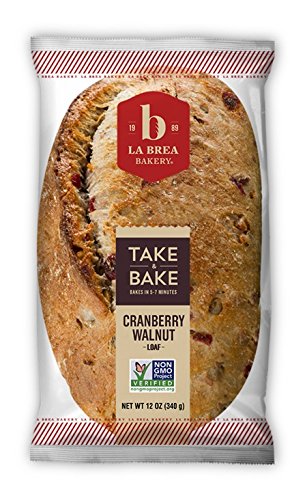
I have cut my consumption of bread to almost nothing. And so when I want a slice, I’m not going to waste it on run-of-the-mill sandwich bread. I want something delicious. And the best bread we’ve found is the La Brea Bakery bread that’s sold at Smith’s and other Kroger food stores.
Our favorites are the cranberry walnut loaf, the toasted sunflower honey loaf, and the pecan raisin loaf. These breads are made the old-fashioned way with a substantial crumb and a crackly, chewy crust that’s a joy to eat. And unlike the bread from a chain bread company that will remain unnamed, these loaves are actually fully cooked.
We just got two loaves today on our trip to Logan. We came
back home, cut a few slices, popped them in the toaster, buttered, and ate with
some chicken noodle soup. Pure bread heaven.
#
With that bread you might want some bratwurst. Not grocery store brats. Real brats. If so, I found the spot to get them (thank you, Larry Correia). There’s a gem of a butcher’s shop in Morgan, Utah called Bingham’s Custom Meats. It’s clean, well-lit, and nice-smelling. The people there are friendly. And they have over thirty different flavors of brats.
Bratwurst, by the way, comes from German. It’s made up of
two words. “Brat,” which means finely chopped meat, and “wurst,” which means
sausage. At Bingham’s they don’t add nitrates or any other preservatives. Their
recipes are pork mixed with various sets of spices.
So far I’ve tried nine of their flavors, and they’ve all
been delicious. They’re great for a low-carb diet. A Bingham’s brat and a bunch
of cooked vegetables makes an awesome lunch. If you want, you can also just
slit the casing and cook the sausage patty or stir fry style.
#
I’ve also cut my consumption of sweets. Which means if I eat
something, I want it to be worth it. And so it gives me great pleasure to
report my discovery of a wonderful flavor of Aggie ice cream at the USU Creamery—it’s
called lemon custard.
I know. Lemon ice cream?
And when I say ice cream, I mean ice cream. This is not a
sherbet. And let me tell you right now, this ice cream is amazing. It’s amazing
all by itself. It’s amazing with a banana, which they sell at the creamery. Furthermore,
for a little fun, if you combine it with the regular Aggie chocolate, the two
together taste like a Tootsie Roll. No lie.
I had it last month, and the month before, and I can’t wait for
another date with the wife to go enjoy another scoop.
Well, from what people have been posting, he seemed like the devil. But I know how the internet can be. Mitt Romney at one time was the devil. Now, I think he’s been degraded in those quarters to janitor of the hot place. Yeah, that one Romney who is out raising tons of money to help fix blindness among the poorest of the poor, that evil son-of-a-gun.
So when I saw there was a new head honcho in town, I decided to see what he was all about.
I did try reading various posts on the internet, but after a dozen or so of those, I realized it would just be easier to go to the source. And so I went to Vox Day’s website and clicked the contact link, which popped up an email.
I asked Day if he’d mind answering a few questions.
He agreed.
What you will read below is our conversation, arranged for easy reading.
Why am I doing this?
Well, who doesn’t want to scoop the devil? But beyond that, I agree with George R. R. Martin: internet conversations that are not moderated to maintain a tone of respectful disagreement are a bane upon us all. Actually, Martin said they were part of the devil’s alimentary canal, but I didn’t want to confuse the topic.
So I’d read a number of posts that Day had made and others folks had made about Day and saw all the bad juju going back and forth. And I wanted to know what this guy actually believed. Once I understood that, if I disagreed, then I could disagree in a way that I think is actually productive.
We talked about some of his views on two subjects—race and women. Are his ideas provocative? Well, you need to know what they are before you decide.
Conversation
Brown
Vox,
I’m following the conversation about the Hugos. Many of the conversations claim you are a racist and misogynist. Knowing how labels and slurs can magically become fact, I wanted to go to the source and understand what it is you truly believe. I’ve done some reading on your site. I’ve seen attack pieces such as this http://rationalwiki.org/wiki/Theodore_Beale#cite_note-real-ass-13.
But it’s all so scattershot and snippets out of context. I’m wondering if you might answer some questions. If so, my first questions are about your views on race.
Do you believe Black Africans have, in general, less genetic potential for intelligence than White Europeans?
Do you believe the same for the darker Asians like those from India or Indonesia?
Which genetic group has the highest genetic potential for intelligence at this time?
My response to those who claim I am racist or misogynist is simple: why do you reject science, history, and logic? It is not hateful to be scientifically literate, historically aware, and logically correct.
Pure Homo sapiens sapiens lack Homo neanderthalus and Homo denisova genes which appear to have modestly increased the base genetic potential for intelligence. These genetic differences may explain the observed IQ gap between various human population groups as well as various differences in average brain weights and skull sizes.
Yes, East Asians have been observed to have considerably higher IQs than Southeast Asians.
The Chinese. Their average IQ is higher than the Ashkenazi Jews, who are genetically a refined group of Semitic-Italian crosses. To be more specific, the highest average IQ is found in Singapore.
No, the genetic groups are the Homo sapiens sapiens/Homo neanderthalus crosses, the Homo sapiens sapiens/Homo neanderthalus/Homo denisova crosses, and the pure Homo sapiens sapiens. These broadly align with Europe, Asia, and Africa, but not exactly.
Let me see if I’ve captured your overall approach. You feel it’s important to examine and conduct science without regard to political correctness. For example, if Vanhanen and Lynn say IQ is genetic, you feel the most appropriate thing to do is not attack them for being racists, but simply examine their data and conclusions dispassionately. It’s important to question it. Argue with it. Try to falsify, as we do with any other scientific claim. But not dismiss it simply on the basis that it doesn’t agree with our what we feel is morally right. Correct?
Day
Yes. Science and history and logic exist regardless of whether we are happy about them or not. We have to take them into account.
Brown
It appears the Lynn & Vanhanen book suggests the genetic IQ differences were caused, not by Homo crosses, but by natural selection operating in colder climates over long periods of time. Can you provide another reference that discusses the DNA tracing and IQ correlation of the various crosses?
Day
There are many articles on the Internet about DNA and IQ, I suggest you simply search them out and read a few. The data is conclusive, the rationale explaining the data is not.
Brown
I’m not sure I understand what you mean when you said the rationale explaining the data is not conclusive. What do you mean by that?
Day
Regarding rationale, the data is beyond dispute. But we cannot explain why the data is the way that it is, we can only construct various explanatory hypotheses. Historical explanations are, for the most part, scientific fairy tales, literal science fiction.
Brown
I read your comment to Jemisin about African exposure to Greco-Roman culture. It seems you’re suggesting societies can’t make large change their culture (values and beliefs) over a few generations, or within one generation. Is that what you’re claiming? It doesn’t seem like you’re making a genetic-intelligence argument since 1,000-2,000 years seems too short for any type of significant evolution. Of course, if it’s a cultural argument, then I don’t see how it’s possible to say it’s impossible for a bunch of Jemisons to accomplish this since she was raised with the Western culture. Confused on your base point here.
Day
Yes, I am claiming that societies are incapable of moving from full primitivism to full civilization within the time frame that primitive African societies have been in contact with what we consider to be civilization. It is a genetic argument. It takes that long to kill off or otherwise suppress the breeding of the excessively violent and short-time preferenced. African-American men are 500 times more likely to possess a gene variant that is linked to violence and aggression than white American men.
Brown
Two more questions. It doesn’t sound like you’re against immigration per se. You just think that if a society wants to continue, they need to breed. Right?
Day
I am against large-scale immigration, particularly population-replacement immigration. Limited immigration, no problem.
Brown
I suspect someone is going to wonder if your ideas on race and IQ and violence mean you favor some type of eugenics program. So let me ask you: do you believe in selective breeding or sterilization? If so, would that be to promote the Homo crosses you think are better? Or just any trait from any group you think is superior?
Day
No, I am not a eugenicist. I oppose forced selective breeding and sterilization. However, I also oppose dysgenic and dyscivic social policies, which is presently what we have across most of the West.
Brown
As much as I want to ask more about what you consider dysgenic and dyscivic policies, I think it would just lead to another topic, which would lead to another. Let’s talk about your views on women. Here are my initial questions.
Do you believe a country is better off when women cannot vote?
Do you believe a country is better off when women are not afforded equal education opportunities as men?
What are the top topics of education do you think would be beneficial for women?
I’ve read this post http://voxday.blogspot.ca/2012/06/scientist-beats-up-pz.html. It sounds like you think the main objective of a country or culture with regards to women should be to reduce female promiscuity (not necessarily male promiscuity) and increase the number of children each female bears. Is that correct?
Referring to that same post, are you saying that genital mutilation and acid burnings are legitimate ways to treat women? Or are you saying that they are bad things, but that the societies that do such things have lower female promiscuity rates and higher fertility rates, and so it’s a small price to pay?
Day
Yes, in a representative democracy. However, note that I favor universal direct democracy and the jury is out there.
It depends. It increasingly appears that a society is improved by widespread female education through high school, and harmed by it beyond that level. If you look at the demographics, a society that sends its women to college stops breeding. How this is supposed to benefit a society, I do not understand.
Again, it depends. If a society is demographically dying, then yes, it had better do something to get its birth rate up or it will cease to exist. This isn’t rocket science. If a society is stable or growing demographically, it has no need to concern itself with such policies.
You appear to have misread the post. PZ Myers claimed that there was no rational case to be made for the Taliban’s activities. I responded by demonstrating that the Taliban’s behavior is entirely rational, it is merely the consequence of different objectives and ruthlessness in pursuing them. But the mere fact that I am capable of observing a logical syllogism does not mean I share the assumptions involved or advocate the conclusion. Considering that the Taliban defeated the Soviets and appear to have outlasted NATO, I think it is remarkably stupid to dismiss them as irrational simply because they are willing to defend their way of life.
Brown
Even though it appears I misread the exchange with PZ Myers, your answers to 2 and 3 suggest you prioritize fertility rates as the main goal a society should have towards women. As long as the population is stable or growing, you feel a society can examine other goals or objectives. But only if those goals or policies do not negatively impact the population rate. Correct?
Day
Yes. The NATIVE population rate. Immigration is used to cover up demographic decline, but it changes the nation.
Brown
Okay, what’s the reason you feel women shouldn’t vote in a representative democracy? And do you think only certain types of males should vote?
Day
The reason women shouldn’t vote in a representative democracy is they are significantly inclined to vote for whomever they would rather f***. Hence the studies about height and hair being relevant to US presidential politics. That’s why women’s suffrage was pushed by the Communists and why it is the first plank of the Fascist Manifesto.
In a representative system, yes, only certain types of males should vote. And before you leap to any silly conclusions, please keep in mind that I have lived most of my life in political systems where I am not allowed to vote. Voting does not equal maximizing freedom and liberty.
Brown
First, what types of males do you think should vote in a representative government and what’s the main reason why?
Second, do you believe large numbers of males will vote based on sexual attractiveness as well when females are running for office?
Day
Men who demonstrate sufficient long-term orientation and a willingness to put the national interest above self-interest.
No, men aren’t wired the same way.
Brown
How would you identify the types of men you mention? Military or law enforcement service? How would you determine who had a long-term view of things?
Day
I have never given any thought to how such men would be identified. Every method is bound to fail in time.
Personally, I’d like to see direct democracy tried. We now have the technology, and it would be MUCH harder to corrupt than representative democracy. At least we don’t know exactly HOW it would fail.
Brown
Vox,
This has been really helpful to me. I think it would be helpful to others wanting to understand you. Agreeing, of course, is a different matter. But that’s a different subject. Would you be okay with me posting this conversation on my site?
Day
Sure, do as you see fit. The usual suspects will have their own hissy fits, but that’s of no concern to me. I find it amusing when people tell me they disagree with some of these things. Do they not understand that it is not me with whom they are disagreeing, but reality? Why people can understand that if pandas don’t breed, they will go extinct, but fail to grasp the same thing is true of nations is beyond me.
Comments
You will notice I wasn’t trying to challenge his ideas. Does that mean I agree with them lock, stock, and barrel?
No. I’m very skeptical about a lot of them.
But as I stated above, before I agree or disagree with someone, I need to understand them. And the best way to understand someone is to ask questions, listen, and verify I’ve understood accurately. The worst way to understand is to start with an attack.
In this stage, the goal is not to trick someone. It’s not to convince them that they’ve contradicted themselves. It’s not to prove any point.
It’s to hear them out. And if there are things that don’t make sense, to ask questions of clarification.
But what do I think about his ideas?
Well, let’s look at them.
Scientific Inquiry
I have to agree with his idea that we should try to look at science dispassionately. I think it’s dumb to reject someone’s science simply because the results offend our sensibilities.
We reject science because there are issues with the data, or the experiments, or conclusions. We reject it because it doesn’t fit with the observations. Or because we can’t replicate the results, or because it fails to predict as it claimed it could. But we only hurt ourselves when we reject it because it doesn’t fit our current political beliefs.
Okay, fine. But what about his views on race and women?
The Rhetoric of Offense
Well, they’re bound to rile feathers. And Day sometimes seems to go out of his way to state them in a way he knows is offensive. I didn’t feel he did that with me. But if you read the links above, you can see he does employ it with others.
Here’s my take on this. The rhetoric of offense is different than the rhetoric of explication. The latter is meant to explain. The former’s goal is to cause injury. It has no interest in sharing ideas. It only has interest in injuring someone, either to try to gain relief from an attack or to beat someone into submission, or because seeing folks get all riled up provides amusement.
A good portion of Day’s posts that I’ve read, admitting it’s nowhere near exhaustive, seem to contain a lot of the rhetoric of offense. And I think this dramatically undermines his ability to get others to consider his ideas, let alone believe them.
Sure, the attacks might bring like-minded folks to his side. But, for the most part, it does not provide the ground in which insight grows. Offense closes both parties off to challenges, biases, and ideas. It closes them off to new information. And new information is such an integral part of learning.
Some people say that tone shouldn’t matter. For example, you may lace the fact that the earth revolves around the sun with expletives, or say it to me sweetly, but the fact remains that the earth revolves around the sun. So asking for a more respectful tone is an ad hominine attack, a logical fallacy. It has nothing to do with the argument.
But here’s where I believe the anti-tone folks go wrong. Offense changes the message. When you call me a jackass, you’ve selected to promote one message over another. It doesn’t matter if you’ve couched your attack in a well-reasoned point because you have decided to no longer communicate your point. You’ve decided to communicate the offense instead.
Can’t we do both?
Not really. It’s like playing a country western tune of reason softly in the background while shoving a 110 decibel speaker blasting an annoying alarm in my face.
It’s like taking the statement “the cow jumped over the moon” and saying “the the the the the the the the the the the the the the” followed by a barely audible statement of the rest. All the receiver hears is “the”. And that’s what they respond to.
This means there’s no fallacy at play because there is no argument being communicated. Instead, you’ve communicated an attack. And invited a response to precisely the same.
If the speaker wants someone to consider his ideas, then he needs to speak in a way that invites consideration. I know, you can do that, and the receiver may still go into what sometimes feels like “a hissy fit.” We see this all the time, don’t we? Communication is indeed a two-way street. However, if the guy who was trying to explain decides to switch and respond with an attack, that’s his choice. But don’t call it explication or reason or conversation.
Day was perfectly polite to me. And I know it’s incredibly difficult sometimes to not attack when being attacked. I know his ideas, even when stated reasonably, will rile some folks. But it’s also true that he sometimes loads his communications with things he knows will offend. Things meant to injure and ridicule. Things which show little regard for others. I find it counterproductive. I think it’s wrong. But I also condemn the same tactic from the other side. And, yes, there is probably a time to use the rhetoric of offense, but that’s for another post.
Okay, but what about his beliefs, John?
Votes for Women
Do you agree it would be better for our nation if women didn’t vote?
No.
I’m not convinced men aren’t affected by charisma. What? When males get in a group, all are equally popular? Or popular only because of their ideas, not their looks, money, power, physical prowess, etc? Nor am I convinced that women can’t be long-term thinkers. I haven’t seen any science that supports that idea. And my personal experience has been just the opposite. The women I know think a lot about the future. Furthermore, when I include women in councils, we usually come up with much better ideas.
Now Day might suggest there’s science to look at. That’s his prerogative. I’m incredibly skeptical. But I think the most productive thing to do in reaction to his claim is to gauge whether you think it merits serious consideration. If it does, or if you’re curious, examine the evidence and report your results. If it doesn’t, just say you haven’t seen anything to suggest its worth looking into further.
Education for Women
What about his idea that the most important thing for a society is to maintain the population, which means the most important thing for a woman is to have babies, and that education undermines this and therefore should be avoided?
In one way, he’s right. If you want to maintain a certain population, you do indeed have to breed.
But if that’s your goal, I don’t see education in general as the determining factor. Mormon women have, as a group, much more education than the average female in the United States AND they have more babies. Lots more. I don’t think it’s education per se. I think it’s the values and beliefs some education fosters.
There are some groups that are taller on average than others, some that are shorter. On the face of it, I don’t see why some groups might not have a genetic disposition to more of one kind of intelligence and other groups less. I haven’t looked into this much. I don’t know anything about Homo sapiens sapiens, Homo neanderthalus, Homo denisova, and the various crosses.
However, I do question if IQ isn’t more about nutrition and early learning. I wonder if IQ tests really measure intelligence or just one type of problem solving. And I’m skeptical that it’s really that big of a difference. Maybe it is. I admit my ignorance and curiosity on this topic openly.
Race and National Success
What about his claim that Homo sapiens sapiens, which he claims are what we find in Sub-Saharan Africa ancestry, have more genes for violence than we do up north and so can’t at the present time build as successful a society?
This one makes no sense to me. I don’t see a difference in violence levels. Like the Romans weren’t violent? Or the Germanic tribes? Hitler and all those that followed him didn’t do violence? Napoleon and his armies? I don’t see how we selected against violence and short-term thinking. I’m incredibly skeptical of these claims.
Now, it could be he needed more space to lay them out. After all, I wasn’t asking for evidence or a full treatise. Only what he believed. But as it stands right now, I’m betting the types of violence he’s looking at are driven more by culture than anything else. And I don’t believe people are genetically predisposed against democracy.
Frankly, the ideas laid out in Guns, Germs, and Steel seem more predictive to me about what makes peoples successful than Homo crosses. But of course I’m always open to new information. However, even if this claim is true, it’s a fallacy to peg each member of a group to the average. People lie along a bell curve for all sorts of things, and it might be that any one person or community or even nation might actually have less of this than another from a different group.
Bottom line
Vox Day wasn’t the devil, dang it.
He is someone who espouses a couple of ideas that I agree with and a number that seem flat out wrong to me. He appears to be someone who enjoys the rhetoric of offense. I may investigate some of his claims. I may not. I am new to the topic of genetics, and am curious. Whatever I do, I found it useful to try to see for myself what the man believes. One thing that he and I agree on is how we should react to claims made with the purpose, not to offend and injure, but to expand our knowledge.
Now, I have no idea what types of comments this post will bring. Please note that I did not ask Day for his sources, or to lay out all the evidence he feels backs up these beliefs. That’s much too big for this post. You can certainly share your ideas and the science you find compelling. But this is my site, and by golly I request that if you post and want to express disagreement, that you disagree respectfully. Name calling, high-octane expletives, etc. will not fly here. Any post that fails to avoid this will be deleted. You can certainly try again, but if any prove unwilling to abide by this rule, I’ll simply block you to save myself some time.
I am much more interested in a discussion here than attack and offense.
Alfred Noyes (1880-1958) wrote poetry that thundered and sang. It’s the kind of stuff that begs to be read aloud. And I want to share with you one of my favorites–“The Highwayman.” I love it for the sound, the story, and the awesome images (note all the color).
All you need to know is that back in the 1600s and 1700s, a highwayman was a robber, often on horseback, who held up travelers. And that when it mentions “priming,” it’s talking about the charge of powder used to ignite a musket.
For maximum pleasure, let me suggest you start Loreena McKennitt’s killer ballad version I’ve embedded at the end, then scroll back up and read along as she sings.
THE HIGHWAYMAN
By Alfred Noyes
The wind was a torrent of darkness among the gusty trees.
The moon was a ghostly galleon tossed upon cloudy seas.
The road was a ribbon of moonlight over the purple moor,
And the highwayman came riding—
Riding—riding—
The highwayman came riding, up to the old inn-door.
He’d a French cocked-hat on his forehead, a bunch of lace at his chin,
A coat of the claret velvet, and breeches of brown doe-skin.
They fitted with never a wrinkle. His boots were up to the thigh.
And he rode with a jewelled twinkle,
His pistol butts a-twinkle,
His rapier hilt a-twinkle, under the jewelled sky.
Over the cobbles he clattered and clashed in the dark inn-yard.
He tapped with his whip on the shutters, but all was locked and barred.
He whistled a tune to the window, and who should be waiting there
But the landlord’s black-eyed daughter,
Bess, the landlord’s daughter,
Plaiting a dark red love-knot into her long black hair.
And dark in the dark old inn-yard a stable-wicket creaked
Where Tim the ostler listened. His face was white and peaked.
His eyes were hollows of madness, his hair like mouldy hay,
But he loved the landlord’s daughter,
The landlord’s red-lipped daughter.
Dumb as a dog he listened, and he heard the robber say—
“One kiss, my bonny sweetheart, I’m after a prize to-night,
But I shall be back with the yellow gold before the morning light;
Yet, if they press me sharply, and harry me through the day,
Then look for me by moonlight,
Watch for me by moonlight,
I’ll come to thee by moonlight, though hell should bar the way.”
He rose upright in the stirrups. He scarce could reach her hand,
But she loosened her hair in the casement. His face burnt like a brand
As the black cascade of perfume came tumbling over his breast;
And he kissed its waves in the moonlight,
(O, sweet black waves in the moonlight!)
Then he tugged at his rein in the moonlight, and galloped away to the west.
He did not come in the dawning. He did not come at noon;
And out of the tawny sunset, before the rise of the moon,
When the road was a gypsy’s ribbon, looping the purple moor,
A red-coat troop came marching—
Marching—marching—
King George’s men came marching, up to the old inn-door.
They said no word to the landlord. They drank his ale instead.
But they gagged his daughter, and bound her, to the foot of her narrow bed.
Two of them knelt at her casement, with muskets at their side!
There was death at every window;
And hell at one dark window;
For Bess could see, through her casement, the road that he would ride.
They had tied her up to attention, with many a sniggering jest.
They had bound a musket beside her, with the muzzle beneath her breast!
“Now, keep good watch!” and they kissed her. She heard the doomed man say—
Look for me by moonlight;
Watch for me by moonlight;
I’ll come to thee by moonlight, though hell should bar the way!
She twisted her hands behind her; but all the knots held good!
She writhed her hands till her fingers were wet with sweat or blood!
They stretched and strained in the darkness, and the hours crawled by like years
Till, now, on the stroke of midnight,
Cold, on the stroke of midnight,
The tip of one finger touched it! The trigger at least was hers!
The tip of one finger touched it. She strove no more for the rest.
Up, she stood up to attention, with the muzzle beneath her breast.
She would not risk their hearing; she would not strive again;
For the road lay bare in the moonlight;
Blank and bare in the moonlight;
And the blood of her veins, in the moonlight, throbbed to her love’s refrain.
Tlot-tlot; tlot-tlot! Had they heard it? The horsehoofs ringing clear;
Tlot-tlot; tlot-tlot, in the distance? Were they deaf that they did not hear?
Down the ribbon of moonlight, over the brow of the hill,
The highwayman came riding—
Riding—riding—
The red coats looked to their priming! She stood up, straight and still.
Tlot-tlot, in the frosty silence! Tlot-tlot, in the echoing night!
Nearer he came and nearer. Her face was like a light.
Her eyes grew wide for a moment; she drew one last deep breath,
Then her finger moved in the moonlight,
Her musket shattered the moonlight,
Shattered her breast in the moonlight and warned him—with her death.
He turned. He spurred to the west; he did not know who stood
Bowed, with her head o’er the musket, drenched with her own blood!
Not till the dawn he heard it, and his face grew grey to hear
How Bess, the landlord’s daughter,
The landlord’s black-eyed daughter,
Had watched for her love in the moonlight, and died in the darkness there.
Back, he spurred like a madman, shouting a curse to the sky,
With the white road smoking behind him and his rapier brandished high.
Blood red were his spurs in the golden noon; wine-red was his velvet coat;
When they shot him down on the highway,
Down like a dog on the highway,
And he lay in his blood on the highway, with a bunch of lace at his throat.
. . .
And still of a winter’s night, they say, when the wind is in the trees,
When the moon is a ghostly galleon tossed upon cloudy seas,
When the road is a ribbon of moonlight over the purple moor,
A highwayman comes riding—
Riding—riding—
A highwayman comes riding, up to the old inn-door.
Over the cobbles he clatters and clangs in the dark inn-yard.
He taps with his whip on the shutters, but all is locked and barred.
He whistles a tune to the window, and who should be waiting there
But the landlord’s black-eyed daughter,
Bess, the landlord’s daughter,
Plaiting a dark red love-knot into her long black hair.
T. Colin Campbell grew up on a dairy farm, loved milk, loved meat, and started his career as a nutrition scientist thinking the cornerstone of good nutrition was high-quality animal protein—meat, milk, and eggs.
One of his first projects was for MIT, trying to help the
chicken industry. Millions of chickens were dying each year from something
toxic in their feed. What was the mystery killer? Campbell was responsible for
isolating and determining the structure of the chemical. Through his work, he
helped discover dioxin, one of the most toxic chemicals ever found.
After helping with that, he began work helping malnourished
children in the Philippines. He wanted to find ways to help them get more
protein in their diets, because, again, protein was supposed to be the
cornerstone of health. Part of the project was remedying an unusually high
incidence of liver cancer in children, which is normally an adult disease. At
the time, they thought a lack of protein was leaving the children vulnerable to
aflatoxin in their diet.
But as they began their scientific investigation, Campbell discovered the kids who ate the most protein had the highest rates of liver cancer.
But that just couldn’t be right.
And then he came across a study of rats and aflatoxin. The
scientists in the study administered the cancer-causing aflatoxin to all of the
animals. Half of the animals were then fed a diet with 5% protein. The other
half were fed a diet with 20% protein. All of the animals fed a diet with 20%
protein developed liver cancer. None of the animals fed a diet with 5% protein
developed the cancer.
Again, that couldn’t be right. Protein was good for you. A respected colleague suggested surely the researchers must have mislabeled the animal cages. Campbell decided to run his own studies and find out. Back at Cornell, he and his research assistants ran the experiment multiple times and in various ways. And all of the experiments confirmed that protein promoted cancer growth. In fact, they could turn cancer growth on and off by the amount of protein they fed the animals.
But it wasn’t all protein. It was animal-based protein. The plant-based protein didn’t promote cancer growth.
Campbell was astounded. The findings rocked his world, but
he was determined to follow the facts wherever they led. This began decades of
research into diet and nutrition. The culmination was what’s called The China
Study. It is the most comprehensive study of nutrition ever conducted. And what
all of his decades of research demonstrated was that “People who ate the most
animal-based foods got the most chronic disease. Even relatively small intakes
of animal-based food were associated with adverse effects. People who ate the
most plant-based foods were the healthiest and tended to avoid chronic disease.”
Campbell didn’t rest there. He sought out the findings of
other researchers and clinicians. And what he found all demonstrates that “The
same diet that is good for the prevention of cancer is also good for the
prevention of heart disease, as well as obesity, diabetes, cataracts, macular
degeneration, Alzheimer’s, cognitive dysfunction, multiple sclerosis,
osteoporosis and other diseases.”
What was the diet that showed such important results? A whole
food plant-based diet. It’s a diet rich in legumes, whole grains, vegetables,
and fruits with little or no meat, milk, and eggs.
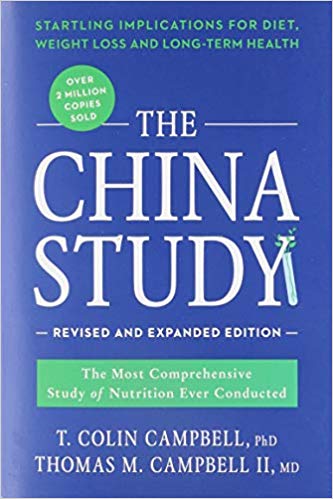
Campbell has written a book for lay people like you and me that explains the science and findings called The China Study: Revised and Expanded Edition.
The book is a fascinating masterwork of clarity. In it, he not only explains the research but also how and why various groups have tried to suppress and discredit the information.
Campbell is not some crazy quack. He isn’t someone selling
pills and supplement drinks on the internet. He has no financial interest in
you believing him. He is one of the foremost researchers on nutrition, a
renowned scientist at Cornell University, who has worked as a senior science
adviser to the American Institute for Cancer Research, sat on government nutrition
panels, and is on the advisory board of the Physicians Committee for Responsible
Medicine.
If you or someone you love are worried about any of the
following:
Heart disease
Cancer (breast, prostate, colon, liver, and
others)
Type 1 Diabetes
Type 2 Diabetes
Erectile dysfunction
Multiple sclerosis
Cataracts
Macular degeneration
Osteoporosis
Alzheimer’s
I think you will be interested in hearing what he has to report. Of course, you’ll have to make up your own mind about the evidence he provides. But I think you owe it to yourself to hear what he has to say.
Back in 2011 I wrote a post titled “Since when did young adult fiction become the cure for cancer?” It was a response to all the YASaves hysteria. The main point of my amazing post (grin) was that the people complaining about some YA content wanted not to ban books, but to simply have a way to more easily evaluate if they wanted to buy a particular book in the first place.
They want to avoid purchasing what they thought was a box of Marshmallow Mateys only to open it and find a bunch of bicycle sprockets.
Last year I decided to work on a solution. I have some ideas. But before I get ahead of myself and build something, I want to really understand if it’s a problem worth solving. I want to chat with others who do care about content to see what aspects of this are important to them and what they’re doing now to find this information.
So, if you wish books had ratings for sex, violence, and language, then I want to talk to you. It will take about 20 minutes. If you’re open to chatting, leave a comment, or click Contact above and fill in the form.
Because I live up in the middle of nowhere, we’ll have to chat via a web meeting. But never fear: I’ll host that. All you’ll have to do is show up and answer my questions 🙂
Did you know that there is one thing that kids can do outside of school that’s been proven, over and over, to lead to them doing significantly better in all other subjects?
And I mean all subjects. Math, history, science, criminology, psychology—you name it.
There’s one thing, and numerous research studies have proven it, that kids do that leads to them getting better jobs later in life.
This one thing, proven by research, leads them to grow up to make more money.
And it doesn’t matter if they start in a rich or poor family. This one thing leads them to greater opportunity. Over and over again.
It’s a thing that kids actually can learn to love. For some it becomes as delicious as eating ice cream.
The kids are back in school. Parents want them to do well. They want them to succeed. How wonderful that there’s one thing that parents can focus on that will so dramatically change their child’s life.
And it doesn’t take long. Even just twenty minutes per day of this activity can change everything.
Twenty minutes.
Is there a parent anywhere that can’t find twenty minutes?
So what is this one thing?
Reading for pleasure.
Notice I didn’t say reading for academic purposes. I didn’t say reading to finish homework. I said reading for pleasure. For the enjoyment it brings.
And it doesn’t matter what the subject matter is. It can be fiction—fantasy, love stories, horror, action. It can be non-fiction—like material on bugs, robots, horses, motocross. It can be fairy stories or funny anecdotes. It can be short or long. The key is that they’re reading for pleasure.
I know some of you might be saying, “But John, my kid doesn’t like to read.”
That’s okay. You can change that.
If you want to find out how to help your child learn to enjoy reading, let me recommend Raising Kids Who Read: What Parents and Teachers Can Do by Daniel T. Willingham, a professor at the University of Virginia whose research has focused on the brain and learning. In the book, Willingham debunks the myths about literary instruction and provides practical, engaging, research-based tips for sharing the joy of reading with kids of all ages.
While you’re waiting for the book to come, here are some things you can do start doing right now to help your child read for pleasure.
First, start reading something fun or interesting with or to them every day. For little kids, this can be picture books. For older kids, this can be anything–an article from a magazine, funny stories online, or books large and small. If you want to start with a joke book, that’s okay. If you want to start by listening to a book on tape, that’s great too.
Wait a minute? A book on tape? Isn’t that cheating?
No.
There are four keys to helping your child read for pleasure. They need to learn to:
Decode the sounds letters make.
Comprehend what’s meant, which is driven by their general knowledge of the subject they’re reading about.
Enjoy reading.
Identify themselves as a person who likes to read books
When you listen to a book on tape, you’re doing numbers 2-4.
Remember: the goal is not to improve the child. It’s not to get them a better job ten years from now. It’s not to make them wealthy. It’s to simply help them enjoy reading. Because once they enjoy reading, once reading for pleasure is something they see as one of the things they do, they will begin to read more and more. And as they read, they become better at reading, which leads to more enjoyment, which leads to more reading. Which leads to all of those other awesome benefits. It’s a virtuous cycle.
So the first thing you need to do is simply start having a good time reading with them. You can read to them at bedtime, after dinner, on weekends. You can have them read articles to you while you’re making dinner or washing the dishes. You can have them read to your or themselves while you’re on the road driving somewhere.
You can make a rule that they have to read with you for twenty minutes before they go play with friends or watch TV or play video games.
And above all, you need to let your child’s interests drive most of the topics you read about. If they want to read about spiders and dinosaurs, then read about spiders and dinosaurs. If they want to read horror stories, then read horror. If they’re into skiing or horses or guns, then help them find interesting stuff on the topics they’re already interested in. And if they don’t like a book, teach them they can abandon it and go find another.
And if you yourself are not someone who reads for pleasure, well, now’s the time to start. You can make reading for pleasure something your family does, just like families make enjoying boating or hunting or riding horses or eating Mexican food part of what they do.
It’s never too late to start.
And seeing that this is the one thing that has such an impact on your child’s success, is there really anything else that would be a better use of those twenty minutes per day?
Reading for pleasure—who knew that having a great time could have so many wonderful effects? Start today. Don’t wait.
It might take a little work. You and your child might run into a few unpleasant spots. But that’s true of anything. How many times do kids fall when learning to water ski or snow ski? How many times do they experience something unpleasant when practicing football or basketball or volleyball?
So start right now. Figure out a time with your child. And begin learning to read for pleasure.
I don”t know how much you travel, but if you’re ever in the upper midwest, then you owe it to yourself to visit a Breadsmith location. We found one locally (St. Louis area–most of them are in WI MI or otherwise scattered about) and try something new each month when we visit. We have’t been disappointed yet.
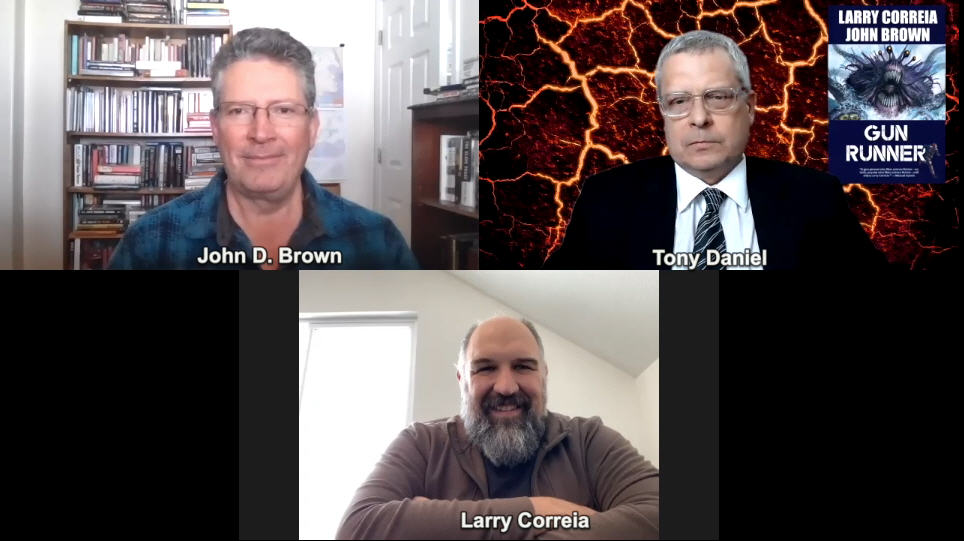
One writing question for you: when you start a new project, do you do a lot of research on common themes related to the project beforehand or do you go with what you know and research for what else you need along the way? In part, I’m curious if you or Larry read/re-read Rachel Bach’s (pen name for Rachel Aaron) Paradox Trilogy (Fortune’s Pawn etc.) or other mechsuit books in prep for your work-in-progress.
Breadsmith looks great. I will be back there in the summer. I’ll have to try to get to one.
I haven’t read Bach’s trilogy. I did look back to get a general idea of what’s been done. Mecha has been around forever in Japan. And we did a lot of research on space and the future of all sorts of tech and thought about what we did and didn’t like in space opera. However, I think our approach is more focused on the characters and action and what we felt was cool in that setting. And so we let that guide us.





I don”t know how much you travel, but if you’re ever in the upper midwest, then you owe it to yourself to visit a Breadsmith location. We found one locally (St. Louis area–most of them are in WI MI or otherwise scattered about) and try something new each month when we visit. We have’t been disappointed yet.
One writing question for you: when you start a new project, do you do a lot of research on common themes related to the project beforehand or do you go with what you know and research for what else you need along the way? In part, I’m curious if you or Larry read/re-read Rachel Bach’s (pen name for Rachel Aaron) Paradox Trilogy (Fortune’s Pawn etc.) or other mechsuit books in prep for your work-in-progress.
Breadsmith looks great. I will be back there in the summer. I’ll have to try to get to one.
I haven’t read Bach’s trilogy. I did look back to get a general idea of what’s been done. Mecha has been around forever in Japan. And we did a lot of research on space and the future of all sorts of tech and thought about what we did and didn’t like in space opera. However, I think our approach is more focused on the characters and action and what we felt was cool in that setting. And so we let that guide us.