You want your kids to succeed in school? There’s one thing you can do…

Did you know that there is one thing that kids can do outside of school that’s been proven, over and over, to lead to them doing significantly better in all other subjects?

And I mean all subjects. Math, history, science, criminology, psychology—you name it.

There’s one thing, and numerous research studies have proven it, that kids do that leads to them getting better jobs later in life.

This one thing, proven by research, leads them to grow up to make more money.

And it doesn’t matter if they start in a rich or poor family. This one thing leads them to greater opportunity. Over and over again.

It’s a thing that kids actually can learn to love. For some it becomes as delicious as eating ice cream.

The kids are back in school. Parents want them to do well. They want them to succeed. How wonderful that there’s one thing that parents can focus on that will so dramatically change their child’s life.

And it doesn’t take long. Even just twenty minutes per day of this activity can change everything.

Twenty minutes.

Is there a parent anywhere that can’t find twenty minutes?

So what is this one thing?

Reading for pleasure.

Notice I didn’t say reading for academic purposes. I didn’t say reading to finish homework. I said reading for pleasure. For the enjoyment it brings.

And it doesn’t matter what the subject matter is. It can be fiction—fantasy, love stories, horror, action. It can be non-fiction—like material on bugs, robots, horses, motocross. It can be fairy stories or funny anecdotes. It can be short or long. The key is that they’re reading for pleasure.

I know some of you might be saying, “But John, my kid doesn’t like to read.”

That’s okay. You can change that.

If you want to find out how to help your child learn to enjoy reading, let me recommend Raising Kids Who Read: What Parents and Teachers Can Do by Daniel T. Willingham, a professor at the University of Virginia whose research has focused on the brain and learning. In the book, Willingham debunks the myths about literary instruction and provides practical, engaging, research-based tips for sharing the joy of reading with kids of all ages.

You can get a used copy for $13 bucks on Amazon.
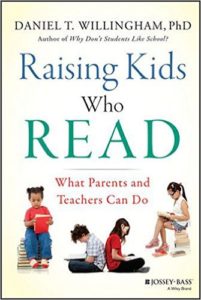
RaisingKidsWhoReadByWillingham

While you’re waiting for the book to come, here are some things you can do start doing right now to help your child read for pleasure.

First, start reading something fun or interesting with or to them every day. For little kids, this can be picture books. For older kids, this can be anything–an article from a magazine, funny stories online, or books large and small. If you want to start with a joke book, that’s okay. If you want to start by listening to a book on tape, that’s great too.

Wait a minute? A book on tape? Isn’t that cheating?

No.

There are four keys to helping your child read for pleasure. They need to learn to:

  1. Decode the sounds letters make.
  2. Comprehend what’s meant, which is driven by their general knowledge of the subject they’re reading about.
  3. Enjoy reading.
  4. Identify themselves as a person who likes to read books

When you listen to a book on tape, you’re doing numbers 2-4.

Remember: the goal is not to improve the child. It’s not to get them a better job ten years from now. It’s not to make them wealthy. It’s to simply help them enjoy reading. Because once they enjoy reading, once reading for pleasure is something they see as one of the things they do, they will begin to read more and more. And as they read, they become better at reading, which leads to more enjoyment, which leads to more reading. Which leads to all of those other awesome benefits. It’s a virtuous cycle.

So the first thing you need to do is simply start having a good time reading with them. You can read to them at bedtime, after dinner, on weekends. You can have them read articles to you while you’re making dinner or washing the dishes. You can have them read to your or themselves while you’re on the road driving somewhere.

You can make a rule that they have to read with you for twenty minutes before they go play with friends or watch TV or play video games.

And above all, you need to let your child’s interests drive most of the topics you read about. If they want to read about spiders and dinosaurs, then read about spiders and dinosaurs. If they want to read horror stories, then read horror. If they’re into skiing or horses or guns, then help them find interesting stuff on the topics they’re already interested in. And if they don’t like a book, teach them they can abandon it and go find another.

And if you yourself are not someone who reads for pleasure, well, now’s the time to start. You can make reading for pleasure something your family does, just like families make enjoying boating or hunting or riding horses or eating Mexican food part of what they do.

It’s never too late to start.

And seeing that this is the one thing that has such an impact on your child’s success, is there really anything else that would be a better use of those twenty minutes per day?

Reading for pleasure—who knew that having a great time could have so many wonderful effects? Start today. Don’t wait.

It might take a little work. You and your child might run into a few unpleasant spots. But that’s true of anything. How many times do kids fall when learning to water ski or snow ski? How many times do they experience something unpleasant when practicing football or basketball or volleyball?

So start right now. Figure out a time with your child. And begin learning to read for pleasure.

Share

Similar Posts

  • Laff and Learn

    My daughters have introduced me to Studio C, a comedy program that started with The Divine Comedy troupe on the BYU campus who all growed up and were given a gig on TV. They do these  hilarious skits.

    Like “Drivers Ed”

    And “Blind Date“.

    And “Shoulder Devil”.

    I hope you enjoy them as much as I do.  BTW, Studio C airs weekly on BYUtv.

    My oldest daughter introduced me to Olan Rogers. Who is crazy.  Here’s “Ghost in the Stalls”

    If you loved that, I think you’ll enjoy “Midnight Claw”  

    Sock slouch . . .

    Next is John Branyan’s brilliant “Three Little Pigs”. My family and I have been enjoying this for months.

    Finally, here’s something to think about. You know I enjoyed Jonathan Haidt’s book The Righteous Mind. Matt Wolfe pointed it out his TED talk to me. The one that preceeded his book. If you’re conservative, like I am, this talk will, at times, annoy you.  But the ideas behind it are great.

    If you want to be equally enlightened but less annoyed, let me suggest you watch Bill Moyer’s interview of Haidt instead.


    Share
  • |

    Writing Update: Curse, trebuchets, CONduit, book industry, & Robinson Wells

    As of 5 PM this last Saturday I have finished 15,000 words of the climax of Curse of a Dark God. I think I have another 10,000 to go and the book will be done. I’m so close to the end of this draft! So don’t let the progress bars fool you. The ending is coming together fabulously–lots of spectacle, big reveals, and major heroics. At least, I think so.

    While working on this, I had to spend a number of hours finding out how strong a wind must be to pick up humans and stones. I also needed to know the destructive forces of various classes of tornados and hurricanes. Why would I need to know such things? I write fantasy, for Leroy’s sake!

    (Yes, that’s good English; I’m a writer, and one of my prerogatives is to make up silly versions of common expletives using the names of friends and enemies.)

    Here’s why: I just can’t write if I don’t believe in what I’m writing. And when I’ve got monsters (skir) that can generate winds that will be used in a siege, well, I had to know the terminal velocities of what these creatures could throw, and what that might mean for fortress defense. I had to know the limitations and ramifications.

    I won’t rehearse all the fascinating details (and it WAS fascinating), but all that research did lead me to a wonderful documentary. It’s called Secrets of Lost Empires 2: Medieval Siege and was produced by Nova in 2000. You can get it on Netflix or Amazon.  In the film, fifty carpenters worked day and night to create and test what they dubbed “the fourteenth century version of the atom bomb”–the trebuchet (tre-byou-SHAY). The trebuchet as the most popular throwing machine in Europe during the middle ages. If you love the history of medieval war, you’ll love this film. You might want to add to it a reading of the excellent Ancient and Medieval Siege Weapons by Konstantin Nossov, which you can get via the inter-library loan program.

    I’ll share two cool factoids for you history fans. “Catapult” means “shield-breaker,” “cata” meaning break or penetrate and “pelta” being the name of the shield used by the Greek light infantry. The original catapults were NOT big spoons–they sped arrows and balls along a track like a crossbow. However, instead of using the spring force of a bow, they used torsion-springs, which is what you get when you twist fibers that want to be straight. In the case of catapults the fibers were ropes made out of animal sinews or hair (horse or human, a woman’s hair being considered the best) and soaked in oil. Click on the image to see a larger picture. 

    A modern example of a torsion-spring are those balsa wood airplanes with propellers attached to a rubber band that’s hooked to the belly of the plane. To fly them, you rotate the propeller round and round, twisting the rubber band. Then you let the propeller go. Because the rubber wants to be straight, it reverses the twist, spinning the propeller the opposite way you twisted it. 

    You might think these torsion-spring engines were weak. But one catapult was reported as being powerful enough that an arrow shot from it broke through a shield, and the armored warrior standing behind it, at a distance of 400 yards! Hence, the name.

    The other factoid is that “trebuchet” comes from the French term meaning to overthrow. If you saw Return of the King, you’ll recognize them as the engines used on the towers of Minas Tirith. Trebuchets are simply an evolution of the staff sling. When it came to breaking castle walls, there was nothing more effective until the cannon appeared. Of course, in my book I use them a bit differently. You’ll see.

    One funny thing. I watched the movie with my oldest who was just as fascinated with the engines as I was. When she was telling my wife about the film, she kept referring to trech-uh-butts. Which, I guess, is as fair an attempt at “trebuchet” as any. However, my wife kept picturing buttocks and couldn’t figure out what the heck my daughter was talking about–“You were watching what with your father?!”

    The French make things so hard . . .

    ***

    The Monday after CONduit I left for work in Mexico and then Vegas. I didn’t get back until this week. So I just wanted to say I had a great time at the con. Loved chatting with all the folks there.

    It was great to see the Larry Correia, Paul Genesse, Jessica Day George, Isaac Stewart (and his brother Dan), Mette Harrison, Eric James Stone, Darren Egget, Julie Frost, Sandra Tayler, LE Modesitt, Josh Perkey, Nicole (whose husband is an Orem cop and I lost his number), Daniel Who-I-Sacrificed-to-My-Editor, and the Dungeon Crawlers Radio guys.

    It was also nice to speak with Julie Wright who was one of the initial judges for the Whitney Awards. She’s always nice to chat with, but this time it was especially nice since she said reading Servant of a Dark God was like eating chocolate. I’ll take chocolate praise any day.

    I also met new author Janci Patterson who just sold a YA with a great premise. It’s called SKIP and is about a young girl whose parents are divorced. The girl has to go stay with her dad who lives in a trailer and is a bounty hunter. I’m a sucker for bounty hunter stories. Especially this one, because she goes out with him and falls in love with one of the guys her dad has to haul in. I’ve slaughtered the pitch, but I got that good old writer’s envy when she told me about it. Can’t wait to read it.

    I also got to see Barbara Hambly. I was at LTUE when she was there like 20 years ago. We loved her stuff. She suddenly dropped out of the writing scene in the early 90’s and now I know why–it appears Del Rey dropped all their midlist authors except for Anne McCaffery and someone else. Hambly was one of the causalities.

    ***

    After Hambly’s main address, I sat with a few authors and had a brief discussion about the book industry where it was suggested the industry was shrinking–fewer readers, fewer sales, doom, doom, doom. But that is exactly opposite all the data I’ve seen.

    1. Book sales have an annual average growth over the last seven years of 1.1%, adult paperbacks are growing 2.9% http://www.publishers.org/main/IndustryStats/indStats_02.htm or http://www.publishers.org/main/IndustryStats/documents/S12009Final.pdf . Now, this doesn’t show units sold. So it could be that they sold fewer units for more money per unit. Still, it shows at the very least that $$$ aren’t shrinking.
    2. The New Book Titles report here shows an increase in the number of titles: http://www.bowker.com/index.php/book-industry-statistics — 80% increase from 2002 to 2009.
    3. Reading rates are actually on the rise: http://johndbrown.com/2009/03/literary-reading-rates-on-the-rise/
    4. Finally, I contacted Bookscan for their numbers for an ALA conference I did last summer. This is just juvenile fiction, but the numbers are in units. Now, I don’t know if they added more sources to their database and so that caused a rise, but I explained to them what I was trying to do—see trends over time—and this is the data they provided. According to their numbers, more juvenile books are being sold now than in 2004. Click on the graphic below. This means we have more and more readers rising up through the ranks! One author asked how much of that was Rowling and Meyer. During that period books by those authors accounted for an average of 7-10% of all juvenile fiction. Bookscan categorizes “juvenile” as everything for kids. That means from Go, Dog Go up through what we consider Young Adult. R&M accounted for an average of 33-36% of what Bookscan categorizes as science fiction, fantasy, or magic within the juvenile mega-category. What all that means is the growth is across the whole category, not just with their books.

    So I’m very sanguine about the book industry’s prospects. Today’s youth seem to be able to play computer games AND read in great quantities.

    ***

    Finally, one last bit of news. Robinson Wells was the one of the main ones to start the Whitney Academy and the Whitney Awards. Well, he just got some fabulous news. Here’s the announcement from Publishers Marketplace: “Robison Wells’ YA debut dystopian thriller VARIANT, a modern-day LORD OF THE FLIES, set at a boarding school where not everything is as it seems and every day is a fight for survival, in a significant deal, in a three-book deal, to Erica Sussman at Harper Children’s.”

    For those of you who don’t know, here are the PM deal categories.

    • “nice deal” $1 – $49,000
    • “very nice deal” $50,000 – $99,000
    • “good deal” $100,000 – $250,000
    • “significant deal” $251,000 – $499,000
    • “major deal” $500,000 and up

    Oh, baby. Someday. Someday. Of course, I’m nothing but happy for Mr. Wells!

    Links

    Share
  • Good Stuff! 2 Sauces You Don’t Want to Miss

    What have the Dutch got that we ain’t got?

    Well, besides signs like this.

    geenhondenpoepopdestoep

    Which is frequently accompanied by the words “Geen Honden Poep Op De Stoep”(no dog poop on the sidewalk).

    I’ll tell you what they have—easy access to sambal oelek (SAHM-bal OO-lek). Sambal oelek is Indonesian for “dang good chili paste.”


    SambalOelek

    And why I started this post with the dog sign, I don’t know. Probably not the best lead in for food. But put that out of your mind now.

    You have avoided the dog, and are now sitting down to a delicious meal. And it’s been made even more delicious because you used sambal oelek. “Sambal” means something like “condiment” or “sauce.” There are a lot of different sambals, of course.  Oelek refers to a type of Indonesian stone mortar and pestle used to grind things. So a rough translation is ground sauce.

    And this sauce/paste is awesome. Now, I’m not a spicy foods guy. In fact, whenever we eat out, and I’m asked how spicy I want my food, I always choose mild. I hate super spicy food. But sometimes a little spice can transform a dish.

    You want to perk up your stir fry? Sambal oelek.

    You want to refresh your scrambled eggs? Sambal oelek.

    You want to try a new kind of PBJ? Sambal oelek.

    A spicy PBJ? Oh, baby.

    I was introduced to this BPJ when I was on my mission in the Netherlands. BTW, it’s not by accident I became of fan of Indonesian food while on my mission. Indonesia used to be a Dutch colony, and so there are tons of Indonesians there. For almost a year, I lived in rooms rented out of the houses of Indonesian landladies who cooked our lunches or dinners for us.

    So one day I watched one of my fellow missionaries spread sambal onto a piece of bread, then follow with peanut butter and a touch of jelly. At the time, I was grossed out. Then I tried it.

    Have you ever had satay? It’s the Thai and Indonesian version of BBQ. It usually comes with this marvelous spicy-sweet peanut butter sauce. If you have, you know you love it. And this, well, this is what you call the sambal PBJ variation of satay.

    If you like Thai, you’ll love this stuff.

    So where did I find it?

    World Market.

    And if you don’t have one close, you can get it on Amazon. Yeah.

    But, wait. There’s another mild hot sauce that you don’t want to miss.

    My two daughters just returned from their missions. One went to Kentucky. At the end of her mission, she was teamed up with one Sister Barajas from Mexico and assigned to work Spanish-speaking folks. And Sister Barajas introduced her to Cholula.

    Cholula

    Heavenly Cholula. Not too spicy. No weird taste like Tobasco.

    You want to perk up your stir fry? Cholula.

    You want to refresh your scrambled eggs? More Cholula.

    You want to try a new kind of PBJ? I don’t know. I haven’t tried that yet. But it’s good on steamed veggies. Good just about anywhere you want a fine little zing.

    Where can you find it?

    Walmart.

    How easy is that.

    If you like mild spice, the little bottle with a wooden top is going to become your friend.

    Okay, so what if you don’t like sauces?

    cafe_zupas

    How about a great soup and sandwich. Here’s the freebie recommendation. If you live close to a Cafe Zupas (Arizona, Idaho, Nevada, Utah), try to new Roasted Veggie and Quinoa soup along with a sandwich. I had the California Turkey. It was delicious. It comes with a little bit of French bread and a chocolate dipped strawberry.

    Life is good.

    Share
  • Murder, Courts, and Bart D. Ehrman

    I’m going to talk a bit about some murderers in Detroit, Jesus, and a couple of books I recently read that I think are just awesome.

    MURDER

    Highers BrothersSo, the murderers.

    Let me start by asking this question: can you establish the truth in a court of law?

    Is that what the judge and jury are deciding? The Truth, with a capital T?

    Think about Tommy and Ray Highers, brothers from Detroit. They were convicted of murder. Open and shut case. No parole. They were two nasty buggers who shot a man down over some dope.

    But then twenty-five years later (last year, in fact) they were back in court because new evidence had come to light that undermined the original conviction. For the curious, this fascinating Dateline episode reveals the amazing way the evidence came to light and what happened because of it: http://www.nbcnews.com/dateline/full-episode-graduation-night-n72666. Watch it. You’ll be happy you did.

    So the Truth. Capital T. Can you establish that in a court of law?

    No.

    What the justice system does is try to determine which story about the evidence available is the most convincing.

    It’s about telling and judging stories.

    There are many types of evidence folks use when telling their stories. Some of it is very strong. Some is so unreliable, like hunches and hearsay, that the court won’t even allow it to be presented.

    Whatever the evidence, the fundamental nature of this is that you can often tell a number of different stories using the same set of data, the same evidence. Sometimes the stories are variations with minor differences. Sometimes the stories are radically different.

    It’s like having only some of the pieces of a 100 piece puzzle. You look at the four, twenty, or thirty pieces you have and imagine what the rest of the puzzle looks like. And then you invent something that seems reasonable.

    You invent it.

    And if that story meets certain standards of proof, then our system allows the authorities to take certain actions. If the standard of a “reasonable suspicion” is met, it allows a police officer to stop someone. If the standard of “probable cause” is met, a higher standard than reasonable suspicion, an officer can arrest you. If a jury in a criminal case decides the defendant is guilty “beyond a reasonable doubt,” an even higher standard of proof, then the justice system authorizes the authorities to sentence the defendant.

    But at no time does the system seek to establish the absolute truth, the truth with a capital T. It only seeks to establish some level of probability that the story being told about the evidence is true.

    All of this is made more complex because what’s “reasonable” is based on other people’s opinion. We have guidelines and rules to help folks be “reasonable.” But reasonableness is still affected by culture, background, history, etc.

    It’s still opinion.

    OTHER PUZZLES

    What other realm of knowledge works like the justice system and consists of inventing stories about missing parts of the puzzle?

    Well, history does.

    In fact, if you think about it, history is what courts do. The processes and principles of our justice system guide everyone involved in how they go about telling the stories that make up that specific type of history.

    And all historians (lawyers, judges, and juries included) have no means of establishing the absolute truth.

    They can’t use science. Science requires you conduct experiments and reproduce results. But how is a historian going to reproduce the same events? What, they’re going to get Lincoln shot all over again and let the rest of us watch it? Dang, John Wilkes Booth did shoot the man. We all saw it happen down in the lab.

    Sure, they can use science to date a manuscript, or determine what something is made of, or establish some other fact. But all science is doing is providing facts about the pieces of the puzzle you have. About the claims the evidence makes.

    But science can’t fill in the missing pieces of the puzzle. It can’t tell the story. The historian has to invent the story that makes the pieces all make sense.

    And then the rest of us determine if that story, that sketch of the full puzzle, is reasonable.

    But that isn’t all there is to it.

    STANDARDS OF PROOF

    Think about conspiracy theories like the ones that claim that the US government perpetrated the 9/11 bombings. Conspiracy theorists are practicing history. They are inventing a story that seems to fit the evidence available to them.

    But what happens when you have only five or ten pieces of a 1,000 piece puzzle? What happens when you don’t thoroughly vet the evidence? What happens when someone screws around with the evidence? And I’m not just talking about tampering or invalidating it by thoughtless handling (contaminating DNA, for example). Folks with the best intentions have biases. In fact, we all have biases that lead us to include and exclude various pieces of evidence based on whether they support or oppose the ideas we want to believe.

    Jonathan Haidt explains these biases in his excellent book The Righteous Mind. He explains that with things we want to believe, we often use the standard of “Can I Believe It”?  We look for anything at all that would allow us to believe our position. If we find it, even if it’s flimsy, we discount all the other evidence that may point another way and conclude we have met the burden of proof for our view.

    For things that we don’t want to believe, we often use the standard of “Must I Believe It”? When falling prey to this bias, we look for anything at all that would undermine the thing we don’t want to believe, even if that evidence is flimsy. If we find it, we ignore all the other evidence, even if there’s a mountain of it pointing another way, and claim we have met the necessary burden of proof.

    In court there are all sorts of procedures and standards that need to be followed to help us avoid invalidating evidence or falling prey to our biases. Those procedures and standards don’t remove all risk. But they do remove a lot.

    Which court system would you want to be processed through? The current American justice system or the medieval witch trials?

    Oh, for sure I’d want to be someone accused of witchcraft back when a claim of “I saw her as a witch in my dream” was admissible, as was the test of poking a mole on the accused’s body with a needle to see if said witch flinched enough. I’d be so happy to go back to the days when a confession obtained by torture was incontrovertible evidence.

    So when practicing history, it’s important to have some guidelines, some rules to establish which bits of evidence are more likely (not guaranteed, but more likely) to be reliable. And it’s important that when folks tell their story, they not only share the evidence, but also all the assumptions they’re making.

    JESUS

    Where does Jesus of Nazareth come into all of this?

    Misquoting Jesus by Bart D Ehrman

    Well, Jesus has affected the world more than any other person who has lived on it. The stories we tell about him (the history we have practiced about him for the last 2,000+ years) have changed the world. And those stories will continue to affect us, especially folks in Western cultures, on everything from foreign policy to which clothes think are fit to be worn in public.

    Who was Jesus? Did he really exist? Was he a god? What did he really teach? Have his teachings been changed?

    These are all fundamental questions. And for the last two-hundred years historians have been re-examining the pieces of the puzzle, finding new pieces, and telling new stories to explain it all.

    Some of these historians believe in Jesus as a god. Some don’t. Either way, the conversation is fascinating.

    Jesus Interrupted  Bart D Ehrman

    I just read three historical books about Jesus that were awesome. AWESOME. Not because I agreed with all of the author’s conclusions, i.e. his stories. I don’t. But because of the way he practiced his history. The way he told his stories. And because what he shared gave me new insights to my stories about Jesus.

    The three books, all by Bart D. Ehrman, a professor of religious studies at the University of North Carolina, Chapel Hill, are:

    1. Misquoting Jesus: The Story Behind Who Changed the Bible and Why
    2. Jesus Interrupted: Revealing the Hidden Contradictions in the Bible (And Why We Don’t Know About Them)
    3. Did Jesus Exist? The Historical Argument for Jesus of Nazareth

    I’ve read the Bible many times, and I’m a believer. Of course, the question is a believer in which story?

    Did Jesus Exist Bart D Ehrman

    What Ehrman so engagingly makes clear is that there have indeed been many stories about Jesus. In fact, the gospels (Matthew, Mark, Luke, and John) and the writings of Paul (most of the rest of the New Testament) seem to all portray a different man and message. Not only do they say things that flat out contradict each other on some details, but if you look at each book separately, each author seems to have a slightly different take on Jesus.

    Furthermore, it appears that what we now have has changed over time. For example, it seems the last twelve verses of Mark were not in the oldest manuscripts. There have been other changes. One of the more notable ones occurs in John 5:7-8.

    Our earliest texts say:

    “For there are three that bear record, the spirit, and the water, and the blood: and these three agree in one.”

    But later texts say:

    “For there are three that bear record in heaven, the Father, the Word, and the Holy Ghost: and these three are one. And there are three that bear witness in earth, the spirit, and the water, and the blood: and these three agree in one.”

    Nowhere else in the New Testament do we have anything that states that creedal doctrine so explicitly. Did John write that? Or was the extra material added to make the idea of the trinity scriptural?

    And what do we make of the fact that we have no manuscript that dates to anywhere close to when Jesus lived? We have some small fragments of manuscripts with a few verses of John, Revelation, and Matthew dated around 150 AD. But the oldest manuscripts we have that contain the majority of any of the gospels are for the gospels of Luke and John, and these are dated around 200 AD. The oldest manuscripts with the full New Testament are dated around 350 AD.

    That’s more than 300 years after Jesus died!

    Have you played the game of telephone? Are we sure that the oral traditions that were written down weren’t changed? What happened to the books mentioned in the Bible that we don’t have now? For example, Jude mentions a prophecy of Enoch that we don’t have in our current Bible. Are we sure that the copyists didn’t add to the text like it seems some did to John?

    And what about the term “Christ”? It’s actually the Greek word for “messiah” which just means one anointed with oil to perform a special service for god. Christ wasn’t Jesus’s last name. It was a title: Jesus the anointed one.

    The anointed ones in those days were kings and prophets and priests. It appears most of the historical sources suggest that a “messiah” to the Jews of that time was someone who would throw off foreign rule and establish the kingdom of Israel as David had. In fact, there were a whole bunch of people who claimed to be messiahs. Here’s a nice list: http://en.wikipedia.org/wiki/Jewish_Messiah_claimants.

    Judas Maccabeus was considered a messiah because he threw off Greek rule in 164 BC. But then around 63 BC Israel was taken over by Rome. And Rome wasn’t too keen on revolts, so around 4 BC they crucified Judas the Galilean for claiming to be the messiah, the king of the Jews. Crucifixion, it seems, was the punishment reserved for seditionists. They crucified Jesus and a whole bunch of other guys claiming to be the king of the Jews. And their crimes were written on a board above them, which is why they hung the words “King of the Jews” over Jesus’s head on the cross. Here’s the criminal, and here’s his crime. These other messiahs were not claiming to be a god that came to earth to atone for sins, but anointed by God to throw off foreign rule and establish his earthly kingdom again.

    Jesus talks a lot about the kingdom of God. Was Jesus just another one of the seditionists?

    Ehrman examines these and many other questions as a historian, providing all sorts of insights.

    But the fabulous thing is that he doesn’t just tell his story. He gives his evidence. Exposes his assumptions. And in all three books he explains the guidelines or “rules” historians use to when trying to determine which stories are more likely and which evidence is more reliable.

    I was enlightened, challenged, and delighted. I learned things about Jesus’s life and times that have helped me understand what I read in the Bible better.

    LIMITS

    Of course, the historical method has its limits.

    Historians, because they are looking for explanations (stories) that are more probable, automatically select against things that are improbable. They exclude miracles. They exclude any story that says Christ was actually resurrected.  They may establish that a lot of folks thought he was resurrected, but they don’t have any methods to establish something like a resurrection actually occurred. And so they ignore it. Historians exclude modern revelation. If someone today were to have a visitation from Jesus as Paul did, the historians would exclude that.

    But we all know that truth is sometimes stranger than fiction. We all know that sometimes the less likely thing is exactly what occurred.

    Historians are looking for what is most probable. Not what actually happened. Because they can’t go back and time and verify their story.

    Excluding “improbable” things changes the types of stories the pieces of the puzzle support. For many of us, me included, we do accept evidences many historians don’t as pieces of the puzzle. And because we have these pieces, we’re able to tell different types of stories.

    The cool thing about Ehrman is that he explains this. He’s not trying to hide anything. Instead, he’s explaining how to approach the Bible from a historical point of view, and where the principles of the historical method lead him.

    And I have found that those methods in his hands have a lot to offer.

    If you’re someone who is interested in religion–as a believer, agonistic, or atheist–you will love these books. Ehrman himself was once an ardent believer, but is now agnostic. However, his respect for believers, including other scholars in his field who believe in the divine Jesus, comes through loud and clear. Ehrman has no axe to grind. He is simply sharing the stories of Jesus that make sense to him and many other historians. And he does it in a very interesting and easy-to-read style.

    If these books sound like something you want to try, I’d start with Misquoting Jesus, move to Jesus Interrupted, and then finish with Did Jesus Exist? And if you enjoy those, let me recommend two more of Ehrman’s books. The first is The Lost Gospel of Judas Iscariot: A New Look at Betrayer and Betrayed, which looks at the discovery and content of a very ancient manuscript that calls itself The Gospel of Judas. The second is Lost Christianities: The Battles for Scripture and the Faiths We Never Knew, which explores the variety of Christian faiths that existed in the few hundred years after Jesus’s death.

    Happy reading!

    Share
  • |

    Dewitt Jones and Clear Vision

    Not many people understand creativity. Dewitt Jones, a National Geographic photographer, does. And this video on the creative process, HOLY COW, it’s so good I had to buy it so I could watch it whenever the yearning took me.

    Clear Vision

    But this isn’t just for artists. The principles of creativity apply to any creative endeavor–from writing and drawing to building microchips and parenting. 

    Go here. Watch the brief clip. Then watch the whole Clear Vision video. Tell me what  you think.  

    Capture the zing!

    Share
  • Masters of Chaos, Chosen Soldier, and Teenage Boys

    US Army Special Forces

    Nobody can stand up to the US Military’s conventional fighting force using conventional tactics.  Yes, Russia and China have significant militaries and a fight with them would be bloody.  But it’s not likely we’re going to go to war with them.  Instead, as we’ve seen since the 1990’s, we’re likely to fight much smaller groups—Somali warlords, genocidal brutes in the Balkans, terrorist-supporting regimes like the Taliban, unstable dictators like Saddam Hussein, or Islamic extremists who aren’t associated with any nation. 

    Those who do try to fight us conventionally get wiped out.  We saw that very clearly with Saddam Hussein.  Which is why the fight went underground.  In this type of war, when the bad guys are hiding among the good, we can’t just rush in and bomb the place to the stone age.  If we do, the local population will soon come to hate our presence and work against us.  And when that happens, we set ourselves up for defeat.

    The best way to fight against insurgents is to ally ourselves with friendly portions of the populace who can identify who the insurgents are, which doors to kick in, and can actually kick those doors in themselves, if only they get some support and training. 

    Because of this, a strong argument can be made that the US Army’s Special Forces are the most effective tool we have in winning the types of wars we’re likely to fight in the near future.

    The US military has a number of special operations forces.  Those you’re probably most familiar with are the Navy SEALs, Delta Force, Rangers, Marine Force Recon, and the Army’s Special Forces (commonly known as Green Berets).  There are other groups like the Air Force’s Combat Control Team, the Army’s 4th Psychological Operations Group, and other black op units that the military doesn’t officially recognize. There is some overlap in the types of things these forces do.  However, each has its own focus, the thing it’s best suited for. The reason why the Army’s Special Forces are so valuable in our current environment is that one of their main missions, the thing they do better than anyone else, is conducting and fighting unconventional wars.

    Along with all the other cool stuff that goes along with special operations work, Special Forces troops have to learn how to build rapport and trust because unconventional war is conducted through and by the indigenous population.  Special Forces troops not only have to know how to conduct high-risk missions, they have to be able to train others to do the same, which is why they are all required to learn a second language.  All this people work requires a more mature soldier.  And it shows: the average age of the SF operators is thirty-two, while the average age of a US Marine is nineteen.

    I just read two fabulous books on the Army’s Special Forces.  The first is Masters of Chaos by Linda Robinson. Robinson was given unprecedented access.  She traveled with them to the front lines and was allowed to interview and report as no other had been allowed up to that point.  She starts with a brief history of the SF and their training; she then details missions the Special Forces carried out from 1989 – 2003, including their work in Panama, El Salvador, Kuwait, Somalia, the Balkans, Afghanistan, and the second gulf war.  My eyes were opened to the significant role they’ve played in all these conflicts.  It was absolutely fascinating.

    The second book is Chosen Soldier by Dick Couch. Couch, a former Navy SEAL and CIA case officer, is the only writer ever given the privilege to attend the many months of Special Forces pre-selection, preparation, selection, and qualification training from start to finish.  He was given “full access to all training, venues, students, and training cadres.”  Couch did not merely interview.  He and his wife moved to one of the few residential structures on base at Camp Mackall in North Carolina.  Couch went out with the SF candidates to observe first hand exactly what they did, and, in a number of instances, do it with them.

    One of the things I loved about this book are the personal bios given about the backgrounds of the various candidates.  They are not at all what you’d expect—everything from bouncers to engineers to one fellow who had a degree in and a passion for Russian literature.  I also enjoyed the details he gave about the training.  There are about 1.2 million people in the US Army.  Only about 5,000 of them are in the Special Forces.  When you finish, you have a good feel for the types of things they learn and why about 80% of those who volunteer for training wash out.

    I couldn’t put either of these books down.  If you decide to read them, let me also recommend you download and read Army Field Manual 3-05.20 Army Special Forces Operations as well, which is the Army’s “keystone manual for Special Forces (SF) doctrine” that “describes SF roles, missions, capabilities, organization, command and control, employment, and sustainment operations across the operational continuum.”  You can find it here: http://tinyurl.com/3ryt3o3.  For those who just want an overview of these forces, the Army has provided a great site here: http://www.goarmy.com/special-forces.html. 

    The Boys of Laketown and Round Valley

    Every school morning my wife and two oldest girls hunt.  They eat their breakfast perched high on a hill and watch for the quarry.  When it appears, a shout is raised, and the trio races to the car.  They blast out of the garage, perform an expert three-point turn, then Monte Carlo down the winding hill road.  Next, they attempt to set a land speed record on the straight shot into town, all in an effort to catch the big yellow school bus. 

    Most days they make it.  The bus makes a few stops in town.  Sometimes they’re not so speedy and can only manage to catch the bus at its last stop.  Sometimes I join in on the hunt.  Most of the time I catch the bus at its last stop in town.  But this week I was quick enough to get them to the third stop in front of the middle school where most of the teens board the bus.  And I had the privilege to witness a class act.

    The first time I arrived with my payload, all but two teen boys had already boarded.  We raced up to the bus, my daughters flew out of the car, and the two teenage boys from Round Valley stopped.  They did not get on.  They waited for my girls to hustle the length of the bus.  My girls got on, and the boys followed them in.

    Odd.

    The next day we got there a little bit earlier.  This time I witnessed ALL of the boys from Laketown and Round Valley stand and wait for all the girls to get on first.

    What was this? 

    I asked my girls about it.  They confirmed—it wasn’t a fluke.  While first initiated by the bus driver, the boys have the class to show this courtesy every day. 

    Teenagers . . .

    Bravo, Gentlemen.  Bravo.

    Share