I’ll be presenting this Saturday, June 8, at the league’s summer writer symposium at USU. Here’s the description of my presentation.
Make ‘Em Beg For More! How do you keep your readers begging for one more page? The answer is probably not what you think. Come to this session to learn the surprising secret—along with plenty of examples and how-tos. When you’re done, you’ll know exactly what you need to do to write stories that are devilishly hard for readers to put down.
Check out the schedule below. Looks like there will be some great presentations. If you attend, please come and say hello.
This is not a Democrat thing. This is not a Republican thing. This is a Budgeting for Morons 101 thing. I think anyone who is sent to Washington needs to pass a test. The test will have two questions.
Can you pass it?
Big Hairy Test
Question 1. Fill in the blank. Use your incredible subtraction skills to solve this equation: 2 – 5 = ?
Question 2. Short answer. Let’s say you don’t have enough money to purchase everything you want; what do you do?
Answers to Big Hairy Test
Question 1.
The answer would be -3 (yes with the little dash thingy in front of it). If you fail this, your name is taken off the ballot. I know it’s harsh. You’re a good person, but you’re just too dumb to be trusted with my money. Please repeat the first grade and run for office again later.
Question 2.
If you say borrow the money, your head gets painted orange so everyone knows you have brains that operate on the same wattage as a citrus fruit.
If you say print the extra money, your head gets painted orange and then you go to jail for plotting to steal everyone else’s money by devaluing it.
If you say, “Contact the Russians, they’ve got a source,” we send you to Russia to work in Siberia digging rocks.
If you say, “But I had to spend more than I had because everyone else was doing it and they might be mean to me and not vote for my proposals,” then we assign you to follow a colony of lemmings in the Norwegian tundra for seven years. It’s okay. Lemmings are very cute.
Awwww!
The correct answer is you either (1) reprioritize, spending less on something else so you can spend more on the thing you really want, (2) eliminate waste in your operations so you have more to spend, or (3) go without, especially when it’s not your money to begin with.
A possible fourth answer is to go to the American people and make a business case for a new tax. The tax cannot be voted on until it has been presented to the American people, and they’ve been given 18 months to review the pros and cons. You cannot use government funds for your dog and pony show to sell the tax. Then the people, NOT you or your cronies, vote on it. It must receive 70% of the popular vote in each state to pass. If it passes, the funds collected by that tax cannot be used for any other purpose than the one stated when it was passed.
Is this really that hard?
No, it’s not hard, but it actually kind of is because the numbers that are reported are so big they don’t mean anything. And the words are sometimes all mixed up. For example, is “deficit” the same as “debt”? When Congress says they’re passing a bill to reduce the deficit, does that mean we’re actually starting to pay down the debt?
The Romney people recently created a chart that makes the numbers immediately understandable. I love this chart. It’s simple and straight to the point. Anyone can see what the current numbers show our very smart representatives in Washington are doing.
Our leaders have a MORAL responsibility not to spend more than they take in. I don’t care what party they belong to–if they don’t have the brains or the morals to use our money wisely, then they should not be able to play with it.
A Shocking Proposal: think like an accountant (horrors!)
Our leaders should not have the ability to raise tax rates or create new taxes. They have abused the priviledge of raising taxes on our behalf. They now should lose that priviledge completely. But the fact is they never should have had that duty in the first place.
Business learned this long ago. This is why it’s standard procedure to separate duties. It is always a VASTLY DUMB idea to have the same person collect the money, deposit it, authorize payments, and make the payments. It INVITES fraud, abuse, and error.
It’s clear that it’s also an equally dumb idea to have the same people in government levy taxes and then spend that tax money. But we knew that. The founders used the idea of separation of duties when they set up our government in the first place. They just called it “separation of powers” instead. The problem is we didn’t separate the duties enough.
Our leaders should NOT have the power to levy taxes on us AND spend our money. We need to separate the duties, reserving the duty of establishing taxes to the people. If our representatives have a really nifty idea they want a tax for, they need to take the business case to the American people as described in answer four to question two in the Big Hairy Test above. And the American people can then vote on it.
And now I’m off to Lowe’s to purchase some orange paint.
Last week, I was booted out of Codex Writers, a private, online writer’s group that I’d been a member of for somewhere around fifteen years. I’m not broken up about it, but the reason for said booting is interesting, unexpected, and worth a post.
Over the years, writers moved in and out of the group, but there were usually somewhere around fifty to a hundred members active on the boards. We discussed the writing craft and business. We held writing contests. We provided critiques. People shared interesting things about their lives.
The group has moderators. And the moderators got together last week and decided John Brown had to go.
Why?
What, of all the sins one may commit online, triggered this?
Was it refusing to stop posting pictures of cats?
Using too many emoticons?
Infecting everyone’s pages with Russian spam bots?
Nope. Nope. Nope.
I know what you’re thinking. Surely, John, you must have
been posting in a belligerent, arrogant, and strident way. You must have been a
jerk.
That’s what you’d think.
I assumed that’s what the problem was too. I invited those
who were angry and hurt to come to my personal thread and explain what it was
that was making them so hurt and angry. A number took me up on the offer. And,
to my great surprise, one of their criticisms was that I was too polite.
One person posted that my politeness made her think I was sealioning (a new term to me). Other’s agreed.
Another person said that my polite manner surely indicated I wasn’t sincere. Other’s agreed.
In fact, one of the moderators stated that being polite was part of the insidious problem that was John Brown. She said that my politeness had suckered folks in to letting my awful behavior go on too long.
I was offensive, and I was too dang polite about it.
So what was I doing?
Well, I was asking for evidence.
Don’t ask for evidence
My sin was suggesting that some claims being made about a
certain topic seemed to be premature. My sin was in looking at the evidence
being offered to support some of these claims and firmly stating that I
couldn’t see how it supported the conclusions.
On every topic on the forum, we could question claims and
discuss evidence in an effort to figure things out. But there was one topic, as
I learned, for which a number of the active members and the moderators decided
that was forbidden.
The topic was systemic or “institutionalized” discrimination.
On the forum, most of the discussion was how it related to publishing.
They explained to me that it was offensive for me to want to
see if the evidence actually supported the claims. It was offensive to post when
I couldn’t see that it did.
You might wonder how in the world can that be offensive.
After all, evidence is one of the first things we ask for when people make
claims.
If Billy Joe comes up to you and says, “Son, aliens done landed in my yard last night. I swear it on a stack of Bibles.” Most of us would want some additional evidence.
We’d want to see the video he took and look at the burn mark
in his lawn and the broken branches he said were made when their ship landed.
And we’d want to see the report showing that the residue collected off the
swing set was a substance unknown to mankind.
But it isn’t just claims about aliens that we do this with.
Historians do it about history.
Scientists do it about science.
Courts require it for reaching verdicts.
Heck, we even do it when we look at movie reviews—we use
those reviews as evidence that the movie is going to probably be good or bad.
Evidence.
We’re always looking for evidence to see if our guesses are
right. But on this topic, wanting evidence was offensive. I was told it was
“hurtful” and “damaging.”
The logic of micro-aggressionism
How could folks get to the point where wanting and
challenging evidence for claims was a bad thing?
Well, quite easily. And they aren’t the first to do it.
And lest you think this unfortunate logic is found only in
obscure writers groups, you need to know it has spread to many American university campuses.
That means it’s eventually coming to an organization near you. And that means
chances are good that you or someone close to you will have to face, at some
time or another, online or elsewhere, an angry mob (or moblet, as the case may
be).
So let’s examine the logic so that when you do, you’ll be
able to see the response for what it is, name it, and bring its tenets out into
the light and show them for what they are.
Here’s their logic.
ONE, each of us
has our individual prejudices, biases, and beliefs about the world.
I’m sure you agree with this. It seems pretty obvious. One guy might think soccer is for wimps, and another might think football is for lumbering meatheads. Of course, it’s not just about sports. We also hold views about people from other groups. Depending on your experience, the media you’ve been exposed to, and the statements and behavior of those around you, you might have unconsciously picked up certain beliefs about Asians, Blacks, Hispanics, Germans, Swedes, Whites, engineers, clowns, etc.
TWO, it’s likely there are others out there with the same prejudices and biases. Some of those ideas will be held in common by smaller percentages of the population. Others will be held in common by larger percentages of the populations.
I’m sure you agree with this too. A lot of Americans like football, but some don’t. A lot of Europeans like soccer, but there are some who don’t. We can see this with our beliefs about various groups. For example, ask anyone in the USA what they think about Nazis, hippies, or hockey players, and you’ll find a handful of common responses.
THREE, various prejudices
and biases can get perpetuated in the society. This is what the
micro-aggressionists call systemic discrimination.
I’m sure you’re nodding along here as well. Americans have
loved football for generations. Europeans have loved soccer too. Views are passed
on from parents to children. They’re passed on via the media. There’s a
systemic introduction to and reinforcement of those likes, dislikes, and
beliefs.
I think we’ll all together here.
However, this is the point where the micro-aggressionists diverge.
When those who have bought into the micro-aggressionist
views see any disparity between groups they focus on (ethnic minorities, women,
and minority genders), they claim, FOUR,
that the disparity between the two groups MUST be because of systemic discrimination.
Nothing else could be the cause.
I was told it wasn’t up for question. Furthermore, I was told that you can’t prove such things anyway. It’s “like ecology.” And so I shouldn’t ask. I was also told that questioning simply proved that I was lazy and ignorant, because if I’d done any amount of thinking or study, I’d agree with them.
But it didn’t stop there. They claim, FIVE, that if you question their default answer, you’re not only an ignoramus, but you are also hurting others. Literally hurting them.
The very act of asking for evidence, they say, is a micro aggression,
a micro threat, a micro attack. It’s a tiny assault. And those tiny assaults
perpetuate the discrimination. So if you disagree, you’re bullying and hurting.
If you question, challenge, or want evidence, you’re damaging people’s lives.
And this all leads them to their final conclusion—SIX, if you won’t voluntarily stop, you
must be made to stop. You must be silenced. And if you can’t be silenced, then
you must be banished.
Did you see where they went off the rails?
Multiple factors
The fact is that there are a LOT of factors that could cause differences in the situations between two people. And commonly held prejudices or biases is ONLY ONE of them. And until you’ve really dug into it, there’s no way to tell how large a factor it is, or if it’s a factor at all.
Here are just a few of the factors that have been shown to
have significant effects on a person’s success:
Birth order
Beliefs about self-efficacy
Grit
Work ethic
Whether you were born and raised in a single-parent family
How wealthy your family was
Self-control
Whether you graduated from high school
Certain pollutants in the environment
Where you lived
Your height
Your level of attractiveness (and it’s different attributes for men versus women)
Your age
Learning disabilities
Reading ability
Level of activity in a religion
General health
Notice that none of them have anything to do with ethnicity,
skin color, or gender. To ignore these as contributing factors in any given
situation is not only simplistic and wrong-headed, it can be harmful.
For example, why do Blacks have such high murder rates in
some of our biggest cities?
Micro-aggressionism would ignore all the many factors above
and assume that it must be some form of systemic racism. It would demand you
accept that explanation. And tell you you’re ultimately contributing to a
perpetuation of high murder rates if you question it.
Luckily, there are others who are looking into that issue. One strong correlation is with high out-of-wedlock birthrates. Another, with the spike in the late ’70s, is with unleaded gasoline. Or was it simply the boom in males aged 15-24? Or is it possible that murder rates are caused by different mixtures of factors at different times? Look at the graphs here.
What if a major factor is out-of-wedlock births? That has nothing to do with discrimination. It has everything to do with a life choice. And if that is indeed one of the main causes, then we can help save thousands of lives by figuring out a way to help the kids in those cities make better life choices and avoid getting pregnant outside of marriage. What if a pollutant is a compounding factor? Working on fuzzy claims of racism isn’t going to take lead out of the air.
But those under the sway of micro-aggressionism gloss over all of that. They are like doctors who diagnose every symptom as a sign of a broken leg.
Your chest hurts?
It must be a broken leg.
You’re bleeding from the head?
It must be a broken leg.
Your belly is distended?
Dang, another broken leg.
Criminalizing disagreement
The second error the micro-aggressionist philosophy makes is
in thinking disagreement is bad.
Yes, it can be uncomfortable when people disagree with you.
Yes, disagreement, even when polite, can stress you, raise
your anxiety level, or make you lose sleep.
But if you forbid disagreement, then you lose all of the
good things disagreement and the challenging of ideas brings.
Things like science and the search for truth.
Things like votes for women.
Things like civil rights.
The progress of our society has only been possible because
we’ve been able to disagree. When we begin to think disagreement is bad, we
start down a road that ultimately leads to a tragic end. One we’ve seen over
and over.
It’s the road of the Taliban and ISIS. The road of the Inquisition.
The road of the KKK. It’s one of the main roads that leads to oppression.
In the last century, Joseph Stalin, the champion of
socialism, the champion of the common man, the one who wanted to wipe out
inequity, killed an estimated 9-20 million non-combatants. Compare that to the estimated
11-12 million Hitler and his Nazi regime killed. What was Stalin’s view on
disagreement? “Ideas are far more powerful than guns,” he said. “We don’t let
our people have guns. Why should we let them have ideas?”
Indeed.
To Stalin, disagreement with his socialist ideas was
hurtful. It was damaging. It perpetuated inequality. Those that expressed even
a whiff of it were either shot or shipped off to the Gulag, the wonderful
forced-labor prison camps where people died in droves.
Mao, Pol Pot, and others all felt the same way about their
programs.
But the micro-aggressionist philosophy blindly ignores that. It ignores they all started with the righteous cause of equality.
Sure, in the beginning, it might feel like the yellow brick
road, but that path doesn’t lead to Oz. It doesn’t even lead to the witch’s
place. That road leads to Mordor.
If you go there and raise that regime, you’d better hope two
little fellows show up who have the courage to disagree.
The truth is that disagreement is like the tension and stress you feel when you workout and build muscles. It leads to a healthy, vibrant, and strong society.
Banning disagreement is like banning exercise. The result is a dramatic loss of health. A society of couch potato, Ding Dong hunchbacks.
What now
The writer’s group I got kicked out of is filled with good and interesting people. I wish them no ill will. And, again, I’m not broken up about being thrown out. Oh sure, there were good conversations and helpful insights. But, ultimately, it means one less distraction. And that’s good for me getting books out the door.
However, the ideology that some there hold is simplistic, unhelpful, and wrong. It’s not going to take them where they want to go. We know because we’ve seen how that movie ends.
And it appears it hasn’t run its course yet in our society. Which means at some point in the future, you’re probably going to meet folks who have, out of the goodness of their hearts, fallen for this logical trap.
I hope you find opportunity to speak up.
When you do, I hope you treat them politely and with good humor.
And I hope you clearly and unfailingly disagree.
Extras
If you want to know more, here are some great reads and
interviews to get you started.
How we pick up unconscious biases
“The Hidden Brain”. This is a Radio West interview of Shankar Vedantam. Nobody conducts interviews better than Doug Fabrizio. In this one Vedantam shares fascinating insights about how we pick up our unconscious biases.
Thinking,
Fast and Slow by Daniel Khaneman. A good-humored and groundbreaking
tour of the two systems in the mind that drive the way we think and the
resulting cognitive biases.
“What
exactly is a microaggression?” By Jenee Desmond-Harris. Another article
from Vox that explains what microaggressions are from the point of view of
someone who agrees with that philosophy.
The First Amendment by the Cornell Law School. An overview of what speech is currently protected and what isn’t.
An example of civic dialogue between a classical liberal and someone who disagrees.
It’s March. Spring is here in most places. And this is when the house hunting season starts to get rolling. I used to moonlight as a realtor. I started from nothing, ran my own little gig, and did very well. Then I got a book contract, and there was no way I could do three jobs. But I learned a lot.
One of the things I learned is that home buyers very frequently have a very hard time staying within their budget.
They set a number, start looking in their price range, then peek at the homes in a higher price range, and of course those homes look better. Why wouldn’t they? They’re more expensive! And, geez, they have such nice faucets and cool counters and a shower with five heads so you can wash your body from every imaginable angle, and suddenly many of my buyers would refuse to see cheaper homes. Because they just had to have the ultrawash shower.
Or a dent in a wall that’s officially called an alcove.
Or a super deluxe gas heater fireplace that runs on banana peelings and saves gerbils.
Or whatever.
It’s called house craze. It’s a temporary thing. It passes as soon as you get in the house and start making the payments.
And then you wake up and realize you have a hot tub and you hate hot tubs! What in the world were you thinking?!
Well, you had house craze.
The unfortunate side effect of buying too much house is that the mortgage eats up so much of the take-home pay that it makes everything else exceedingly tight. Or impossible.
You don’t have room to pay off debts. Don’t have room to invest much, or at all. Don’t have room to have fun vacations. Don’t have room for anything except the fricken-ricken, blankity-blank, #$%!* house!
This condition is called being house poor.
So house craze leads to being house poor.
Which leads to second jobs and stress and often more debt. You may also end up in a roadside ditch. The situation below occurs with more than just with cable companies.
The lender will tell you that you can lend up to 36% of your take-home pay!
Your eyes go wide, and you being to think that maybe you can afford two ultrawash showers. But just slow down and think for a second–the lender is the one SELLING you the loan.
Right…
Don’t listen to the lenders.
Listen to common sense.
My advice is the same as Dave Ramsey’s:
Don’t buy a house until you’re out of debt and have saved enough to pay 10% of the purchase price of the house.
When you’re at that point, get a 15-year, fixed-rate mortgage with a monthly payment that’s no more than 25% of your take-home pay.
So that’s my advice. You’re free to do with it what you wish. Just know that being house poor sucks.
And all that to introduce the calculator which will tell you exactly how much home you can afford. It takes 10 seconds to fill in.
I love the sunny winters we get up at Bear Lake. I hate the
snow that my car brings into the garage. Because the snow melts, and the water
runs to the bottom corners of the garage and pools there, creating a huge mess until
I get out there with my cement squeegee.
Who wants to continually be moving crap in and out of the
garage so you can squeegee it? And in the winter when it’s freezing?
Not me.
For years I’ve wanted to do something about it, but what can
you do after the concrete of your garage is poured?
Well, this year, after the first big storm, I got sick and
tired of traipsing through the water and mud and cleaning all that crap up. So
I put my massive Google-fu skills to work. And, lo and behold, I discovered a
product called TruContain.
It’s a car mat for your garage. It’s made of thick vinyl and
has raised edges.
I bought one.
The UPS man delivered it not many days later.
The installation instructions were simple. Two steps. The
perfect number for me to manage. Step one was to let it warm up in the house
for twenty-four hours so it was easier to unroll. I did that. Step two was to unroll
and position it in the garage where we park our car. That took about a minute. So
far so good.
No soon after the mat was deployed, we had another snow
storm. The van went out for daily driving and came back with an undercarriage
covered in ice and snow. We parked the van on the mat. The ice and snow melted.
And the mat caught it and contained it.
I was delighted.
The next day the van went out for another day’s use and came
back all covered in snow and ice again. The snow and ice melted, along with a
bunch of dirt. And the mat caught it again!
I was whooping for joy.
I’m still whooping for joy because my garage is dry!
If we get a lot of water on the mat, I’ll use the shop vac
to suck it up. I took out five gallon of dirty, cold water the first time. Five
gallons that would have flooded my garage! If there’s not too much water on the
mat, I’ll drag the mat out with a helper and dump the water on the lawn.
I love my TruContain garage mat.
If you have winter water mess in your garage, you’ll want to
consider it. I got mine from the manufacturer garageflooringllc.com.
One word of advice. If you get one, don’t get one bigger
than you need. If it’s too big, then the mat will stick out from the sides of
the car, and when you go to step out, you’ll be stepping out into your mini
garage lake.
#
I enjoy books about Army Rangers, Navy SEALS, Special Forces
soldiers, etc. Almost all of them are
written from the point of view of the operators. But I just found and enjoyed
one, not about the operators, but about a guy who helped them in Iraq.
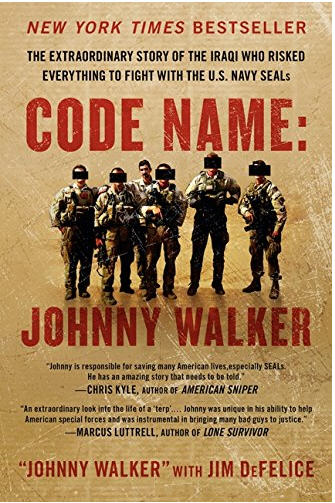
The book is called Code Name: Johnny Walker and was
written by the guy the SEALs called Johnny
Walker with the help of Jim DeFelice.
Who is Johnny Walker?
He was a resident of Mosul and was what they called a “terp”,
an interpreter who went with the SEALs on their missions. He went on hundreds
and hundreds of missions with them. And he offers a fascinating glimpse into what
life was like in Iraq during the Iraq War for those Iraqis who helped the
coalition forces.
The SEALs appreciated his service. I know this because a
host of them have blurbed his book. Furthermore, they helped him eventually immigrate
to America. That’s how grateful they were for his service.
If you like these types of books and would enjoy new
insights, I think you’ll really enjoy the book. Johnny Walker does swear a bit.
But I tend to take people as they are. And it was well worth time I spent
listening to him.
#
For Christmas my daughter received a number of seasons of The Great British Baking Show. It’s a
competition baking show. I’d heard about it before, but I’d seen episodes of American
competition cooking shows and didn’t enjoy them at all.
However, my daughter said this was nothing like the American
shows, that it was awesome, and it was so awesome she wanted to the DVDs for
Christmas so she could watch the episodes again. I needed to give it a try, she
said. So I gave it a try.
I’m happy to report that I and my family have are enjoying
the heck out of her DVDs.
The British folks that are competing in the challenges are down-to-earth
and interesting. Some of them are funny. The tips about baking are interesting.
And, best of all, the British show makers know how to create suspense.
They start each season with a group of twelve amateur bakers. Two professional bakers give them a baking challenge with a time limit and then judge the bakes. After a series of three challenges, the pros name a star baker for that series and then also announce who was at the bottom of the pack and will be leaving the show. If you like cooking or have ever found yourself watching a cooking program all the way through, I think you’ll really enjoy these fun, British bakers.
There’s nothing quite like the laughter and fun a good family or party game creates. And we discovered two games this summer that have brought hours of pleasure.
The first is Just One. It’s for 3 to 7 players and takes about 20 minutes to finish.
Now, I was skeptical of this game at first because it’s a cooperative party game.
I mean, come on. Cooperation?
No teams?
No competition?
What were we going to do—hold hands and sing Kumbaya?
I was fully expecting to be bored out of my mind. Boy, was I wrong. There was suspense, laughter, and loads of fun.
There are 13 rounds in each game. In each round, one player blindly selects the number of a word on one of the game cards. The other players each write a one word clue to help that player guess the word. However, if two or more players write down the same word, they have to remove that clue.
So you’re trying to come up with one-word clues the others won’t that still help the guessing player. Some clues lead the guessing player off onto funny tangents. Others are just funny. And then there’s the suspense of whether someone else wrote your word and whether the player will be able to guess it from the clues that are left.
Your goal is to guess all 13 words selected. And there’s a little score card that ranks what it means if you get 13, 12, 11, etc.
As an aside, it’s crazy to me that the score card provided motivation. But it did. It was a delightful little brain hack.
One Word is a quick, fun game. We’ve played it with a few as 3 and as many 8 players and had a ball each time. We are so happy to have it in the family game closet.
The next is Fish Bowl. It’s for 4+ players. What this game does is take favorites like Taboo, One Word, and charades and mixes them together in a competitive game between two teams.
Here’s how you play it. Each person writes up 5 to 7 different words or phrases on separate slips of paper, folds the papers, and puts them in a bowl. Then you do 3 rounds.
Round 1 is like Taboo, where you can describe, but can’t say or act out the word or phrase on the paper. You select a team to go first. One person on the team selects the papers from the bowl and then tries to describe the word or phrase. The team has 30-45 seconds (you decide) to guess as many of the words as possible. When the time is up, it’s the other team’s turn. Back and forth you go, selecting a new team member each turn to give the clues, until there are no more slips of paper in the bowl. Then you count the number of slips each team got and move to round 2.
In round two, you put all of the slips of paper back into the bowl. The team that went second in the first round starts this one. This time the person giving clues gets to share one word. That’s it. And the team has to guess it. Again, the team has 30-45 seconds to guess as many as they can. Then it goes to the next team. And you switch back and forth just like you did in round 1, and when the slips of paper are gone, each team counts up their score.
In round 3, you put all of the slips of paper back into the bowl. The time the person giving the clues has to act them out. No words allowed. You run this round just like you did the first two with 30-45 second turns, switching back and forth between the teams until all the papers are gone. At that point, the teams total their scores for this round and then for all 3 rounds together to see which team won.
If you don’t want to use paper, you can play a version online.
Either way, it’s another fast, fun game. In fact, we played it last night. And laughed and laughed when one daughter was trying to get the other to guess “sling” and nailed her teammate in the head trying to act out a rock hitting Goliath. Movies are great. But sometimes what you need is some delightful game fun. And I’m betting you’ll love these.
I just finished Three Days in Moscow: Ronald Reagan and the Fall of the Soviet Empire by Bret Baier. It’s a New York Times bestseller that takes you into the world of Ronald Reagan, his rise to power in politics, and his role in ending the Cold War. And it does in a personable way with gentle humor throughout.
I enjoyed the fascinating behind-the-scene insights about the personalities involved and the clarity about what really happened. And how the book brings Reagan to life, as if he’s almost there. Along the way you’ll also get insight into Mikhail Gorbachev, the assassination attempt on Reagan, and more.
Baier is the chief political anchor for Fox News. In 2001, he became the station’s chief Pentagon correspondent and ended up traveling to Afghanistan 11 times and Iraq 13 times. In 2007, he became the station’s chief correspondent to the White House. More importantly, Baier seems to be one of the few journalists these days who is simply trying to get and report facts instead of spin. And that’s exactly what he’s done here.
If you like biographies or history, if you want to know how the U.S.A. and the U.S.S.R. stepped back from decades of mutually assured destruction, if you want to get a view into how diplomacy is done, then I think you’ll love this book. And you’ll probably love it even more if you can listen to the audio book version, read by Baier himself, which also includes a recording of Reagan’s speech to the students at Moscow State University. I listened to it via the Overdrive account my public library provides. Baier’s reading was terrific.