“Would I be more excited about this book if I…”

As new writers we want to do our best but because we haven’t yet internalized all the principles, we often want to create checklists of rules. We want to list out all the the aspects of a golden story and make sure we include them.  And these lists can help.

Everything I’ve learned about building expertise suggests that experts have internalized guidelines, patterns, and concepts. But in the beginning we don’t have those internal constructs. And so we often are benefited by exetrnal support in the form of diagrams, lists, etc. Sooner or later we internalize. And what used to be conscious becomes automatic.

Case in point: Dean Koontz. In his book on how to write best sellers he states in so many words that you’d be in idiot not to have an outline. That was back in the late 1970’s. In an interview almost 30 years later about his Odd Thomas books, he says he never outlines. I suspect he’s so familiar with the form outlines are redundant for him now.

So lists can be good. But lists can also hinder us if we’re not careful.

For example, James Maxey, a great author, likes characters with dark secrets. He states: “One of my tricks for making my characters interesting is that the primary characters are usually motivated by a dark secret. Vendevorex in Bitterwood desperately does not want Jandra to learn that he killed her parents. Rail Blade in Nobody Gets the Girl doesn’t want anyone to know that she killed her brother with her superpowers in a moment of anger when she was still young. The key revelation for me is that the thing that the world most wants to know about a person is often the thing that a person least wants anyone to know.”

Dark secrets are kind of cool, right?

But if we then said, okay, a great story must have a character with a dark secret, and we put that on our list, that’s when we start to work against ourselves. The “must” is the problem.

Not because we don’t have tests and guidelines. Tests assume objectives. And I, for one, certainly do have objectives for my books as a whole an in their various parts. For example, I sure as heck want to make sure my opening chapter starts with a strong draw. I sure as heck want an ending that leaves me feeling some poignancy, cosolation, and a telescoping of possibilities. I most definitely want characters that intrigue me. I have some definite musts.

But any one of the techniques or elements we might list (dark secrets, 3 acts, 7 acts, the players in Campbell’s “Hero’s Journey,” characters with an internal problem, etc. and ad infinitum) are nothing more than options that might or might not serve any given objective. They’re not necessary (of course, monkeys may be necessary). And I don’t mean that in an anomaly way.

I’m not suggesting it’s counterproductive to say, well, I love characters [fill in the blank] or plots that [fill in the blank] and I want one in this novel. I’m saying if we begin to think that all (or most) good novels must have these elements, then I think we’ll end up limiting ourselves.

So when you find something that works, when you hear about a technique, or some writerly rule, put it on your list of option prompts. Not on your list of must haves. And then ask this creative question, which I got from another great author, Luc Reid: “Would I be more excited about this book if I…”

Another version might be: “Would I care about and believe in this story/character/scene/etc. more if I…”

Would I care about and believe in this story more if had a character with this [insert option]? Would I care more if this plot line had [insert option]? Would I believe the story more if there were monkeys hiding in the attic?

If the answer is yes, then add it. If the answer is no or maybe, then put it aside. That option can go back on the shelf for another time.

Share

Similar Posts

  • | |

    30 books you should read before you die

    An avid reader friend of mine began reading through the books in a list called “100 books you must read before you die.”

    She got to Jack Kerouac’s On The Road and went to Facebook and posted the following: “I don’t get the appeal. It’s about a group of boys/men who are irresponsible, drunks, whoring around taking advantage of others and being enabled by their women. Why is this a classic and why should I have wasted my time on it? Can some of my literary friends explain? I hated a brave new world and the handmaid’s tale too.”

    Is the book a classic?

    Should she read it before she dies?

    Is it really that important?

    Let me share an edited version of my response and then provide my list of 30 books you should read before you die.

    *

    Annette, the unfortunate truth is that these lists of “classics” are a sham because there is no objective criteria for determining literary excellence.

    Or maybe I should say that measuring quality in the arts isn’t like measuring the unambiguous, objective score of a baseball game. After books exhibit a certain level of proficiency, it becomes increasingly difficult to distinguish the quality of one book from another, especially because much of this depends on a reader’s interests and subjective experience of the story.

    When it becomes hard to rank performances, people rely on other measures. One of the most powerful is social networks.

    So if two readers find two different books that blow them away, one of the books might get all the attention because the one book gets picked up by a news service (The New York Times) or a platform (the Oprah Book Club effect) or some other social network of influence. A lot of the so-called literary classics only appear on various lists because they tapped into the academic network, which kept them alive far longer than they would have lasted otherwise.

    On The Road is simply a book that made a stir among some circles in the 1950s. That’s it.

    Was it more important or of higher quality than Exodus? The Chronicles of Narnia? Lord of the Rings? A Town Like Alice? All published in the 1950s as well.

    It depends.

    If you’re wanting to understand the 1950s beat culture, it would be an important book.

    But if you’re wanting to understand fantasy writing of the time, it wouldn’t.

    If you’re wanting to read a book that’s had a huge impact on popular culture, well, LOTR beats On The Road like a dog.

    Some people have the feeling that the so-called classics have some inherent medicinal value because someone put them on a list and called them classics.

    Nope. They’re just stories. Some of which can shed light on the issues and interests of a part of the culture in a given period. But if you’re not interested in that specific sub-culture, who cares?

    And if you’re reading to be entertained, moved, uplifted, or educated—which ones do that best for Annette is for you to decide.

    So all that to say I wouldn’t devalue your reaction to the book ?

    *

    I’m now going to give you my list.

    But it’s not going to be a list of titles. Nor will it focus on a book’s impact on some sub-culture of a given period.

    It’s going to be a real list. One that focuses on what so many of us go to stories for.

    1. The one that makes you weep.
    2. The one that makes you giggle and snort.
    3. The one that reminds you of what it’s like to fall in love.
    4. The one that gives you hope.
    5. The one that you begin to read more and more slowly because you don’t want it to end.
    6. The one that scares the soup out of you.
    7. The one that you can’t put down, even though you need to wake up early in the morning.
    8. The one that makes you wish you lived there.
    9. The one that’s so good that when you close it, you immediately start to read it a second time.
    10. The one that gives you and your child hours of pleasure together.
    11. The one that gives you a sacred, spiritual experience.
    12. The one that makes you reread some of the lines because the turns of phrase are just so delicious.
    13. The one that gives you courage.
    14. The one that takes you on an awesome adventure.
    15. The one that makes you want to be a better person.
    16. The one that bores you to tears (just so know you how good the others are).
    17. The one that introduces you to a different culture that delights you.
    18. The one that makes you think.
    19. The one that lingers with you for days.
    20. The one that gives you lovely insights.
    21. The one that inspires you to love your spouse more.
    22. The one that introduces you to the sorts of people you normally don’t like and makes you actually like them.
    23. The one that delights you with its characters.
    24. The one that whisks you away to a different historical period.
    25. The one that inspires you to give your children a hug.
    26. The one that gets your adrenaline pumping.
    27. The one that sparks all sorts of ideas in your head.
    28. The one that makes you wonder and start imagining what it would be like to be there.
    29. The one that blows your freaking mind.
    30. The one that makes you stand up in your living room and cheer.

    We could do more than 30, couldn’t we?

    Like the one that makes you think people from a different time period are just like us. And the one that makes you think people from that same period are completely alien.

    But I think we’ll stop. That there above is a list.

    Those are 30 books I think everyone will want to read before they die.

    Share
  • |

    Your single biggest challenge writing novels

    I’m about to put together a brand-new novel writing boot camp, but before I do that I want to know what would be most helpful to YOU.

    So if you want to write novels, my question to you is this…

    When it comes to writing novels, what’s YOUR single biggest challenge, frustration, or concern?

    Please CLICK THE LINK to tell me.

    Click here.

    As a thank you, those that answer the question will get a seat at a virtual, 1-hour training session I’m putting on where you discover 3 key principles of keeping your readers hooked.

    I look forward to the insights.

    You’re awesome ?

    Share
  • How to write a logline

    I have found that having a logline is not only essential to pitch a story, but it also helps me as I’m writing the story. An unnamed producer sent this to Orson Card who passed it onto his online workshop. It is the best tutorial I’ve ever come across on writing loglines. And everything Christopher Lockhart says about loglines can be used when pitching your novel to agents and editors. I would also read his article about pitching your story. Now I did a little digging and found these resources as well that include both Lockhart articles plus a examples of loglines that work and don’t and few other articles that you might find helpful.

    Share
  • |

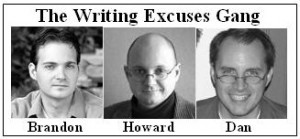
    John guests on Writing Excuses season 3 episode 16

    writing-excuses-the-guys2-300x139A while ago the Writing Excuses team asked me to record with them, and last Friday I got to do it and had a blast.

    We recorded three episodes. In the first podcast we talk about putting and not putting ourselves in our writing and making characters who don’t all sound like the author. As usual, the guys had some great insights. Check it out: The Anti-Mary Sue Episode.

    Share
  • The Novel Writers Academy – Do you want it?

    Are you tired of being educated ABOUT writing?

    Do you just want someone who knows what they’re doing help you do it?  

    Specifically, do you want to develop a killer story idea, outline it, and write the first 3 chapters with the guidance of a pro?

    If so, then here’s your chance to vote to have me create a course that will do just that. 

    Read on for more information…

    Educating versus Training

    When you’re educated about something, you can talk about concepts and principles. You can recall facts. But most people I know don’t want to be educated about writing. They want more than another class, podcast, video, or book about the topic.

    They want to be trained.

    They want to develop a killer idea, sketch it out, and actually begin writing. Not just watch or read about it. But they want some help.

    I’ve been asked many times if I would teach an online class or workshop, but I’ve put it off for years because I know that I don’t want to offer just another set of videos about writing.

    Of course, I will offer just videos. That’s all some people want.

    But I know there are others out there who want to go beyond that. They want on-the-job training. They want to develop a fun story, but don’t know the process well enough, and want someone who knows it to guide them.

    They want training.

    But training takes time. More than the time it takes to create videos or posts.

    That’s what I do, by the way. When I’m not writing novels, I work in corporate America training people to actually do things. Over the last 20 years I’ve trained people to do everything from give compelling presentations and speak Dutch to plan and schedule manufacturing plants and close their accounting books at the end of a financial period.

    And so I know there’s a difference between being educated about something and being trained.

    Just think about it. Do you want a surgeon who has been educated about surgery or one that’s been trained to perform surgery at a mastery level? Do you want a plumber who has been educated about plumbing, or one that’s been trained to plumb? Do you want your airplane pilot to be educated about flying or trained to fly, in all sorts of weather?

    Going to school and being educated is cool, awesome, and necessary. But we all know we have to go beyond that. We need to be able to actually DO things. Training requires you know concepts and principles, but it also requires you take the next step and actually do something.

    Do You Want Training?

    I’m willing to provide this on-the-job training, but before I develop and conduct this course, I need to know enough people are interested in it for it to be worth my time (it would probably be more sensible for me to focus exclusively on getting the books I need to write out the door, but I love to teach too, and had to figure out a way to do it).

    So here’s the test. If you want to take the class described below, sign up to express your interest.

    This does not obligate you to anything. It simply says that you are almost 100% sure you want to take the class, barring earthquakes, plagues of demons, or crazy in-laws.

    When enough people signup, I know it will be worth my time, and the love of teaching part of me will be able to convince the sensible part of me to do it.

    And then I’ll do a Kickstarter to make it official. Or I may just develop and release. We shall see.

    So, here’s more on the course.

    Your Novel’s Core: Develop a Killer Idea, Outline it, and Write the First 3 Chapters

    The first order of business is to determine if this course is right for you.

    Do you want to write a novel, but feel like you have no idea what you’re doing?

    Do you often get ideas for a character or setting or snippets of scenes and dialogue, but find they just never go anywhere?

    Are you tired of learning about writing, and just want someone who knows what they’re doing help you to do it?

    If so, this class is for you.

    This is not a theory class. Oh, we’ll talk about theory. You’re going to learn a ton of theory. But this isn’t about theory because I don’t care about theory. And neither, I suspect, do you. I care about developing an awesome story experience and sharing it with readers who enjoy it as much as I do.

    So I’m not interested in talking about it. I’m interested in doing it. And having fun.

    Which means that in this course you’re going to:

    • Develop at least 10 story ideas that beg you to write them
    • Select one of those ideas and create an outline
    • Write the first three chapters of that novel

    In order to do that, you will need to learn the secrets to:

    • A story idea that works and how to come up with one
    • Interesting characters and how to develop one
    • Transporting your reader to the story so they feel like they are witnessing the whole thing
    • Keeping readers on the edge of their seats
    • What story and plot are really about
    • Writers block and why it’s a gift (no, really, it is)
    • Knowing what comes next
    • Getting feedback from beta readers that’s actually helpful (and if you don’t know this, much of what you’ll get will be worthless)

    These secrets and many more. But remember: this isn’t a course about secrets. It’s a course about you actually improving your ability to generate story ideas, develop them into ideas worthy of a novel, and then write them.

    This means you need to not only produce, but also have someone who has the ability look at your work and guide you along. It means getting feedback.

    So I will be there helping you every step of the way. And if you’re writing in a genre I don’t know as well, I will loop in working authors who are successful in that genre to add their two cents.

    Fumbling in the Dark

    I started my novel writing career when I received a three-book, $50,000 deal from a major publisher. I am now an indie author with books that sell thousands of copies each year to readers all over the world. I’ve had publishers purchase and produce my books in audio. I’ve sold story rights to foreign publishers. I love developing and telling stories. And I love teaching others how to do the same.

    But when I started, years before that novel contract, I had no idea what I was doing. I didn’t know where to start stories, how to develop them, or even where they were supposed to end. And I didn’t have anyone to really help me. In fact, I remember asking one of my creative writing professors after class how you knew where to end your story. He looked at me, shrugged, and said, “I don’t know. I just end them.”

    What the heck?

    It was all a vast mystery. I loved stories, but I was clueless about what they were, how they worked, and how someone went about developing and writing one. I had a lot of fun, enjoyed my writing teachers (they were all great people), but I was never able to write something that hung together and felt like something you’d see in a movie or read in a book.

    But that didn’t discourage me. I kept at it. And over the years, I made a number of breakthroughs.

    What I discovered was that there are three things you must learn to write killer stories. You must learn:

    • What stories do to the reader
    • How they do that
    • And effective techniques for both developing and telling the story

    In this class, you’re going to learn those three things and the key principles for each, saving yourself all the frustration and discouragement that comes from trying to discover these insights by stumbling around on your own in the dark. With this class, you can cut years off the time it takes to learn how to write.

    When you know these three things, you will be able to write stories on purpose, instead of by accident. You will have power over your craft.

    You will see that instead of trying to remember a list of hundreds of “writing rules” or use “writing formulas,” many of which are nonsense, you’ll write by focusing on the simple and fundamental heart of what storytelling is all about.

    Course Outline and Price

    Below is a more detailed view of the course. My lessons are called quests because I’m expecting you to actually do something, not just watch.

    Quest 1: Discover what stories do, then create your personal story profile

    • The three things you must learn to write killer stories
    • Your personal story type
    • The three main reader responses you must generate
    • The big secret: trigger and delay
    • Genre
    • Sensitizing yourself

    Quest 2: Discover what you need at the core of your story, then perform a craft analysis of 2 of your favorite novels and report your findings

    • The story engine (without this, your story goes nowhere)
    • What makes characters interesting
    • The vital THOMR
    • The desire to gain or retain something specific
    • Formidable obstacles
    • Uncertainty
    • Surprise
    • The same but different
    • The 3 grunts

    Quest 3: Discover the secret to developing ideas, then develop 10 fully-formed story ideas that beg to be written

    • The 4 main creative principles you must follow
    • 5 super productive techniques for generating ideas
    • Creating a schedule and goals
    • Using the story engine job aid
    • Using the setting job aid
    • Using the magic job aid
    • Using the world building job aid
    • Using the character job aid
    • Using the formidable obstacle job aid

    Quest 4: Discover how to figure out what comes next, then develop your story sketch (outline)

    • The number of scenes for your story
    • The story cycle
    • Story turns
    • Trigger and delay
    • Structure, and why structure models so often fail to help

    Quest 5: Discover how to transport your reader to the story, then write your first three chapters

    • Techniques for telling your story so it’s vivid and clear
    • Narrative summary versus narrative detail and when to use  each
    • Effective description
    • Writing point of view, hot and cold
    • Orienting the reader
    • Transitions

    Quest 6: Discover the three main effects you should read for, then deliver a reader report for the first chapters of seven different novels

    • The 3 grunts (the secret that allows you to learn from other novels)
    • Reader report rules
    • How to get feedback for the rest of your project

    Quest 7: Discover your next steps, then create a plan

    • Methods to write quickly
    • What you need to do to publish independently
    • What you need to do to publish with a traditional publisher

    As you can see, in this course you aren’t going to just hear someone go on about theory. You’re going to define your type of story, surprise yourself by developing at least 10 solid story ideas that beg to be written (by you). Then you’ll select one of those ideas, sketch an outline, and write the first three chapters, all under my guidance, using the same practical, simple methods I use.

    Most important of all, you’ll actually stop thinking about writing and be well on your way to finishing your novel with a clear path to the end.

    Instead of dreaming about someday, you’ll enjoy the excitement of writing a novel right now.

    The cost of the course depends on what you want:

    • Access to all of the videos: $199
    • Access to all of the videos and two rounds of coaching on your story idea, outline, and first three chapters $399

    Not for everyone

    Having said that, you need to know that this class is not for everyone. If you are not willing to actually make time to do the work I ask, you will find no benefit.

    How much time will you need to spend?

    With all of the videos, reading, and development you’ll do, you should expect to take 30-40 hours. You can move through it at your own pace, but I strongly suggest you spend at least five hours per week. Any less than that, and you’re going to find it very difficult to keep your creativity hot enough to make dinner.

    Also, if possible, I recommend you take the course with a friend. You will progress so much more quickly when you discuss the lessons and insights and bounce your ideas off of each other.

    If you want to just watch the videos, that’s perfectly fine. If you want to actually develop a story and learn on the job, then you have to make time to do this awesome thing, just as you would if you wanted to learn how to dance, quilt, race cars, rappel, or paraglide.

    So if you aren’t in a position to make the time, I understand. Please don’t sign up.

    But if you’re interested, then click below to raise your hand as someone who is definitely interested. Once I see there are enough people interested, you’ll get the class.

    Yes, I’m definitely interested!

    If you’re interested, let me know by filling out the form below.

    This does not obligate you to anything. It simply says that you are almost 100% sure you want to take the class, barring earthquakes, plagues of demons, or crazy in-laws.
    * indicates required


    Share
  • Can you write for love AND money?

    Many artists think you can’t. And not simply because they envy those who are selling hundreds of thousands of copies.

    The reason they think this is for the simple fact that the creative process is fueled by following the zing. It’s ruled by passion. You have to care about AND believe in what you’re writing. You have to because if you think it’s boring or unbelivable, then it’s likely everyone else will as well. 

    For example, let’s say you are deeply bored by vampires, but see that vampire love stories are making piles of cash and decide to write about one with smoldering eyes and a bad habit of chewing tobacco even though it leads to dental problems with the fangs (hey, why would her man-toy care?), then you’re substituting passion (that which springs up from within) for graphs and plots about marektability (stuff that’s imposed from without).

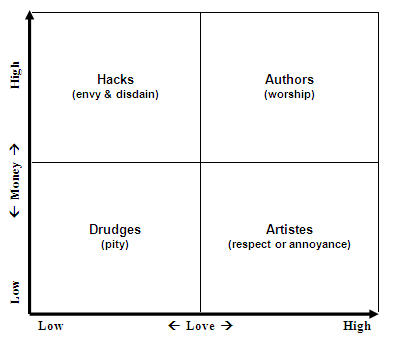
    And so many folks think that there’s a continuum. On one end is writing for passion. On the other is writing for money. And the two don’t cross. But this is a false dichotomy. The truth is that money and passion are independent factors.

    Lon Prater, a writer friend, recently expressed it this way.

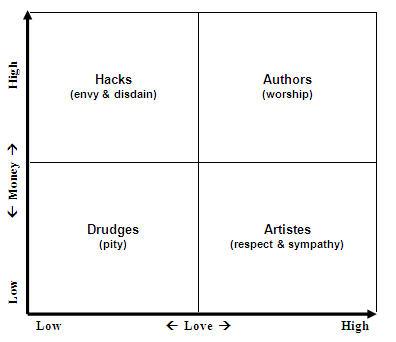
    Not a dichotomy, but rather an X and Y axis, the way I see it.

    There’s:

    low love, low money (SEO writing?)

    low love, high money (For me, this would be tech writing, or media tie-in to a universe I didn’t care about)

    high love, low money (unfortunately too much of my writing!)

    high love, high money. (Loftiest of goals) 🙂

    You can find datapoints for every quadrant, and of course “love” is highly subjective and individualized, as are what counts as low and high for each writer.

    If we put labels to the quadrants, we get something like this, along with common emotions they tend to evoke in other writers. (Although I will say that envy seems to want to run amok in the author quadrant as well.) 

    writer-love-and-money-quadrants2

    Share