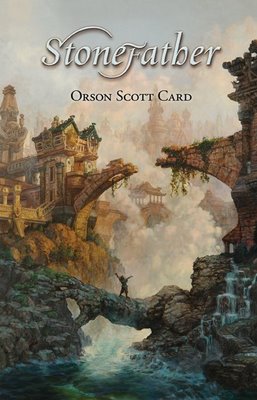
Stonefather by Orson Scott Card

stonefather_72dpi“When Runnel was born, he was given a water name even though there had never been a wetwizard in the family.

In the old days such names were given only to those babies as would be sacrificed to Yeggut, the water god. Later, such names were given to those whould would live to serve as priests to Yeggut. Still later, wetnames went to children of families thath pretended they once had a watermage in their ancestry.

But now, in the village o Farzibeck, wetnames were given because the mother was fond of a nearby brooklet or because the father had a freind with such a name.”

So begins Stonefather by Orson Scott Card. It tells the tale of Runnel who is the ninth son and fifteenth child of a farmwife who likes all her children well enough but calls them all “by each other’s names and didn’t know enough numbers to take a census and notice when one or two were missing.”  He’s also the son a man who beats him. Eventually, Runnel leaves home and seeks his fortunes in Mitherhome, the big city far to the south.

This isn’t a full novel, but a novella of 112 pages. However, the Subterranean Press edition has a glorious cover and ink illustrations inside. More importantly, the story tells a tale that’s full of wonder, humor, and a number of delightful characters. It reminded me of the best of Card’s Hatrack books. But, of course, this world is very different. It’s strange, and I was happy to explore it with Runnel as my guide. Take an hour to read this. You won’t be disappointed. Then you can look forward, as I do, to the first of the Mithermage novels based on this world.

Share

Similar Posts

  • Last Word & Park City Peaks

    LastWordGameMy youngest’s birthday fell on Thanksgiving this year. We asked her what she wanted to do. She said she wanted to go to a hotel to swim and then play a game as a family, so Nellie and I went to work. Nellie got the game. I got the hotel. Both were great.

    The game was Last Word by Buffalo Games Inc. It’s fairly simple. There are subject cards with categories on them like “vegetables,” “breeds of dogs,” or “places you find water.”  Then there are letter cards. Each player gets a subject card.

    The round starts when someone flips over a letter card. If you can think of a word that starts with that letter in your category, you shout it out, slam your subject card down, and then everyone else tries to come up with words that start with that letter and fit the category.  Or you try to think of words in someone else’s category if they beat you to it.  There’s no order to it–you just shout out the words as they come to your head.  The last one to come up with a word before the timer buzzes wins that round. The twist that makes it so fun, however, is that the timer is random.

    You can play individually, in teams, or some mix (our youngest and I teamed up). Because of the random timer, anyone who can think up a word can play, which means our daughter who is eight could compete with the one that was seventeen.

    We had a great time. One of the funniest things about it is that everyone is desperately trying to come up with words. Some fit, some don’t. Some don’t even exist. For example, when we did the category “male names,” number 3 shouted out “Mancake.” We couldn’t stop laughing. I think that one is going to enter the family vocabulary.

    ParkCityPeaksHotelWe also had a great time at the Park City Peaks hotel. As far as rooms go, they were good rooms. The bed was a bit too soft for me, but perfect for my wife. We got them for $65 a night, which isn’t bad at all. But it was the pool that made the experience. 

    The pool is an actual pool, not the big bathtubs some newer hotels offer. For example, the deep end is six feet deep. But the cool thing is that half of it is indoors and half of it is out. And the outdoor portion is heated. There’s also a large heated hot tub outside as well. In the picture it’s the thing producing the long row of steam in the back.

    It helped that we didn’t have much snow so the place wasn’t crawling with skiers. In fact, we had the pool mostly to ourselves. So imagine: there we were on a November night in this alpine setting, the steam rising off the water, swimming and horsing around underneath the winter stars. It was marvelous. You can be sure we’re going back.

    BTW, we had Thanksgiving dinner at a restaurant. Let me recommend this to you. It makes the day a breeze. You can still have your homemade turkey dinner, but picking up the turkey  a few days after the holiday allows you to get them for cheap, cheap, cheap.

    Share
  • Audio book is on the way

    This last week I listened to the reading of Bad Penny by Mikael Naramore on our trip down and back to Panguitch (and the forest fire from hell) and then later here at the house and was so happy I hooked up with Naramore. He’s done a wonderful job. He nailed the voices of Frank, Sam, Pinto, Carmen, Ed (ye slimy villain), and all the rest and delivered excellent sound. And the process was so easy.

    Right now ACX is doing its quality control on the production. When they clear it, it will be posted for sale on Audible, iTunes, and Amazon.

    I’m very excited to bring Frank to the audio market. I think he and Naramore are going to please a lot of listeners.

    Here’s the final cover for the audio book.


    Share
  • Bartimaeus & The Time Traveler’s Guide to Medieval England

    Pure Delight

    One of the most delightful literary characters to appear in the last decade is the cheeky Bartimaeus–a five-thousand-year-old djinni (“genie”) who plays the lead role in Jonathan Stroud’s trilogy The Amulet of Samarkand, The Golem’s Eye, and Ptolemy’s Gate.

    In Stroud’s world, magicians have no magic in themselves, but they do have the lore to summon and enslave demons, who can work magic. There are demons of various levels and powers. The lowest regularly summoned and enslaved are Imps, who can be crude and like to tell outright whoppers, but are good for standing watch and carrying messages. Next come Foliots, which Bartimaeus describes as “cut price djinn.” In the middle of the great chain of beings are the Djinn themselves, whose clever intelligence Bartimaeus extols, followed by Afrits, and finally Marids, who are rarely summoned because they are too strong for any but the most powerful magicians to control. Of Marids, Bartimaeus insightfully reveals that they are “dreadfully full of themselves.”

    In the trilogy, Bartimaeus is summoned and enslaved to do the bidding of a sometimes jerkish young magician who learns to be a better person, despite himself. Of course, along the way the magician sends Bartimaeus in great peril, which he eludes with cunning, sardonic wit, and many good one-liners. I read the first book, loved it, then listened to all three read by Simon Jones, who makes these stories even better. The sad news is that I finished them. I simply wasn’t ready to let Bartimaeus go.

    Which is why I was so happy to find that Stroud recently released a fourth book: The Ring of Solomon, which is a stand-alone prequel to the trilogy. The family and I just finished listening to it, and it is every bit as good, if not better, than the first three.

    This story is set in biblical times where King Solomon has risen to uncontested power because of his possession of an all-powerful ring which allows him to summon hordes of powerful demons in a blink. Bartimaeus is enslaved to one of Solomon’s magicians.  A mean man, who Bartimaeus catches in a mistake and escapes, principally by devouring him. But Solomon doesn’t take kindly to that, and orders Khaba, a sinister and cruel magician, to summon him back to make an example for the other demons.

    Meanwhile, the Queen of Sheba, having denied Solomon’s marriage proposal three times, is sent an extortion threat.  Angry and frightened, she sends Asmira, a young woman and loyal captain of the guard, to Jerusalem to assassinate Solomon.

    Bartimaeus and Asmira hook up and find themselves in quite a pickle as they attempt to solve their problems. The story provides lots of humor, adventure, peril for both Bartimaeus and Asmira, and a number of surprising turnarounds. It also, in its own way, makes a comment on leadership, loyalty, and zealotry.

    You’ll find it in the middle-grade section of your bookstore, but don’t let the placement fool you into thinking it’s not for adults. Like the best stories, it offers something for everyone. It’s a perfect blend of insight and entertainment and had my whole family, oldest to youngest, spellbound for the duration as we listened to it riding in the car. This is one of my favorite books this year. And if you want to really indulge yourself, listen to the audio book read by Simon Jones.

    Travel to Medieval England

    I love learning new things about places and peoples, even if it’s a place I’ve “been” to before, which is why Ian Mortimer’s The Time Traveler’s Guide to Medieval England intrigued me. The first page convinced me to buy to book. And I’m so happy I did.

    I’ve read my fair share of interesting and well-written texts on this subject, including, among others, Life in a Medieval City and Life in a Medieval Village by Frances and Joseph Gies, Standards of Living in the later Middle Ages by Christopher Dyer, The Medieval Castle by Philip Warner, Daily Life in the Middle Ages by Paul B. Newman, and Power and Profit: The Merchant In Medieval Europe by Peter Spufford. All engrossing reads. What sets Mortimer’s book apart is that he not only approaches the topic as a travel guide that leads to you interesting sights and shares fascinating tidbits about the place, but he also helps you imagine how it would be, as a 21st century person, to actually travel there.

    For example, where would you go if you got sick? What happens if you’re robbed, where do you report the crime, and should you? Where might you get food and would it be something you’d find palatable? How will you get from place to place? Why kind of entertainment can you expect? And what can you wear without offending your hosts?

    Mortimer focuses on the fourteenth century England, since this period comes closest to the popular idea of the medieval times. He tackles the topics of the landscape, people, the Medieval character, basic essentials, what to wear, traveling, where to stay, what to eat and drink, health and hygiene, the law, and what to do. And he does it all in a chatty, clear, and informative manner, with a bit of humor thrown in for spice.

    Each page was a delight, and I found myself feeling like I was there. Furthermore, I learned a number of things that I hadn’t picked up in my previous readings. I’m tempted to quote all sorts of interesting tidbits he shares about the age, but I’ll refrain. If you are at all interested in the Middle Ages, I think you’ll love this book.

    Share
  • | |

    Building Expertise by Ruth Colvin Clark

    When we find a great teacher, we prize them not only because what we learn improves our lives but also because good learning can be one of the most exhilirating things we experience. Unfortunately, a lot of teaching stinks. It’s boring, rambling, forgettable.

    I’ve made a study of teaching. I’ve had to. For almost 20 years I’ve taught and designed courses in the private sector. And for many of those years my work has been in a revenue generating department. What that means is that if my classes are ineffective and dull, nobody signs up, revenue falls, and a lot of folks will stand around and wonder if it might not be better to just replace me with a potted plant. At least a plant would be something pleasant to look at, plus it would also clean the air.

    Now not everything I do is stellar (I wish that were so). Sometimes in the quality, cost, speed triangle, quality is the thing that takes the hit. But the point is I have to be alert and try to miminize the schlock. But how do you do that? How do you develop and deliver effective and interesting education?

    Luckily, the field of instructional technology (I’m not talking about computers, but principles of instruction) has come a long way in identifying what works and what doesn’t. This is important because teaching theories of the past (many of which are still used today) often relied on rules of thumb and anecdotal evidence. Their precriptions were often ineffective and sometimes counterproductive. What’s exciting is that in the last few decades researchers in this area have put techniques and principles to the test. We know better now than ever before how to structure learning that is effective and interesting. And I have yet to find a better explanation of the proven techniques and principles than Ruth Colvin Clark’s Building Expertise: Cognitive Methods for Training and Performance Improvement, 3rd Edition.  

    Don’t let the “training” part fool you. We often associate “training” with learning procedures and simple tasks (which is what leads to the “we want to provide sex education, not sex training” obfuscation). But Clark isn’t using the term that way. Training here includes all types of learning.

    What Clark does is not only share the techniques that build expertise, but also the psychological reasons and research-based evidence for those techniques. This isn’t nonsense based on personality or political correctness. It’s practical and proven.

    Among other things, you’ll learn:

    • Why working memory is key to instruction and how to overcome its limits
    • How to motivate learners
    • How to structure learning
    • When to use lecture and when to put learners into action
    • What methods work best

    You’ll learn when taking notes can actually be counterproductive and what you can do about it. Or how making your delivery more personable (and what that means) can actually improve attention. You’ll see why lots of practice isn’t always the best answer–sometimes your child will learn more if you do half of their homework questions for them.

    You’ll find that there “Is no Yellow Brick road” in teaching. Instead, you’ll see that the effectiveness of any method depends on whether it’s suited to the specific situation. And Clark will explain what the key factors in any situation are so you know which methods to apply and the trade-offs you’ll make when you do.

    If you’re a teacher in any setting–family, job, church, school, or recreation–or if you’re trying to teach yourself, this book (specifically the 3rd edition) will be a goldmine for you. I can’t recommend it highly enough.

    Share
  • |

    Ender’s World: Fresh Perspectives on the SF Classic Ender’s Game

    Smart Pop publishes smart, fresh, and engaging articles on the best of pop culture TV, books, and film, with a particular focus on science fiction and fantasy television and literature.

    You want to hear what Scott Westerfield (Uglies, Pretties, etc.) has to say about Buffy?  Go to Smart Pop.

    What about Orson Card’s thoughts on Joss Whedon’s Firefly universe? Smart Pop.

    What about the venerable Lawrence Block on Robert B. Parker’s Spenser series? Um, Smart Pop.

    Strange.  Do you see a pattern emerging? 

    Whether it’s Mad Men, House, Hunger Games, George Martin’s epic fantasies, Halo, True Blood, or Alias, Smart Pop gathers together New York Times bestselling authors, television writers, psychologists, philosophers, and others–folks who love of pop culture and have something worth sharing about it–and asks them to share their insights.   

    Recently, they’ve been putting together just such a collection on Ender’s Game.  It’s called Ender’s World: Fresh Perspectives on the SF Classic Ender’s Game. It’s coming out February 2013.  You can read more about it here.

    I’m announcing this now because The Man was fortunate enough to be invited to contribute.  I love Ender’s Game.  LOVE IT.  How cool is it that I get to write about it in an anthology edited by the folks at Smart Pop and Card himself? And then get to read what everyone else has to say, including military strategists Colonel Tom Ruby and Captain John Schmitt.  As well as the little bits they’ll include on things like why the battle room is the shape it is and why they were recruiting kids.

    But I’m also announcing this because in addition to the essays all we Ender-lovers get to write, Smart Pop is also going to include a series of Q&As with Scott Card, and they are currently soliciting the question from readers. FROM YOU. Right now.

    You ever wonder about a character or part of the setting or event in Ender’s Game?  Ever wanted to know what inspired Card? Ever wanted to ask any question at all about Ender’s Game?  Now’s your chance. Just submit you question here: http://www.smartpopbooks.com/ask-orson-scott-card-a-question-about-enders-game/

    You can see questions already submitted at Smart Pop’s Tumblr.

    From a writer’s pov, I have to tell you that the folks at Smart Pop have been nothing but enjoyable and insightful to work with. I’m looking forward to this book!

    Share