Gapminder Website
After watching two of Roslings’ presentations at TED, I had to find his website. Or at least the gapminder website. You’re going to love noodling around with the free tools out there.
After watching two of Roslings’ presentations at TED, I had to find his website. Or at least the gapminder website. You’re going to love noodling around with the free tools out there.

In Why Publishing is Making You Crazy—and What You Can Do About It: The Tao of Publishing, Steven Axelrod and Julie Anne Long write an interesting post that takes some findings made by Duncan Watts and attempts to explain why writers should only focus on the quality of their work because they cannot reliably affect popularity in any other way.
I agree with them that social-influence seems like a good explanation for the sometimes unexplicable successes we see in publishing and the difficulty publishers have in both predicting and producing a steady stream of hits. However, I do not find support for their main conclusion that writers can do nothing but write. In fact, I suggest that Watts’ findings show quite the opposite.
Axelrod and Long base much of their argument on an experiment conducted by Duncan Watts that tested the power of social-influence on music selection in some controlled music websites. Watts summarizes his findings in the excellent Is Justin Timberlake a Product of Cumulative Advantage?.
In his part of the post, Axelrod points out that the Watts findings indicate “50% of the factors affecting your career could be totally outside of your control—totally random” and that “unless we can separate out those random factors which contributed to an author’s past success [and we can’t, Axelrod suggests], anything we can say or predict about why she succeeded will invariably be way off-the-mark.” And therefore “what’s interesting—and chilling, as well—is that there’s evidence that the harder a person works to make sense of a random event, the farther they’ll end up from the truth.”
In other words, the only thing an author can reliably do to improve the popularity of his stories is focus on their instrinsic quality. And get more stories out so he has more shots in the fickle social-influence game.
I agree that having more product in the market increases your odds. I also agree that focusing on the intrinsic quality of the writing can do the same. I even agree that this is where authors should spend most of their time. However, Watts’ studies do not indicate other efforts are wasted. In fact, they suggest the opposite.
Watts does not controvert anything we now know about marketing. What he does is clarify the power of social-influence in our decision making and the dynamics of ONE type of endorsement system. What Watts shows is:
These findings, however, need to be put in context. From cars, to camcorders, to recipes, the popularity of a product depends on three main factors. These aren’t new ideas and publishing is no different than any other industry. The factors come from long-standing marketing practice:
Each of these three affects the other two. Visibility makes endorsements and initial attractiveness possible. Endorsements make a product more attractive and more likely to be visible. Attractiveness makes something more visible and more likely to be endorsed. And round and round we go.
It’s true that Watts shows 50% of the effect is due to endorsement. But nowhere does Watts suggest an author cannot increase the probability of visibility and endorsement.
In the study, the endorsement method used was a counter showing the number of times the song had been downloaded. It was random, anonymous, and perceived as unbiased. That was a controlled environment. However, what if a singer had been able to ask all those he knew who loved his song to download it from the site? Or what if someone organized such a campaign independent of the singer? Both actions would immediately affect the probability of the song increasing in visiblity and endorsement and, hence, popularity.
It’s too bad Watts didn’t test this in one of his sites to see if he could make a winner. As it was, all Watts was doing was seeing if he could predict a success by quality alone. He was passively observing, not actively taking measures to increase visibility and endorsement.
Furthermore, the counter is just one type of endorsement system. There are a number of others. We’ve all seen how an Oprah endorsement can move the market. The identity of that endorser is NOT random and has great predictive value. Her decision to endorse is still random. But what if you have a way to make your book visible to her? Would it be a waste of time to do so?
Robert Sawyer loves to tell of one action he took with someone with much less endorsement power than Oprah and the effect it had on his sales. Was Sawyer guaranteed visibility and endorsement from that action? No. However, he DID increase the probability, and it resulted in sales. Here’s his account.
Watts confirms that endorsements have a mighty effect on popularity. Even something as simple as a “most downloads” counter can easily overwhelm a listener’s own reactions. But the logical conclusion is not to do nothing. The logical conclusion is that if authors want to increase their popularity, they must not rely only on the intrinsic value of their product, but they must also search for ways to increase visibility and endorsement.
Axelrod is correct that it’s sometimes difficult to see the effect of any given marketing campaign or tactic. This is because marketing efforts are probabilistic, not deterministic. However, probabilistic does not mean random. Furthermore, it does not indicate you cannot increase the probability of success. While publishers may not be able to produce best sellers every time, I’m confident if they decided to stop marketing altogether, sales would drop.
Will all efforts succeed? No. Any marketing progam needs to consider the effect of diminishing returns. The effectiveness of some actions may be difficult to test. Furthermore, authors may not have the budget to run a campaign large enough to increase their probabilities, although there are strategies to become a big fish in a small pond (see Geoffery Moore’s Crossing the Chasm).
Despite all these issues, we know, in general, getting endorsements helps. In general, the right placement in book stores increases visibility. Author visits to schools, if done right for middle age readers, can also increase visibility. Radio interviews, if done right, do the same. There are many things that DO improve an author’s odds. We can increase the probability of visibility and endorsement by taking intelligence, consistent action.
And that’s good news. We might not be able to guarantee a hit, but one thing IS certain—we’ll have no direct influence on visibility and endorsement if we do nothing.
(BTW, for those interested, here’s a great presentation on a related idea:Six Degrees: The Science of the Connected Age a presentation by Duncan J. Watts.)
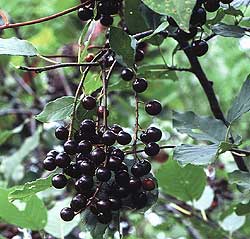 When you live where we do, you cannot hope to landscape likes folks in a warm suburb. First of all, at 6,000 feet with a min temp of -30 Fahrenheit you can’t grow a lot of warmer climate plants. Second, the deer seem to eat everything else you do grow. So we’ve been looking and I think I’ve found a tree to add.
I actually found it earlier when I was biking around the beautiful Round Valley and had to stop and go back to revel in the delicious fragrance. But I didn’t know what it was at the time. I do now.
It’s the black chokecherry.
It grows naturally up here. Has beautiful fragrant blossoms in the spring. And it produces fruit that can be made into a delicious syrup. Oh, the raccoons like it as well.
Now when you eat the raw berry, unless you eat it late in the fall, you’re in for an astringent, alum after-punch. But we picked the berries up a canyon behind our town after the first frosts. In fact, many of our berries were wrinkled. They just fine raw. Even Lilia, my pickiest eater, enjoyed them.
We picked about 1.25 gallon ice cream buckets of the stuff. Then we followed this recepie and made about 4 quarts of syrup.
It’s absolutely delicious on pancakes.

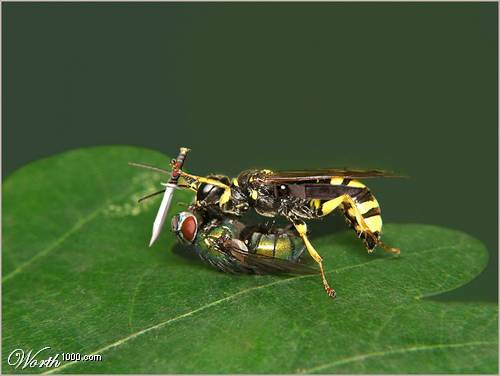
This idea.
Oh, my, heck.
One of my first novelettes was about using insects as military grade spies. Just a bit of wetware to get control of their brains. Then mount a nano recording and transmitting device…
How are you going to stop that?
But wait–insects can be far more sinister.
Jeffrey A. Lockwood has written Six-Legged Soldiers: Using Insects as Weapons of War. I can’t wait to read this. I hope it’s not a fluff book. Can’t wait to report my findings to you. Read more about it.
Oh, and did I mention that I’ve got weaponized insects in the novel I’m currently working on? Crown of a Dark God is turning into such a blast to write.
The deer came through this morning and ate the peanuts and cheese.
The good news is it appears the crows actually heard the weird call mix yesterday and had been scoping the place out for some time. My oldest saw them on the east. I saw them on the west. Then yesterday evening after writing the last post the pair of crows returned and did some acrobatics down the hill maybe 50 yards from the house.
Today I found some calls from the Crow Busters site. I created a new playlist using the Rally, Attention, and Look Here calls. I set out a pie tin, a bit further from the house with a few Sun Chips and a handful of large bird seed (dried corn, sunflower, etc.) in it. Then I played the calls for about 20 minutes.
Results: Nellie said she wanted to throw herself off the balcony. I’m telling you, these birds would not get the golden ticket on Avian Idol.

Some people must think I’m nuts. It appears crows can cause quite a bit of damage and have in other parts of the country. The folks at Crow Busters have listed their litany of reasons for hunting the birds. But they’re scarce where I live, so I’m not too worried.
Results of today’s efforts: nothing.
From Edmund Schubert, editor of Orson Scott Card’s Intergalatic Medicine Show:
“During the month of February we are going to make one story from each of our first four issues available at no charge. Two stories will be set free on February 1st, and two more on February 15th. Just visit www.intergalacticmedicineshow.com and explore the table of contents; the free stories will be clearly marked.”
Of course, having been published in the first issue and slated to be the cover story for the Spring 2008 issue, I can vouch for the magazine’s impeccable taste and the gigawatt entertainment buzz you’ll get from the stories they select.
