|

Black Chokecherry Syrup

When you live where we do, you cannot hope to landscape likes folks in a warm suburb. First of all, at 6,000 feet with a min temp of -30 Fahrenheit you can’t grow a lot of warmer climate plants. Second, the deer seem to eat everything else you do grow. So we’ve been looking and I think I’ve found a tree to add.

I actually found it earlier when I was biking around the beautiful Round Valley and had to stop and go back to revel in the delicious fragrance. But I didn’t know what it was at the time. I do now. 

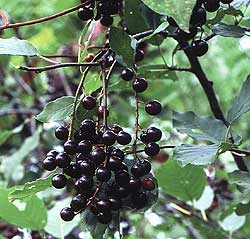
It’s the black chokecherry.

It grows naturally up here. Has beautiful fragrant blossoms in the spring. And it produces fruit that can be made into a delicious syrup. Oh, the raccoons like it as well.

Now when you eat the raw berry, unless you eat it late in the fall, you’re in for an astringent, alum after-punch. But we picked the berries up a canyon behind our town after the first frosts. In fact, many of our berries were wrinkled. They just fine raw. Even Lilia, my pickiest eater, enjoyed them.

We picked about 1.25 gallon ice cream buckets of the stuff. Then we followed this recepie and made about 4 quarts of syrup.

  • 3 cups chokecherry juice (see first step)
  • 3 cups apple juice (not from a store, but cooked from apples)
  • 6 1/2 cups sugar
  • (I’ve heard some folks add 1/4 teaspoon almond extract for a stronger cherry taste)
  1. Wash chokecherries, place in a large kettle, barely cover with water and cook, covered, for about 30 minutes till the cherries are soft. Mash gently and strain the chokecherry juice through a sieve or cheesecloth.
  2. Do the same with the apples.
  3. Pour the juice into a large kettle; stir in the sugar.
  4. Cook on high, stirring constantly.
  5. Boil hard for 1 minute.
  6. Remove from heat and skim foam.
  7. To can: Pour hot syrup into sterilized hot jars to within 1/8th inch from top.

It’s absolutely delicious on pancakes. 


Share

Similar Posts

  • | |

    30 books you should read before you die

    An avid reader friend of mine began reading through the books in a list called “100 books you must read before you die.”

    She got to Jack Kerouac’s On The Road and went to Facebook and posted the following: “I don’t get the appeal. It’s about a group of boys/men who are irresponsible, drunks, whoring around taking advantage of others and being enabled by their women. Why is this a classic and why should I have wasted my time on it? Can some of my literary friends explain? I hated a brave new world and the handmaid’s tale too.”

    Is the book a classic?

    Should she read it before she dies?

    Is it really that important?

    Let me share an edited version of my response and then provide my list of 30 books you should read before you die.

    *

    Annette, the unfortunate truth is that these lists of “classics” are a sham because there is no objective criteria for determining literary excellence.

    Or maybe I should say that measuring quality in the arts isn’t like measuring the unambiguous, objective score of a baseball game. After books exhibit a certain level of proficiency, it becomes increasingly difficult to distinguish the quality of one book from another, especially because much of this depends on a reader’s interests and subjective experience of the story.

    When it becomes hard to rank performances, people rely on other measures. One of the most powerful is social networks.

    So if two readers find two different books that blow them away, one of the books might get all the attention because the one book gets picked up by a news service (The New York Times) or a platform (the Oprah Book Club effect) or some other social network of influence. A lot of the so-called literary classics only appear on various lists because they tapped into the academic network, which kept them alive far longer than they would have lasted otherwise.

    On The Road is simply a book that made a stir among some circles in the 1950s. That’s it.

    Was it more important or of higher quality than Exodus? The Chronicles of Narnia? Lord of the Rings? A Town Like Alice? All published in the 1950s as well.

    It depends.

    If you’re wanting to understand the 1950s beat culture, it would be an important book.

    But if you’re wanting to understand fantasy writing of the time, it wouldn’t.

    If you’re wanting to read a book that’s had a huge impact on popular culture, well, LOTR beats On The Road like a dog.

    Some people have the feeling that the so-called classics have some inherent medicinal value because someone put them on a list and called them classics.

    Nope. They’re just stories. Some of which can shed light on the issues and interests of a part of the culture in a given period. But if you’re not interested in that specific sub-culture, who cares?

    And if you’re reading to be entertained, moved, uplifted, or educated—which ones do that best for Annette is for you to decide.

    So all that to say I wouldn’t devalue your reaction to the book ?

    *

    I’m now going to give you my list.

    But it’s not going to be a list of titles. Nor will it focus on a book’s impact on some sub-culture of a given period.

    It’s going to be a real list. One that focuses on what so many of us go to stories for.

    1. The one that makes you weep.
    2. The one that makes you giggle and snort.
    3. The one that reminds you of what it’s like to fall in love.
    4. The one that gives you hope.
    5. The one that you begin to read more and more slowly because you don’t want it to end.
    6. The one that scares the soup out of you.
    7. The one that you can’t put down, even though you need to wake up early in the morning.
    8. The one that makes you wish you lived there.
    9. The one that’s so good that when you close it, you immediately start to read it a second time.
    10. The one that gives you and your child hours of pleasure together.
    11. The one that gives you a sacred, spiritual experience.
    12. The one that makes you reread some of the lines because the turns of phrase are just so delicious.
    13. The one that gives you courage.
    14. The one that takes you on an awesome adventure.
    15. The one that makes you want to be a better person.
    16. The one that bores you to tears (just so know you how good the others are).
    17. The one that introduces you to a different culture that delights you.
    18. The one that makes you think.
    19. The one that lingers with you for days.
    20. The one that gives you lovely insights.
    21. The one that inspires you to love your spouse more.
    22. The one that introduces you to the sorts of people you normally don’t like and makes you actually like them.
    23. The one that delights you with its characters.
    24. The one that whisks you away to a different historical period.
    25. The one that inspires you to give your children a hug.
    26. The one that gets your adrenaline pumping.
    27. The one that sparks all sorts of ideas in your head.
    28. The one that makes you wonder and start imagining what it would be like to be there.
    29. The one that blows your freaking mind.
    30. The one that makes you stand up in your living room and cheer.

    We could do more than 30, couldn’t we?

    Like the one that makes you think people from a different time period are just like us. And the one that makes you think people from that same period are completely alien.

    But I think we’ll stop. That there above is a list.

    Those are 30 books I think everyone will want to read before they die.

    Share
  • |

    Is Product Popularity Random?

    In Why Publishing is Making You Crazy—and What You Can Do About It: The Tao of Publishing, Steven Axelrod and Julie Anne Long write an interesting post that takes some findings made by Duncan Watts and attempts to explain why writers should only focus on the quality of their work because they cannot reliably affect popularity in any other way.

    I agree with them that social-influence seems like a good explanation for the sometimes unexplicable successes we see in publishing and the difficulty publishers have in both predicting and producing a steady stream of hits. However, I do not find support for their main conclusion that writers can do nothing but write.  In fact, I suggest that Watts’ findings show quite the opposite.

    Axelrod and Long base much of their argument on an experiment conducted by Duncan Watts that tested the power of social-influence on music selection in some controlled music websites. Watts summarizes his findings in the excellent Is Justin Timberlake a Product of Cumulative Advantage?.

    In his part of the post, Axelrod points out that the Watts findings indicate “50% of the factors affecting your career could be totally outside of your control—totally random” and that “unless we can separate out those random factors which contributed to an author’s past success [and we can’t, Axelrod suggests], anything we can say or predict about why she succeeded will invariably be way off-the-mark.” And therefore “what’s interesting—and chilling, as well—is that there’s evidence that the harder a person works to make sense of a random event, the farther they’ll end up from the truth.”

    In other words, the only thing an author can reliably do to improve the popularity of his stories is focus on their instrinsic quality. And get more stories out so he has more shots in the fickle social-influence game.

    I agree that having more product in the market increases your odds. I also agree that focusing on the intrinsic quality of the writing can do the same. I even agree that this is where authors should spend most of their time. However, Watts’ studies do not indicate other efforts are wasted. In fact, they suggest the opposite.

    Watts does not controvert anything we now know about marketing. What he does is clarify the power of social-influence in our decision making and the dynamics of ONE type of endorsement system. What Watts shows is:

    1. A perceived non-bias endorsement of your product can have a huge effect in the product’s popularity.
    2. The intrinsic quality of the product has an effect on popularity, but social-influence plays as large or larger role.
    3. Popularity in the system set up in the test websites depended on the decisions of a few early-arriving potential endorsers, i.e. good early reviews (downloads in this case) are amplified and lead to an effect he calls “the richer getting richer.”
    4. In this one endorsement system, neither a future endorsement nor the identity of the early endorser can be predicted.

    These findings, however, need to be put in context. From cars, to camcorders, to recipes, the popularity of a product depends on three main factors. These aren’t new ideas and publishing is no different than any other industry. The factors come from long-standing marketing practice:

    1. Visibility (people know about it)
    2. Endorsement (recommendation from an attractive person, trusted authority or friend, or trusted system like the perceived unbiased reviews on Amazon or “most downloads” stats)
    3. Attractiveness (intrinsic to the product, the perceived value offered the target market, and the social effect as pointed out by Watts)

    Each of these three affects the other two. Visibility makes endorsements and initial attractiveness possible. Endorsements make a product more attractive and more likely to be visible. Attractiveness makes something more visible and more likely to be endorsed. And round and round we go.

    It’s true that Watts shows 50% of the effect is due to endorsement. But nowhere does Watts suggest an author cannot increase the probability of visibility and endorsement.

    In the study, the endorsement method used was a counter showing the number of times the song had been downloaded. It was random, anonymous, and perceived as unbiased. That was a controlled environment. However, what if a singer had been able to ask all those he knew who loved his song to download it from the site? Or what if someone organized such a campaign independent of the singer? Both actions would immediately affect the probability of the song increasing in visiblity and endorsement and, hence, popularity.

    It’s too bad Watts didn’t test this in one of his sites to see if he could make a winner. As it was, all Watts was doing was seeing if he could predict a success by quality alone. He was passively observing, not actively taking measures to increase visibility and endorsement.

    Furthermore, the counter is just one type of endorsement system. There are a number of others. We’ve all seen how an Oprah endorsement can move the market. The identity of that endorser is NOT random and has great predictive value. Her decision to endorse is still random. But what if you have a way to make your book visible to her? Would it be a waste of time to do so?

    Robert Sawyer loves to tell of one action he took with someone with much less endorsement power than Oprah and the effect it had on his sales. Was Sawyer guaranteed visibility and endorsement from that action? No. However, he DID increase the probability, and it resulted in sales. Here’s his account.

    Watts confirms that endorsements have a mighty effect on popularity. Even something as simple as a “most downloads” counter can easily overwhelm a listener’s own reactions. But the logical conclusion is not to do nothing. The logical conclusion is that if authors want to increase their popularity, they must not rely only on the intrinsic value of their product, but they must also search for ways to increase visibility and endorsement.

    Axelrod is correct that it’s sometimes difficult to see the effect of any given marketing campaign or tactic. This is because marketing efforts are probabilistic, not deterministic. However, probabilistic does not mean random. Furthermore, it does not indicate you cannot increase the probability of success. While publishers may not be able to produce best sellers every time, I’m confident if they decided to stop marketing altogether, sales would drop.

    Will all efforts succeed? No. Any marketing progam needs to consider the effect of diminishing returns. The effectiveness of some actions may be difficult to test. Furthermore, authors may not have the budget to run a campaign large enough to increase their probabilities, although there are strategies to become a big fish in a small pond (see Geoffery Moore’s Crossing the Chasm).

    Despite all these issues, we know, in general, getting endorsements helps. In general, the right placement in book stores increases visibility. Author visits to schools, if done right for middle age readers, can also increase visibility. Radio interviews, if done right, do the same. There are many things that DO improve an author’s odds. We can increase the probability of visibility and endorsement by taking intelligence, consistent action.

    And that’s good news. We might not be able to guarantee a hit, but one thing IS certain—we’ll have no direct influence on visibility and endorsement if we do nothing.

    (BTW, for those interested, here’s a great presentation on a related idea:Six Degrees: The Science of the Connected Age a presentation by Duncan J. Watts.)

    Share
  • Good Stuff! Lindybeige Rocks!

    I’ve been watching Lindybeige videos for a few years now. Lindybeige is the online name for Nikolas Lloyd, a smart, funny geek of the re-enactement, fencing, and RPG line. He’s got a youtube channel that is chock full of videos in which he makes witty and insightful points about ancient and medieval warfare, archaeology, dance, and anything else that takes his fancy.

    For example, have you ever seen folks pushing each other about with swords? Is that realistic?

    Interesting, what about pushing in a shieldwall?

    Food for thought, isn’t it? It makes me want to go read up on shieldwalls. Were they really as he concludes they were? But enough about history and conjecture. What about the truth? What about science? For example, if you believe in science, must you also believe in a certain approved list of theories?

    But surely that doesn’t apply to Global Warming Theory, which is now called Man-made Climate Change because the warming bit never panned out. No?

    Wow, and he even accepts the data on the warming. Okay, enough about the truth. Back to fantasy geekiness and weapons in fantasy worlds that make sense.

    I love this guy. If you’re a fantasy geek and haven’t yet begun to watch Lindybeige, you’ve got a lot of enjoyment ahead of you.

    Share
  • Good Stuff! 2 Sauces You Don’t Want to Miss

    What have the Dutch got that we ain’t got?

    Well, besides signs like this.

    geenhondenpoepopdestoep

    Which is frequently accompanied by the words “Geen Honden Poep Op De Stoep”(no dog poop on the sidewalk).

    I’ll tell you what they have—easy access to sambal oelek (SAHM-bal OO-lek). Sambal oelek is Indonesian for “dang good chili paste.”


    SambalOelek

    And why I started this post with the dog sign, I don’t know. Probably not the best lead in for food. But put that out of your mind now.

    You have avoided the dog, and are now sitting down to a delicious meal. And it’s been made even more delicious because you used sambal oelek. “Sambal” means something like “condiment” or “sauce.” There are a lot of different sambals, of course.  Oelek refers to a type of Indonesian stone mortar and pestle used to grind things. So a rough translation is ground sauce.

    And this sauce/paste is awesome. Now, I’m not a spicy foods guy. In fact, whenever we eat out, and I’m asked how spicy I want my food, I always choose mild. I hate super spicy food. But sometimes a little spice can transform a dish.

    You want to perk up your stir fry? Sambal oelek.

    You want to refresh your scrambled eggs? Sambal oelek.

    You want to try a new kind of PBJ? Sambal oelek.

    A spicy PBJ? Oh, baby.

    I was introduced to this BPJ when I was on my mission in the Netherlands. BTW, it’s not by accident I became of fan of Indonesian food while on my mission. Indonesia used to be a Dutch colony, and so there are tons of Indonesians there. For almost a year, I lived in rooms rented out of the houses of Indonesian landladies who cooked our lunches or dinners for us.

    So one day I watched one of my fellow missionaries spread sambal onto a piece of bread, then follow with peanut butter and a touch of jelly. At the time, I was grossed out. Then I tried it.

    Have you ever had satay? It’s the Thai and Indonesian version of BBQ. It usually comes with this marvelous spicy-sweet peanut butter sauce. If you have, you know you love it. And this, well, this is what you call the sambal PBJ variation of satay.

    If you like Thai, you’ll love this stuff.

    So where did I find it?

    World Market.

    And if you don’t have one close, you can get it on Amazon. Yeah.

    But, wait. There’s another mild hot sauce that you don’t want to miss.

    My two daughters just returned from their missions. One went to Kentucky. At the end of her mission, she was teamed up with one Sister Barajas from Mexico and assigned to work Spanish-speaking folks. And Sister Barajas introduced her to Cholula.

    Cholula

    Heavenly Cholula. Not too spicy. No weird taste like Tobasco.

    You want to perk up your stir fry? Cholula.

    You want to refresh your scrambled eggs? More Cholula.

    You want to try a new kind of PBJ? I don’t know. I haven’t tried that yet. But it’s good on steamed veggies. Good just about anywhere you want a fine little zing.

    Where can you find it?

    Walmart.

    How easy is that.

    If you like mild spice, the little bottle with a wooden top is going to become your friend.

    Okay, so what if you don’t like sauces?

    cafe_zupas

    How about a great soup and sandwich. Here’s the freebie recommendation. If you live close to a Cafe Zupas (Arizona, Idaho, Nevada, Utah), try to new Roasted Veggie and Quinoa soup along with a sandwich. I had the California Turkey. It was delicious. It comes with a little bit of French bread and a chocolate dipped strawberry.

    Life is good.

    Share
  • Good Stuff! Simply Three

    The joy of music. Pure, unadulterated joy–this is what I recently stumbled across on YouTube.

    I was watching the The Piano Guys and thought I saw something new from them. I clicked, but it wasn’t The Piano Guys. It was Simply Three doing a cover version of the popular “Wake Me Up” by Avicii.

    For those unfamiliar with the term, a “cover” or “cover version” is a reworking, updating, or interpretation of an existing song. And this cover simply blew me away.

    SimplyThreeWakeMeUp

    Simply Three is an electrifying trio made up of cellist Zack Clark, bassist Nicholas Villalobos, and violinist Glen McDaniel, although they have switched in other violinists, including Alex Weill and Olivia Lemmelin. But don’t let the instruments fool you–this isn’t some stuffy classical music gig. And it’s not muzak in the elevator. Not even close.

    They are doing what Lindsey Stirling and The Piano Guys are doing: taking modern songs in wonderful new directions and, in the process, making these classical instruments cool again.

    I went on to watch a number of their other covers, and then I had to purchase the songs because I simply had to be able to listen to their great beats and interpretations on the road.

    Here’s their cover of “Wake Me Up.” The joy Zack Clark (the cellist) exhibits sells the whole thing for me.

    Here is their cover of “Demons” by Imagine Dragons.

    And finally their cover of “Counting Stars” by OneRepublic.

    If you like them, you can get each of these on Amazon for less than a buck with these links:

    Buying them not only supports the artists, but it lets them know there’s a demand for it and encourages them to make more. And I hope they make more.

    ***

    By the way, “Counting Stars” has some interesting lyrics. Ryan Tedder, the songwriter, is a professed Christian. He grew up in a Charismatic household and graduated from Oral Roberts University.

    However, you might look at some of the lyrics and think he’s given all that faith up.

    I feel something so right
    Doing the wrong thing
    I feel something so wrong
    Doing the right thing
    I could lie, could lie, could lie
    Everything that kills me makes me feel alive

    But you need to look at the lyrics in context of the rest of the song and the artist’s statements about the song to see he’s singing about something totally different.

    Some poets, and songwriters are poets (song is where poetry lives these days), think being obscure is cool. Tedder follows that more obscure approach in this song, which is unlike the immediate clarity he put into the lyrics of the fantastic “Halo,” performed by Beyonce, or his own OneRepublic’s “Apologize.”

    Sometimes the artist writing gnomic lyrics doesn’t want to pin down a message for the listener—they think it’s cool for each person to make up their own message (I prefer clarity). Other times they do have a message, but they want the listener to work for it, and so they try to be subtle. Or sometimes they simply goof and don’t realize their lyrics are being so vague.

    I have no idea which path Tedder was trying to take with these lyrics, but I do know that he’s made statements about the song. And these statements give us a guide.

    In an interview with 5280, the Denver magazine (Denver is where Tedder lives) we get the first glimpse.

    At 15, he began writing his own songs. “I obsessed over music and just loved it,” Tedder says. “But I never considered it as a career. Where I grew up you go to high school, you go to college, you find a wife in college, you get married, you have 2.3 kids, and if that hasn’t all happened by the time you’re 24, some people think there’s something wrong with you—or the assumption is that maybe you’re not into the opposite sex.”

    But he couldn’t keep away.

    Back in Oklahoma, at Oral Roberts University, the largest charismatic Christian university in the world, Tedder majored in public relations and advertising. At least that’s what his diploma says. Based on the time he put into sneaking into the Timko-Barton Performance Hall’s piano rooms, he probably could have been a double major. He spent hours on the piano and the guitar deconstructing his favorite albums—like Eric Clapton and B.B. King’s Riding with the King—figuring out the chords and then trying to write new songs using those same chords. He was skipping classes—even meals—to write songs.

    No one knew. Not friends. Not his roommate. He sang in secret. He was in the school choir, but his friends always thought it was odd that a person who didn’t seem overly musically inclined would be taking a singing class. When he was in one of the piano rooms he would tape a piece of notebook paper over the small window in the door so that no one could see him.

    Tedder says there were two reasons he hid his passion. The first was that he believed there were so many bad singers and bad songs in the world that he didn’t want to add to the noise. He wanted to be certain he would be successful before he revealed himself. The second reason was more deep-seated: Being raised in a religious home, Tedder had been taught that there was a purpose for his life, and that because God had ordained that purpose, he should live the life expected of him—one that was pious and humble. “Deciding you want to go into the music business is about the most narcissistic thing in the world,” Tedder says. “I had this constant battle—and to some degree I still do.”

    So Tedder felt “wrong” about songwriting. But he eventually began to see it as his gift to share.

    In an interview with Billboard magazine, we learn that he wants his OneRepublic to sing about different themes than the norm.

    Billboard: Given “Counting Stars”‘ uplifting, faith-based message, it must be gratifying to be connecting with such a meaningful song.

    Tedder: I think it’s our responsibility as a band, and what separates us from everyone else. I took that from being a fan of U2 for two decades now, since “Achtung Baby.” To this day, they might be the only band on that level who sings about things other than just boy-girl troubles or the kind of selfish, “I’m a badass” stuff. I’ve spoken with Bono about this when we toured with him, and he said the same thing. I felt a responsibility to actually write and sing about things that have a level of human gravity to them. If everybody else sings about sex and love and lust and money, then somebody’s gotta be singing about life and faith and hope and things of that nature.

    So if “Counting Stars” isn’t about sex, lust, and money, what’s it about?

    In another interview with Radio.com, he indicated that the whole counting stars bit was for anyone who loses sleep wondering how they’re going to be able to afford their rent or provide for their family. When he was first starting out, things were rough.

    “A lot of time I just lay in bed awake, stressing out,” Tedder said. “Everybody does it. And I just thought, I can’t wait until I’m counting stars and not counting dollars anymore. Things will be so much better.”

    To me, it’s clear that Tedder is singing about his story. And he’s singing for people like him who have a passion, but society says it’s not the practical thing to follow or dedicate your life to. Songwriting is what makes him feel alive. Furthermore, he had flashing signs indicating that if he sought, he would find—in other words, it was the thing God wanted him to do. And he just had to have hope, a four-letter word for those who are practical- and money-minded, and follow that passion.

    We can argue the merits of that follow-your-passion message, but I think we’re all happy Tedder followed his.

    ***

    And while we’re talking about the joy of music, how about this baritone saxophone and drum.

    Share
  • Hornswoggle & Happiness

    Since we now know that happiness is contagious and that a happy friend is worth $20,000, I figured I’d provide a practical means of infecting you with some mild levels of joy so you could increase your value. Hey, who needs stinking bionics to become the million-dollar man?

    Have you ever noticed that using some words elevates your mood?

    No?

    Trust me. Words do have power. And I am sure researchers could prove that if you used a certain number of words like “schlub,” “smithereens,” and “diddly” each day, you could raise your happiness level by some statistically significant amount.  And even if they couldn’t demonstrate this, that would only prove that some scientists are made of styrofoam. But we knew that already. The point is that there are some words that are so delicious, goofy, or beautiful they must be preserved at all costs. If only for their happy-making ability. And in that light, I present to you “hornswoggle.”

    (HORN-swog-uhl)
    MEANING: verb tr.: To cheat, hoax, or deceive someone.

    Hornswoggle.

    USAGE: “Now, however, some special interests are out to hornswoggle residents, and they’re stooping low to do it.” Lauren Ritchie; But Doctor, Your Name is on the Mailer; The Orlando Sentinel (Florida); Oct 4, 2006.

    Aaaah, I’m feeling better already.

    You can use this too. See: “Son, don’t try to hornswoggle me,” “That dude’s a hornswoggler,” “Joe’s auto-body is a hornswoggling den of mechanical iniquity.”

    Now add to that skedaddle, discombobulate, and flummadiddle. (If you want definitions, just visit this list from wordsmith.org.)

    Take them home with you. Use them. Spread the happiness around.

    Share