Is book marketing bad?

At CONduit I spoke with an author friend who thought that marketing was indeed a bad thing, especially marketing for YA, because said author felt it didn’t build an audience based on the merits of the book. It built one based on hype and buzz.  Instead of buying a book because it delivered a wonderful experience, readers would be buying only because it was what everyone else was doing. Furthermore, publishers only have so much money, and by choosing to put the dollars behind some books, they choose to let other books, which might deliver a better experience, languish.

I understand wanting to build a readership that’s based on love, not hype. But what I think my friend is overlooking is that you can’t love something if you don’t try it. And you won’t try it if you don’t know it’s there. Marketing and PR help make sure people know the book is there.

Yes, some readers might try it the first time because it’s what everyone is doing. But if the book is really that good, i.e. it actually delivers a wonderful experience for the target audience, then those readers will come back for another serving. They might look initially because everyone else is, but they’ll stay for love.

One of my editors just forwarded a link to “Not Quite a PR Campaign” by Sherry Thomas. Lots of interesting details there about what she does for PR, but probably one of the most important ideas she shares is the fact that marketing & PR don’t build an audience. A great story experience does that. However, marketing & PR can get the book in the audience’s hands.

What we all want to happen is word-of-mouth. PR doesn’t really create word-of-mouth, love does. But readers won’t read a book until they know it exists. So then the point of a PR campaign, if a PR campaign has any point at all, is to create awareness and hope that awareness will translate into love, once a critical mass of readers have read and enjoyed your book.

Readers may miss many high quality (i.e. they deliver a great experience to the intended audience) books because the lion’s share of the publisher’s marketing budget is being spent on a small group of books, and the author who gets the leftovers just doesn’t have the cash or know-how to do it themselves. But that doesn’t mean marketing is bad. It means that getting a big marketing push is like any other lucky break or opportunity.

I just started reading Guide to Writing Fiction by Phillys A. Whitney (a huge seller in the 1970’s and 1980’s). It’s a wonderful, slim, down-to-earth volume. She opens the book with a chapter called “Opportunity is Like a Train.” She maintains that her success did not come from starting with loads of talent. In fact, she says her ability was “modest.” She certainly wasn’t as gifted as many other authors she’d worked with in the writing groups of her youth. Nor did it come from immediate initial success. It came from being ready when opportunity knocked. 

Of course, I have been lucky. I’ve had extraordinary breaks come my way–along with some pretty bad blows and disappointments. There’s been bad luck too, but that doesn’t always show. Good fortune and unexpected opportunities are always coming along. Perhaps opportunity is like a train on an endless track. Now and then it makes a stop at your station, often without fanfare, and without warning.

…What is important is not the lucky break, the stopping of the train–that’s only part of it. Life is full of trains that stop. What counts is what we are doing with our lives when there is no opportunity and not a train in sight.

James Dashner is someone who is getting a big promo budget from Random House this year for Maze Runner. A very big one. But if you read his story about how he got published (links to all nine parts of the story are in his sidebar) and what got him to this point, you’ll see this promo train was a long time coming. 

Meanwhile, if the big promo budget ever stops at my station, I’m going to hop on. Until then, I will keep writing the best stories I can and make my current marketing budget (part publisher, part mine) go as far as possible. I’ll do the one for the love, the other because I can’t share the love if nobody even knows it’s out there.

Share

Similar Posts

  • |

    I want to be Scott Westerfield

    Laura Miller at Salon.com has it all wrong when she says promoting books with movie-style trailers is a silly idea.

    Here, watch this book trailer for Scott Westerfield’s Leviathan.

    Yeah, I know you want to–go ahead, watch it again.

    Miller looks at book trailers, sees that the vast majority of them are lame, lame, lame (actually, this is the FIRST I’ve seen that’s any good). Sees that they reach no markets and then concludes that all trailers are silly. It’s true: lame trailers ARE a waste of time and money. But ANY advertisement (print, video, audio, whatever) that’s lame is a waste of time and money. Making killer trailers that nobody sees is an even bigger waste of time and money. But that’s true of ANY killer advertisement that nobody sees.  

    Look. I’ve never read Westerfield. Don’t know much about him or his books. But I saw that clip and now want to read that book. Hum, trailer worked for me. I AM a reptoid mutant, but I suspect there are others out there like me. I mean, come on. Good gravy, woman–“Do you oil your war machines? Or do you feed them?” Killer!

    Movie trailers, book trailers–any advertisement–isn’t about delivering what the person is going to experience on the spot. If that were the case, then you’d never show a print ad of a meal at Olive Garden because it doesn’t deliver the goods right there on page 10 of Woman’s Day. Nope, all you’d do is go around giving out samples in places with Italian mood.

    Miller’s error is not understanding the difference between making an offer and delivering on one. What an ad is supposed to do is make the offer. Let you know this thing is available. Because you’re not delivering the actual experience,  you can make the offer via all sorts of media. Now, if you can give them a taste, that’s great. But you don’t need to deliver the full deal right there.

    So what do you need in an offer? You need the offer to say, “Hey, I’ll deliver this type of experience.” It needs to call to some action, either directly or by implication–“buy this” or “be here.” You also need it to say, “You can trust this will be worth it” and make the consumer believe that’s likely to be true. It communicates this last bit by being a quality piece of work.

    Making an offer is exactly what book covers do–they make the offer and give the consumer a little taste. And book covers matter. This has been proven over and over. Just like most people, when I see a cool cover, I pick up the book and check it out. When I see a lame one, or one that offers something I’m not interested in, you’re going to have to threaten me to pick that book up. Or it better dang well have some righteous word of mouth. It’s that simple. We all judge books by their covers because the cover is making an offer. And lame offers don’t get very many takers.

    Book trailers are nothing more than deluxe book covers. The cool thing about them is the cool thing about movie trailers–you can make the offer by providing a little taste. You do that by giving the audience the story situation, the pitch. You do it by communicating the feel of the experience and raising curiosity. You do it by making it a pro job. The good  ones make you laugh, say cool!, or raise curiosity and expectation.

    And that Westerfield trailer does that.

    Dang, “Do you oil your machines? Or do you feed them?”

    Run that on TV. Run it on the radio. Put it up on sites where people are likely to see and click. Confirm it in print. Make the offer to real people. Get it infront of young readers. I’ll stake my eyebrows that ad can sell as many books as a good movie trailer can sell movie tickets.

    Crimeny, now I want to be Scott Westerfield.

    Edit, I lied

    I have seen another book trailer that’s as good as Westerfield’s. Do you remember this: http://thesecret.tv/movie/trailer.html ?

    Very effective advertising for the book. I think the content of the book is crap, but that trailer made me pick it up just to see what it was all about.

    Do you notice that this one and the Westerfield one combine extreme professionalism AND they make the pitch in a clear and grabbing way? The pitch for both was what the book was about. For fiction it’s the concept. For non-fiction how to it’s the promise.

    So many of the book trailers lack one or more of those things. For example, look at the book award finalist for THE FALLEN: http://www.youtube.com/watch?v=vsLE6bNaIrk. I don’t know what the heck the book is even about after a long 2 minutes. They’re trying to make a movie.

    Something else. On both of these you have a voice over PITCHING the book to you just as someone might do it in person or to an editor. It’s a powerful method, I think.

    Notice also how short the Westerfield one is. Just over a minute. Westerfield’s really is like a query pitch or cover copy–in just a few lines tell me what your story is about. We get genre, setting, character, and the story problem or concept.

    Share
  • Generating Story 12: Creative Q&A with Author Melissa Mead

    Melissa Mead lives in Upstate NY with her husband and cat. Her stories have recently appeared in IGMS and Daily Science Fiction. She’s a member of SFWA, Codex, and the Carpe Libris Writers Group: http://carpelibris.wordpress.com/.  She too had a story to tell about using questions to help her develop her published stories.  I think it’s worth sharing.

    Melissa

    My Double Dragon novel Between Worlds (Double Dragon Publishing) came about because of a reading mistake.

    You see, I’d come across the word “cantrip.” Not being a D&D player, I’d never heard it before, so I went to the OED and looked it up. The first definition said “A minor spell or incantation.” The second said “A mischievous trick,” but somehow I misread it as “A mischievous sprite.”

    Oh wow- a mythological being I’d never heard of! I ransacked the library looking for any reference to those mischievous sprites. Didn’t find any, of course. Finally I decided that if I couldn’t find them, I’d make them up. So I started asking myself “What are Cantrips?” From the definition, I figured they must have some minor magical powers, and were most likely small.

     So why hadn’t we heard of them before? Perhaps they were hiding.

    Why were they hiding? Perhaps something awful had happened between humans and Cantrips long ago, driving the Cantrips underground. Literally.

    Then why we were hearing about them now? Something must have happened that made staying hidden more risky than coming above ground. Starvation? Underground isn’t the best place to maintain a steady population. But that’s not very dramatic or personal, for story purposes. Maybe, in addition, there’s an outside threat.

    Ok, so someone needs to confront this threat. One person, so we have someone to focus on. Someone more adventurous than your typical Cantrip.

    And so Miska, and all the Cantrips, brought a new form of mischievous sprites to the world.

    All because of the question “What the heck is a Cantrip?”

    John Sez

    First of all, notice she followed her zing.  She stumbled upon this new creature and started to research.  Her research didn’t provide much, of course. But following that impulse is key.  

    Next, did you notice she kept asking why?  Why don’t we know about Cantrips?  Why did they go underground?  Why are they returning?  That’s a motive or cause question. 

    There’s no way you’d use those exact questions in your story.  But you WILL want to know WHY things are they way they are.  You will want to know motives and causes, internal and external.  You’ll want to know WHY your hero is facing this problem, WHY the antagonist is working against her, WHY the hero decides to tackle the problem instead of ignore it or run away.  When the hero reacts and makes a decision to do X, you will want to know WHY (as well as WHAT’S THE RESULT).  Same with the antagonist.  When building setting, you might find it useful to ask things like WHY did they build a village here or WHY is my character a tailor?  Do you see?

    In addition, I’ve found that replacing “why” with “what” seems to be more productive to me.  So “what led or caused my character to be a tailor” helps me more than “why.”  “What’s motivating the antagonist” helps me personally more than “why is he doing this?”  That might be my own weirdness, but I think “what” subtly leads me straight into nouns and situations and values and beliefs.  Try it on and see if it doesn’t help you.

    Finally, did you notice her use of objective. The story about overpopulation in the underground didn’t interest her much.  She wanted something with an active antagonist.  Something that could focus on a character.  Knowing that objective, she started generating options that might fit the bill.  Which lead to the cool idea of a new type of mischevious sprite.

    Follow zing. Use the “what” (why) to identify cause and motive.  If you can, state your objective; the clarity will give your wonderful mind a focus for its generating powers.


    For more in this series, see How to Get and Develop Story Ideas

    Share
  • |

    Why you can’t popularize literary fiction

    T.C. Boyle is one of my favorite writers. He saved me in my undergraduate program. I was buying the The Best American Short Story, Pushcart, and O’Henry anthologies. I was reading for my coursework. And so much of it bored me to death. And then one day I began reading “The Ape Lady in Retirement” and my eyes hung out because finally the text was interesting. Finally someone wrote a story I could read start to finish.

    I immediately bought his anthologies–Greasy Lake, If The River Was Whiskey, Descent of Man. I was in heaven. Now, not all of his stories worked magic on me. But when I was having a hard time finding one story in a whole anthology, his books seemed like a treasure trove.

    He didn’t do as well in his novels. Oh, the writing was just as good. The characters and descriptions just as odd and stunning. But he didn’t keep my interest. The problems never built into anything. Nevertheless, I loved him.

    I’ve been having a brief conversation with him and the fan boy in me is delighted to finally talk to this guy. And after reading an interview with him, I realize why he probably spoke to me. While the other literary fiction authors were following the tastes of the fringe group, Boyle at least wanted to entertain.

    In his interview he says.

     Everybody has forgotten that literature, like all art, is, at root, entertainment. It is supposed to entertain you. It’s not supposed to be some conundrum to be resolved by some professors in the university. It’s not a game. It’s not masturbation. It’s art. And I think great art is great on all levels. But the first level on which it must be great is that it must be entertaining.

    Amen, brother Boyle. Amen!

    I’m in a top-20 MFA program in the West.  And I think it’s odd that many in these MFA writing programs, mine included, totally miss the boat on what readers want and bemoan it when nobody comes to buy their stuff. They don’t get it’s about entertainment. About being moved. About much, much more than the language.

    Here the full Boyle AWP interview.

    However, I still think he misses the mark. In it he says about bestsellers:

    But it’s mainly vampire books and Tom Clancy and all the rest of it. I don’t understand why we can’t make our books more available to everybody-not by compromising what we do, but by popularizing them, getting them out to the public.
    He also says about editors and MFA programs:
    I think that now we don’t have great editors. We have editors who are basically trying to hold on to their jobs and who publish good books once in a while. They’re basically cheerleaders for the books. They’re not editors, really. They’re incapable of being editors; they don’t need to be. Because editing is done-self-editing is done-through the apprenticeship in the writing programs. Nearly everyone from my generation on to your generation and beyond will have been through an MFA program. It’s just the way it is now. It’s a different world. It’s essential.

    I’d like to suggest that Boyle, despite his love of entertainment, still misses the mark in his interview because you cannot popularize something that only appeals to a small market. The reason why Stephenie Meyer, Patterson, et al sell exponential circles around folks like Don DeLillo or Louise Erdrich is because Meyer and gang are very good at delivering what the largest portions of the reading public want. They deliver types of entertainment that DeLillo and Erdrich do not. (And I mean “entertainment” in a very broad sense.)

    We could point at the Oprah effect (whether you like it or not, Mr. Cold Mountain) and say that’s not true. It’s all PR and marketing. But that assumes publisers are idiots. And while some of them may be, I think it’s an extreme assumption. Publishers are in it for the love AND money. And you can be sure that the board of directors is looking for smart, money people to lead the companies. You don’t make money, you’re fired.

    Which means that IF the publishers found literary fiction sold like hotcakes they’d promote it like hotcakes. But literary fiction too often fails to entertain anybody but a handful of fringe readers. And so trying to popularize it can only have a limited effect. When people are thirsty, not many are going to pass up tall glasses of ice water for the pickled jalapenos at the end of the line.

    Meyer, Clancy, Grisham, Roberts etc are masters of entertainment. And, like it or not, that’s the main reason the small portion of the public who actually read go to fiction.

    I think it’s fine to cater to the fringe audience if that’s your pleasure. But I think it’s ridiculous to think such fare is better than what most people enjoy. Or that it deserves any special veneration. The MFA programs I’m familiar with seem, by and large, to miss the point. Instead of teaching the meat of fiction (entertainment) they focus on teaching students to serve up the parsley with great pomp. And when the customers go elsewhere to get the meat they crave (or the salad for you vegans), they respond by saying the customers are simply too dumb to get it or have no taste.

    Now, I’m not saying the folks I work with in the MFA program are idiots. Or jerks. Almost everyone I’ve met has been extremely nice and smart. They have great insights. But there is a strong pressure in that culture, amost a moral pressure, to think about fiction this way. And it’s based on their tastes.

    I think we all do this. 90% of what’s out there is crap. But it isn’t, really. The truth is that 90% of what’s out there simply doesn’t appeal to us. And so because it doesn’t deliver the goods, it’s crap to us. The problem is when we don’t realize the difference and begin to think that because we don’t have the taste for something that it’s garbage.

    It’s not.

    And that’s one thing the gentle and smart people in my program have shown me. I’m just as liable to make this mistake as anyone.

    So what MFA programs need to do is teach fiction. The meat. As well as the parsley. They need to teach all the genres, not just one. Alas, for the meat you have to go to communications departments to even talk about it. And then hope you find someone like Dolf Zillman, Bryant Jennings, Jenefer Robinson, or Peter Vorderer.

    Which leads me to the next point. Boyle is wrong about editors and writers. The majority of the authors that actually sell never set foot in an MFA program. MFA’s teach students to write for a small fringe market. And so they’ll dominate that fringe market, but not the big markets. Not what most people actually read.

    Since I haven’t worked with any editors in that so-called golden age of editing, I cannot comment on the difference. But I do know that the editors I and other authors have worked with do many edits on the projects they oversee. They are thorough. They want it to be the best story it can be. It’s true they won’t take something that’s a complete mess and work on it. But why should they? There are so many better manuscripts out there it only makes sense.

    Anyway, I love Boyle. Probably becasue he loves plot and story as much as language. His shorts saved me in my undergrad program. They were one of the few interesting things I read. I just am dismayed that these writing programs are so far off in the weeds.

    Share
  • What does an author earn per book?

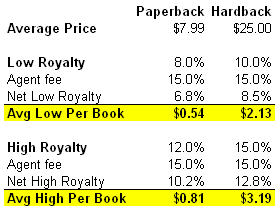
    People are always curious about this, so I thought I’d post it and refer to my previous post about what kind of sales numbers it takes to make a living as a fiction author in the US. Of course, the royalty rates depend on what’s in your contract. Many contracts have sales volume break points. For example, an 8% royalty on the first 50,000 paperbacks sold, 10% on anything above that. But this should give you a good feel.

    Earnings per book

    Share
  • |

    Presentation for Brandon Sanderson’s writing course

    PDF of the slides

    Brandon asked me to substitute for him on March 1st and teach the students about indie publishing. For those of you who were there, here are the slides.

    2018 Sanderson Class – Indie Publishing Final PDF

    “If I Were Published”

    To start the presentation, I regaled the students with a surprise: my epic-fantasy-BYU-newbie-author version of the classic Fiddler on the Roof song which I called “If I Were Published.” Dylan Rowe, a student in the class with some serious violin chops, practiced with me in secret, then accompanied me during the performance. He was great. And the performance went well. We all had a great time. There’s a recording. Once I get it, I’ll post it here.

    Here’s how it went.

    Isaac introduced me. I said how happy I was to be there. I then asked for a show of hands: who was hoping to be published. Not all did, BTW. Some were taking the course for other reasons. I then said that the sight of such a vast assemblage of unpublished writers made me think of someone else. I displayed the slide of Tevye dancing. They all laughed, and I knew this was going to be a good crowd.

    And then Dylan, who was hiding off to the side, played the phrase for “If I were a rich man” and I put on my own black Tevye hat. There was more laughter and surprise, and I began.

    Dear Lord, you made many, many unpublished writers.
    I realize, of course, that it’s no shame to be unpublished
    But it’s no great honor, either.
    So what would have been so terrible if I had one small best-selling series?

    [Dylan began to play and I began to sing]

    If I were published,
    Yaba dibba dibba dibba digguh deedle daidle dum.
    All day long I’d biddy-biddy-bum
    If I were a published man

    Wouldn’t have to work hard,
    Yaba dibba dibba dibba digguh deedle daidle dum.
    If I were a biddy biddy pub
    digguh deedle daidle published man

    I’d write a big long epic–hundreds of characters!
    Swords and dragons and a lot of gore
    A snot-nosed lad who was prophesied for the fight

    There’d be a quest to one far side of the map
    And one to find a lovely ancient lore
    And one more leading out into the blight

    [I paused here, to think, then sang the tune to the last line again with the first four of these]

    To meet a sprite,
    and a dark knight,
    with an old birth right,
    read by moon light,
    that … cures snake bite.

    [Dylan produced a big scratch. I covered my eyes in shame.]

    Oy! Bad story development.

    I’d see my wife, my Nellie,
    Looking like a rich man’s wife,
    with a proper golden skin,
    rolling out the yoga mats to her heart’s delight.

    I’d see her driving the kids
    in something other than a minivan
    Oy! What a happy mood she’s in!
    Posting perfect selfies to day and night.

    Hordes of bright-eyed zoobie writers will come to fawn on me.
    They will ask me to advise them,
    like Sanderson the Wise.
    “If you please, Mister Brown?”
    “Pardon me, Mister Brown?”
    Posing problems that would cross a Shakespeare’s eyes
    Ya da dee da dum, ya dah da dum

    And it won’t make one bit of difference
    if I answer right or wrong.
    When you’re published they think you really know.

    If I were published, I’d have the time that I lack
    to go to the temple and to pray,
    seated in a corner of the celestial room.
    And I would serve on projects building Enoch’s Zion
    from here to Africa and beyond.
    And that would be the sweetest thing of all

    Oy!

    If I were pub-lished.
    Yaba dibba dibba dibba digguh deedle daidle dum.
    All day long I’d biddy-biddy-bum
    if I were a published man.

    Wouldn’t have to work hard.
    Yaba dibba dibba dibba digguh deedle daidle dum.
    Lord who made the lion and the lamb,
    You decreed I should be what I am.
    Would it spoil some vast, eternal plan,
    if I were a pub-lished man?

    Limericks

    I took a bunch of copies as my books as gifts to support the good cause of entertaining hard-working students. But there was a twist. To get a book, they had to pay me one limerick. It could be about anything and of any quality. But it needed to be a limerick. They had, like, 5 minutes to write one at the end. Thirty-three souls came up with the payment. Here they are for your enjoyment.

    1.
    A writer, a publisher, and a poet,
    And now, wouldn’t you know it,
    They’re debating a comma,
    and imagine the drama,
    When they’re divided on just how to cull it

    2.
    There once was a class of fiction
    Which had a stranger take up his position
    He was quite amusing
    He kept them from snoozing
    For he had quite a talent for diction.

    3.
    John Brown’s book could be greatness
    I hope it’ll be a hit, not a miss
    Your lecture was great,
    It did not stagnate
    I hope you will great me my wish! (to get your book)

    4.
    I want to write a book that is fun
    where an evil something kills someone
    And the people will fail
    ‘Til the heroes prevail
    But I fear I will never be done.

    5.
    I’m trying to write my own book.
    But, if you now went to look
    I fear you will find
    It’s all in my mind
    But, oh – all the effort it took!

    6.
    There once was a poodle named Paddle
    whose fur was cut into a saddle
    until in the park
    he ate too much bark
    And now his tight fur is a battle.

    7.
    There was a young woman whose head
    Had eyes that looked dead
    As boys approached her,
    Her sharp tongue they started to stir
    Filling others with dread

    8.
    A poet sat twiddling his thumbs
    He felt his ideas were dumb.
    He was lacking in time
    But just couldn’t rhyme
    So he loosened his thoughts with some rum.

    9.
    “In honor of your song”
    “You know I’d really love to be published
    Oh, the glam and the glory I would relish
    The hordes of fans my mind’s eye can see-
    Sanderson with John Brown bowing to me –
    And don’t (?) tell me my dreams are embellished”

    10.
    Homework I do not much like, you see
    But for your book a lim’rick it be
    and so i must do,
    with great thanks to you,
    this my small bit of lame poetry

    11.
    There once was a boy named John
    Who needed to mow the lawn.
    He pulled on the rope
    But oh, what a dope!
    Alas, the gas was all gone!

    12.
    Guardian Angel Limerick
    I’ve struggled to write since the phone call,
    when the maybe’s, the what-if’s turned actual
    and the grieving stretched on
    till the morn she was gone
    and the world lost, but I gained, an angel.

    The note with that one: “I was the girl who asked if the limericks had to be funny. Thank you for coming to class and giving us the books. I’ve included my limerick below. My mother passed away a couple weeks ago. This is my tribute to my loudest cheerleader and my harshest critic.” Boy, I’m definitely honored to have this one.

    13.
    There was a young man from Pocatello
    Who thought that he was a brave fellow
    But one dark, dark night
    He took quite a fright,
    And found that he was quite, quite yellow.

    14.
    There once was a sorcerer bloke
    Who traveled outside for a smoke
    He yawned, “curse this day”
    And that is to say
    The incantation now was spoke

    15.
    There once was a ship fresh-moored
    With my favorite couple on board
    But despite the large fanon
    It was destroyed by the canon
    And my ship, sunk quick, sailed no more

    16.
    There once was a sad unicorn
    Who had tragically lost his gold horn
    And thus ran away
    and still to this day,
    He stands but a horse all forlorn

    17.
    There once was a grandma so old
    on her birthday she had a bad cold
    as she blew out her candles
    her kids yelled, “Mad scandal!”
    as her dentures flew into the mould

    18.
    There once was a cat named caterer
    who keeps running into the mirror
    we got her some glasses
    form the shopping masses
    and now she sees everything clearer

    19.
    There once was a dust speck named Mike
    Who lived on the edge of a spike.
    He was bumped off that edge,
    then snagged on some sedge,
    ending up on the wheel of a bike

    20.
    I am a cat who is hip.
    Who likes to shoot from the lip.
    My songs are all crude.
    My stories are lewd.
    I like to make reality flip.

    21.
    There once was a bunny named Mopey
    Who had friends that were silly and dopey.
    They hopped on a train
    That took them to Maine
    Where someone threw them in a bath that was soapy

    22.
    I want something to teach me to cook
    but this sure and that kind of a book
    but bore shadiz tes (yeah, couldn’t read it, dang it)
    and this sure seems fair
    So now I guess I should take a look

    23.
    There once was a man named John
    Who put his books out to pawn
    Some students one day,
    Wrote limericks to say,
    “We love your free books–give us one.”

    24.
    My mother wanted to get a book,
    And she gave me that terrible look.
    A limerick the price,
    I wrote one down twice,
    So please give me that sought after book.

    25.
    There once was a man named Lam
    Who like to eat lots of Spam.
    When the aliens came
    He cooked them a meal
    And so his soul they did not steal

    26.
    There once was a tiger named Ted
    He went to town in a bed.
    Jeep in the rustle
    He spotted a tussle
    And now he has bumps on his head.

    27.
    Once I tried writing haiku;
    it seemed like a fun thing to do.
    But I fumbled the timing,
    and couldn’t stop rhyming,
    and now this haiku is just poo.

    28.
    Once I was writing a sonnet
    But my paper hand not a word on it.
    I sat there confused,
    My talents unused,
    Because nothing else rhymes except “bonnet”.

    29.
    I love me a good paper book
    But the digital have a nice look
    Shopped for a kindle all day,
    Tried to buy on eBay,
    But, somehow I just have a Nook.

    30.
    There once was a man with pink hair
    And all he ever got were rude stares.
    He said, “I know that I’m hot.
    There’s no need to gawk.
    Goodbye.” And left with great flair.

    31.
    There once was a lobster named Clyde
    Who was inexplicably snide.
    But he had some bad luck,
    from the sea he was plucked
    and now he’s been battered and fried.

    32.
    I was once walking home on the street
    When a woman, I happened to meet
    I said to her, “Hey.”
    She said to me, “Nay.”
    So I went out and bought me a treat.

    33.
    Tetris is the very best game
    My playing will put you to shame
    See… I am the best
    Put it to the test
    One day it may lead me to fame.

    Share
  • Four-letter words and fiction

    Here’s Joseph Finder, a NY Times best-selling author, talking about how he studied his craft, why he uses outlines, and what he decided about four-letter words and why.

    I had the same reaction when my daughter came to me wanting to read my stuff. I’ve never heard of Joseph Finder–there are soooo many authors these days. But I can tell you I’m going to pick up one of his books to see what he’s all about.

    Share

2 Comments

  1. Yeah, I’m with you. Why wouldn’t you want to tell people about your book? *shrug*

  2. Could not agree more John. My first book with a small local publisher is coming out about the same time is yours, so all I can learn from you is great.

Comments are closed.