What does an author earn per book?

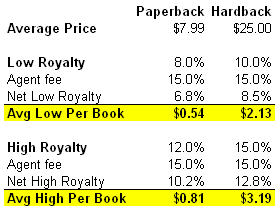
People are always curious about this, so I thought I’d post it and refer to my previous post about what kind of sales numbers it takes to make a living as a fiction author in the US. Of course, the royalty rates depend on what’s in your contract. Many contracts have sales volume break points. For example, an 8% royalty on the first 50,000 paperbacks sold, 10% on anything above that. But this should give you a good feel.

Earnings per book

Share

Similar Posts

  • 2015 LTUE presentation materials

    I promised the audiences that I would post the PowerPoints and handouts to the website. Well, here they are. For those wondering, we do not have any recordings of the events.

    How to Build an Action Plot

    How to build an action plot

    How to Build an Action Plot Handout

    How to Build A Romance Subplot

    How to build a romance plot

    How to Build a Romance Plot Handout

    How to build a romance plot lecture notes

    The Power of the Story Setup

    Using Story Setup

    Share
  • Indie Thoughts: Enticing with price

    The top two factors driving book sales both stem from having a loyal customer base. Building that base is the goal as it is in any business that depends on repeat customers. In a previous post I outlined these parts to building that base.

    1. Create a product (a book in this case) that’s likely to delight a certain set of consumers (readers).
    2. Let those consumers (readers) know about it.
    3. Make it enticing for them to give it a try.
    4. Make it easy for those who liked it to know when they can get another; and make it easy to get.
    5. Get more product (another book that’s similar to the last) out the door so your repeat customers can come back for more.

    In this post I’m going to share some thoughts on #3.

    So how do you entice someone new to give you a try? There are a lot of things I see that play into that:  a great cover, description, sample chapters, and reviews that all say quality and scream genre. But there’s another huge factor to making something enticing. And that is price. Or rather price vs. perceived value.

    I’m looking at Mark Corkers reports from Smashwords.

    I’m looking at slides 65-69. I know many of us have seen them.

    If the patterns are similar at Amazon, which sells more ebooks than anyone else, then a price of $3.99 on average will sell more than double the copies of $6.99.

    $3.99 means MORE readers who might develop some level of loyalty, MORE word of mouth, and it means MORE revenue than at other price levels.

    It means more than double the chances of getting your stuff in front on an influencer.

    More than double the chances for luck to come into play.

    And those odds grow exponentially.

    And, again, all along the way that price earns you more than if you were pricing at $6.99 or $9.99 because you sell more books.

    Of course, these are averages, which means folks are winning at prices above and below this. Furthermore, it’s not the same across genres. For example, it appears romance tends to sell better towards the lower end of the range Corker shows.  But it clearly shows that price is an important part of enticing a reader to give you a try.

    And when I look at the indies who are selling huge numbers and have built their customer base, the vast majority of them seem to have gotten there by tapping into the market forces Corker shows on these slides.

    That doesn’t mean they price all their books the same. Some are doing very well using a loss-leader/sample strategy where they offer the first book in a series for 99 cents or free. This also doesn’t mean they set their price and forget. it. They seem to do just the opposite, experimenting with different prices.  I noticed the Joe Konrath, who became a mega-seller at $2.99, raised his prices to $5.99 recently. He’s dropped them back down to $2.99 and $3.99. But he was clearly testing something. In an interview earlier this year with Simon Duringer, Russell Blake who is doing very well in the thriller category recently said this.

    Probably the most effective thing I did over the last two years other than Select, which came and went in terms of usefulness, was making the first book in my JET and my Assassin series free. That lowered the barrier to giving my work a whirl to nil, and my readership exploded from there. About a month and a half ago I stopped doing that because I saw my conversion rates were averaging about 12-13% from the first to the second book, and I questioned whether, with, say, 500 downloads a day, and seeing 60 sales of book two, it might not be more desirable to get 70 paid sales of book one, and seeing that same 60 on the conversion (because if someone pays for your first book, they’re probably going to read it, and soon, whereas if they get it free, it could take years, or more likely, never happen). So far so good.

    Clearly the folks who are doing well with this are experimenting with price to see which levels maximize revenue and loyal customers. And I think that’s the key. They are looking at what seems to be working for others, experimenting, and basing decisions on results.


    Share
  • |

    John guests on Writing Excuses season 3 episode 19

    writing-excuses-the-guys2-300x139

    Here’s the third episode I recorded with the Writing Excuses guys.

    In the first podcast we talked about putting and not putting ourselves in our writing and making characters who don’t all sound like the author. In the second, we talked about how to not repeat yourself as an author. In this one, I shared some basics about generating emotion in readers and dealing with negative emotions writers face when they encounter rejection, compare their career with others, hit writer’s block, or hear someone didn’t like their story.

    As usual, the guys had some great insights. Check it out: Emotion in Fiction.

    Share
  • Can you make a living writing short stories?

    We already know that many people break into the novel market WITHOUT writing short stories. So they’re not necessary for starting a writing career, although they might have helped some folks. See this page http://johndbrown.com/writers/writing-business-facts-figures/ for links that will show you how people break in. But some people just love short stories, so the question is can you make a living writing them?

    The answer is yes, you CAN do it–you go into television and get hired to write scripts for TV series (grin).

    But what about doing it in print? Well, let’s try some conservative math.

    1) How much would you need to sell?

    TARGET: a conservative $30,000 gross per year.

    The median household income in the USA is $50,000. But you can find a place (rural Ohio or Indiana or North Dakota etc.) where housing is relatively cheap and live on $30k. I think this is a reasonable target. So let’s make some assumptions about the stories. We’ll assume each short averages around 4,000 words and that you get paid seven cents per word. To earn your target amount you’d have to sell:

    • TOTAL WORDS YOU NEED TO SELL: 428,571
    • TOTAL STORIES YOU NEED TO SELL: 107 (words divided by average story length)
    • TOTAL STORIES/WEEK: 2 sales per week (weeks in year divided by number of stories)

    At 10 cents a word:

    • TOTAL WORDS YOU NEED TO SELL: 300,000
    • TOTAL STORIES YOU NEED TO SELL: 75
    • TOTAL STORIES/WEEK: 1.4 sales per week

    No, this doesn’t count reprints, movie deals, gaming contracts, etc. But reprints usually don’t pay well and movie deals, while they pay well, can’t be counted on. Besides, we’re being conservative. 

    2) Is this a feasible production rate?

    Again, a little math.

    TARGET: 2 stories, 8,000 words average per week

    If we assume you write five days per week for six hours per day at a rate of 500 words per hour, which may be very aggressive if you try to include thinking and revising time in that, then you’ll produce 15,000 words per week.

    So, yes, this is a feasible, if aggressive, production rate–on paper. But I don’t know anyone finishing this many stories per week. Furthermore, it’s highly unlikely you will sell 100% of what you send out. So you need to actually produce MORE than two stories per week. You might have to end up writing three or four. Week after week after week. That’s one story every day or two.

    Theoretically, yes, that rate of production still fits in the 15,000 word capacity. But I’m going to say it’s doubtful anyone can do this because I haven’t seen anyone do it. Have you? 

    But even if you were the Lizard King of writing and could pull this off every week of the year, the question is can you sell all those stories?

    3) Is it feasible to sell two stories per week?

    According to http://duotrope.com/index.aspx there are about 200 venues for short fiction paying pro rates, which for them is 5 cents or more. No,  anthologies are not represented there. But I’m not sure it will change the equations that much. So you have to sell 107 stories to these 200 markets. I don’t know how many slots are open in these places. Some of these venues publish one story per year, some publish twelve, some more. Some are published semi-annually, quarterly, bi-monthly. Let’s say there are 2,000 slots. Of course, we might need to count total wordage up for hire at these venues instead, but we’re just doing this on the back of a napkin. So 107 stories out of 2,000 slots means you’d have to make up 5% of the market. You sell five of every 100 stories these folks buy.

    FIVE PERCENT OF THE WHOLE MARKET!

    Nobody makes up 5% of the whole short fiction market. NOBODY. Okay, let’s say there are 4,000 slots. Each venue averaging twenty stories per year. So you have to make up 2.5% of the market. Nobody does that either. What about 1%? Anyone? One out of every 100 stories? No.

    Is this because writers are lazy? Could it be done? You might be the first?

    That’s lotto thinking. What you want is demonstrated income, i.e. people have DEMONSTRATED it can be done. Nobody has demonstrated this can be done in the current market. So it’s not reasonable to expect you’ll do something nobody else is doing.

    So the answer is that even if you produce three to four short stories per week, you’ll never be able to sell enough to make a living. Now, I know of a few authors who can make a few thousand dollars per year writing short stories. I’ve heard of one guy who made $10,000 a year for a few years. But can you live on that? Even if you move to a place where housing is very, very cheap? Besides, we’re trying to avoid lotto thinking here. We’re trying to be practical and conservative. This is one guy. Do you yourself know anyone who has done this? I wouldn’t want to base my future on what one guy did.

    CONCLUSION: there’s no evidence that strongly suggests it’s feasible to sell at the necessary rate to make $10,000 per year let alone $30,000.

    4) Re-purpose the wordage to Novels!

    Go back up and look at the annual output of words. If you can write 300,000 to 450,000 words per year, you could write four to six young adult novels (averaging 70,000 words per book) or two to three adult novels (averaging 120,000 words per) in that same time.

    Why not build a career in novels?

    Yes, you may start at $5,000 – $6,000 advance per book. But if you sell well, that goes up. Plus, if it does sell well, you get royalties. Plus you can sell foreign novel rights. Plus you get an advance to help with some expenses. More importantly, we have thousands and thousands of folks DEMONSTRATING they can make a living writing at that pace.

    So write short stories if you love them, but don’t expect to make a living at it.

    5) But what about Amazon and self-publishing?

    Could you make a living selling your shorts out there?

    Only if your shorts were once worn by Brittany Spears.

    For more on e-book sales, let me recommend you read a few posts by J. A. Konrath. I’ll let you decide. But please note that he’s selling NOVELS. And as always, you want to be realistic about this and make sure you see many people DEMONSTRATING it can be done. Do you think Konrath presents such evidence? You tell me.

    Postscript

    Read these two posts by Dean Wesley Smith where he busts some big myths about not being able to make a living writing:

    Killing the Sacred Cows of Publishing: Only 300 Writers Make a Living

    Killing the Sacred Cows of Publishing: Can’t Make Money in Fiction
    Share
  • |

    Is Product Popularity Random?

    In Why Publishing is Making You Crazy—and What You Can Do About It: The Tao of Publishing, Steven Axelrod and Julie Anne Long write an interesting post that takes some findings made by Duncan Watts and attempts to explain why writers should only focus on the quality of their work because they cannot reliably affect popularity in any other way.

    I agree with them that social-influence seems like a good explanation for the sometimes unexplicable successes we see in publishing and the difficulty publishers have in both predicting and producing a steady stream of hits. However, I do not find support for their main conclusion that writers can do nothing but write.  In fact, I suggest that Watts’ findings show quite the opposite.

    Axelrod and Long base much of their argument on an experiment conducted by Duncan Watts that tested the power of social-influence on music selection in some controlled music websites. Watts summarizes his findings in the excellent Is Justin Timberlake a Product of Cumulative Advantage?.

    In his part of the post, Axelrod points out that the Watts findings indicate “50% of the factors affecting your career could be totally outside of your control—totally random” and that “unless we can separate out those random factors which contributed to an author’s past success [and we can’t, Axelrod suggests], anything we can say or predict about why she succeeded will invariably be way off-the-mark.” And therefore “what’s interesting—and chilling, as well—is that there’s evidence that the harder a person works to make sense of a random event, the farther they’ll end up from the truth.”

    In other words, the only thing an author can reliably do to improve the popularity of his stories is focus on their instrinsic quality. And get more stories out so he has more shots in the fickle social-influence game.

    I agree that having more product in the market increases your odds. I also agree that focusing on the intrinsic quality of the writing can do the same. I even agree that this is where authors should spend most of their time. However, Watts’ studies do not indicate other efforts are wasted. In fact, they suggest the opposite.

    Watts does not controvert anything we now know about marketing. What he does is clarify the power of social-influence in our decision making and the dynamics of ONE type of endorsement system. What Watts shows is:

    1. A perceived non-bias endorsement of your product can have a huge effect in the product’s popularity.
    2. The intrinsic quality of the product has an effect on popularity, but social-influence plays as large or larger role.
    3. Popularity in the system set up in the test websites depended on the decisions of a few early-arriving potential endorsers, i.e. good early reviews (downloads in this case) are amplified and lead to an effect he calls “the richer getting richer.”
    4. In this one endorsement system, neither a future endorsement nor the identity of the early endorser can be predicted.

    These findings, however, need to be put in context. From cars, to camcorders, to recipes, the popularity of a product depends on three main factors. These aren’t new ideas and publishing is no different than any other industry. The factors come from long-standing marketing practice:

    1. Visibility (people know about it)
    2. Endorsement (recommendation from an attractive person, trusted authority or friend, or trusted system like the perceived unbiased reviews on Amazon or “most downloads” stats)
    3. Attractiveness (intrinsic to the product, the perceived value offered the target market, and the social effect as pointed out by Watts)

    Each of these three affects the other two. Visibility makes endorsements and initial attractiveness possible. Endorsements make a product more attractive and more likely to be visible. Attractiveness makes something more visible and more likely to be endorsed. And round and round we go.

    It’s true that Watts shows 50% of the effect is due to endorsement. But nowhere does Watts suggest an author cannot increase the probability of visibility and endorsement.

    In the study, the endorsement method used was a counter showing the number of times the song had been downloaded. It was random, anonymous, and perceived as unbiased. That was a controlled environment. However, what if a singer had been able to ask all those he knew who loved his song to download it from the site? Or what if someone organized such a campaign independent of the singer? Both actions would immediately affect the probability of the song increasing in visiblity and endorsement and, hence, popularity.

    It’s too bad Watts didn’t test this in one of his sites to see if he could make a winner. As it was, all Watts was doing was seeing if he could predict a success by quality alone. He was passively observing, not actively taking measures to increase visibility and endorsement.

    Furthermore, the counter is just one type of endorsement system. There are a number of others. We’ve all seen how an Oprah endorsement can move the market. The identity of that endorser is NOT random and has great predictive value. Her decision to endorse is still random. But what if you have a way to make your book visible to her? Would it be a waste of time to do so?

    Robert Sawyer loves to tell of one action he took with someone with much less endorsement power than Oprah and the effect it had on his sales. Was Sawyer guaranteed visibility and endorsement from that action? No. However, he DID increase the probability, and it resulted in sales. Here’s his account.

    Watts confirms that endorsements have a mighty effect on popularity. Even something as simple as a “most downloads” counter can easily overwhelm a listener’s own reactions. But the logical conclusion is not to do nothing. The logical conclusion is that if authors want to increase their popularity, they must not rely only on the intrinsic value of their product, but they must also search for ways to increase visibility and endorsement.

    Axelrod is correct that it’s sometimes difficult to see the effect of any given marketing campaign or tactic. This is because marketing efforts are probabilistic, not deterministic. However, probabilistic does not mean random. Furthermore, it does not indicate you cannot increase the probability of success. While publishers may not be able to produce best sellers every time, I’m confident if they decided to stop marketing altogether, sales would drop.

    Will all efforts succeed? No. Any marketing progam needs to consider the effect of diminishing returns. The effectiveness of some actions may be difficult to test. Furthermore, authors may not have the budget to run a campaign large enough to increase their probabilities, although there are strategies to become a big fish in a small pond (see Geoffery Moore’s Crossing the Chasm).

    Despite all these issues, we know, in general, getting endorsements helps. In general, the right placement in book stores increases visibility. Author visits to schools, if done right for middle age readers, can also increase visibility. Radio interviews, if done right, do the same. There are many things that DO improve an author’s odds. We can increase the probability of visibility and endorsement by taking intelligence, consistent action.

    And that’s good news. We might not be able to guarantee a hit, but one thing IS certain—we’ll have no direct influence on visibility and endorsement if we do nothing.

    (BTW, for those interested, here’s a great presentation on a related idea:Six Degrees: The Science of the Connected Age a presentation by Duncan J. Watts.)

    Share