Laboratory Grown Meats?

How would you like to eat cuts from slabs of meat grown from stem cells?  

Give the cells some water, glucose and natural proteins. To make sure you have something that feels like meat you “exercise” the muscle with electrical pulses.

Gross? Maybe. But someone is thinking about it.

http://www.popsci.com/environment/gallery/2008-09/inside-vertical-skyscraper

As with all zing, post story ideas in the comments.

Share

Similar Posts

  • |

    “The Fringe Benefits of Failure, and the Importance of Imagination” by J.K. Rowling

    This is J. K. Rowling’s 2008 Harvard commencement speech, “The Fringe Benefits of Failure, and the Importance of Imagination.” It’s one of the best speeches I’ve ever heard. Watch and then watch again. Read the full text here.

    Two quotes that in no way can do justice to the whole thing.

    And so rock bottom became the solid foundation on which I rebuilt my life.

    You might never fail on the scale I did, but some failure in life is inevitable. It is impossible to live without failing at something, unless you live so cautiously that you might as well not have lived at all – in which case, you fail by default.

    . . . 

    Though I personally will defend the value of bedtime stories to my last gasp, I have learned to value imagination in a much broader sense. Imagination is not only the uniquely human capacity to envision that which is not, and therefore the fount of all invention and innovation. In its arguably most transformative and revelatory capacity, it is the power that enables us to empathise with humans whose experiences we have never shared.

    One of the greatest formative experiences of my life preceded Harry Potter, though it informed much of what I subsequently wrote in those books.

    Share
  • Up & Over It does “We Speak No Americano”

    Because today is a special and you deserve to smile.

    Performed and choreographed by Suzanne Cleary & Peter Harding
    Film by: Jonny Reed
    Music: “We Speak No Americano” by Yolanda Be Cool & DCUP
    Up & Over It: http://www.facebook.com/upandoverit or http://www.upandoverit.com
    Produced by: http://puckproductions.com

    It appears “We Speak No Americano” by Yolanda Be Cool & DCUP samples the 1956 song “Tu vuò fà l’americano” (You pretend to be American), a Neapolitan language song by Italian singer Renato Carosone.

    If someone with some language skillz can translate, please do so in the comments.

    Share
  • Uncanny cool

    I just had the most uncanny, coolest experience. It’s 6 PM. I’m out on a walk along a road that runs by a swampy river called Birch Creek to a fork in the road. The sky is this glorious blue with brilliant white and gray clouds. I stop and pick some ripe black currents off a little spindly bush growing down off the shoulder in the rocks and continue on.

    I take the left fork, south along the hill and enjoy the sight of the mown fields, a scattering of green ton bales standing on the short meadow grass, and the storm clouds gathering over the hills to the west.

    A few rabbits spook and run across the road. I reach the mile mark and turn back. I’d already done 30 minutes worth of shred before the walk and needed to get back to practice basketball with my oldest. The whole time I’m listening to Lois McMaster Bujold’s HALLOWED HUNT read by Marguerite Gavin. It’s warm, sunny, lovely. The story is good.

    I come back by the fork and hear this sound over the audio. It’s like a single prop airplane in the distance. I continue on another hundred yards. That distant, thin drone grows, but I can’t figure out what it is, so I put the audio book on hold and take off the ear phones.

    The air is perfectly still. That muggy stillness that precedes a storm. But all around me is this sound. This thin drone, filling up road. It’s coming from all sides.

    Insects?

    I look down off the side of the road at the sloughs and cattails and willows and see nothing. I look back up. Look around. And then I notice a small black body speed past. And another. And another.

    Flies? It can’t be flies. When have you ever seen a fly pursue a straight line?

    Three more. Half a dozen. Another, another, and they’re everywhere. But they’re not flying thickly. Not mobbing. Not massed in some cartoon clump. They’re all spread out. I strain to see them in this odd light.

    Bees. They’re dark. Almost black in their flight, but it has to be bees!

    And they’re all around, thirty feet to either side of me. Zooming past. There, there, and there. It’s like dozens and dozens of refugees in flight with single purpose. There’s no looping around. No dalliance. No crazy panic. They’re serious, focused. All of them going the same way. Straight ahead on some urgent goal.

    There’s a big fat blue dragonfly in the willows that keeps zipping after individual bees as they fly past, trying to get a meal, but each time, just at the moment when it would attack, it spooks and darts back for cover. Dragonflies are voracious buggers. But these aren’t single bees. It must be thinking the other bees are coming for it. Still it can’t resist and darts out again.

    And all around is the humming. It grows. The bees directly in front of me see me as they approach and make course corrections. I keep walking. A half a mile and the thin droning still surrounds me. The bees keep coming, but they’re thinning.

    Thunder cracks behind me. The wind begins to pick up. The sky behind me is darkening.

    The sound of the drone grows thinner, is almost gone. But there are bees still out there, following. I can hear them. See them. Individuals trailing the others, flying past me toward the storm that’s still about a mile off. And I think they’re too far behind.

    Maybe their hive was wrecked. Maybe it’s just time to swarm and there’s a queen up front leading them. And somehow her scent is on the wind. Somehow they know to follow.

    I don’t know if they’ll find a new place. They’re going to have to cross a mile of mown meadow before they get to anything that might serve as any type of shelter. I don’t know if the wind will ground them, or the main group will find safety but the stragglers will be blown to their deaths. All I know is that I’m sitting here in awe, electric with life.

    Share
  • |

    Wolves in my backyard

    National Geographic ran an article in the March issue titled “Wolf Wars.” It has a great interactive map. You’ll want to read the whole article, but I want you to look at something.

    First, here’s a picture of a wolf in Yellowstone licking his or her chops over a recent elk kill.  Looks real friendly, doesn’t it. Here, poochie, poochie, poochie.
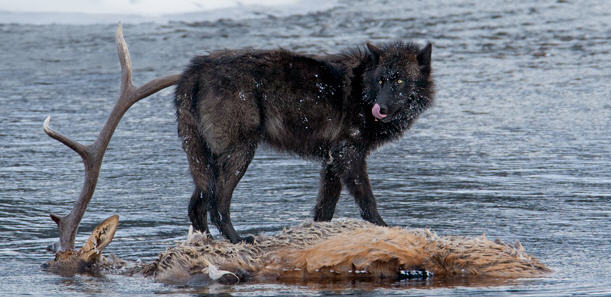
    A few facts. Wolves can grow up to six feet long (tip of nose to tip of tail) and three feet tall. They weigh on average about 80 pounds but can be as heavy as 150-190 pounds. Wolves can reach 40 mph when chasing, but the use their stamina more than speed. Regardless of how they catch you, their jaws are strong enough to crush bones. You want more facts? Go to this wiki article on canis lupis.  The point is that they are large, smart predators. At the top of the food chain. These aren’t little doggies. They’re killers. And they are mighty hard to socialize with humans (read the wiki article).

    Of course, it can be done. Not far away in Heber City, Utah lives Doug and Lynne Seus (yes, that’s the name–gotta love it!) who train wild animals for movies. The company is called Rocky Mountain Wasatch Wildlife. I know you’ve seen one of their animal “actors,” Bart the bear, in many movies. The Seuses also happen to train wolves. A friend of mine grew up in Heber with the daughter of Doug and Lynne. She visits from time to time. Last summer she went down and saw the wolves. My friend was told that she had to carry any children she might bring.

    Why?

    Because the children are food. That’s why. And when she went out there, the wolves were tracking those children every minute with their eyes. Freaked her out. In fact, another friend got so freaked she took her kid back to the main house and didn’t come out again. Folks, these are wolves that work with humans ALL THE TIME.

    I know the nature programs often make it seem like wolves are harmless, but they’re predators. Just like grizzlies, tigers, or crocodiles. Wolves are dangerous. A pack kills up to two elk a week. That’s a lot of eating. But they’re all up in Yellowstone, right?

    Um, no.

    Exhibit 1: Documented wolf packs, i.e. two or more wolves, in 1992 (click on image to see it full size)
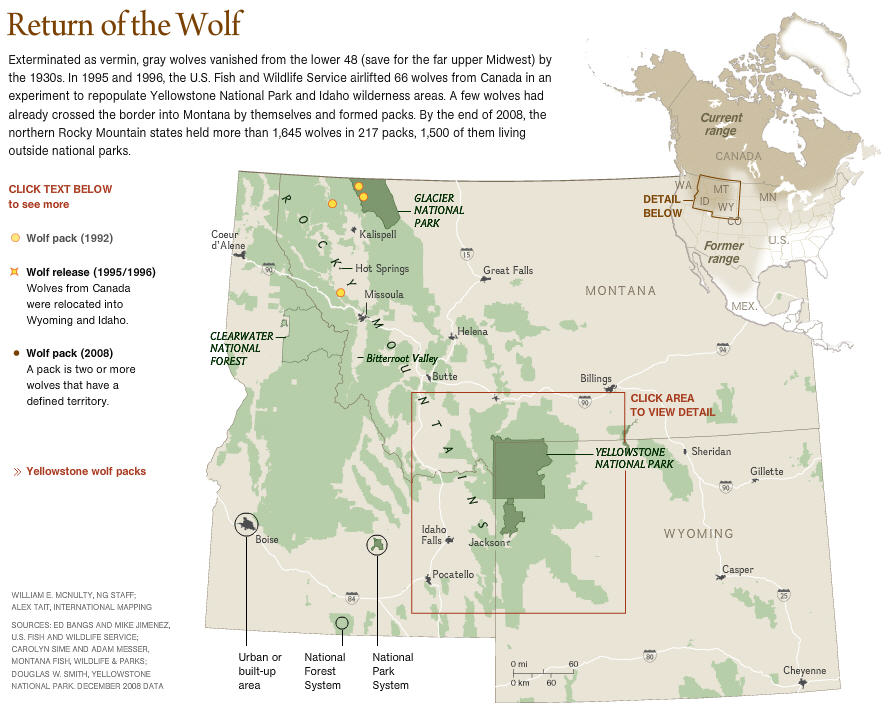
    Exhibit 2: packs released in 1995
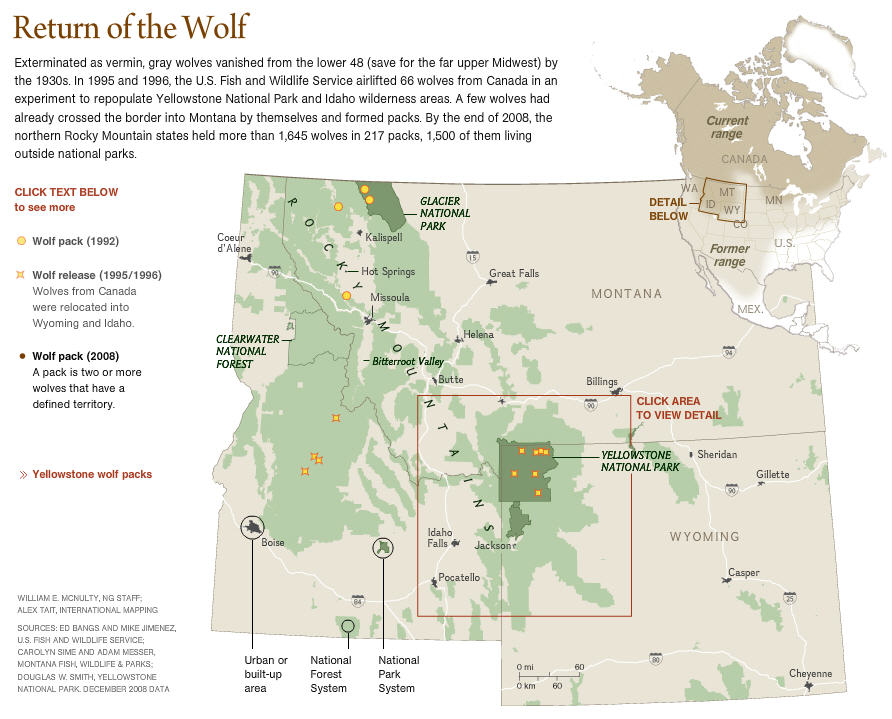
     

    Exhibit 3: wolf packs as of 2008 (2 years ago)

    Holy schnitzel!

    If you didn’t read it above, they’re estimating about 1,645 wolves in 217 packs. And that’s just the ones that have been officially documented. You know there are more out there that haven’t been seen. Look at the one all the way out by Casper, WY. Those bad boys can travel. In fact, the NG article says that wolves stake out a territory of about 200 to 500 square miles (a circle of that size has a radius of 8 to 13 miles). They travel on average (AVERAGE!) 60 miles from their pack when seeking a mate or new pack. Although one was recorded traveling 500 miles.

    Okay, so given the maps and sightings above, how is the John Brown family doing down in Laketown?

    Exhibit 4: I need a gun!

    The map below marks Laketown, UT with an A. I marked over that the packs shown in NG in red and others reported in pink. I also show orange rings 20 miles apart.  

    The “unofficial” sighting just inside the 80 mile ring was by my brother-in-law. The wolves were killing a bunch of his neighbor’s ewes he was taking care of. I didn’t say “eating” because they were killing far too many to eat. Wolves looked up at brother-in-law on four-wheeler. Assessed him. No whimpering, no cowering, no doggie wagging of tails. Just a frank assessment–human, danger or lunch? Said wolves sent a herd of the willies galloping up brother-in-law’s back. Freaked him out. He high-tailed it out of there and called the Feds who found that pack and killed them about fifteen miles away. But that sighting was before 2003. The sighting just outside the 100 mile mark was by some neighbors around 2007. The sighting down by Manila, UT was reported in a  news report by KSL news in 2008, just two years ago.
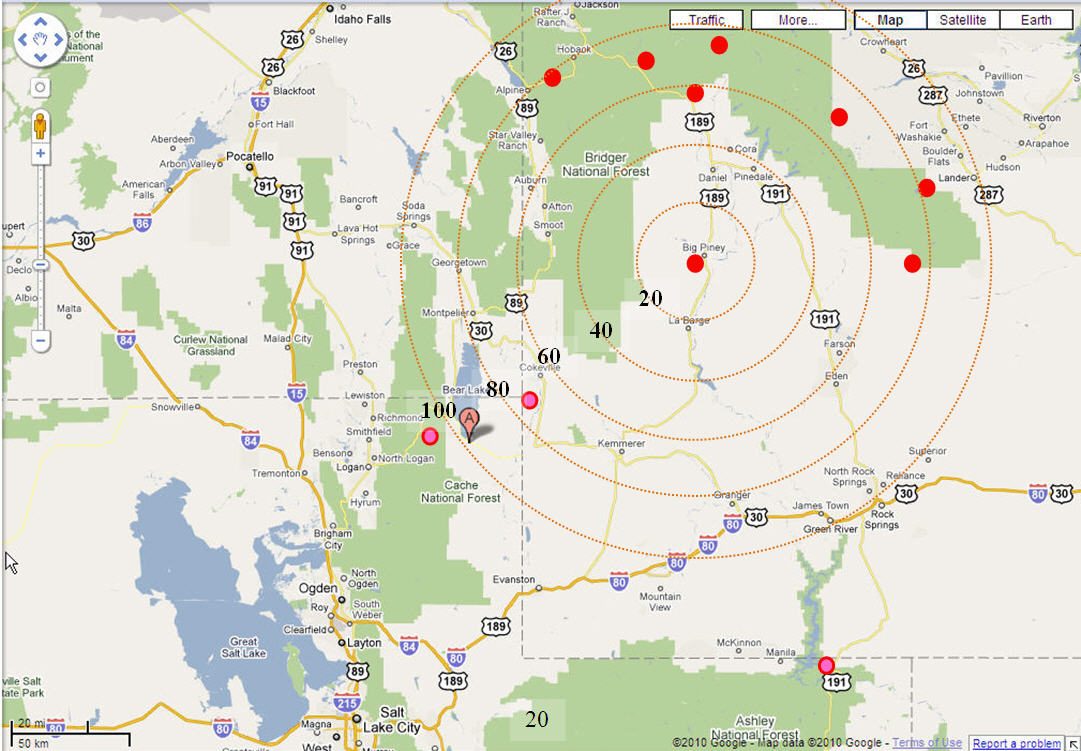
    Okay, so I think it’s pretty safe to say that we probably have wolves in our backyard. And if we don’t, they’ll be here in a year or three.

    Go read “Wolf Wars” in the the National Geographic. It’s free. Then tell me how you’d feel with a few packs in your backyard. Are you all warm and comfy? Here, little doggie . . .

    So I’m thinking that when the girls or I go hiking, which we do all the time, we need to carry more than a walking stick. More than a paintball gun used to scare the deer out of our garden. I know that even with all the packs shown above, I haven’t heard about wolves attacking humans, but is it wise to assume they just freak out when they see humans and all run away–“that’s a eight-year-old human girl, she will make me wear the cone of shame. I do not like the cone of shame.”

    Or will it be, “Hum, possible lunch over there, let’s check it out. Ooh, look at the fat one. I bet he’s tasty.”

    What do you think?

    Share
  • Epigenetics

    Our genes aren’t in charge.

    Yes, you say, of course. There’s environment and choice; both of these affect what we become. 

    But I’m not talking about being in charge at that level. I’m saying that our genes aren’t even in charge of themselves.

    What?

    We all know that computer hardware (processor, RAM, motherboard, etc.) is important, but that the software that runs the show. Well it appears that our genes are like the hardware. Something else runs the show.

    That something else is our epigenome, our epigentic tags (“epi” meaning just above as in “epidermis” or “epicenter”). The tags are chemicals that turn particular genes on and off, telling cells what they’re supposed to be–liver, skin, brain.

    Furthermore, researchers think they the tags can change through a number of means, including what we eat. For example, you can take two identical set of genes for hair and, with tags, change hair color.

    Research has also shown the epigenome can be passed down to posterity. So what you eat and its effect on you can be passed down to your posterity. Likewise, what you are is what your parents and maybe grandparents ate.

    Genes are only a part of the story.

    Holy heck, this is so cool. Watch the 12 minute video now.

    Share
  • UFO over Washington D.C.

    I just ran across this.

     Published on Saturday, July 27, 2002 in the Washington Post
    F-16s Pursue Unknown Craft Over Region
    by Steve Vogel

    WASHINGTON — For Renny Rogers, it was strange enough that military jets were flying low over his home in Waldorf in the middle of the night. It was what he thinks he saw when he headed outside to look early yesterday that floored him.

    “It was this object, this light-blue object, traveling at a phenomenal rate of speed,” Rogers said. “This Air Force jet was right behind it, chasing it, but the object was just leaving him in the dust. I told my neighbor, ‘I think those jets are chasing a UFO.’ ”

    Military officials confirm that two F-16 jets from Andrews Air Force Base were scrambled early yesterday after radar detected an unknown aircraft in area airspace. But they scoff at the idea that the jets were chasing a strange and speedy, blue unidentified flying object. Read more here.

    I don’t automatically assume it was methane creatures from Jupiter or our long lost cousins from Alpha Centauri. But I do find it interesting. Was it some new military craft? An exercise? Something the military has seen before? From another nation? The possibilities are endless. Here’s another link to the full article since the WP appears not to have archived it online.

    Share