One of my personal flaws is my monkey fascination. I am interested in too many things. For example, when I was at the university I wanted to major in English, History, Dutch, Art, and graduate with Honors.
Um, no. That didn’t work. They finally wrote me a letter and said 220 credits was more than enough. And I would graduate the next semester with whatever degree I could cobble together.
Of course, then I started my Masters of Accountancy and Information Systems program. (Some people never learn.)
When I was in my Masters program I started an investment club, wrote fiction, and wanted to start a FSBO home business as well as a write a non-fiction book with 4 collaborators. Oh yeah, and I was supposed to be Mr. Mom with two kids at the time while my wife put me through school.
All this did was stress my marriage to the point that my wife was considering giving me the pink slip. Of course, being so involved in so many projects I had no idea I was in danger of being layed off.
No, over the years I’ve learned that simplicity and focus is divine. It’s good to say no to the million things that vie for my attention, even the many noble causes. It’s smart to put a lot of effort into a few things. Become an expert in one area.
In business, I’ve watched some friends focus, focus, focus. They’ve put in their time and have become very successful at what they do. They’ve worked hard. . . at one thing. On the other hand, you have those of us who haven’t yet been able to give up that danged monkey brain. (Although I will give myself credit–for the last five years I’ve been trying to reduce. Trying to focus. I’m failing spectacularly. But I figure sooner or later my efforts will pay off.)
The multitasking myth shows up not only in the general activities we engage in, but also in learning. I heard this NPR story on myth of multitasking and thought I’d share.
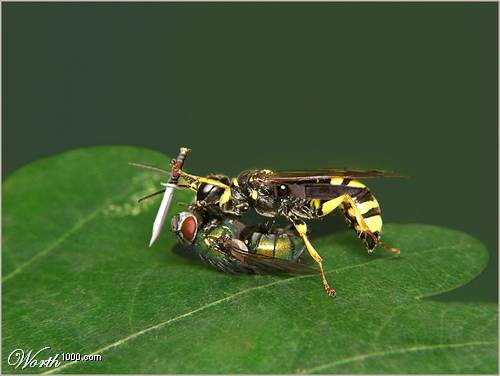
One of my first novelettes was about using insects as military grade spies. Just a bit of wetware to get control of their brains. Then mount a nano recording and transmitting device…
How are you going to stop that?
But wait–insects can be far more sinister.
Jeffrey A. Lockwood has written Six-LeggedSoldiers: Using Insects as Weapons of War. I can’t wait to read this. I hope it’s not a fluff book. Can’t wait to report my findings to you. Read more about it.
Oh, and did I mention that I’ve got weaponized insects in the novel I’m currently working on? Crown of a Dark God is turning into such a blast to write.
Here, watch this book trailer for Scott Westerfield’s Leviathan.
Yeah, I know you want to–go ahead, watch it again.
Miller looks at book trailers, sees that the vast majority of them are lame, lame, lame (actually, this is the FIRST I’ve seen that’s any good). Sees that they reach no markets and then concludes that all trailers are silly. It’s true: lame trailers ARE a waste of time and money. But ANY advertisement (print, video, audio, whatever) that’s lame is a waste of time and money. Making killer trailers that nobody sees is an even bigger waste of time and money. But that’s true of ANY killer advertisement that nobody sees.
Look. I’ve never read Westerfield. Don’t know much about him or his books. But I saw that clip and now want to read that book. Hum, trailer worked for me. I AM a reptoid mutant, but I suspect there are others out there like me. I mean, come on. Good gravy, woman–“Do you oil your war machines? Or do you feed them?” Killer!
Movie trailers, book trailers–any advertisement–isn’t about delivering what the person is going to experience on the spot. If that were the case, then you’d never show a print ad of a meal at Olive Garden because it doesn’t deliver the goods right there on page 10 of Woman’s Day. Nope, all you’d do is go around giving out samples in places with Italian mood.
Miller’s error is not understanding the difference between making an offer and delivering on one. What an ad is supposed to do is make the offer. Let you know this thing is available. Because you’re not delivering the actual experience, you can make the offer via all sorts of media. Now, if you can give them a taste, that’s great. But you don’t need to deliver the full deal right there.
So what do you need in an offer? You need the offer to say, “Hey, I’ll deliver this type of experience.” It needs to call to some action, either directly or by implication–“buy this” or “be here.” You also need it to say, “You can trust this will be worth it” and make the consumer believe that’s likely to be true. It communicates this last bit by being a quality piece of work.
Making an offer is exactly what book covers do–they make the offer and give the consumer a little taste. And book covers matter. This has been proven over and over. Just like most people, when I see a cool cover, I pick up the book and check it out. When I see a lame one, or one that offers something I’m not interested in, you’re going to have to threaten me to pick that book up. Or it better dang well have some righteous word of mouth. It’s that simple. We all judge books by their covers because the cover is making an offer. And lame offers don’t get very many takers.
Book trailers are nothing more than deluxe book covers. The cool thing about them is the cool thing about movie trailers–you can make the offer by providing a little taste. You do that by giving the audience the story situation, the pitch. You do it by communicating the feel of the experience and raising curiosity. You do it by making it a pro job. The good ones make you laugh, say cool!, or raise curiosity and expectation.
And that Westerfield trailer does that.
Dang, “Do you oil your machines? Or do you feed them?”
Run that on TV. Run it on the radio. Put it up on sites where people are likely to see and click. Confirm it in print. Make the offer to real people. Get it infront of young readers. I’ll stake my eyebrows that ad can sell as many books as a good movie trailer can sell movie tickets.
Very effective advertising for the book. I think the content of the book is crap, but that trailer made me pick it up just to see what it was all about.
Do you notice that this one and the Westerfield one combine extreme professionalism AND they make the pitch in a clear and grabbing way? The pitch for both was what the book was about. For fiction it’s the concept. For non-fiction how to it’s the promise.
So many of the book trailers lack one or more of those things. For example, look at the book award finalist for THE FALLEN: http://www.youtube.com/watch?v=vsLE6bNaIrk. I don’t know what the heck the book is even about after a long 2 minutes. They’re trying to make a movie.
Something else. On both of these you have a voice over PITCHING the book to you just as someone might do it in person or to an editor. It’s a powerful method, I think.
Notice also how short the Westerfield one is. Just over a minute. Westerfield’s really is like a query pitch or cover copy–in just a few lines tell me what your story is about. We get genre, setting, character, and the story problem or concept.
Radio and TV have incredible power. But until the last decade they were always constrained by time and signal power. You had to listen when the station broadcast it, and you had to listen where you could pick up the signal.
Living out in the boonies we don’t get good radio or TV reception (no I don’t subscribe to satellite). Which is why the internet is so wonderful.
You can listen and watch almost anything when you want from almost any location–yes, even in Laketown, UT, Boonie Central. Millions listen to music, conservative talk, or libral talk (NPR) via the internet. I enjoy all three depending on my mood. But there’s so much more out there than music and blah blah blah, as much as I love it. For example, you can listen to the British BBC. You can listen to the Dutch. See what’s going on in Australia. Doesn’t matter that they are a number time zones away and all asleep when I’m working. I love the internet.
One of the best programs I’ve heard in the last six months is the three-part “Parasites” presented by Radiolab. In a fascinating hour they address the following questions:
Parasites: are they evil, or are they awesome?
Should you get infected with hookworms?
Can parasites exercise mind control over their hosts?
Along the way they tell a number of amazing stories. Listen now. You won’t be able to stop.
Is this not delicious? I found it on istockphotos.com and couldn’t stay away. I want to be on that trail. I want to know what’s around that bend. Holy moly, the feeling of this photo is just marvelous.
So I bought a copy. It’s by stellalevi.
Zing, Baby!
6 Comments
I showed this to Kierce (my 17 month old). he didn’t move a muscle the entire song. It was like some sort of incredible lava lamp. He watched it again this morning with the same result. I’ve never seen him stand still for anything, so I now call this video “the three minute babysitter”
I play this song at my DJ gigs! Awesome song!
Bryce, I think you could use it to babysit me.
Translation is a bit difficult because it is sampled from an older song. You only get a piece of the original lyrics which make it hard to translate context.
I speak 3 regional Italian dialects and Neapolitan isn’t one of them. However, it is close enough that I can make a go of it.
here is a rough translation.
“You pretend to be an American. Listen to me! What do you think you are doing? You think you are stylish, but you drink whiskey and soda. You are bothering me.
You dance to rock and roll. You play baseball, but where did you get the money for Camel cigarettes? Your mother’s purse!
You pretend to be an American, but you were born in Italy. You are Neapolitan.
Why do you think it is so great to speak American? When you make love under the moonlight do you say I LOVE YOU?”
repeats
Wikipedia says it best.
The lyrics are about an Italian who imitates the contemporary American lifestyle and acts like a Yankee, drinking whisky and soda, dancing to rock ‘n roll, playing baseball and smoking Camel cigarettes, but still depends on his parents for money.[1] The song is generally considered a satire on the process of Americanisation that occurred in the early post-war years, when southern Italy was still a rural, traditional society
Great video.
RyanV,
That is great. I like that song even more now. Thanks!

 Radio and TV have incredible power. But until the last decade they were always constrained by time and signal power. You had to listen when the station broadcast it, and you had to listen where you could pick up the signal.
I showed this to Kierce (my 17 month old). he didn’t move a muscle the entire song. It was like some sort of incredible lava lamp. He watched it again this morning with the same result. I’ve never seen him stand still for anything, so I now call this video “the three minute babysitter”
I play this song at my DJ gigs! Awesome song!
Bryce, I think you could use it to babysit me.
Translation is a bit difficult because it is sampled from an older song. You only get a piece of the original lyrics which make it hard to translate context.
I speak 3 regional Italian dialects and Neapolitan isn’t one of them. However, it is close enough that I can make a go of it.
here is a rough translation.
“You pretend to be an American. Listen to me! What do you think you are doing? You think you are stylish, but you drink whiskey and soda. You are bothering me.
You dance to rock and roll. You play baseball, but where did you get the money for Camel cigarettes? Your mother’s purse!
You pretend to be an American, but you were born in Italy. You are Neapolitan.
Why do you think it is so great to speak American? When you make love under the moonlight do you say I LOVE YOU?”
repeats
Wikipedia says it best.
The lyrics are about an Italian who imitates the contemporary American lifestyle and acts like a Yankee, drinking whisky and soda, dancing to rock ‘n roll, playing baseball and smoking Camel cigarettes, but still depends on his parents for money.[1] The song is generally considered a satire on the process of Americanisation that occurred in the early post-war years, when southern Italy was still a rural, traditional society
Great video.
RyanV,
That is great. I like that song even more now. Thanks!