Interview on A Motley Vision
In this interview William Morris of A Motley Vision: Mormon Arts and Culture asks the normal questions about the book, but he also asks about my Mormonism and how that affects my writing. Enjoy!
In this interview William Morris of A Motley Vision: Mormon Arts and Culture asks the normal questions about the book, but he also asks about my Mormonism and how that affects my writing. Enjoy!
Folks, a huge thanks goes to Stephen Nelson for putting all this together. You may kiss his hand when you see him.
This is a recording of “How to Write a Story that Rocks,” a two-hour seminar Larry Correia and I just put on at the annual BYU’s Life, The Universe, & Everything symposium. I think we had 130-140 people attend. This symposium is focused on writing fiction. And while the panels and presentations do include things specific to the science fiction, horror, and fantasy genres (both adult and young adult), a lot of time is also spent on story writing fundamentals that apply to ALL genres. So when I developed this workshop, I made sure I took the fundamental approach.
The two-hour seminar has been broken down into 12 segments. To switch between the segments:
If you prefer, you can watch all 12 on the How to Write a Story that Rocks YouTube playlist page.
I’ve found whenever I develop any presentation or training that it takes a few iterations and revisions before it’s the best it can be. This is the first iteration of this seminar. And so below this video I’ve provided additional comments on each segment explaining key concepts, principles, and techniques that we might have failed to discuss or convey as clearly as we’d hoped. Enjoy!
How to Write a Story That Rocks – Handout
It’s documented–right-wing gun nut Larry Correia sang “Kumbaya.” What’s next? The hugging of small trees? Oh, Larry, the disilluion. The disillusion.
The reason why I had Larry sing was not for his mellifluous performance, but to demonstrate the difference in reactions between him and our happy volunteer (“Country Road” by John Denver–this really was a love fest). The volunteer balked because he hadn’t taken any thought to know what to sing before he was commanded to do so. On the other hand, Larry and I had spoken before the seminar. So Larry had something to sing BEFORE he sang it. It’s a simple demonstration, but it illustrates a principle a lot of new writers forget. Writing is a performance. It helps to know what it is you’re going to perform before you perform it.
It’s one thing for you to tell yourself to write. It’s much easier to tell yourself to write the scene where the rancher finds out one of his illegal ranch hands has been kidnapped.
Now this doesn’t mean that you have to know everything. Or that you can’t write exploratory drafts to figure out what it is you want to write. But it does illustrate that whatever techniques you use, you’ll be a lot more effective in your writing when you have something to say first.
But what do you develop? What are the things that bring the story to life? How do you go about getting those things to say? That’s precisely what I wanted to address in the seminar. In the segments that follow, I try to:
I think this segment went fairly well. What rocks will different from person to person, even though there will often be a huge overlap between people. So it’s important for authors to seek to develop the kinds of stories that rouse their passion. Watch this interview with best seller Debbie Macomber to see what I mean. So I can’t tell you what to write about. Or if whath you think rocks will resonate with a large number of people. However, what I can do is share the techniques I use that have been most productive in helping me develop initial ideas into something that has much more power.
You can use the techniques to juice up any of the four parts of story. However, I will say that I find that the most productive, the most important parts, are character and problem. Plot and setting are important. I love them and work to juice them up. But when I get a good character and problem, that’s when the writing seems to flow the easiest.
And no, I don’t list theme as a part of story. Everyone talks about theme, but when I read what they have to say or press them for examples, it seems that it always either boils down to (1) a story element or topic that’s repeated, (2) a story problem/issue stated in an abstract manner, or (3) some moral situation. Les Miserables is about the “theme” of mercy versus justice. But saying justice versus mercy is just an abstraction of the story problem and dilemmas the story deals with. So, no theme.
Loved this bit about scenes from David Mamet: http://www.slashfilm.com/2010/03/23/a-letter-from-david-mamet-to-the-writers-of-the-unit/
I’ll be adding my comments to the rest of these segments over the next few days.
Check it out: Dan Wells on How to Build a Story (story structure). I find Dan’s “start with the ending” technique helpful as well as thinking about a worst fears realized moment. Watch the videos and see if there isn’t something there that can help you develop your story idea.
You can get the PowerPoint of How to Build a Story on Dan’s site.
If you find this approach useful, you might want to check out what novelist Larry Brooks has written about the same material on StoryFix.com.
Shiny.
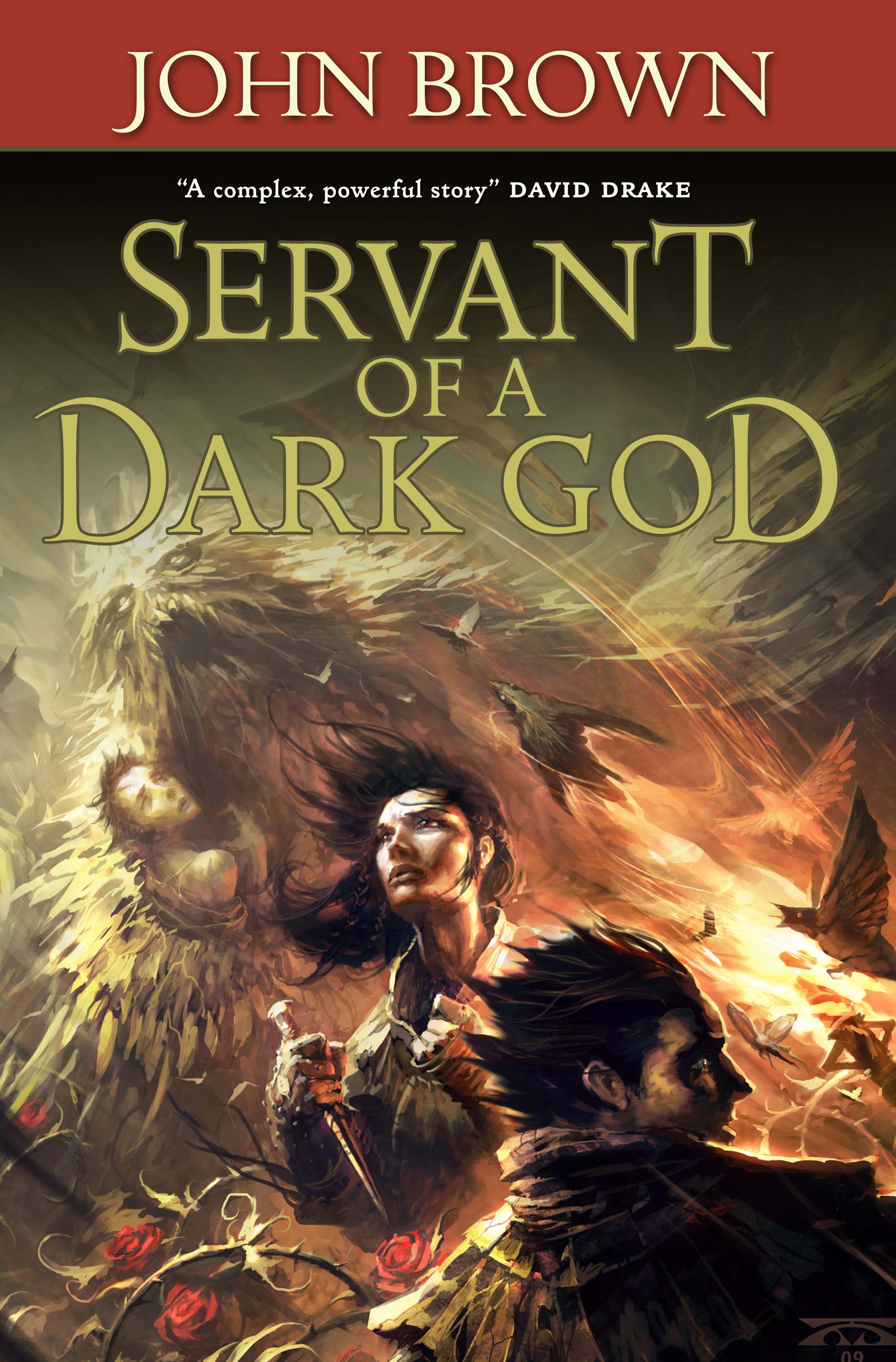
They moved the David Drake blurb to the side, lightened the lettering and moved things so the title wasn’t covering the top of Hunger’s head. At first I thought they moved the lettering, but they didn’t. It appears the shrunk Hunger a bit so we could see more of him. Small changes, but I think they make a significant effect. I think the overall effect is better. I like how Hunger looks more menacing in this one. Sugar is different. Don’t know which version of her I like better. I’m leaning to the original. Your thoughts? Either way, we luvs Tor’s art and production department. Here’s the before and after.
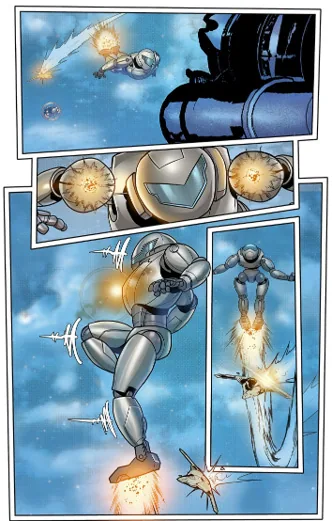
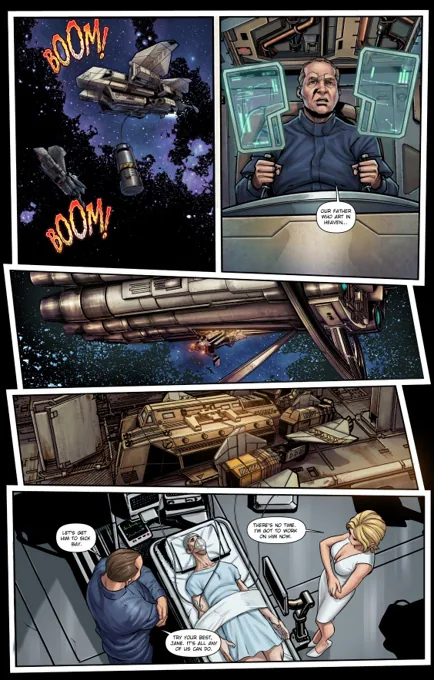
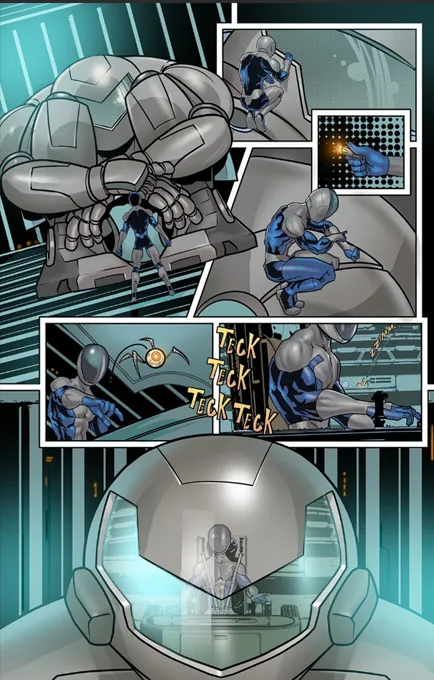
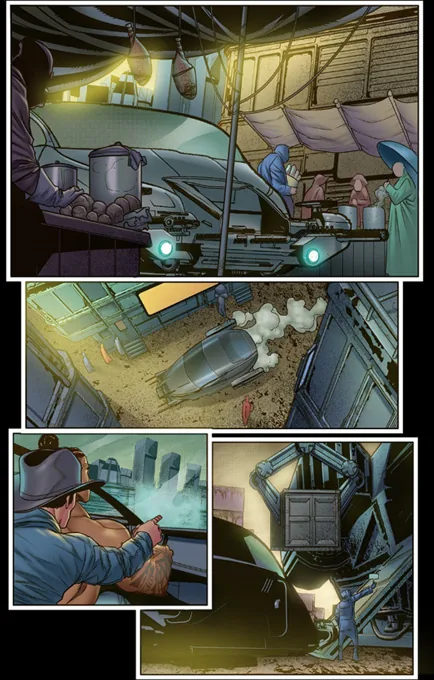
The Dragon Award winning novel Gun Runner, by Larry Correia and me, is being adopted into a graphic novel by Hound Dog Media. The writer is the legendary Mike Baron (The Punisher, Nexus) and the art is by Marcelo Salazar.
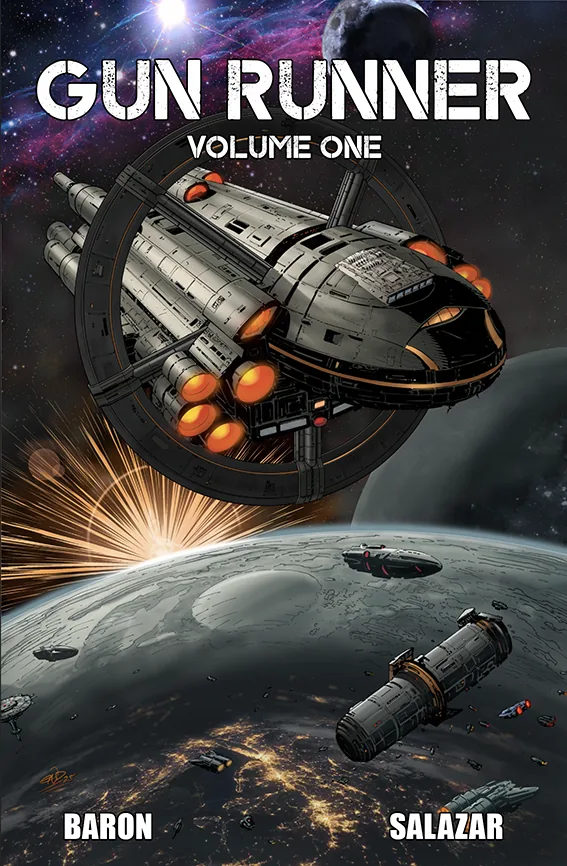
This is a story about a smuggler crew who specialize in stealing battle mechs and selling them to worlds that aren’t allowed to have them. The book is great. I can’t wait to see it as a graphic novel.
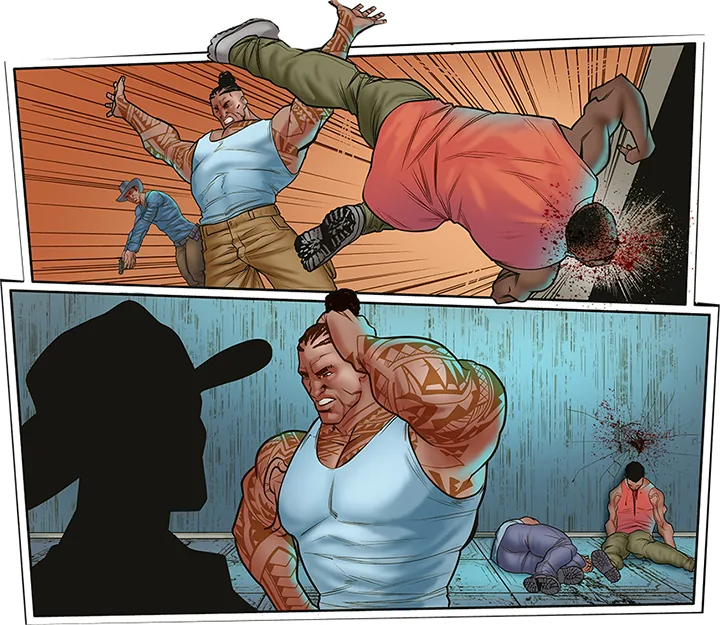
This is going to be awesome. Check it out. There’s even a pledge level to get yourself drawn as a member of the crew.
I’ve got a deal to make t-shirts for my book available, and I have to make some decisions. The problem is that I am terrible at making these kinds of decisions. So I’m asking for your help. Any input would be appreciated.
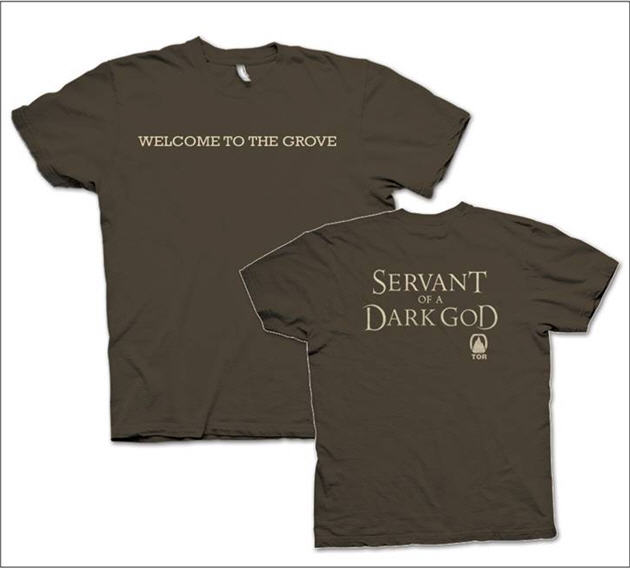 So we’ve decided on the design. It will say “Servant of a Dark God” on the font as shown. We might put “Welcome to the Grove” or “Beware, the Mother is Watching” on the back. It will NOT have the Tor logo indicating it’s a book. Who knows what that is anyway? Instead, the question is whether to put my name on the shirt in some fashion.
Option 1
Some suggest that it’s better to just have a shirt that has the crazy label, suggesting the wearer is a servant of a dark god. It’s provocative, and if someone asks, the person wearing it can talk about the book. With this option we would NOT put my name on the t-shirt, just a small open book icon under the title. The idea behind this is that those who would buy the shirt would already be fans and the provocative statement will do more to spread the word than my name because going this route will make the shirt more fun to wear.
Option 2
Others think that you should have your name on the shirt to advertise. So we’d put “by John Brown” underneath the title. Or we’d put it on the back of the shirt. But some say it would make the shirt less fun.
What would you prefer and why?
Because of the way we’re going about this, the color of the letters must be fixed. So the question is do we simply let people choose their own shirt colors that they thing will work with the color of the lettering or fix both the color of the lettering AND the shirt?
Option 1
Fix the shirt colors. Brown for guys and plum for women. Make the lettering a fantasy green or cream.
Option 2
Give people as much choice as possible and choose a font color that will work with the bulk of the shirt colors here: http://gildan.com/distributors/colorpalette/.
But what would color would do that and still say fantasy, or would it matter?
So which option to you think would work best? If you chose option 1, which colors?
Why is John worrying about this? Shouldn’t he be spending his time tracing his ancestry back to old grandpa lemur?
The answer to that is that John’s mind works in mysterious ways, dear Reader. You must bear with him. And you must now face your greatest fashionista test ever: which colors would say fantasy and still be something people would want to wear? I will be making shirts up for the book store employees to wear before I come to signings. So I have to decide. Someone suggested plum is all the rage this year for women. Make the letters a nice new willow green. We could have another color for men. Any ideas of what would appeal broadly?
I await your ideas.
(Ha, look at this. It appears one of my greats did indeed live his life out in the Prague menagerie. Hum.)
When I got my agent, I didn’t quite believe it. When my agent told me I got a three-book deal, I doubted. Could it be so?
Folks, I’ve got a galley. A galley is basically a copy of what the book will look like. IT’S REAL!!! Check this out: Servant of a Dark God, galley, front page.
Reminder: Starting TODAY and running all week long, X96 radio will be doing book giveaways of Servant of a Dark God (on the radio and streaming online).
Listen to the morning Radio From Hell program (Gina, Bill, & Kerry), Kerry Jackson’s Geek Show, and Todd Nuke ‘Ems afternoon shows.