The Husband by Dean Koontz

TheHusband_DeanKoontzYou’re name is Mitch Rafferty. You’re a gardener. You have no past as a cop, spy, or Navy SEAL–you’re just a plain old petunias and begonias guy. You’re working in someone’s yard when you get a call on your cell phone. You answer. And the guy on the other end has your wife.

He tells you that you will get him two million dollars or you’ll never see her again.

You’re lost. This has to be a sick prank. You’re just a gardener. You know peat moss and mulch. You don’t have two million. Heck, you have, at the most, $11,000 in the bank. You tell him this. He tells you he knows.

Then your wife screams over the phone. The wife who you love, who makes  you whole. They let her talk. It’s not just one man. And then, just to show you that they’re serious, they kill a complete stranger who is walking a dog across the road. They shoot him in the head. You know they’re watching you. You look around and can’t see where the sniper is hiding.

You’re a gardener. They have your wife. If you go to the cops, they kill her. If you don’t deliver, they kill her. What do you do?

That’s the premise of Dean Koontz’s The Husband. I listened to this on audio book, read by Holter Graham, and, folks, I don’t think a book has gripped me like this in a very long time. And that despite some quirks in the reader’s presentation. I’m coming to respect Koontz as a writer more and more. I can’t recommend this book highly enough. Go get it. Read it. Do it before they make the movie.

Share

Similar Posts

  • The Rocket Science of Overspending

    In July, I blogged some spending 101 for Congress and the President, including contigency planning for alien invasions.  I thought I made some good points.  However, through the whole spending debate that occured this last spring nobody in the media or elsewhere was able to make clear what is going on with the US government. Nobody except Dave Ramsey. He explained it on Fox and then on his website. If you take the big federal numbers and translate them to a size we can understand, here’s the situation:

    – Joe and Susie (the Federal government) make $55,000 a year
    – They spend $96,000 a year
    – At the same time, they have $366,000 in credit card debt

    Look at those numbers again. Every year those clowns in Washington are adding $41,000 a year to that massive debt total. Soon enough, our overspending will kill our ability to do anything else except pay the interest on that debt.  150 years after America abolishes slavery, we decide that debt slavery really is a good idea. Yea! Give us shackles! Give us shackles!

    No wonder our credit score as a nation (our bond rating) was reduced.

    So what did the government do this last Spring? They agreed to find some way to cut spending from $96,000 to $78,000. Meaning they’re still adding $28,000 dollars a year to the government’s massive credit card debt total. Which we have to pay!

    If the US Government was a family, they would be making $55,000 a year, they spend $96,500 a year, & are $366,000 in credit card debt. What’s the first step to get out of debt? Stop overspending! But that means a family that is used to spending $96,500 a year has to learn how to live on $55,000. That’s a tough pill to swallow. It works the same way for the government. You can’t borrow your way out of debt, whether you’re a typical American family or the entire U.S. government. At some point, you’ve got to say, “Enough is enough!” and make the hard cuts necessary to win over the long haul. – Dave Ramsey

    The answer is NOT to print more money.

    If you do that, you reduce the value of each dollar. It’s called inflation. As Ron Paul rightly points out, it acts effectively as a tax. Or as I like to put it–a PAY CUT. How many of you would like to get a nice fat 10% or 20% pay cut this year? Furthermore, instead of fixing the problem, the overspending continues, which means more pay cuts in the future. More fun!

    No, the thing we have to do is STOP SPENDING MORE THAN WE MAKE.  Here’s what has to happen.

    1. We must write into law that Congress balance its budget every year–they must not be able to spend more than they take in except in rare emergencies. This means they might need to build up a rainy-day fund.
    2. We must cut our spending. Now. I linked to an idea Ron Paul has for this in my 101 post where we just go back to 2007 levels of spending.
    3. We must work to increase our revenues. Not through hiking taxes to monstrous levels, but by providing optiomal regulatory conditions for economic growth. See my 101 post. 
    4. We need to make sure the taxes are visible, so the American people can easily see what’s going on. Congress has mandated that lenders provide clients an APR so they can clearly see the rate they will pay on a mortgage. Why shouldn’t we mandate that the IRS send out an ATR–annual tax rate (or maybe Annual Grab Rate or Annual Tax Burden or you come up with the name)–which includes all Federal taxes translated into one total rate?  
    5. We need to give everyone the opportunity to pay for the soldiers that defend them and the roads they drive on, even if it’s just $50-100 a year for the very poor.
    6. We must send people to the White House and Congress who are willing to do what it takes RIGHT NOW.

    I mentioned Ron Paul a number of times above. He’s not my choice for president. But he has added a number of good things to this discussion. Here are the Ramsey links:

    EDIT: Mark Holt makes an excellent point in the comments. Inflation isn’t just a pay cut. It’s a savings cut, a retirement cut, a 401k cut, a house value cut, an everything cut. Using that backdoor method, the DC Connivers institute a tax of everything, something they’d never be able to pass out in the open.


    Share
  • Good Stuff! A great place to eat

    huhot-fb-defaultNellie and I recently celebrated our anniversary and enjoyed a delicious meal at HuHot Mongolian Grill in Logan, Utah.

    If you’ve never been to a Mongolian grill, here’s how it works. You take a plate, pile it with your desired selection of fresh meats and veggies, douse it with sauces, then hand the plate to the chef. He then spreads it on his gigantic, circular Mongolian grill and cooks it before your eyes, then hands your hot meal back to you. You take it to your table and enjoy a fine, fresh stir fry of your own making.

    If you want more, or want to try something different, when you’re finished, you go back because it’s an all-you-can-eat grill. I can happily report that Nellie and I did go back. We wanted to go back a third time but were stuffed.

    The food was excellent. The service was friendly. If you’re looking for something different, I think you’ll want to give HuHot a try.

    Share
  • Temple Grandin, Butternut Soup, & Five Guys

    Must-See Movie

    Time magazine has named her one of the 100 most influential people in the world. This summer, the National Cattlemen’s Beef Association’s honored her with the Lifetime Achievement Award. She serves as an animal-welfare consultant for international companies like McDonalds, Wendy’s International, and Burger King. Her work has transformed the design of cattle handling facilities worldwide. In fact, fifty percent of the cattle in the U.S. and Canada are handled in equipment she has designed for meat plants.

    She is one of the most fascinating people I have read or listened to. Her name is Temple Grandin. And she’s autistic. When she was four years old she couldn’t speak a word. The doctors, at the time, wanted her mother to commit her to an institution. But her mother wouldn’t accept that. Temple learned to read. She was tormented in junior high and high school. But she persevered, got into college, was almost expelled, and ultimately earned a PhD in animal science.

    Recently, HBO produced a film about her called Temple Grandin. It is one of the best films I have seen in the last five years. It’s full of drama, heartache, triumph, and good humor. When you’re done, Temple Grandin will likely become one of your heroes.

    Claire Danes does a fabulous job playing Temple. The movie also features Julie Ormond as Temple’s mother, Catherine O’Hara as her aunt, and David Strathairn as Dr. Carlock. Earlier this year, the film won seven Emmy Awards. But I didn’t need that to know how good it was. All I had to do was look at my wife and girls who sat rapt as the story unfolded. Get it on DVD. And if you want to know more about Grandin’s ideas, go to www.grandin.com.

    Squash Devils

    My wife was recently possessed by an evil squash spirit.

    How do I know this?

    Simple. Have any of you out there ever been sitting around and suddenly got a mighty hankering for pureed squash? Even when you were in the Gerber bottle stage?

    No, didn’t think so.

    So what else would explain her sudden need for a bowl of butternut bisque?

    Alas, I did recall once having a tasty pumpkin soup in a fancy restaurant in California, and so I didn’t immediately call the Brethren in for an exorcism. Instead I went to allrecipes.com and looked up a recipe for her.

    I found “Butternut Squash Soup II” by someone named Maplebird, which inspired tons of confidence since all the great chefs are named after tree-animal mixes.

    Then Nellie made the soup. I partook. And the evil spirit must have jumped into me because I’m telling you right now that I could not get enough of it. The mouth feel, the taste—the TASTE. There wasn’t a thing squashy about it.

    Folks, this is the real deal. And at least 494 other people out on allrecipes agree with me and have rated it an average of 4.5 starts out of 5.

    Ingredients

    • 2 tablespoons butter
    • 1 small onion, chopped
    • 1 stalk celery, chopped
    • 1 medium carrot, chopped
    • 2 medium potatoes, cubed
    • 1 medium butternut squash – peeled, seeded, and cubed
    • 1 (32 fluid ounce) container chicken stock
    • Salt and freshly ground black pepper to taste

    Directions

    Melt the butter in a large pot, and cook the onion, celery, carrot, potatoes, and squash 5 minutes, or until lightly browned. Pour in enough of the chicken stock to cover vegetables. Bring to a boil. Reduce heat to low, cover pot, and simmer 40 minutes, or until all vegetables are tender.

    Transfer the soup to a blender, and blend until smooth. Return to pot, and mix in any remaining stock to attain desired consistency. Season with salt and pepper. Say a prayer and call for a priest or someone with the Melchizedek priesthood to be on hand just in case.

    Burger Salvation

    Okay, I know some of you are rolling your eyes. Squash? Have you got to be kidding?

    If that’s you, then let me recommend Five Guys burgers and fries. Burgers started to bore me years ago. But a buddy recently recommended Five Guys, and I’m so glad I went. They’re a national chain. In Utah, we have eight of their joints from Layton to Orem.

    They don’t offer salads or wraps or yogurt. They make four kinds of burgers, three kinds of dogs, and two kinds of fries. That’s it. You order the toppings you want–the regular things like grilled onion, cheese, and pickle, but you can also get grilled mushrooms, bacon, jalapenos, and BBQ sauce. More importantly, your burger is cooked fresh, right before your eyes. No microwaved unmeat retrieved from a mystery bin. It comes to you hot and juicy. The fries, cooked in 100% peanut oil, are served up sizzling. And there are a lot of them. I ate mine with a Cherry Coke.

    If you’re ever in the mood for burgers and fries, you’ve got to try Five Guys.

    Share
  • |

    Nancie Atwell and Real Learning

    If you’ve read my article on the Teachers section, you know I think a good portion of what we do in our public schools is a waste of time because it’s not driven by any natural motivation. The result is that  students are bored more than they need to be. They develop a distaste for many subjects that could provide them great joy. Finally, when they do learn, it’s for a test, not life. And so when the test is over the promptly forget what they’ve learned. 

    This is not to say that I’m against testing or teaching to a test. Far from it. A good test demonstrates that you’ve learned what you’re supposed to have learned. A good test focuses on the main things you want to learn. Good tests (and there are many types of tests) are critical.  The problem is the objectives the tests are built on. If the objectives are idiotic then teaching to the test becomes idiotic.

    Now Nellie just got a job (we’re so happy!) teaching 7th and 8th grade English. For some of you that will elicit groans. The memories of supreme boredom produced by endless grammar lessons and assigned readings with worksheets are still that strong. And Nellie and I had the same feelings. If her job was to teach grammar et al for nine months, she was going to shrivel and die.

    Because grammar is bad? No, for heaven’s sake. Because grammar isn’t the point. Nor are assigned readings. Or iambic pentameter, rising action, theme, character, plot, induction, deduction, the six traits and all the rest of the usual suspects. The point is to enjoy writing and reading for the things writing and reading do.

    So we’ve been working and disussin how she might still meet all the state requirements yet teach the practical joy. Becasue if she teaches the joy, then the students will become better readers and writers than they ever could be otherwise. Which means they’ll be able to do and enjoy the things that can be enjoyed and done when you know how to write and read.  Case in point: our girls. Nellie’s done such a good job teaching the joy of reading that we have to ground them from books every once in a while.

    So anyway, I came up with some ideas, a first draft of a curriculum. Of course, starting from scratch is a huge project. There were issues with it. More importantly, would it work? You don’t want to risk your first year on the job. Luckily, Nellie is smarter than I am and found someone who already discovered this wheel. Nellie handed me Nancie Atwell’s In the Middle.

    I began to read, and I didn’t stop until almost 1 AM. Everything I’ve learned about teaching in the last 20 years, everything I’ve learned about learning how to write in the last 20 years–it’s all there. The key principles are all there. And the implementation of those principles is simple and proven (they actually test results).

    What are the principles? What is the program?

    Read the book. Heck, just read the first chapter.

    I cannot tell you how excited I am for Nellie. We ordered these books and can’t wait to devour them.

    • In the Middle: New Understanding About Writing, Reading, and Learning
    • The Reading Zone: How to Help Kids Become Skilled, Passionate, Habitual, Critical Readers
    • Lessons That Change Writers
    • Naming the World: A Year of Poems and Lessons
    • Side by Side: Essays on Teaching to Learn

    Nellie is also going to apply for a four-day intership at the Center for Teaching and Learning in Edgecomb, Maine. I hope she gets in. She’s also going to do a week-long writer’s workshop at BYU.

    Stay tuned. I’m going to twist her arm and see if she won’t blog about her experience this first year.

    Share
  • The MT Sandwich, To A Dying Girl, Bloody Jack

    you-MOM-ee

    I used to move along the salad bars, looking at the mushrooms, and think: they’re vegetable Styrofoam! Who ever thought eating mushrooms was a good idea? My answer, of course, was it must have been some starving dude lost in the woods who found they were easier to chew on than bark.

    Such were the days of my ignorance. Because while raw mushrooms are fairly bland, sautéed or grilled mushrooms are worthy of a passionate, say it slowly, “oh my freaking heck” (hey, I live in Utah).

    I now love mushrooms. And I’ve found they very easily replace tasty meats. Probably because they have loads of the fifth basic taste—umami (you-MOM-ee)—just as meats do. I know some of you are thinking, “hold on, didn’t I learn that the tongue can only taste four things?” That’s indeed what you learned. But you were wrong. In 1985 scientists discovered we have a fifth taste, popularly referred to as savoriness, that’s been sitting on the tongue with the sweet, sour, bitter, and salty all along. In fact, humans get their first experience with it in momma’s milk.

    But cooked mushrooms not only taste good, they are also actually good for you. They help safeguard against cancer, boost the immune system, supply hard to get nutrients, and can help you cut calories and saturated fats by, as I said before, moving some of the meat off the plate.

    With all this goodness it’s hard not to see new opportunities for consumption. And indeed I found one. I love a good BLT (bacon-lettuce-tomato sandwich, for any troglodytes who read this column), especially when the bacon is crispy and the tomatoes have some sass or a little feta cheese to accompany them. But one day while partaking of some of my fungus friends, my mind was expanded, and I thought: why not replace the bacon with some sautéed mushrooms? Why not, indeed?

    I replaced. I partook. And rejoiced. Then I ate my MT (mushroom-tomato) for lunch three more days in a row (I also found if you must have crispiness, two Sun Chips added to the top of the sandwich do the trick nicely).

    Do not disdain the fungus. Cook the little guys up and devour them with some well placed oohs and aahs on an open-faced MT.

    “To A Dying Girl”

    Clinton F. Larson was a poet who taught at BYU. I remember him coming in to read during one of my classes, but he soon retired, and I was never able to take any of his classes. How sad I am that I could not learn from him because he had much to teach, as evidenced by some of his poems. Here’s one of my favorites.

    To a Dying Girl

    How quickly must she go?

    She calls dark swans from mirrors everywhere:

    From halls and porticos, from pools of air.

    How quickly must she know?

    They wander through the fathoms of her eye,

    Waning southerly until their cry

    Is gone where she must go.

    How quickly does the cloudfire streak the sky,

    Tremble on the peaks, then cool and die?

    She moves like evening into night,

    Forgetful as swans forget their flight

    Or spring the fragile snow,

    So quickly she must go.

     -Clinton F. Larson

    The first reading fills the mind with vivid images and a sense of beauty and sorrow. Subsequent readings deepen the feeling. Especially when we reflect a bit on the three images he evokes of passing from life into death. First, the black swans arise to fly south for winter: graceful, beautiful, and dark as death. They’re the girl’s own harbingers, maybe her guides, coming from mirrors, reflecting in the depths of her eye. The second image presents fleeting grandeur and beauty with the stunning cloudfire that often awes us as the sun sets. Isn’t death the time we most value life? The time when, like cloudfire, it burns in glory and beauty and then is gone? The last image presents another image of passing, but not one of loss. It’s not a transition to blackness or cold or bitter loneliness, but of winter passing to spring. Of a fecund beginning.

    Of course, there are other things the lines and images evoke. This isn’t a poem to be wrapped up in a tidy bow. Poetry is meant to be felt, not dissected like a dead animal. In the end, that’s what Larson delivers: sorrow, loss, and hope all wraped in the music of his rhythm and words. Beautiful.

    A Great Read

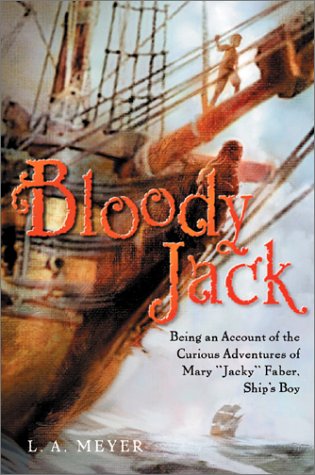
    Sometimes a book’s beginning is so good you can’t not purchase it. Here’s one that forced my hand.

    “My name is Jacky Faber and in London I was born, but, no, I wasn’t born with that name. Well, the faber part, yes, the Jacky part, no, but they call me Jacky now and it’s fine with me. They also call me Jack-0 and Jock and the Jackeroe, too, and, aye, it’s true I’ve been called Bloody Jack a few times, but that wasn’t all my fault. Mostly, though, they just call me Jacky.

    “That wasn’t my name, though, back on That Dark Day when my poor dad died of the pestilence and the men dragged him out of our rooms and down the stairs, his poor head hanging between his shoulders and his poor feet bouncin’ on the stairs, and me all sobbin’ and blubberin’ and mum no help, she bein’ sick, too, and my little sister, as well.

    “Back then my name was Mary.”

    The book is a historical novel by L. A. Meyer called Bloody Jack. It tells the tale of Mary Faber, who is orphaned in London in the early 19th century and survives only by joining a street gang and then, posing as a boy, the crew of a ship. On board, she has to hide who she is and avoid the many perils of ship life.

    The book is delightful, transporting the reader to the time and place with excellent details and a style that evokes the speech and times. There’s humor, danger, adventure, and an interesting cast of characters. I recommend it highly. If you end up loving it as I do, you’ll then be happy to know this is only Jack’s first adventure.

    Share
  • A War of Gifts by Orson Scott Card

    orson-card-war-of-giftsI think this has just become one of my favorite Card stories (note: like Stonefather, this is NOT a novel, but another novella). I’m sure part of the interest stemmed from the religious angle. Many people of many differing faiths will see their religion in it, but there were so many of my own beliefs twisted and made into frights that I felt Card was speaking directly to me. I’m sure another part was that I served my LDS mission in the Netherlands and the story revolves around a Dutch tradition. And it didn’t hurt that I listened to the audio version read by Scott Brick and Stefan Rudnicki. But there was more to it than that.  In the end, it was the saving of the main character, Zeck Morgan, that made me care.

    Because I should be working on my novel now, I’m going to simply quote the summary from Publisher’s Weekly review so you get an idea of what it’s about: “When Zeck Morgan, the young son of a puritanical minister, qualifies for admission into the International Fleet’s Battle School, he is brought to the school against his will. Citing his pacifist religious beliefs, Zeck refuses to participate in any simulated war games, but when he sees a Dutch student give a friend a small present in celebration of Sinterklaas Day, he [thinks he sees a way to be sent home].”

    Okay, so I shortened the PW summary. I did so because this isn’t about religious holidays, as their summary leads you to believe. It’s about something far more important, and Card does a great job writing about it.

    Share