|

Nancie Atwell and Real Learning

If you’ve read my article on the Teachers section, you know I think a good portion of what we do in our public schools is a waste of time because it’s not driven by any natural motivation. The result is that  students are bored more than they need to be. They develop a distaste for many subjects that could provide them great joy. Finally, when they do learn, it’s for a test, not life. And so when the test is over the promptly forget what they’ve learned. 

This is not to say that I’m against testing or teaching to a test. Far from it. A good test demonstrates that you’ve learned what you’re supposed to have learned. A good test focuses on the main things you want to learn. Good tests (and there are many types of tests) are critical.  The problem is the objectives the tests are built on. If the objectives are idiotic then teaching to the test becomes idiotic.

Now Nellie just got a job (we’re so happy!) teaching 7th and 8th grade English. For some of you that will elicit groans. The memories of supreme boredom produced by endless grammar lessons and assigned readings with worksheets are still that strong. And Nellie and I had the same feelings. If her job was to teach grammar et al for nine months, she was going to shrivel and die.

Because grammar is bad? No, for heaven’s sake. Because grammar isn’t the point. Nor are assigned readings. Or iambic pentameter, rising action, theme, character, plot, induction, deduction, the six traits and all the rest of the usual suspects. The point is to enjoy writing and reading for the things writing and reading do.

So we’ve been working and disussin how she might still meet all the state requirements yet teach the practical joy. Becasue if she teaches the joy, then the students will become better readers and writers than they ever could be otherwise. Which means they’ll be able to do and enjoy the things that can be enjoyed and done when you know how to write and read.  Case in point: our girls. Nellie’s done such a good job teaching the joy of reading that we have to ground them from books every once in a while.

So anyway, I came up with some ideas, a first draft of a curriculum. Of course, starting from scratch is a huge project. There were issues with it. More importantly, would it work? You don’t want to risk your first year on the job. Luckily, Nellie is smarter than I am and found someone who already discovered this wheel. Nellie handed me Nancie Atwell’s In the Middle.

I began to read, and I didn’t stop until almost 1 AM. Everything I’ve learned about teaching in the last 20 years, everything I’ve learned about learning how to write in the last 20 years–it’s all there. The key principles are all there. And the implementation of those principles is simple and proven (they actually test results).

What are the principles? What is the program?

Read the book. Heck, just read the first chapter.

I cannot tell you how excited I am for Nellie. We ordered these books and can’t wait to devour them.

  • In the Middle: New Understanding About Writing, Reading, and Learning
  • The Reading Zone: How to Help Kids Become Skilled, Passionate, Habitual, Critical Readers
  • Lessons That Change Writers
  • Naming the World: A Year of Poems and Lessons
  • Side by Side: Essays on Teaching to Learn

Nellie is also going to apply for a four-day intership at the Center for Teaching and Learning in Edgecomb, Maine. I hope she gets in. She’s also going to do a week-long writer’s workshop at BYU.

Stay tuned. I’m going to twist her arm and see if she won’t blog about her experience this first year.

Share

Similar Posts

  • Good Stuff: Books Worth Multiple Readings Part 1

    Would you like to improve your relationship with your spouse or children?

    Would you like to improve your experience with teachers, coaches, and administrators this coming year at school as you try to influence them and work with them for the benefit of your children?

    Would you like to simply have a better time with the people in your community?

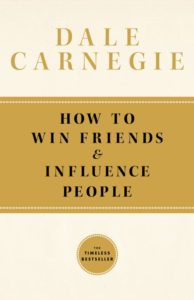
    There are some books so full of practical wisdom about relationships that they deserve to be read every year or three. I want to recommend two such books to you. The first is How to Win Friends and Influence People by Dale Carnegie.

    This book has been in print for eighty years. And not only that, it has been, year after year, one of the bestselling books out there for almost each of those eighty years. For example, Amazon right now ranks it the #9 most read book. You’ll see other books come and go on that list. But books like this and Stephen R. Covey’s The Seven Habits of Highly Successful People stay.

    There are thousands of how-to books published each year on relationships in business and personal settings. Most are never seen again. But this one has stayed because people find it so useful they recommend it over and over again.

    And I wish to heck I’d not waited ten years to pick my copy up again.

    As I re-read the book this last month, I saw that if I’d been thinking about the practical guidelines Carnegie shares, I could have avoided a number of public and private arguments I’ve had over the last few years.

    I could have avoided subjecting those relationships to attack, coming to my senses, and then trying to clean up the mess, large or small.

    But even more important, I could have added a little more sweetness to my life and the life of others I encounter on my way. There are only so many days we have here on earth, and how much better it is to add additional drops of honey to them instead of vinegar.

    One of the wonderful things about his book is that Carnegie shares the wisdom in a down-to-earth way with lots of examples and stories. He shares wisdom on building relationships, being liked, winning people to your way of thinking, and how to make your requests for change known without giving offense or rousing resentment. And he does it simply and in a way that you feel like you’re sitting down with a good-humored grandfather. There are no dry, abstract parts. Just look at a sampling of the chapter titles.

    • “If You Want to Gather Honey, Don’t Kick Over the Beehive”
    • “He Who Can Do This Has the Whole World with Him. He Who Cannot Walks a Lonely Way”
    • “An Easy Way to Become a Good Conversationalist”
    • “If You Must Find Fault, This Is the Way to Begin”
    • “Give a Dog a Good Name”

    I can tell you that every time I try to approach things the way he proposes, they almost always seem to go better.

    If you have an issue you want to discuss with a school teacher, coach, or administrator this year, let me suggest you first listen to what Carnegie has to say. I can promise you you’ll get much farther. And you will probably end up enjoying the interaction.

    If you want to improve your time with your wife and kids, open this book and look for insights.

    If you want to have a better time with your co-workers or boss, I suggest reviewing the wisdom you’ll find here.

    Carnegie doesn’t possess all the wisdom there is to be had about relationships. There are many people out there with great insights. But, gee whiz, he provides a great start. If you want to add some sweetness to your life, I think you’ll find this book a great help.

    Let me illustrate this Carnegie stuff with an experience I had with one of our high school coaches two years ago. I have a vast background in basketball that includes, well, nothing. I basically know how to dribble a ball. Oh, yeah, I also played church ball two or three years in a row back in the 1980s. So, as you can see, my knowledge is vast.

    And not to toot my own horn, but this wasn’t just any church ball team. This was a team that improved the sport.

    How? You ask.

    Well, during one of those church ball years, me and the guys from my ward (“congregation” for those not familiar with the Mormon faith) thought it would be capital to make jeans and concert tee-shirts our uniforms. Back in those days concert tee-shirts looked like this.

    This meant we ran up and down the church courts with drugs, sex, and rock and roll on our chests (I’m sure that’s precisely what the brethren had in mind for the program).

    As you can see, we were way up there on the basketball ladder.

    So back to this coach. My daughter was playing on the high school team, and the team was having a consistently hard time with one type of defense. And I thought, “Self, there’s got to be a way to break that defense.” These are the big thoughts that basketball gurus like myself have.

    And so I researched and watched and talked to folks who had actually played basketball competitively (unfortunately, without concert tee shirts) and identified an offensive counter that looked like it might work.

    And I sent an email to the coach sharing my idea.

    Now, the coach could have reacted in many ways. Especially given the fact that (1) he had already thought of the idea I was proposing, (2) had already tried it in games that, yes, I had attended, and (3) probably knew just a teensy bit more about basketball and his team than I did even though my church ball team had vastly superior uniforms.

    But this coach, whether he knew it or not, was following a number of the principles found in Carnegie’s book, including the chapter titled “Let the Other Person Save Face”. This meant that instead of rolling his eyes or ridiculing or saying something like, “Brown, are you blind?”, he explained what he was doing and then expressed his appreciation. He was happy I was so invested. He thanked me.

    And here’s the thing: he meant it.

    I replied that if he ever wanted someone to suggest an idea he was already trying, to just call. I’d be happy to help.

    We laughed, but the important thing is that what could have been a wedge became a good experience for all. And, more than ever, I wanted to work with him to help my daughter in the program.

    I will give you one more example. There’s a mother who had four of her children go through my wife’s seventh and eighth grade language arts classes. Now, Nellie is a worker. She expects her students to work. She wants to have a good time, loves having great interactions with the kids, but she also wants them to improve and learn, and knows that’s going to take some work. Sometimes the assignments, despite her best efforts, aren’t clearly understood. Sometimes they’re a bit challenging. And this sometimes creates frustration.

    There are a lot of ways that parents deal with this. But this one mother took an approach that, whether she knew it or not, followed many of the principles in the book including those shared in “You Can’t Win an Argument” and “A Formula That Will Work Wonders For You”. This resulted in a fabulous working relationship. It helped the mother have less stress. Helped her kids. And helped Nellie improve her program.

    The issues the mother encountered could have become wedges, but instead, because of how she handled them, they became stepping stones. And this didn’t happen with this one individual. There are many mothers and fathers who have taken a similar approach with similar results. The principles work every time.

    I could go on with many more examples in other situations, but why listen to mine? Carnegie has a book full of them. If you want to improve your relationships or persuade others to your way of thinking, you’ll want to start by reading this book.

    The second book I want to recommend is I Don’t Have to Make Everything All Better by Gary and Joy Lundberg. But this post is full, so stay tuned, and next time I’ll explain what awaits you in its fabulous pages.

    Share
  • | |

    30 books you should read before you die

    An avid reader friend of mine began reading through the books in a list called “100 books you must read before you die.”

    She got to Jack Kerouac’s On The Road and went to Facebook and posted the following: “I don’t get the appeal. It’s about a group of boys/men who are irresponsible, drunks, whoring around taking advantage of others and being enabled by their women. Why is this a classic and why should I have wasted my time on it? Can some of my literary friends explain? I hated a brave new world and the handmaid’s tale too.”

    Is the book a classic?

    Should she read it before she dies?

    Is it really that important?

    Let me share an edited version of my response and then provide my list of 30 books you should read before you die.

    *

    Annette, the unfortunate truth is that these lists of “classics” are a sham because there is no objective criteria for determining literary excellence.

    Or maybe I should say that measuring quality in the arts isn’t like measuring the unambiguous, objective score of a baseball game. After books exhibit a certain level of proficiency, it becomes increasingly difficult to distinguish the quality of one book from another, especially because much of this depends on a reader’s interests and subjective experience of the story.

    When it becomes hard to rank performances, people rely on other measures. One of the most powerful is social networks.

    So if two readers find two different books that blow them away, one of the books might get all the attention because the one book gets picked up by a news service (The New York Times) or a platform (the Oprah Book Club effect) or some other social network of influence. A lot of the so-called literary classics only appear on various lists because they tapped into the academic network, which kept them alive far longer than they would have lasted otherwise.

    On The Road is simply a book that made a stir among some circles in the 1950s. That’s it.

    Was it more important or of higher quality than Exodus? The Chronicles of Narnia? Lord of the Rings? A Town Like Alice? All published in the 1950s as well.

    It depends.

    If you’re wanting to understand the 1950s beat culture, it would be an important book.

    But if you’re wanting to understand fantasy writing of the time, it wouldn’t.

    If you’re wanting to read a book that’s had a huge impact on popular culture, well, LOTR beats On The Road like a dog.

    Some people have the feeling that the so-called classics have some inherent medicinal value because someone put them on a list and called them classics.

    Nope. They’re just stories. Some of which can shed light on the issues and interests of a part of the culture in a given period. But if you’re not interested in that specific sub-culture, who cares?

    And if you’re reading to be entertained, moved, uplifted, or educated—which ones do that best for Annette is for you to decide.

    So all that to say I wouldn’t devalue your reaction to the book ?

    *

    I’m now going to give you my list.

    But it’s not going to be a list of titles. Nor will it focus on a book’s impact on some sub-culture of a given period.

    It’s going to be a real list. One that focuses on what so many of us go to stories for.

    1. The one that makes you weep.
    2. The one that makes you giggle and snort.
    3. The one that reminds you of what it’s like to fall in love.
    4. The one that gives you hope.
    5. The one that you begin to read more and more slowly because you don’t want it to end.
    6. The one that scares the soup out of you.
    7. The one that you can’t put down, even though you need to wake up early in the morning.
    8. The one that makes you wish you lived there.
    9. The one that’s so good that when you close it, you immediately start to read it a second time.
    10. The one that gives you and your child hours of pleasure together.
    11. The one that gives you a sacred, spiritual experience.
    12. The one that makes you reread some of the lines because the turns of phrase are just so delicious.
    13. The one that gives you courage.
    14. The one that takes you on an awesome adventure.
    15. The one that makes you want to be a better person.
    16. The one that bores you to tears (just so know you how good the others are).
    17. The one that introduces you to a different culture that delights you.
    18. The one that makes you think.
    19. The one that lingers with you for days.
    20. The one that gives you lovely insights.
    21. The one that inspires you to love your spouse more.
    22. The one that introduces you to the sorts of people you normally don’t like and makes you actually like them.
    23. The one that delights you with its characters.
    24. The one that whisks you away to a different historical period.
    25. The one that inspires you to give your children a hug.
    26. The one that gets your adrenaline pumping.
    27. The one that sparks all sorts of ideas in your head.
    28. The one that makes you wonder and start imagining what it would be like to be there.
    29. The one that blows your freaking mind.
    30. The one that makes you stand up in your living room and cheer.

    We could do more than 30, couldn’t we?

    Like the one that makes you think people from a different time period are just like us. And the one that makes you think people from that same period are completely alien.

    But I think we’ll stop. That there above is a list.

    Those are 30 books I think everyone will want to read before they die.

    Share
  • The Story Behind “Amazing Grace”

    John Newton writes the following about himself.

    “My father was a very sensible, and a moral man, as the world rates morality; but neither he, nor my step-mother, was under the impressions of religion: I was, therefore, much left to myself, to mingle with idle and wicked boys; and soon learnt their ways.”

    And learn them he did, and not just from wicked boys.  This is the John Newton who worked aboard a “respectable” slave ship and then became the captain of his own.  But this is also the John Newton who later wrote “Amazing Grace,” probably the most famous of all folk hymns.

    That song has been sung in countless arrangements and to different tunes. I love the version by The Five Blind Boys of Alabama sung to the music of “The House of the Rising Sun”.  Soulful.  Incredible.

    And the fabulous mash up of those two same songs performed by Jerry Lawson And The Talk Of The Town on NBC’s The Sing-Off season 2.

    And the more traditional version featured on the movie Amazing Grace sung by Chris Tomlin and titled “Amazing Grace (my chains are gone)”.

    There are simply too many wonderful versions to list.

    But what makes this song so wonderful is not only the words, but also the story behind the song.  This song isn’t a song of theology—it’s John Newton’s own heartfelt expression of gratitude to God, who helped him turn from his profane and wicked life and eventually fight against the ills he practiced.  Later in life, Newton became a supporter and inspiration to William Wilberforce who lead the fight to pass the British Slave Trade Act in 1807, which abolished the slave trade in that empire.

    Although the experience of Newton’s turning point is dramatic, and referred to in the song, his change didn’t occur over night.  In fact, it took him a number of years to fully come to himself.   It was 34 years AFTER he retired from slavery, which was years AFTER he turned toward a new life, that he published his forceful pamphlet Thoughts Upon the Slave Trade, in which he describes the horrific conditions of the slave ships and apologizes for a confession that “comes too late” and “will always be a subject of humiliating reflection to me, that I was once an active instrument in a business at which my heart now shudders.”

    My heart soars when seeing someone turn a life around (maybe because I’m in need of a turnaround).  It’s such a wonderful and instructive tale of hope.

    Recently, Asbury University Media Com students and an Asbury Art Dept student under the direction of Professor Greg Bandy produced a short 14 minute documentary called Amazing Grace: The Story Behind the Song on the fascinating story of how John Newton wrote the most famous hymn in the world . . . and helped bring about one of the most powerful social justice movements in the history of Western Civilization.  It’s a great tale.  Watch it below.

    Amazing Grace: The Story Behind the Song from Gregory Bandy on Vimeo.

    Share
  • Author Interview: David Farland

    David Farland has been a big influence on me. It was his workshop back in the 90’s that actually made me think I could write professionally and led directly to my first publication as a Writers of the Future winner. Later Dave gave me comments on my first novel which helped me write a second, much better one that attracted Tor Books. And it was Dave who showed me the ropes on my first ever author tour.

    But long before all that, Dave was a writer whose work I loved. I read ON MY WAY TO PARADISE when it first came out and enjoyed the heck out of it. SERPENT CATCH and PATH OF THE HERO were next. I gobbeled them up too. Then came the THE GOLDEN QUEEN. By the way, SERPENT CATCH and THE GOLDEN QUEEN are two of my favorite novels. Now, all of those were written under Dave’s given name–Dave Wolverton. When he switched over to fantasy he used the Farland pseudonym.  His first Farland book was RUNELORDS. Folks, RUNELORDS is, in my opinion, one of the top 10 epic fantasies ever written. Ever.

    Of course, Dave has written many other novels and was involved with some Hollywood producers. Now he’s doing something new. He’s started his own publishing company–East India Press–and is releasing the first of his enhanced books through it.  Enhanced meaning far more than a book in print or electronic form–there’s also a soundtrack and art. NIGHTINGALE is that book. I asked him to share with my readers a bit more about it. Here’s his reply.

    *

    JOHN:  Tell us about how you came up with the idea for Nightingale?

    DAVE: Years ago, in the late 1980s or early 1990s, I read a book by a doctor who had worked for the CIA, experimenting with drugs that would erase both long- and short-term memories.  It was fascinating work, and he eventually won the Nobel Prize for it.  So I became interested in memory transfer.

    Later on, one Christmas, I got to thinking about the three “Wise Men” from the bible.  Normally, a “wise man” is called a wizard.  A “maji” is called a magician.  Why was it that the writers of the bible were using double-speak when discussing these guys?  Weren’t they astrologers?  Doesn’t the Old Testament condemn these folks to death?

    So I went back to the Hebrew and found out that indeed these three gentlemen were in the same class of magicians that the Old Testament condemned to death, the m’khashepah—which originally referred to a class of magicians that hung around royal courts.  Of them the bible says, “Thou shalt not suffer a m’khashepah to live.”

    So the thought occurred to me, “What if they weren’t just coming to give Jesus gifts?  What if they really had come to be . . . advisors.  What if they wanted to give him wisdom?”

    That started a whole train of thought dealing with memory transfer—transfer of memories, the possibility of training reflexes, transfer of memories on a cellular level, and so on—which led to the creation of my magic system. 

    The questions arose, what would people do with such power? 

    And of course from that a novel was born.

    Nightingale tells the story of a young man named Bron Jones, who is abandoned at birth.  Raised in foster care, he’s shuffled from home to home.  At age 16, he’s kind of the ultimate loner, until he’s sent to a new foster home and meets Olivia, a marvelous teacher, who recognizes that Bron is something special, something that her people call a “Nightingale,” a creature that is not quite human. 

    Suddenly epic forces combine to claim Bron, and he must fight to keep from getting ripped away from the only home, family, and girlfriend that he has ever known.  He must risk his life to learn the answers to the mysteries of his birth: “What am I?  Where did I come from?  Who am I?”

    This is a big project, an enhanced novel with illustrations and animations from half a dozen talented illustrators.  It has a sound track by the head of the National Composer’s Guild, James Guymon, with a dozen professional musicians and vocalists.  We’re releasing the novel in several formats, as an enhanced novel, a normal e-book, an audiobook, and as a hardcover.

    But we did one last cool thing.  The enhanced book was designed for the iPad, though you will also be able to read it on just about any other pad or smartphone.  But we had our programmers create a web app so that you can enjoy the book on your computer—read a few chapters, take it for a test drive, or simply buy it for reading online.  You’re free to go check out the results at www.nightingalenovel.com.  If you like it, remember to “Like” us on Facebook.  Better yet, re-post our site info and tell your friends on Facebook.

    Oh, and while you’re there, check out our short-story contest, where you can win $1000.

    *

    John sez: I’m very excited to see where this goes. I’ve loved Dave’s stories for a long time. And the premise of this book sounds great. Samples are available at: www.nightingalenovel.com

    Share
  • Good Stuff! The audio production of Lockwood & Co.

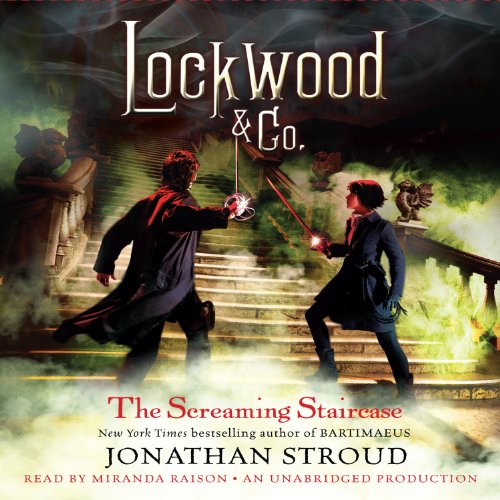
    I’m excited to share the Lockwood & Co. series by Jonathan Stroud. It’s a delightful audiobook experience for the whole family.

    Nellie introduced me to it on our road trip to Yosemite last October.

    And, oh my gosh, how we’ve enjoyed listening.

    They’re young adult paranormal thrillers with a good dose of humor and English charm.

    Yes, Netflix, launched a show based on the books, but Nellie and I tried it, and the Netflix productions don’t hold a candle to the audiobooks.

    It’s not even close.

    If you’re going to do this series, listen to the audiobooks or read them.

    The story is set in England in, I’d say, the 1980s, before cell phones and the internet became a thing. The problem is that ghosts, specters, tommy knockers, etc. are appearing all over the place and causing havoc. Because, in this world, when you’re touched by a visitor from the other side, you can easily become ghost locked, basically put in coma, or die.

    And while the ghosts can touch anyone, children and teens are the only ones who can see them. And so it’s children and teens who must fight them. Of course, large ghost protection agencies are formed, but our story is about Lucy Carlisle, who joins a tiny agency run by a daring young man named Anthony Lockwood.

    There are five books in the series, which translates to about fifty-nine hours of delightful listening. Perfect for the long road trips, cleaning, fixing dinner, walks, etc.

    Miranda Raison is the reader for the first book, Katie Lyons the second, and Emily Bevan for the final three. And they’ve all been a joy to listen to.

    I’m not normally a paranormal kind of guy, but this is making me reconsider. We loved Stroud’s Bartimaeus series. And he brings the same fast action, interesting characters, and wit to these. 

    If you enjoy delightful characters and derring-do leavened with some humor, give these a try. I think you’ll be glad you did.

    Share
  • Navy SEALS Buds Class 234, Crackting the ACT, & Running the Green River

     Of the 1.4 million people in the armed forces, only 2,800 of them are Navy SEALS (acronym for “sea, air, and land”). That’s 1/5th of one percent. They are one of the most elite fighting forces in the world. However, less than 20% of those who attempt to become a SEAL ever succeed. To even try you must pass a physical screening test which requires you to swim 500 yards in ten minutes or less, perform seventy-nine push-ups in two minutes or less, and eleven pull-ups. You have to be able to run 1.5 miles in at least 10:20 minutes, and that’s while wearing boots and trousers.
    Some may think: well, that’s not too difficult. I could work up to that. However, the reality is that this level of physical fitness will not be enough. Because once you get into the initial training, you’re going to be doing far more than this every day.

    Can you knock out 500 push-ups in a day, along with a four mile run, hours of paddling out in a six-man raft into a ten foot wave that tumbles you again and again into chilling waters, hefting your share of a 160 pound log over your head until you can barely lift your arms, and running an obstacle course with obstacles three-stories high. You’ll do a lot of this while covered with sand, your thighs and armpits chafing. On some days you’ll have to swim a few miles in a cold sea. And then you’ve got to get up and do it all again the next day. No wimpy hour-long workouts on Monday, Wednesday, and Friday with rest days in between. Heck, on the third week, you’ll get only about four hours of sleep over four days.

    Can you do it?

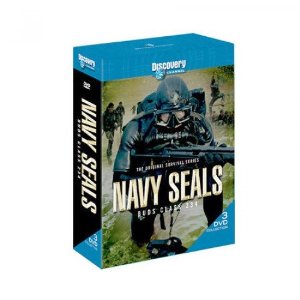
    Maybe you can. But before you try, or assure yourself that you could have if you’d only had the chance, let me suggest you watch Discovery Channel’s Navy SEALS BUDS Class 234 to witness what it takes to become the best of the best. It’s a fascinating three-DVD set, just over five hours of programming, that follows class 234 through the initial six-month SEAL training called BUDS (basic underwater demolition/SEALS). You’ll see 114 men start the six-month course and only 17 finish it. In fact, less than thirty make it past the first three weeks, which include the most grueling and punishing training I’ve ever seen. Those initial weeks are designed specifically to weed out all but the most committed and able.

    The Discovery Channel does a great job with this six-part series. And it’s not just for guys. It only took about three minutes for each of my daughters to get hooked as well. And why wouldn’t they? It’s as fascinating as any American Idol or So You Think You Can Dance. In fact, in many ways it’s far more interesting. Heck, it was so good I think I’m going to watch it again. You can get it on Amazon, rent if from Netflix, or check it out from the Logan library.

    For more info on the SEALS, let me recommend you start with these two sites: http://www.seal.navy.mil/seal/ and http://en.wikipedia.org/wiki/United_States_Navy_SEALs

    *** 
    My high school age daughters took the ACT last year and got good scores. But we wanted to make sure that they had excellent scores. High enough to put them in the upper levels of those applying to their desired universities. But how would we prepare them?

    Back in the olden days when I was preparing to get my Masters of accounting degree, I knew I’d need some help to get a score on the GMAT that would be competitive. I looked at a number of study guides and ended up choosing the Princeton Review guide for the GMAT. I studied hard, got a great score, and became a believer. The guide made everything so easy. More importantly, everything the guide prepared me for was on the test. This is why, when I wanted to get a Masters of fine arts in creative writing, I used the Princeton Review for the GRE. Again, the study guide was easy to follow, and I got an equally good score on that test. Having had two great experiences, it’s no surprise I turned to Princeton Review again to help my two girls with their test. (BTW, some may see an attempt to get more than one graduate degree as smart, others as masochistic, and yet others as simple ivory tower bone-headery—I’ll let you decide which it might be in this case.)

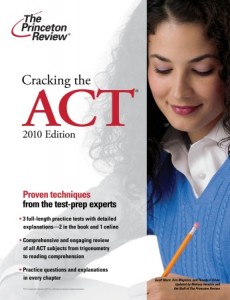
    The Princeton Review guide for the ACT is called Cracking the ACT. A new edition is published every year and includes general ACT test-taking tips, everything you need to know in the specific content areas, and practice tests. It also includes access to the Princeton Review’s online resources which include another practice test. It’s a big guide (this year’s edition was 619 pages), but the size is deceptive. There’s plenty of white space for taking notes, and the text is written so clearly, and everything broken down in such an easy manner to follow, that you’ll start only to suddenly realize you’ve just read thirty pages. Besides, you don’t have to study it all. You can focus on specific content areas, if that’s all you want to do.

    This spring, both daughters worked through the book. We looked at their previous scores, identified areas for improvement, and set up a six-week schedule that required them to study about an hour per day, sometimes with help from Mom or Dad, but mostly on their own. One daughter studied hard, took the test in June, and improved her score by five points. The other daughter studied a little less diligently, took the same test, and improved her score by four points.

    When 36 is the highest possible score, such jumps become significant. However, they’re not the result of special DNA. While I tend to think my girls are everything and a bag of chips (especially when they give me back scratches), the truth is the ACT doesn’t test some mumbo-jumbo innate intelligence. It tests skills. Skills anyone can learn. What my girls supplied was consistent effort. All they needed was expert guidance in how to apply the effort. And Cracking the ACT provides boatloads of that.

    If you’re looking to improve your own score or help your children improve theirs, get this book. I have no doubt that anyone who supplies a bit of effort will be able see some nice results.

    ***

    Imagine emerald pools, steep red canyons, and a gentle breeze. Imagine water so clear you can see the plants and rocks sixteen feet down on the bottom. Imagine trout swimming only feet away. Imagine swimming with those trout and then getting back into your raft to ride some rapids. Imagine picnicking a the water’s edge or atop a flat, shaded rock forty feet up that gives you a grand view of the river. If you’re lucky, maybe you’ll see an osprey dive for a fish or watch a pair of river otters swim by. Imagine doing this with family or friends, all in a short twenty-four hour period.

    This experience is only about three hours away from Laketown, Utah. Well, everything except the swimming with the trout bit. The fish don’t really swim with you. They mostly just flee, but you get the idea. To enjoy it, all you need to do is raft the seven mile stretch of the Green River from the Flaming Gorge dam down to the Little Hole campground.

    My family and I just did this with some friends and had a grand time. Because the river is relatively slow and the rapids are relatively moderate and short, parents don’t have to worry every second that someone is going to fall in and drown in a man-eating surge. In fact, along many of the calm areas we actively helped the children into the sparkling cold water (grin), including one rafter who was only three years old. One of the most enjoyable moments was when we pulled the rafts up into the gentle backwash of a large rock in the middle of the river, climbed the rock, and took turns jumping into the current and letting it carry us downstream.

    The sun was shining, the weather warm. It was a wonderful trip. A total memory-maker. We put in just before noon and hauled the raft out just before 6 PM. But we could have taken much longer to play along the way.

    The experience was fairly cheap. It cost about $70 to rent an eight-man raft. Perfect for six people. But there are other smaller and larger raft sizes. You’ll need to arrange a way to get the raft to the river and back again. We simply tied our raft to the top of our minivan. You can pay the rental people to drive your car to the exit ramp at Little Hole after you put into the river, or bring two cars (or a bike) and drop one at the exit. Or you can pay for a shuttle service where they drive you to the River and pick you up.

    You’ll want to bring a small cooler with drinks, snacks, and sunscreen. You’ll also want to have good footwear. The river bed is rocky, and when you pull into shore, you don’t want to be ouching it the whole way in. I don’t recommend flip flops. They’re no better than bare feet. Old sneakers are fine, but they don’t dry quickly. And they waterlog and get heavy, which makes them less than ideal for swimming. Your best bet is to get real water shoes that are made to be light and drain quickly and yet still have a decent sole–a sandal or mesh covered shoe that uses Velcro to strap up. You can be fancy and spend a lot, or do what I did and get yours at Wal-Mart for less than ten bucks.  

    You could make it a long trip and drive to and from the gorge and run the river all in one day, but why push it? Just find a place to stay overnight. There are some motels in the area, but we elected to camp. The spots at the Firefighters Memorial campground were $27 per night. The campground was beautiful and tidy with restrooms and running water. One of the most surprising things about this particular campground was that I didn’t see one mosquito while I was there.

    I’m one of these types that attracts the villains. If there’s only one mosquito within a mile radius, it will smell me, pass up many other suitable victims (including my wife), and risk its life and limbs to sink its #@!* proboscis into my flesh. I think my blood must be some kind of mosquito crack. There’s probably some mosquito black market out there for it, run by some nasty mosquito cartel, which is led by a murderous, malaria-ridden mosquito boss making piles of evil mosquito money and spending it on opulent mosquito yachts and guns!

    Anyway, not one bite. We watched the sun set and then fell to sleep with the stars overhead and the wind gently soughing through the boughs of the pine trees.

    To make campsite reservations, go to www.utah.com to get a good map view of possible camping sites. Then go to www.recreation,gov to make the reservations online. Make sure your specific camping spot has everything you need. Our campground was very rocky and not all of the sites had tent pads. If you want to scope the lay of the land, the recreation.gov site will give you GPS coordinates of the campground. Enter those into Google maps then switch to satellite view and zoom in. You see exactly what you get. This way you can avoid accidently booking the site right next to the bathrooms or road or the one that features no trees.

    Finally, when you’re done, you might want to top it all off by stopping at the The Flaming Gorge Lodge restaurant, just a few miles south of the dam, and enjoying a monster-sized cup of hot chocolate with whipped cream and one of their fabulous desserts. The blackberry cobbler and ice cream was delicious.

    Share

2 Comments

  1. I have taught 8th grade for 10 years. Each year I kept thinking that I am missing something big with my students. I knew that I wanted them to love my class – but did not actually see it. Then I read the Nancie Atwell books….Especially In the Middle and The Reading Zone. It changed who I am as a teacher. It provided the answer to my “missing something big”. Now my students love my class – but more importantly they love to read and found passion in their writing. Thank you Nancie!

Comments are closed.