Similar Posts
Growing Your Own Replacement Parts
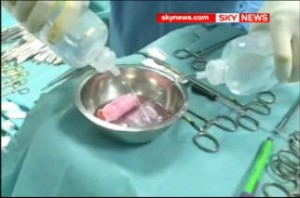
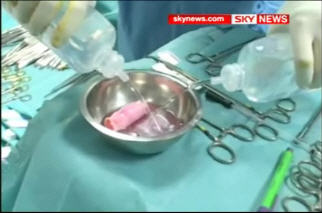
This is simply incredible. Watch the video about Claudia Castillo growing a replacement to part of her windpipe with her own stem cells. She didn’t grow the complete tube, but nevertheless…
Ms Castillo, who was born in Colombia, had suffered a tuberculosis infection that ravaged her airways, leaving her unable to do simple domestic tasks. Disease had caused her windpipe, or trachea, to collapse just at the point where it entered her lung. Without the pioneering operation in June, the lung would have been removed. Today she again has a normal life and is able to look after her two children. She can walk up stairs without getting breathless and has even been dancing.
Oh, my. Can you believe this? What the future holds for all the folks with damaged parts…
And does this mean as we age, we’ll be able to swap out the old for new? How will that affect aging? This is simply incredible.
Free Stories from Pros
From Edmund Schubert, editor of Orson Scott Card’s Intergalatic Medicine Show:
“During the month of February we are going to make one story from each of our first four issues available at no charge. Two stories will be set free on February 1st, and two more on February 15th. Just visit www.intergalacticmedicineshow.com and explore the table of contents; the free stories will be clearly marked.”
Of course, having been published in the first issue and slated to be the cover story for the Spring 2008 issue, I can vouch for the magazine’s impeccable taste and the gigawatt entertainment buzz you’ll get from the stories they select.
So that’s where Tolkien got “Orc”

Tolkien was a master of words with sounds that connote meaning. But I often find that a lot of his work was not produced from thin air. Case in point: I was looking today at the word “ogre.” Check out this etymology from the OED.
French ogre (late 12th cent. in Old French in sense ‘fierce pagan’, c1300 in sense ‘man-eating giant’, attested again from 1613; also hogre (1704 in the passage translated in quot. 1713 at main sense)), further etymology uncertain and disputed.
French ogre is perh. < classical Latin Orcus, the name of the god of the infernal regions, Hades, Pluto (further etymology uncertain), with metathesis of r (perh. influenced by words such as bougre BOUGRE n.), or perh. < post-classical Latin Ugri, Ungri, Ongri, applied by early writers to the Hungarians or Magyars (see UGRIAN n.). Cf. (< classical Latin Orcus) Middle French orque hell (16th cent.; prob. a later reborrowing), and also Italian orco demon, monster (13th cent.), Spanish huerco devil, personification of death or hell (1330-1900), Sardinian orcu demon, and early modern Dutch orck unruly person (Dutch regional ork). Spanish ogro (1787-1900) is a borrowing from French ogre.
In folklore and mythology: a man-eating monster, usually represented as a hideous giant. In extended use: a person resembling or suggestive of an ogre; a cruel, irascible, or fearsome-looking person.
But Tolkien’s not the only one using his brains. Here’s one from Robert Jordan.
sangrayle, -grayll(e, seynt graal, 7-9 sangreal, 9 sangreall. [a. OF. Saint Graal ‘Holy Grail’: see SAINT a. and GRAIL.
The pseudo-etymological form sang roial (confusing the word with SANG-ROYAL 2) appears in AF. of the 15th c.: see Godefr. Compl. s.v. SANC. Another spurious etymology formerly common appears in the following quot.:
1685 STILLINGFL. Orig. Brit. i. 13 Others think that the word was Sangreal, being some of Christ’s real blood..said to be somewhere found by King Arthur.]1. = GRAIL.
a1450 Le Morte Arth. 10 The knights of the table Round, The sangrayle when they had sought. c1450 Merlin ii. 32 Thi boke shalbe cleped the boke of the seynt Graal. 1470-85 MALORY Arthur II. xi. 88 Soone after the aduentures of the Sangrayll shalle come among yow and be encheued. 1808 SCOTT Marm. I. Introd. Epist. 268 He took the Sangreal’s holy quest. 1871 G. MEREDITH H. Richmond II. 145 They bear the veiled sun like a sangreal aloft to the wavy marble flooring of stainless cloud.
Zing!
Epigenetics
 Our genes aren’t in charge.
Yes, you say, of course. There’s environment and choice; both of these affect what we become.
But I’m not talking about being in charge at that level. I’m saying that our genes aren’t even in charge of themselves.
What?
We all know that computer hardware (processor, RAM, motherboard, etc.) is important, but that the software that runs the show. Well it appears that our genes are like the hardware. Something else runs the show.
That something else is our epigenome, our epigentic tags (“epi” meaning just above as in “epidermis” or “epicenter”). The tags are chemicals that turn particular genes on and off, telling cells what they’re supposed to be–liver, skin, brain.
Furthermore, researchers think they the tags can change through a number of means, including what we eat. For example, you can take two identical set of genes for hair and, with tags, change hair color.
Research has also shown the epigenome can be passed down to posterity. So what you eat and its effect on you can be passed down to your posterity. Likewise, what you are is what your parents and maybe grandparents ate.
Genes are only a part of the story.
Holy heck, this is so cool. Watch the 12 minute video now.
Anti Monkey Butt
Sometimes words fail me…

With Calamine Powder
Sweat Absorber and Friction Fighter
Anti Monkey Butt® Powder is specially formulated to absorb sweat and minimize frictional skin discomfort. Helps to keep you dry and comfortable. Ideal for butt busting activities such as motorcycling, bicycling, horseback riding, truck driving, hiking, hockey, football, and baseball.
Indoors or outdoors, work or play, or on occasions when you sit on your butt all day. Don’t let your buns get red. Use Anti Monkey Butt ® Powder instead!